
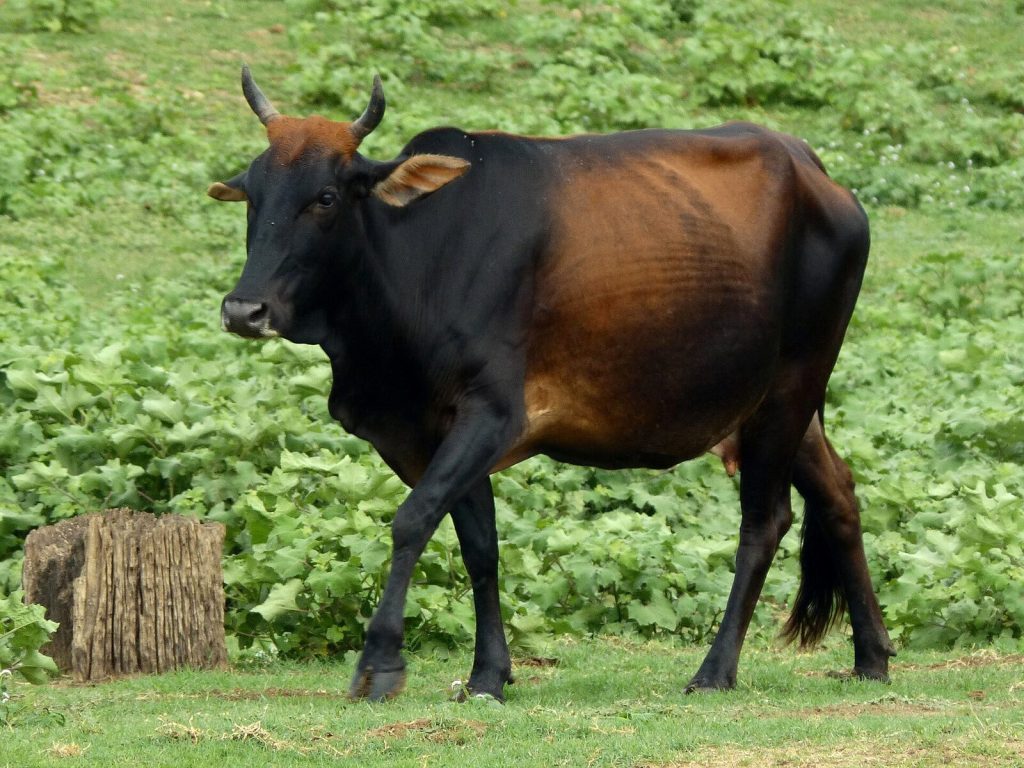
Four exotic dairy cattle breeds are available in Uganda through the national breeding centre: Friesian, Ayrshire, Jersey and Guernsey, all supplied as semen from bulls bred in East Africa. Alongside them sit the indigenous Ankole and zebu types and their crosses, which carry most of the national herd. The best breed for a Ugandan farm is decided by feed and ticks rather than by a catalogue.
Which Dairy Cattle Breeds Uganda Actually Supplies Semen For
Start with what you can actually buy. The National Animal Genetic Resources Centre and Data Bank, the government body mandated to lead livestock breeding in Uganda, publishes a bull catalogue for the bulls kept at its own bull stud, from which semen is collected. Counting the entries, that stud holds eleven dairy bulls across four breeds and eight bulls of beef and dual purpose type across two.
Two things in that catalogue matter more than the bull names. First, every bull in it was bred in Kenya rather than in Europe. Second, the centre states its reason plainly: exotic bulls bred in temperate conditions and moved to the tropics have repeatedly run into trouble from lack of adaptation, and semen from bulls raised in this country, this region or the tropical belt is the better route to stock that stays productive on natural and improved pasture while resisting local disease and parasites.
That is the Ugandan breeding authority telling you, in its own document, that adaptation beats pedigree alone. It is the argument this whole page rests on.
What a Breeder's Lactation Figure Does and Does Not Tell a Ugandan Farmer
Each dairy bull in the catalogue comes with his mother's production record, three lactations deep. Across the eleven dairy bulls those dam records run from about 5,250 to 8,200 kg of milk per lactation over roughly 297 to 305 days in milk. By breed: Friesian dams about 5,969 to 7,625 kg, Ayrshire about 5,487 to 8,200, Jersey about 5,250 to 5,688, and the single Guernsey dam about 6,050 to 7,160.
Those are real records, and they are also records from specialist pedigree herds in Kenya, certified by a breeders' registry, kept by people whose business is selling genetics. They describe what the genes did on a stud farm. They do not describe what a daughter of that bull will do in a shed in Luwero on Napier grass.
| Where the figure comes from | What it measures | Kg per lactation |
|---|---|---|
| Bull dam records, Kenyan pedigree herds | Genetic potential, specialist farm | 5,250 to 8,200 |
| Graded cows, Ugandan zero grazing and paddocks | Measured farm records | 2,400 to 2,700 |
| Ugandan herd about a quarter graded | Measured farm records | about 1,141 |
| Local cows, Ugandan extensive grazing | Measured farm records | 435 to 564 |
Read the gap. The best measured Ugandan graded cow in a detailed seven farm budget study produced about 2,700 kg in a lactation, which is roughly a third of the top dam record in the catalogue and about half of the lowest. A national statistic of roughly 493 litres per lactation across all milked Ugandan cows sits inside the local breed band instead.
Friesian Crosses: The Default Dairy Breed and Its Feed Bill
The Friesian cross is what most Ugandan dairy farmers actually own, and often without knowing how much exotic blood is in her. A Makerere study of smallholder farms in Luwero and Kayunga recorded its crossbred animals simply as indigenous crossed with Holstein Friesian "of unknown percentage of genetic composition", because no farm had a breeding record. In Kiruhura district, 61 percent of surveyed farms kept Ankole and Friesian crossbreds. Among 100 dairy enterprises across five south western districts, 84 percent kept only crosses and the commonest exotic parent was the Holstein Friesian.
What she gives, measured in Uganda: about 5.4 litres a day for lower grade crossbreds and about 7.4 litres for higher grade ones in Kiruhura, about 5.2 litres a day across central Ugandan smallholdings, about 6.5 litres under zero grazing, and 2,400 to 2,700 kg over a lactation on the best fed Ugandan farms in the budget study.
What she costs to run is the part that gets skipped. A regional smallholder dairy feeding manual from the international livestock research institute puts a large breed such as a Friesian at more than 100 kg of fresh forage a day. On the Ugandan zero grazing farm that produced 2,700 kg, concentrate use ran at about 1.22 tonnes per cow per year, which is roughly 4 kg a day through a 300 day lactation. She also handles heat poorly, so water has to be in front of her all the time. None of that is optional. A Friesian cross on grass alone is an expensive local cow.
Jersey and Guernsey: Smaller Cows, Thin Ugandan Farm Evidence
The Jersey's case in Uganda is about appetite rather than output. The same regional feeding manual puts lighter breeds such as Jerseys at 65 to 85 kg of fresh forage a day against more than 100 for a Friesian. On a farm where somebody cuts and carries every mouthful by hand, that difference is a third of the daily labour, and labour is the largest single line in the cost of making conserved forage on Ugandan farms. A smaller cow that fills on less is a genuine argument where the constraint is the person with the panga rather than the land.
Jersey milk also carries more butterfat, which matters where milk is sold into processing or turned into a product at home. It does not matter at all where the buyer pays on volume and tests nothing, which is the common Ugandan case.
Now the uncomfortable part. I went looking for Ugandan on farm performance measurements for Jersey, Guernsey and Ayrshire cows and found none. Searching a global research index by title and abstract, Ankole cattle and Ugandan milk returns 34 records and Holstein Friesian with Uganda returns six, so the method works. The same search for Jersey, Guernsey or Ayrshire with Ugandan dairy cattle returns two to four records each, and not one of them is a measurement of those breeds milking on Ugandan farms. So the national breeding centre supplies semen from all three, and nobody appears to have published what their daughters do here. That absence is the honest finding, and anyone quoting a Jersey yield figure for Uganda is quoting somewhere else.
Ayrshire in Uganda: Available as Semen, Unmeasured on Farms
Worth separating from the Jersey, because the catalogue makes a quiet point. The highest single dam lactation record in Uganda's national bull catalogue, about 8,200 kg, belongs to an Ayrshire bull's mother, not to a Friesian's. Ayrshire dam records across the three bulls span about 5,487 to 8,200 kg, a wider band than the Friesian entries.
The breed has a reputation for hardiness and for walking well, which fits a grazing system better than a heavy Friesian does, and it is available as semen through the national programme. What does not exist is a Ugandan number. Treat an Ayrshire cross the way you would treat any change of genetics on your farm: as a trial you record, with one or two animals, against the cows you already have.
Ankole and the Local Zebu Types: A Lower Cost Per Litre
Here is the result nobody selling cattle will tell you. Working through the arithmetic on verifiable Ugandan cost lines, the local breed cow comes out with a lower cost per litre than the crossbred, roughly 433 to 587 shillings against 650 to 725, because she carries far less capital and buys far less feed. The crossbred wins on total margin per cow. She does not win on the cost of making a litre. If cash is short and feed is bought, that distinction is the whole decision.
What the local cow gives, measured in Uganda: about 2.6 litres a day on central Ugandan smallholdings, about 2 to 2.5 litres a day at grazing sites in the west, and 435 to 564 kg over a lactation of 180 to 210 days under three extensive systems in the budget study, with a calving interval around 16 months. A ministry source puts local breed lactation yield at 500 to 1,500 kg while also stating about 2,000 kg in the same document, so the published potential span is wide and the disagreement is worth knowing about.
Two details that change how you read her. First, on the extensive farms the local cows received no concentrate at all, only mineral salt, and the semi nomadic herd used the most minerals per cow of any farm type in the study at about 83 kg a year, because salt was the only thing bought. Her yield is a yield on nothing. Second, in the central Uganda study local cows that calved in the dry season recorded higher production, about 2.8 litres a day, than those that calved in the wet season at about 2.3, while crossbreds ran the other way at 6.0 wet against 4.2 dry. The local cow is less thrown by the season the calf arrives in, and that steadiness has a value that no litre count shows.
Nganda and the Sanga Crosses of Central Uganda
Central Uganda's local cow is often not an Ankole. Feed assessments in Mukono district found Nganda type cattle kept by more than half of households, with the crossbreds on those same farms being Friesian crossed onto Nganda. In Mityana, Nganda were kept by about a fifth of households alongside Friesian and Jersey crosses. The Nganda sits between the shorthorn zebu and the long horned Sanga types and is bigger and better milking than a plain zebu.
For a buyer, the practical consequence is that "local cow" in a central Ugandan market and "local cow" in Mbarara are not the same animal, and neither is the crossbred that comes out of them. If you are crossing onto what you already have, the base matters, and the base is regional.
How Much Exotic Blood a Ugandan Dairy Farm Can Feed
The real question is not which breed but how far up the blood ladder your feed can follow. The seven farm Ugandan budget study happens to contain the answer, because it includes a herd that sits between the two extremes.
The middle rung is the interesting one. A quarter of exotic blood roughly doubled lactation yield with no concentrate bought at all, because the crop residues covered the dry season. Going from there to a fully graded cow roughly doubled it again, but only alongside a tonne of concentrate a year and a fodder plot. Each rung costs more than the last, and the money arrives before the milk does.
There is also evidence that higher grading pays where the rest of the system keeps up. In Kiruhura, higher grade crossbreds gave about 7.4 litres a day against 5.4 for lower grade ones, calved first at about 26 months rather than 31, and returned to calf every 11.4 months rather than 12.6. That is a real gain, on farms with land and pasture management. The same extra blood on a tethered cow eating roadside grass buys nothing.
Ticks, Trypanosomiasis and Heat: What a Breed Choice Costs
Exotic blood buys milk and sells resistance. Ugandan work in the south west found crossbred animals more susceptible to tick borne disease, with their owners shortening spray intervals to twice weekly and at least doubling concentrations in districts where acaricide resistance is established across more than one chemical class. Farms in a high resistance district recorded about 3.2 tick borne disease cases a month against about 0.2 in a low resistance district. East Coast fever was the commonest condition in both.
Cost follows. Among 100 south western dairy enterprises, veterinary expenses were the largest single cost share at about 24.9 percent of the cost of producing a litre, ahead of labour at 14.1 percent and feed at 11.4 percent, and the authors attributed it to tick borne disease pressure on grazing herds. So the higher grade cow in that system is more than a bigger feed bill. She is also a bigger veterinary bill in a place where the chemicals are losing ground.
One Ugandan finding cuts against the obvious. On central Ugandan smallholdings, trypanosomiasis was reported mostly on the zero grazing farms while worms and East Coast fever were reported mainly on the tethering farms. Confinement is not automatically the safer place for an exotic cross. Whichever way you go, budget tick control as a standing production cost rather than an emergency, and read cattle tick control and common cattle diseases in Uganda before you buy an animal you cannot protect.
Every treatment also starts a withdrawal period, a stretch of days when her milk belongs in a pit rather than in a can. Only the label of the product actually bought carries that number, and only a veterinarian should say how it applies to the animal in front of you. Ugandan sampling found antibiotic residues in 21.25 percent of raw milk on farms in one high resistance district against 4 percent in a low one, so the rule is broken often and the consequence lands on the buyer.
Why Management Level Beats Breed Choice in Ugandan Herds
The single most useful comparison in the Ugandan literature is not between two breeds. It is one crossbred population split in two by management. Tethered on central Ugandan smallholdings, those animals averaged about 3.0 litres a day. Housed and fed cut Napier, the same type averaged about 6.5. Local cows on the same farms sat at about 2.6, so the tethered crossbred landed nearer the indigenous animal than her own housed herdmates.
The same study warns about averages. Much of the crossbred advantage in its records came from four animals producing more than 10 litres a day, and the curve for crossbreds excluding those four sits far lower. A herd average can be one good cow carrying nine ordinary ones, which is exactly the kind of number that gets quoted at a buyer.
And in the seven farm budget study, the highest lactation yield, the longest lactation and the shortest calving interval all belonged to a household keeping one graded cow, ahead of a 45 cow investor farm running the same breed. Attention per animal moved the result more than scale did. Before paying a premium for genetics, read the dairy cow feeding guide and settle whether the fodder is standing.
Buying a Dairy Cow: What to Check Instead of the Breed Name
Blood percentage cannot be judged by eye, and the seller's claim is not evidence. Two separate Ugandan studies had to record their crossbreds as being of unknown exotic percentage because no farm kept a breeding record. So stop asking what she is and start asking what she has done.
Current asking bands sit on the dairy cow price page, sellers are listed under dairy cow suppliers, and one quote from one trader tells you nothing about the market. Cross check against Friesian cattle farming and Jersey cattle farming for the breed specific management. The section overview is at cattle and dairy farming, and the wider picture is in dairy farming in Uganda.
Best Dairy Cattle Breeds in Uganda: Common Questions
Which dairy cattle breed gives the most milk in Uganda? On measured Ugandan farm records, a graded Friesian cross under zero grazing on grown fodder and concentrate gives the most, at 2,400 to 2,700 kg a lactation or roughly 6.5 to 8 litres a day. That answer only holds where the feed holds. The same breed under tethering on natural grass drops to about 3 litres a day, which is barely above a local cow, so the breed is not doing the work on its own.
How much does a dairy cow cost in Uganda? Ugandan marketplace listings for animals described as dairy heifers, in calf heifers or Friesian types have run from roughly 2,400,000 up to about 7,000,000 shillings, and secondary sources put exotic dairy types at roughly 2,000,000 to 8,000,000. Every one of those is an asking price rather than a sale price. What moves it is in calf status, the grade of exotic blood claimed, current yield and how close the seller is to a town. Price her against the running cost in cost of dairy farming before paying a premium for a grade you cannot feed.
Is a Jersey better than a Friesian for a small Ugandan farm? Possibly, on labour. A Jersey type eats 65 to 85 kg of fresh forage a day against more than 100 kg for a Friesian, and on a cut and carry farm that is a third less cutting. It is also possibly worse on price, because most Ugandan buyers pay on volume and ignore butterfat. The honest position is that no Ugandan on farm measurement of Jersey yield appears to have been published, so the comparison cannot be settled with local data.
Can I keep a pure exotic cow in Uganda? Uganda's own breeding centre argues against relying on temperate bred imports, saying they have repeatedly run into adaptation problems, and stocks bulls bred within the tropics instead. A pure exotic cow needs the feed, the water, the shade and the tick control to match, and in a district with acaricide resistance that last one may not be buyable. A high grade cross is the usual practical ceiling.
Are local Ankole cows worth keeping for milk? For cost per litre, yes. The local cow's cost per litre works out lower than the crossbred's on verifiable Ugandan lines, she takes no bought concentrate, and she is less disturbed by the season she calves in. For total milk out of one animal, no. Which of those two matters depends on whether your constraint is cash or shed space.
Is artificial insemination worth it in Uganda? It is the only practical way to raise grading without buying animals, and Ugandan farmers say they want it: across 450 central Ugandan smallholdings over 90 percent used natural service while 56 percent said they preferred insemination. The barrier is cost and availability. Insemination has been costed at about five times a natural service, and among smallholder organic farms in central Uganda only 13 percent used it, all of them under zero grazing. Ask your district production office what a service actually costs where you are rather than working from a national figure.
How do I know a cow really is the crossbred the seller claims? You mostly cannot, and the research shows it: two Ugandan studies recorded their crossbreds as being of unknown exotic percentage because no farm had records. Colour and size are not proof. Judge her on her own milk record, her udder, her calving history and what she is currently eating, and treat the breed name as marketing until a record backs it.
Before choosing a breed, get three local numbers rather than national ones: what a litre fetches at your nearest collection centre now and what it fetched at the peak of the last dry spell, what feeding her monthly would cost at today's mill and store prices, and whether the district veterinary office is seeing acaricide resistance where you farm. A cow you can feed and protect beats a better cow you cannot, every time. Your district production and veterinary office and a local extension officer can confirm all three, and what insemination services reach your parish.