
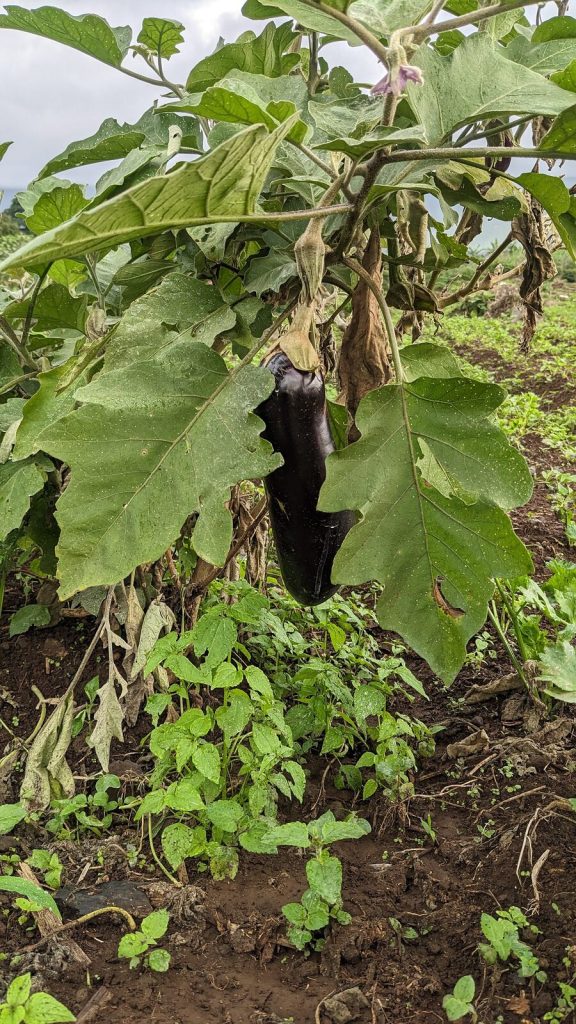
Eggplant farming in Uganda covers at least three different plants. One is the long purple fruit most people picture. Another is nakati, a leafy African eggplant harvested for its leaves and grown more widely here than the purple sort. A third is the small bitter ball sold as ntula. Which one you are planting changes the seed, the spacing, the harvest and the buyer.
Three Different Crops Are Sold as Eggplant in Uganda
The confusion is botanical and it runs through every growing guide on this crop. The purple or striped fruit sold in supermarkets is Solanum melongena, the Asian and Mediterranean species. What Ugandan farmers mostly grow is a different species, Solanum aethiopicum, the African eggplant, and it is divided into groups by what part of it is eaten.
Research on the species sets out four groups. Gilo is grown for its fruits and is the group cultivated most widely around the world. Shum is grown for its leaves and is the form most common in Uganda, Nigeria and Cameroon. Kumba is used for both leaves and fruits. Aculeatum is ornamental. A fourth species, Solanum macrocarpon, and the wild relatives Solanum anguivi and Solanum incanum all sit close by and turn up in the same gardens and the same breeding work.
So a grower asking for eggplant seed and a seller reaching for a packet may be talking about entirely different crops. Settle that first. Everything downstream, from spacing to the week you start cutting, follows from which plant you are actually growing.
Nakati Is Uganda's Most Grown African Eggplant, and It Is a Leaf Crop
Ugandan research on the Shum group describes nakati as supporting the livelihoods of over four million people in urban and peri urban areas, and names Wakiso, Mukono and Luwero as the country's major producing districts. The crop is culturally embedded too: the bitter flavour is wanted as an accompaniment to matooke in Buganda, and a Ugandan government vegetables pamphlet from the nineteen seventies already recorded how the leaves were cooked in banana leaves with the bananas, then mashed and salted.
That matters for anyone planning a plot, because a leaf crop and a fruit crop are different businesses. A leaf crop is cut repeatedly from a few weeks after transplanting, sold fresh, wilts within a day and has to move to market quickly. A fruit crop starts later, picks over months, and travels better. Peri urban location is not incidental to nakati; it is part of why the crop works where it works.
Ugandan work on the same crop lists what holds productivity down: drought susceptibility, pests and diseases, limited access to quality seed, and heavy losses after harvest. Three of those four are solvable at farm level and the seed one is not, for the reason in the next section.
What Uganda's Only Eggplant Extension Guide Actually Says
Uganda's agricultural research body publishes one eggplant document for farmers, a good agronomic practices poster produced under a northern Uganda development programme. It is worth reading, and it is worth reading closely, because of what it leaves out.
The poster runs ten steps: choose a good site, choose the right variety, prepare the land with a first and second ploughing, prepare a nursery bed, apply manure and transplant, weed as soon as weeds emerge, apply fertilizer, control pests and diseases, harvest at the right time, and market the crop. It adds three back yard garden layouts, raised, sunken and flat beds. Its siting advice is specific and useful: avoid waterlogged, rocky, shady and steeply sloping ground, and avoid a field that carried the same crop the previous season.
On spacing it gives one metre between plants, one seedling per hole, planted at a depth of ten centimetres. And then, in the box where the plant density should be, the published poster reads "Plant density (XX Seedlings)". The placeholder was never filled in before printing.
The number is not hard to supply. At one metre by one metre a hectare holds 10,000 plants, so an acre holds about 4,047. But a farmer holding the only national extension sheet for this crop cannot get that from the sheet. The same poster tells the reader to "choose the right variety" and to "use resistant seed" while naming no variety and no resistance trait anywhere.
Eggplant Varieties and Where Their Names Come From
Uganda has released no eggplant variety, and the shape of that absence in the record is worth seeing. The national research body's public technology catalogue runs to 121 released technologies. Read every entry and field crops dominate it: cereals, grain legumes, roots and tubers, a coffee series, a banana, a mango. The entire vegetable contribution is one released cherry tomato. Query the same catalogue for nakati, for ntula, for entula, and each comes back with nothing; query it for Solanum and the four hits are all Irish potato. A control query for bean returns forty, so the silence is about this crop and not about the index.
The research library holds two eggplant items. One is the extension poster above. The other is a masters thesis on collections of scarlet eggplant, and it needs care: the listing looks exactly like the Ugandan varietal record this crop lacks, but the title page shows the work was submitted to a British university and carried out in a glasshouse there. Its value to a Ugandan grower is its description of the species and its groups, which the section above draws on, and nothing about what performs in a Ugandan field.
What does exist is a Ugandan participatory evaluation. Twenty four nakati genotypes were planted in three replications across six farms in the three main producing districts, and 177 farmers scored them for pest, disease and drought tolerance, appearance, leaf yield, leaf texture and seed yield. Men and women ranked both traits and genotypes the same way, which the authors read as an opening for a single variety to serve the whole market. The traits farmers wanted most were seed yield and leaf yield, then pest and disease resistance. The genotypes that came top carry research codes rather than names, because none of them has been released.
So any eggplant variety name you meet on a Ugandan seed packet came from a seed company catalogue somewhere else. That is a legitimate source of information provided everyone treats it as one. What it is not is a Ugandan release, and any maturity, yield or disease tolerance figure attached to such a name has no Ugandan trial behind it. Our guide on judging seed quality from what the pack actually declares covers what to check at the counter.
Raising Eggplant Seedlings in a Nursery Bed
Both the African and the Asian eggplant are raised in a nursery and transplanted, and both are slow starters compared with the tomato most growers are used to. The bed wants a fine tilth, firm under the hand, with shade above it and drainage below. Sow thinly. Crowded eggplant seedlings stretch early and never recover the stem thickness they lost.
The seedling is ready to move when it carries four to five true leaves and stands up on its own. A common instruction circulating in Ugandan content is to transplant at two to three leaves, which is too early: a plant that small has almost no root system to carry it through the transplant shock, and losses in the first week run high. Harden the seedlings by cutting back water and opening the shade for a few days before they move, then move them out early or late in the day, out of the midday sun, and water them in at once.
Plan a surplus. Whatever plant population you are aiming at, raise around a tenth more seedlings than that so you can reject the weak ones and still fill gaps a week later. Gap filling with a much younger seedling gives you a plant that never catches up and complicates every later operation.
Eggplant Spacing and Plant Population Per Acre
The national extension poster gives one metre by one metre with a single seedling per hole, which puts 4,047 plants on an acre. Content circulating elsewhere gives 60 cm between plants with 90 cm between ridges, which would put about 7,500 plants on the same acre, nearly twice as many.
Neither figure comes with a yield trial, so this page will not tell you one is correct. What it will tell you is how to think about the gap. Wider spacing gives each plant more light and air movement, which lowers leaf disease pressure and suits a plant that will stand for months. Closer spacing gives more plants and more early yield, at the cost of a canopy that stays wet longer after rain. A leaf crop cut repeatedly and a fruit crop picked over months do not want the same compromise.
Work your own number rather than taking either. Our guide to counting plants from a spacing sets out the method, and the arithmetic is simple enough to do on paper: an acre is 4,047 square metres, so divide that by the area each plant occupies. One metre by one metre gives one plant per square metre, and the answer falls out.
| Spacing | Plants per acre | Source |
|---|---|---|
| 1 m by 1 m | about 4,047 | National extension poster |
| 60 cm by 90 cm | about 7,495 | Circulating content, unsourced |
| Your own | 4,047 divided by area a plant | Measure it |
Manure and Fertilizer on a Ugandan Nakati Crop
This is one of the few places where a genuinely Ugandan on farm trial exists for a vegetable, and it is worth more than any imported recommendation.
Researchers ran a farmer managed trial on nakati on highly weathered soils in the Lake Victoria Crescent, testing a gradient from all organic to all mineral fertilizer at two nitrogen rates, with the rates themselves set from a survey of what smallholders already put on their vegetable plots. The results were not what the integrated soil fertility literature predicted.
Take two things from that. Manure is not a poor substitute for a bag on this crop; it was the majority partner in the best performing mix. And the soil's pH is doing work that fertilizer cannot. Our guides on getting value out of cattle manure and on the other organic sources a farm can use cover preparing the material, and the national extension poster puts manure application at transplanting rather than at sowing.
Saving Eggplant Seed, and What Cross Pollination Does to It
Nakati farmers rank seed yield among the traits they most want, which tells you how much of this crop's seed is saved rather than bought. So the pollination biology matters in a practical way.
Ugandan work on African eggplant found every genotype tested to be self compatible, and the species to be mainly self pollinating while carrying floral features that support crossing between plants. Flowers show heterostyly, meaning style length varies, which is one of those features. In a full diallal crossing study most flowers opened by eight in the morning and pollen viability ran above 80 percent across genotypes, with incompatibility appearing in only five of thirty nine crossing combinations.
The practical translation. Seed saved from your own plants will mostly come true, because the crop largely pollinates itself. It will not come true entirely, because some crossing happens, and if a neighbouring plot of a different type is close then some of that crossing will be with it. If you are saving seed deliberately, take it from plants in the middle of a block of the type you want rather than from the edge, keep different types apart, and refresh from a bought source periodically. A seed lot drifting slowly over several seasons is the usual reason a crop that used to perform stops performing.
Eggplant Pests and Diseases, and One Claim That Will Cost You a Crop
The fruit boring caterpillar is the pest that defines fruiting eggplant across the tropics. It belongs to the genus Leucinodes, and the African species in it were only recently separated taxonomically from the Asian one, so older guidance naming a single species is out of date. The damage is inside the fruit, which means by the time you see the entry hole the loss has already happened, and it means scouting is about flowers and small fruit rather than about visible caterpillars. Aphids, whiteflies, spider mites and flea beetles all take their share of the leaves, which matters more on a leaf crop than on a fruit crop.
On the disease side there is a claim circulating in Ugandan content that has to be corrected, because acting on it costs a crop. Bacterial wilt is not controlled by a fungicide. It is caused by soil borne bacteria in the Ralstonia group, fungicides act on fungi, and a grower spraying fungicide at a wilting solanaceous crop is spending money on a category error. The same content attributes bacterial wilt to "wind and water", which misdirects every management decision that follows.
What does work against a soil borne wilt is soil and planting management. Rotate away from the whole solanaceous family, which means tomato, pepper, Irish potato and the other eggplants, rather than just the one you grew last. Drain the plot, because the poster's warning against waterlogged ground is about this. Pull and remove wilting plants rather than leaving them in the field. Do not move soil, seedlings or tools from an affected block into a clean one. Our tomato growing guide and green pepper guide cover the other family members you will be rotating with.
This page names no pesticide and gives no rate. The rate that governs is on the label of a product currently registered for this crop in Uganda, and a district extension officer confirms it. Eggplant leaves and fruit are both eaten with little processing, so the pre harvest interval on the label is the gap between a legal crop and one that should not be sold. Our page on applying pesticide safely covers the part that transfers.
Harvesting Eggplant and the Loss That Happens Afterwards
Heavy loss after harvest is one of the four constraints Ugandan researchers name for this crop, and it is the one growers most often absorb without recording.
On the leaf crop the loss is speed. Cut leaves wilt within hours in the sun and lose their market before they lose their weight. Harvest in the cool of the morning, keep the crop shaded from the moment it is cut, and move it to the buyer the same day. On the fruit crop the loss is judgement. African eggplant fruits turn orange or red as they pass maturity, and once they turn they are seed rather than vegetable. Pick before the colour changes, pick with a knife rather than by pulling, and pick often, since a plant carrying over ripe fruit slows down its own flowering.
Do not wash either crop before transport. Water on the surface accelerates rot in a heap, and the practice of washing at the farm, which circulates in Ugandan growing content, works against the keeping quality the grower needs.
Selling Eggplant Without a Grade or a Price Series
Uganda reports no national eggplant production statistic; its vegetable reporting to the international database covers onions, tomatoes and a single catch all line for other fresh vegetables. Twenty three other African countries do report eggplant rows in the same file, so this is Uganda's blank rather than the dataset's. Going through the regional standards catalogue there is no eggplant specification either, although the same catalogue carries a fresh bulb onion standard, so the gap is real.
No statistic, no grade, no published price. Three practical consequences. Agree with your buyer in advance what size, colour and bunch they want, because nothing published will settle a dispute afterwards. Weigh what leaves the farm, every time, since a record kept in bundles or basins cannot become a cost per kilogramme later. And treat the peri urban market position as part of the enterprise rather than a detail: a leaf crop that must sell the day it is cut cannot be grown far from the buyer.
Questions Ugandan Growers Ask About Eggplant Farming
Is nakati the same crop as the purple eggplant in the supermarket? No. Nakati is the leafy Shum group of the African eggplant, a different species from the long purple Asian eggplant. They are relatives, they share pests and diseases, and they are both called eggplant in English, but they are grown for different parts, sold to different buyers and harvested on different schedules.
How many eggplant seedlings do I need for an acre? At the national extension poster's spacing of one metre by one metre, about 4,047 plants, plus around a tenth more raised in the nursery so you can select and fill gaps. Closer spacings in circulation would put roughly 7,500 on the same acre. Neither has a Ugandan yield trial behind it, so pick the spacing that suits your crop type and your disease pressure, then hold it consistently so you can learn from it.
Can eggplant be grown in a greenhouse in Uganda? Yes. Content circulating in Ugandan farming pages claims eggplant cannot be grown under cover because it tolerates neither heat nor cold, and that is wrong; it is a standard protected cropping species in many countries. Whether a greenhouse pays for this crop in Uganda is a separate question about capital and market price, and it is not the same as the crop being unsuitable.
Will seed saved from my own eggplants come true? Mostly, because Ugandan work found African eggplant to be self compatible and mainly self pollinating. Not entirely, because the flowers carry features that support crossing and some crossing does happen. Save from the middle of a block of one type, keep types apart, and buy fresh seed from time to time rather than running the same saved lot indefinitely.
Why are my eggplants wilting and dying in patches? Patchy wilting in a solanaceous crop points first at a soil borne bacterial wilt, particularly on ground that holds water or that grew tomato, pepper or potato recently. It is bacterial, so a fungicide does nothing for it. Manage it by rotating out of the whole family, draining the plot, removing affected plants and keeping tools and soil out of clean blocks.
Which eggplant variety should I plant in Uganda? No variety has been released here, so there is no Ugandan answer to give. Every name on a packet comes from a seed company catalogue elsewhere, and the figures attached to those names have no Ugandan trial behind them. Buy from a supplier who can show you what the pack declares, plant a strip before committing an acre, and keep a record of what the strip did.
How long does eggplant take before the first harvest? The leaf crop starts being cut within weeks of transplanting and is then cut repeatedly; the fruit crop starts later and picks over months. Published maturity figures circulating for Ugandan eggplant carry no source and do not say whether they count from sowing or from transplanting, which makes them unusable. Take the figure from your own seed pack and confirm it in your first crop.
Checking Eggplant Seed and Buyers Before You Plant
The two decisions that settle an eggplant enterprise both happen before any land is prepared: which of these crops you are actually growing, and who is going to buy it. Talk to buyers about the type, the size and the bunch they want, then talk to more than one input supplier about what their eggplant seed packets actually declare and where the variety comes from. The rest of our vegetable growing guides cover the family members you will rotate this crop with, which is the main defence it has.