
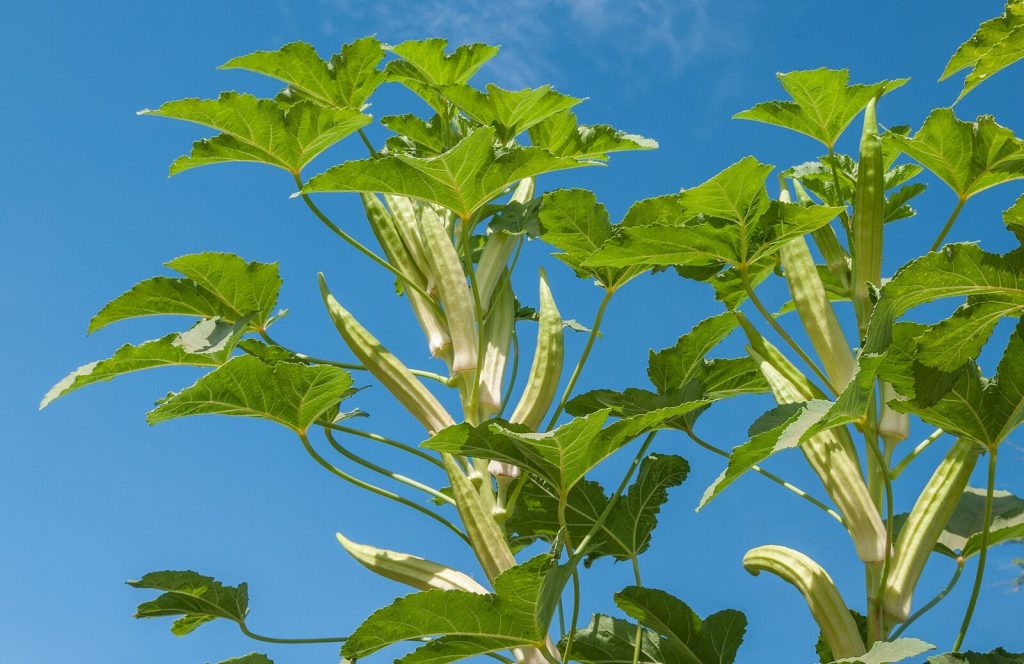
Two East African variety trials have now compared local okra landraces against imported improved varieties, and in both the local material yielded more. So the standard advice on okra farming in Uganda, that a grower should replace landraces with bought seed, runs against the only regional evidence available. Okra is a warm season annual grown for immature pods picked every day or two over several weeks.
Local Okra Landraces Against Improved Varieties
This is the most useful finding on the crop and almost nobody publishes it.
A Makerere University field trial at the university's agricultural research institute at Kabanyolo compared five okra entries in a replicated block design: two local selections and three named improved varieties. Ten agronomic measurements were taken. All ten differed by variety. The two local selections came out ahead on most traits, including fruit yield, and the improved varieties had lower leaf area. The author's recommendation was that the two local selections be given to farmers in the meantime, that the work be repeated for at least two more seasons before anything is treated as settled, and that somebody work out the right plant population for the improved varieties, because nobody knows it.
That was one site, one season and an undergraduate special project, which is exactly why the author asked for two more seasons. Taken alone it would be a lead rather than a finding. It does not stand alone.
A larger Ethiopian study evaluated 21 okra entries at a university research farm under irrigation, 11 of them collected from Ethiopian growing regions and 10 of them commercial varieties introduced from India and the United States, across 25 measured traits in three replications. Its conclusion: the indigenous collections were more genetically diverse and outperformed the introductions on most traits, including green fruit yield and seed yield. The three lowest yielding groups in that trial were the two registered commercial varieties, the Indian introductions and one regional collection, at 3.62, 5.48 and 5.5 tonnes a hectare.
Two independent trials in two countries, one small and one substantial, pointing the same way. That is enough to treat as a real pattern rather than a curiosity.
The introductions did buy something, and it was not yield. In the Ethiopian trial the Indian material flowered and matured earlier than the indigenous collections, and the study notes why that matters commercially: an earlier crop reaches the market before anyone else's and gets a better price for it. So the honest trade off is a choice between two different things.
Where Ugandan Okra Variety Names Come From
Okra has no Ugandan release behind any name on the market, and that was checked rather than assumed. NARO's databank of technologies and publications holds no okra entry; the same query returns 40 entries for bean, 29 for sweet potato and two for tomato, so the tool is working and the gap is the crop. The ministry publishes one variety list extract, covering roots, tubers and bananas, with no vegetable on it.
What does exist is a trail of names, and each has a different source. Pusa Sawani is an Indian bred variety, and it appears in the Makerere trial under a slightly different spelling and in the Ethiopian trial among the Indian introductions. Clemson Spineless is an American variety, and it too appears in both. Maha F1 is a commercial hybrid and appears in the Makerere trial. Burgundy is a red podded ornamental type that turns up on Ugandan content with no research behind it. None of these is a Ugandan variety and none has been evaluated here beyond the single Makerere season.
A seed catalogue is a legitimate source for the characteristics of the seed that company sells, provided it is named as one. What it is never evidence of is Ugandan adaptation or disease resistance in Ugandan conditions. Claims that a particular okra variety resists root knot nematode in Uganda circulate widely and rest on nothing measured here. Our notes on choosing quality seed set out what to ask at a counter, and on okra there is a further question worth asking: whether the pack is a hybrid, because a hybrid cannot be saved and a landrace can.
Saving seed is a genuine option on this crop, which separates okra from carrot, cabbage and onion. Okra sets seed readily in the same season, dry pods on the plant are the seed, and the Ethiopian trial measured seed yield alongside fruit yield precisely because okra seed has its own value, carrying roughly forty per cent oil. A grower keeping the best plants from a local selection is doing something no carrot grower in Uganda can do.
Planting Okra: Warm Soil, Spacing and What Nobody Has Measured
Okra wants heat and will not be hurried. It is a tropical annual, and the constraint in Uganda is not warmth but the absence of a Ugandan recommendation for anything else.
Here is the honest position on spacing. No Ugandan okra plant population recommendation exists, and the Makerere trial's author said so explicitly, listing the determination of optimum plant population for the improved varieties as work still to be done. The Ethiopian trial spaced its plants 0.6 metres apart within plots with three seeds a hole thinned to one at the three to four leaf stage, which is a research spacing rather than a commercial one. Figures of 70 to 80 centimetres between rows and 40 to 50 centimetres in the row circulate on Africa focused growing content without a source attached. Our plant population calculator will convert whatever spacing you settle on into plants per acre so you can price seed against it, and the sensible move on a crop this thinly documented is to trial two spacings side by side.
On timing, the Ethiopian trial gives measured figures from a warm irrigated site, and they are the most reliable phenology numbers available for this crop in the region. First flowering came between roughly 47 and 60 days after sowing depending on the entry, half the plants were flowering between roughly 55 and 76 days, and maturity ran between roughly 67 and 97 days. The study also states the general shape: okra sets its first flower one to two months after sowing and runs to maturity over about 90 to 100 days. Content promising a harvest in 50 to 60 days is describing first flowering rather than a crop.
Two practical points about that spread. A 30 day range in days to maturity across entries means variety choice moves your harvest date by a month, which is the whole basis of the earliness trade off above. And because okra is picked repeatedly rather than lifted once, maturity is the start of the harvest rather than the end of the crop.
Picking Okra Every Day or Two, and Why the Interval Is the Yield
Everything that makes okra profitable and everything that makes it exhausting sits in one operation.
An okra pod is edible only while immature. It goes fibrous and woody fast, and the window between a pod worth selling and a pod worth nothing is measured in days, not weeks. Ugandan farming press guidance puts the target at pods of roughly two to four inches. Beyond that the pod hardens and the buyer will not take it.
The second half is less obvious and it is where the money is. A plant carrying a mature pod slows or stops making new flowers. So a missed picking round does not just cost you the pods you missed; it cuts the flowering and fruiting the plant would have done afterwards. The picking interval is not a harvesting schedule, it is a yield input.
Handling after picking is short and unforgiving. Okra is highly perishable, bruises show, and pods held warm go limp and discolour within a day. Cut or snap pods cleanly, keep them shaded and out of field heat from the moment they leave the plant, and get them to the buyer the same day wherever you can. A crop that has to survive a second day loses grade before it loses weight.
Okra Pests and the Pod Borer Problem
Uganda publishes no okra pest survey, so this section states what the country actually monitors and stops there.
Uganda's plant health authorities, working through a multi year project on horticultural export compliance, developed survey and monitoring procedures for five priority quarantine pests affecting fresh fruit and vegetables. Two of them matter directly to okra. Helicoverpa armigera, the bollworm, is a pod feeding caterpillar with a very wide host range, and a caterpillar inside a pod is beyond the reach of anything sprayed on the outside. The fruit flies in the genera Dacus and Bactrocera are the second, and the mechanism is the same: damage develops inside the fruit after an adult lays into it.
That project's extension materials, which produced booklets and posters on good agronomic practices and on pest and disease management, covered chilli, garden eggs, bitter gourd and bottle gourd. They did not cover okra. So Uganda's horticultural export system has produced crop specific pest guidance for four vegetables and not for this one, which is worth knowing before trusting any okra pest list you find.
One further caution on the source, recorded because it illustrates a pattern. That project report lists its five priority pests with common names attached, and one of the parenthetical common names contradicts the report's own abbreviation list elsewhere in the same document. When a Tier 1 document disagrees with itself about what an insect is called, work from the scientific name and ask an extension officer, not from the label.
The safety position follows from the mechanism. No rate, dilution, interval or product name appears on this page. Pod feeding pests are not reached by a surface spray once they are inside, which makes scouting, prompt removal of damaged pods and field hygiene the work that actually pays. Where a product is used, the registered label governs and a district agricultural officer confirms it against the pest you have. Okra is picked repeatedly over weeks, which means the interval between an application and the next picking round comes up again and again rather than once, and that is the part growers underestimate. Our guides on agrochemical labels and on applying pesticides safely cover the rest.
Okra Yield Per Acre Across East Africa
Uganda reports no okra production figure. The FAO production database carries a separate okra item and 20 African countries file against it; Uganda does not, and its whole vegetable output beyond tomato, onion and chillies sits in a residual category the FAO flags as imputed rather than declared. The national Annual Agricultural Survey explains why there is nothing to find: its coverage focuses on 16 major crops, all of them cereals, roots, pulses, oilseeds, banana or coffee, and no vegetable is among them.
So the comparison comes from elsewhere in the region, and the spread is wide enough to matter.
| Source | Yield | Basis |
|---|---|---|
| Kenya | 9.8 to 16.2 t/ha | Official national |
| Tanzania | 4.4 to 4.5 t/ha | Official and estimated |
| Ethiopian trials, low end | 3.6 to 5.5 t/ha | Research plot |
| Ethiopian trials, cited range | 9.4 to 48.5 t/ha | Research plot |
Read those rows together rather than picking one. Kenya's officially reported national yield has been rising and sits between about 10 and 16 tonnes a hectare, on a crop that grew from 12,632 to 23,599 tonnes across recent years. Tanzania reports a much larger crop, about 43,880 tonnes, at roughly a third of Kenya's yield. And the Ethiopian research literature spans 9.4 to 48.5 tonnes a hectare across genotype trials, with one review of 25 genotypes averaging 30.38 tonnes a hectare.
The top of that research range is three to five times the officially reported national yields in the same region. That gap is not a mystery and it is not fraud: a genotype trial is a small irrigated plot, hand picked on time, with no marketing losses. It is what the plant can do, not what a farm does. For a plan, use the reported national figures, which convert to roughly 1.8 to 6.6 tonnes an acre, and take your own losses out of that. The same trial against national gap runs across Ugandan vegetables, and our tomato yield per acre page works through the largest example of it.
Selling Okra on the Ugandan Market
Okra's domestic market in Uganda is real but narrow, and the shape of it should govern how much you plant.
Take the national ceiling first, so the scale is clear. Every formally exported Ugandan vegetable put together comes to somewhere between 22,300 and 34,600 tonnes in a year, and the border value of that has run from about USD 19 million to about USD 33 million, of which a fifth to a little over a quarter is produce that was re exported rather than grown here. Okra sits inside that total as a fraction of a fraction.
Domestically, okra sells through markets, through grocers serving communities that cook with it, and through restaurants. None of those outlets absorbs volume without notice. The crop is perishable enough that a grower cannot hold it while looking for a buyer, and picked frequently enough that supply arrives every day or two rather than in one load. Both facts push toward the same sequence. Agree a quantity and a frequency with a named buyer, then plant to that number. How to open those conversations is covered on our pages about reaching produce buyers and about supplying hotels and restaurants, while the wider vegetable farming hub holds the rest of the section.
Exporting Okra From Uganda: What the Ministry Requires
Okra is one of the vegetables Ugandan content most often describes as an export crop. Here is what exporting a fresh vegetable from Uganda actually requires, from the ministry's own published guidance.
An intending exporter of fruit and vegetables registers with the phytosanitary and quarantine inspection service inside the ministry's Department of Crop Inspection and Certification, which is Uganda's national plant protection organisation. The steps the ministry lists include registration with the national registration services bureau, a recommendation from the trade ministry's external trade commissioner, an export readiness pre assessment of the applicant's production and pack house by the sector's apex association, a recommendation letter from that association, and then an application to the Commissioner for Crop Inspection and Certification. Applicants have to show ownership of a pack house, whether owned, rented or shared, before the ministry's audit takes place, and have to show either an owned nucleus farm or contracted farmers. A tax identification number is required, and an additional registration number for those exporting to the European Union.
Two conditions in that list are the ones that decide the answer for a smallholder. The ministry states that no company will be registered without a physical address and an approved producer traceability system. And the penalties are institutional rather than nominal: de registration runs from six to twelve months, suspension from one to twenty four weeks, and being intercepted twice without corrective measures is among the grounds for suspension.
Uganda has been through the consequences of getting this wrong. Across two recent years more than eighty per cent of Ugandan fresh fruit and vegetable consignments arriving in the European Union were intercepted carrying harmful organisms, most of them chilli consignments carrying false codling moth. The ministry's response was to impose a temporary ban on chilli exports rather than risk losing the market altogether, and the European Union is around sixty per cent of Uganda's fresh produce export trade. A subsequent compliance programme cut interceptions of that one crop from 43 in a year to three, added twenty five inspectors to a service that had four, and produced the apex association that now sits in the registration chain. Our page on agricultural export basics covers the wider framework.
Why Okra Never Appears in Uganda's Trade Statistics
There is a reason no okra export figure exists for Uganda, and it is not that the trade is absent.
Okra has no dedicated six digit line in the international customs classification. It is declared inside a residual heading for other fresh vegetables, along with several other crops. Uganda's declarations under that heading are large and extremely unstable: exports have run between roughly 100 and 3,046 tonnes a year across recent years, worth between about USD 102,000 and USD 2.34 million. In the year with full destination detail, the two dominant buyers were the Democratic Republic of the Congo at about 468 tonnes and the United Kingdom at about 421 tonnes, with much smaller volumes to the Netherlands, Türkiye, Sweden, South Sudan, Norway, Belgium, Qatar and Switzerland.
That pattern is worth reading carefully, because it holds the useful lesson. One large regional buyer and one large European buyer, with a long tail of small European and Gulf consignments. The regional volume is a border trade; the European volume is airfreighted produce moving through registered exporters and pack houses. Both are inside one statistic and neither can be separated out. So anyone quoting an okra export figure for Uganda is quoting something else, and any claim about okra's export earnings here is unverifiable by construction. What the data can tell you is that a route exists, that it runs mostly to one neighbour and one European market, and that it swings by a factor of thirty between years.
Common Questions About Growing Okra in Uganda
How long before okra is ready to pick?
The best regional measurements come from an Ethiopian trial of 21 entries: first flowering between roughly 47 and 60 days after sowing, and maturity between roughly 67 and 97 days depending on the entry. The same study puts the general shape at a first flower one to two months after sowing and maturity over about 90 to 100 days. Content promising a crop in 50 to 60 days is describing first flowering. Keep in mind too that maturity begins the harvest rather than ending it, since okra is picked repeatedly for weeks afterwards.
What does it cost to grow okra, and what can it earn?
No Ugandan okra budget can be built from published figures, because no Ugandan source publishes an okra yield, seed rate or farm gate price. Figures circulating in dollars per hectare for Ugandan okra returns trace back to unsourced content and should be ignored. What can be named is where the money goes, and okra's cost stack is unusual: seed is cheap if you save a landrace and expensive if you buy a hybrid, fertility is ordinary, and labour is the dominant line because dozens of picking rounds have to be paid for. Price the labour before anything else, get your own local quotes for the rest, and use the supplier directory as the starting point for seed.
Should I plant a local okra variety or buy improved seed?
Two East African trials, one at Makerere and one in Ethiopia, both found local material out yielding introduced improved varieties. Neither is conclusive: the Makerere trial was a single undergraduate season and its author asked for two more. What the imported varieties did deliver in the Ethiopian trial was earliness, which is worth money if you are aiming at the start of a season. Grow both in strips in the same field and count pods. On a crop with this little Ugandan data, your own comparison is better evidence than anything published.
Can I save okra seed?
From a landrace or an open pollinated variety, yes. Okra sets seed in the same season, dry pods on the plant are the seed, and the seed carries roughly forty per cent oil, so it has value of its own. From an F1 hybrid, no: the next generation will not repeat the parent. This is one of the few vegetables in Uganda where saving seed is a genuine option, which is part of why local selections persist on farms and part of why the trial results above matter.
Why are my okra pods hard and stringy?
They were picked too late. An okra pod is edible only while immature and turns fibrous within a few days of opening, with Ugandan farming press guidance putting the target at roughly two to four inches. There is a second cost to the same mistake: a plant carrying mature pods slows its flowering, so a late round reduces the crop that follows. If pods are consistently overgrown, the problem is the picking interval rather than the variety or the soil.
Can a smallholder export okra from Uganda?
Not directly. The ministry's registration requirements are built around a company: a pack house the applicant can show ownership of before the audit, an approved producer traceability system, a physical address, a recommendation from the sector's apex association and an application to the Commissioner for Crop Inspection and Certification. The realistic route is to supply a registered exporter as a contracted farmer, which the ministry's own conditions anticipate, and that means accepting that your spray records and picking practice affect somebody else's licence.
Is there a Ugandan okra variety?
No. NARO's databank holds no okra entry, and the same query returns 40 entries for bean, 29 for sweet potato and two for tomato, so nothing is broken. The ministry publishes one variety list extract and no vegetable appears on it. Every okra name on the Ugandan market traces to an Indian, American or commercial breeding programme, or to a landrace nobody has registered. Ask which company bred the seed, and treat any disease resistance claim for Ugandan conditions as unverified, because no Ugandan trial has tested one.
Where to Check Okra Prices and Find Buyers
Okra is a crop where the buyer conversation has to come before the planting decision, because the pods arrive every second day and cannot wait. Find out who in reach actually buys okra, whether that is a market trader, a grocer, a restaurant or an exporter looking for contracted growers, and ask three things: how much they take a week, at what pod size, and whether they pay by weight or by the heap. The third answer will change your margin more than anything you do in the field. Then get a seed quote for both a local selection and an improved variety so you can run the comparison strip that the published research has not run for you. Our price pages follow what Ugandan produce is fetching, and the supplier directory lists where growers source seed and inputs.