
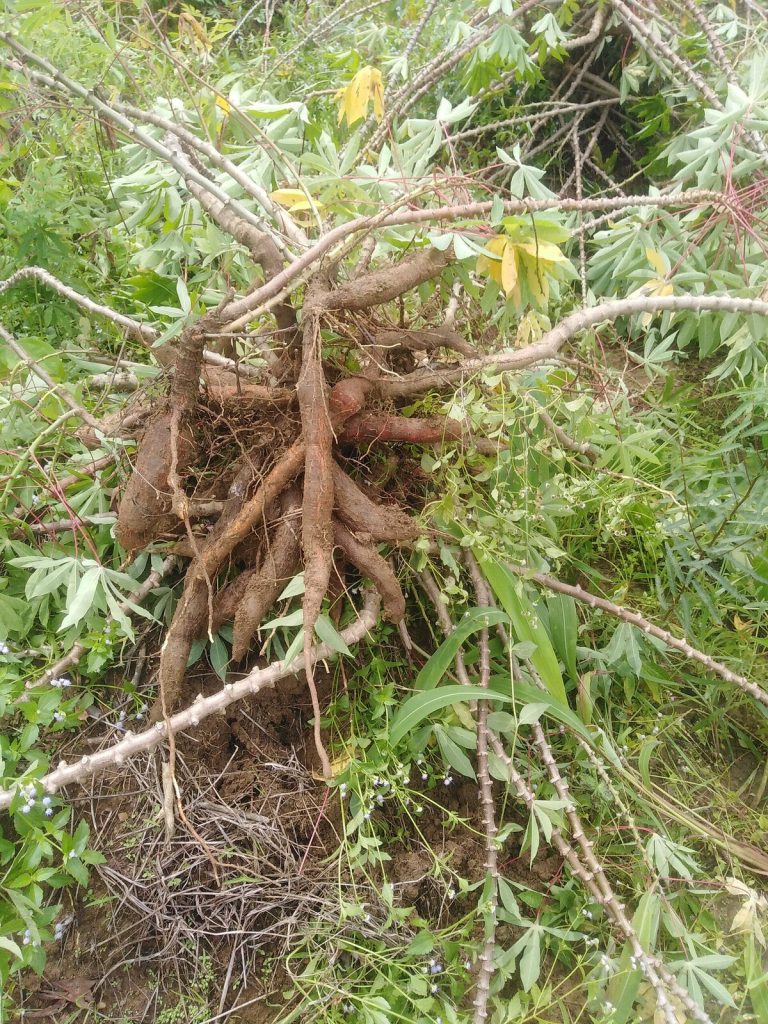
Cassava diseases and pest control in Uganda turns on one fact: the two problems that cost the most are viruses, carried in the stem cuttings you plant and by a single whitefly. No spray reaches them. Control is selection, roguing and field sanitation. The insect pests that do respond to management are mostly already held down by natural enemies, and pesticides kill those.
Most advice available to a Ugandan cassava grower starts at the sprayer. That is the wrong end of the problem, and following it costs money twice: once for a product that cannot act on a virus, and again in the biological control it destroys. So this page is organised by what each problem actually is and how it moves, because a grower who knows the transmission route can work out the control for a problem nobody wrote about.
Cassava Mosaic Disease: The Damage and the Vector
Cassava mosaic disease is caused by a group of viruses that live inside the leaves and stems of the plant. Seven of them are known across the region, and all seven are carried by the same whitefly complex, Bemisia tabaci, which picks the virus up while feeding and injects it into the next plant it feeds on. The same viruses travel far more efficiently a second way: inside cuttings taken from an infected plant.
What you see is leaf discolouration in a patchwork of normal green mixed with pale green, yellow and white areas. Under heavy attack the leaves come out small and distorted and the whole plant is stunted. Symptoms show more strongly on young plants, usually those under six months, than on older ones, which is one reason a field can look worse at four months than at nine and still be carrying the same virus load.
Root yield loss in a sensitive variety is large and the published estimates do not agree on how large. One review puts it at up to 85 percent; a CGIAR brief on Uganda's cassava system gives 20 to 95 percent in susceptible varieties. Both agree the number depends on the variety and that the upper end takes most of the crop.
Uganda has specific history here. A virulent form of the disease emerged in the late nineteen eighties, infected cuttings were distributed widely, and a destructive epidemic developed in Uganda that caused income loss, food shortages and deaths from famine, before spreading from Uganda into ten other countries in eastern and central Africa. Whitefly numbers across the region rose over the same period from a few adults per cassava shoot tip to hundreds. The vector became superabundant and the disease travelled with it.
The one piece of good news in the evidence is how strongly variety choice acts here. In NARO's trial of 32 Ugandan varieties across three sites, variety accounted for 95.4 percent of the variation in mosaic severity and the site accounted for 0.4 percent. Almost the entire outcome is decided by what you plant. Very little else in cassava behaves that cleanly.
Cassava Brown Streak Disease: The Rot You Cannot See Until Harvest
Brown streak is the harder of the two, for one reason: it damages the part you sell and it hides until you cut the root open.
Two viruses cause it, cassava brown streak virus and Ugandan cassava brown streak virus, both ipomoviruses and both carried by the same whitefly, transmitted semi persistently. In a Ugandan crossing block trial where infections were typed by PCR, single infections of the first were found in 81.6 percent of positive samples against 3.2 percent for the second, so the two are not present in equal measure and mixed infection is common. Symptoms differ between them: one causes circular pale blotches between the leaf veins, the other feathery pale streaking alongside the veins, and the first of those is also the one causing the more severe root damage.
The foliar symptoms are often too faint for a grower to notice, and infected plants can be completely symptomless above ground. What the disease is doing instead is constricting the storage roots and producing a brown to black necrotic rot inside them. Root yield loss runs up to 70 percent. The practical consequence is brutal and it is documented: growers do not know their crop is affected until harvest, and infected cuttings get distributed in the meantime because the source plant looked healthy.
Brown streak was first recorded in coastal Tanzania in 1936 and for decades sat below about 1,000 metres of altitude, which made it somebody else's problem for most of Uganda. It re emerged in the nineteen nineties, spread through the Lake Victoria region and then across eastern Africa, and it now occurs above 1,000 metres. Most of Uganda sits above that line, so altitude is no longer a defence. Neither is distance from the lake.
| Feature | Mosaic disease | Brown streak |
|---|---|---|
| What you see | Leaf patterning, stunting | Often nothing above ground |
| Where the loss is | Fewer, smaller roots | Rot inside the root |
| Found at | Any stage, worst under 6 months | Root damage builds to harvest |
| Worse season | Wet season spread | Symptoms worse in dry season |
| Variety effect | Very strong | Weaker, and site matters more |
| Recovery | Plants can outgrow symptoms | Roots do not recover |
Why Spraying Does Not Control Either Cassava Virus Disease
A fungicide acts on fungi. Mosaic disease and brown streak are caused by viruses, so there is nothing for a fungicide to act on, and no amount or frequency changes that. This is not a matter of the right product being expensive or unavailable. There is no product.
Killing the whitefly instead sounds more promising and does not work either, for two reasons that compound. A whitefly transmits the virus while feeding, which happens long before an insecticide reduces the population, so the infection is already made. And the insecticide removes the predators and parasitoids that are holding down the pests that do matter, which is why IITA's own pest field guide states the instruction plainly: do not spray pesticides on cassava, because they kill the natural enemies of cassava pests. That is a Tier 1 extension source telling growers the opposite of the advice they usually get.
What does move both diseases is planting material and field hygiene, in that order. Everything below follows from that.
Clean Planting Material Is the Real Disease Control
Almost every cassava disease travels in the stem. The viruses, the blight bacterium and the anthracnose fungus all survive on or inside cuttings and reach new fields that way. In a Ugandan value chain survey, about 80 percent of growers in both study areas named lack of good quality planting material as a major constraint, which means they already know this.
Even material from a formal source can be mixed. In a district variety trial in Adjumani planted from breeders' material, the only brown streak symptoms found in one plot came from three plants that were off types of a different variety. Selection at the field is not a substitute for trusting your source, and it is not made redundant by it either. The buying side of this is worked through in the guide to cassava varieties.
Roguing and Field Sanitation in a Cassava Crop
Roguing means pulling out the diseased plants and replacing them with healthy cuttings. For mosaic disease the best moment is three to four weeks after planting, as soon as the cuttings have sprouted and while symptoms are at their most visible; NARO's brief extends the window to two to three months after planting for removing any unwanted plants. Do it early and you remove both a yield gap and a virus source that the whitefly would otherwise feed on all season.
Sanitation is the other half and it is the half that gets skipped. After you lift the roots, destroy the stems and root debris that show disease symptoms rather than leaving them heaped at the field edge, because dead stems and leaves carrying the blight bacterium or the anthracnose fungus are a source for the next crop. Clean tillage tools before and after working a field, since root rot fungi move on contaminated tools.
One more practice costs nothing and is easy to forget: plant early, at the onset of the rains. Both field guides make the same point from different directions. Early planting gives the crop enough growth to carry dry season pest pressure, and most cassava pests are dry season pests, so a late planted crop meets them small.
The Whitefly That Carries Both Cassava Diseases
Bemisia tabaci is not one insect but a complex of closely related cryptic species, and the one driving the eastern African cassava epidemics is the population designated sub Saharan Africa 1. It sucks sap from the leaves and does little direct physical damage by doing so. Its importance is entirely as a vector: it carries all seven of the regional mosaic viruses persistently and both brown streak viruses semi persistently.
Its numbers across east and central Africa rose from a few adults per cassava shoot tip to hundreds over the period the two epidemics spread, and the populations reaching those densities do so even above 1,000 metres, which is where most Ugandan cassava grows. You will find the adults on the undersides of young leaves near the shoot tip, and they scatter when the plant is disturbed.
There is no verified route to controlling it with a product on cassava in Uganda, and chasing one is the trap described above. What reduces its effect is reducing the amount of virus available for it to pick up, which is the roguing and clean material argument again, plus planting a variety that resists the virus rather than the insect.
Cassava Mealybug and Green Mite: the Pests Biological Control Already Handles
Two of the worst insect and mite pests of African cassava, the cassava mealybug Phenacoccus manihoti and the cassava green mite Mononychellus tanajoa, arrived on the continent by accident from South America without the natural enemies that keep them in check at home. That is why they were devastating on arrival, and it is also why biological control worked so well against them.
The mealybug sits at shoot tips, on the undersides of leaves and on stems, covered in white waxy secretion. It shortens internodes, compresses and distorts the shoot tip, and heavy attack strips leaves. The parasitoid wasp Apoanagyrus lopezi, once described as Epidinocarsis lopezi, is the most effective natural enemy against it and has brought it under control across most of Africa. You will see the result as brown mummies among the mealybugs, each one a dead pest with a wasp developing inside. Ladybird beetles feed on it too.
The green mite sucks sap from leaves and shoot tips and produces tiny yellow speckling on the upper leaf surface. That speckling is easy to mistake for early mosaic disease, and the IITA guide flags the confusion explicitly. The distinction matters because one problem is a virus you must remove the plant for and the other is a mite you should probably leave alone.
The predatory mite Typhlodromalus aripo is the most effective control of the green mite. It lives mainly on the young leaves at the shoot tip, and it looks like the pest except shinier and faster moving, which you need a hand lens to see. Two things a grower can do actively help it:
The variegated grasshopper, Zonocerus variegatus, is a native pest and is handled differently. It debarks stems, which kills the buds and destroys the cutting value of the stem, and it defoliates. Its egg pods sit shallow in the soil and can be dug out and destroyed, but only if enough neighbouring farms do it in the same wet season, because the insects simply move in from next door otherwise. Siam weed harbours the young stages, so clearing it from the field discourages them gathering. Termites weaken stems by burrowing into them, and smearing the cut ends of cuttings with a watery paste of soil limits the damage where they are a known problem.
Cassava Bacterial Blight, Anthracnose and Root Rot Diseases
These three are real and are named by Ugandan growers, but they sit below the two virus diseases in importance and two of the three are seasonal.
Cassava bacterial blight starts as small water soaked dead spots between the leaf veins, most visible on the undersides, angular rather than round. The spots merge into brown patches that kill the leaf blade, working from the blade toward the petiole. Blighted leaves wilt, die and fall, which can cause defoliation, dieback at the shoot tip or death of the whole shoot. Brown gum may appear on leaves, petioles and stems. It is worse in the wet season and worse on young plants. It spreads by infected cuttings, by rain splashing the bacterium from plant to plant, on contaminated tools, and on insects such as grasshoppers that have walked over infected tissue. Only cassava is affected.
Cassava anthracnose is a fungus and shows as cankers, or sores, on the stems and at the bases of leaf petioles. The cankers weaken the petiole so the leaf droops downward before wilting and falling. That droop is the field test that separates anthracnose from bacterial blight: a blight damaged petiole stays horizontal as the leaf falls, an anthracnose damaged one droops first. Anthracnose starts at the beginning of the rains and worsens as the wet season goes on. Spores travel on wind from cankers, and cankered cuttings carry it directly.
Root rots are a group rather than one disease, and they matter more than their profile suggests because they damage the harvested organ. In the Adjumani district trial, cassava root rot turned up on NAROCASS 1 at 23 and then 33 percent incidence across two seasons, and on NASE 19 at 13 percent, restricted to one subcounty. Site drainage and seedbed type are the levers here, which is why the advice against planting cassava on waterlogging soil appears in every guide.
Leaf spot diseases occur mainly on mature leaves of older plants, usually beyond five to nine months. Because root number is already set by then, leaf spots are unlikely to cost much root yield, and they are on this page chiefly so you can recognise them and not act.
Rodent and Bird Damage to Cassava Roots at Harvest
Vertebrates are hard to control and the practices that work are mostly about not presenting them with an easy target. Birds and rodents peck and gnaw storage roots that have pushed up out of the soil, so build seedbeds that keep roots covered and heap soil back over any root that becomes exposed. Fence where grasscutters, cattle, goats or sheep reach the field, and set traps in the fence line rather than in the crop. Weed and slash the surrounds on time, because rank vegetation around a field is rodent habitat.
Two more levers are worth knowing. Bitter varieties deter pigs and monkeys, which prefer sweet types, so a bitter variety at the edge of a field bordering bush does useful work. And harvest as soon as the crop is mature rather than leaving it standing, because every extra month is another month of exposure. That last point cuts against using the field as a food store, which is a genuine trade off rather than a rule.
When Cassava Pest Damage Is Worth Acting On
The most useful single sentence in IITA's pest guide is the one telling extension agents to discourage growers from rushing to control at the first sign of damage. Cassava carries damage unusually well. Most varieties can lose a lot of leaves and still produce a good root crop, because the plant replaces leaves. Acting on the appearance of damage rather than on the risk of yield loss is how growers spend money for nothing.
Three questions sort a real threat from a cosmetic one.
Should You Harvest Early Where Brown Streak Is Present
This is the decision brown streak actually forces on Ugandan growers, and it now has a measured answer rather than a guess. Because root necrosis builds with time in the ground, the standard coping strategy is to harvest early, which loses yield to small root size. So both choices cost something.
A trial at two Ugandan sites harvested six varieties at twelve, sixteen, twenty and twenty four months after planting. Marketable fresh root yield fell by about 14 to 27 percent as plants stayed in the field past twelve months. Mean root necrosis severity rose from 2.6 to 3.1 at one site and from 1.9 to 2.4 at the other across that period. Dry matter content did not change with harvest date.
The finding that changes the decision is that one variety in that trial held its roots almost undamaged out to twenty four months at both sites. In ground storability under disease pressure is a variety trait. So the question is not whether to harvest early, it is whether the variety in your field is one that can wait, and that is settled before planting rather than at harvest. The yield arithmetic behind those percentages is worked through on cassava yield per acre.
If You Use an Agrochemical on a Cassava Crop
Almost everything above is deliberately non chemical, because that is where the verified evidence points on this crop. Where a product is genuinely the answer, usually for a specific pest rather than for either virus disease, a few rules are not negotiable.
The rate, the dilution and the interval come from the product label and nowhere else. No page, including this one, should give you a number to mix, because formulations differ, registrations change and a figure copied from an old extension document can send you to a counter asking for something that is no longer sold or no longer legal. Buy from a licensed dealer, keep the label, and have a district extension or plant health officer confirm that the product is registered in Uganda for use on cassava and for the pest you actually have.
Cassava carries a particular reason for care about intervals. Both the roots and the leaves are eaten in Uganda, and the leaves are picked as a vegetable while the crop is standing, which is a much shorter route from a sprayed surface to a plate than on most crops. Any product applied to the foliage has a pre harvest interval attached to it, and that interval applies to leaf picking as much as to root harvest. Treat a sprayed field as off limits for leaf harvesting until the label's interval has passed, and if the label does not address leaf harvesting, ask rather than assume. Background on reading a label properly is in how to read agrochemical labels, and the handling side is covered in safe pesticide application.
Cassava Disease and Pest Questions From Ugandan Growers
What is the difference between cassava mosaic disease and cassava brown streak disease? Mosaic disease shows on the leaves and stunts the plant, so you can see it; it reduces the number and size of roots. Brown streak often shows nothing above ground at all and instead rots the inside of the storage roots, so you discover it when you cut a root open. Both are viruses, both are carried by the same whitefly and by infected cuttings, and both cause large losses. Variety choice controls mosaic disease very strongly and brown streak much less reliably.
Can I spray my cassava to stop mosaic or brown streak? No. Both are viruses, so a fungicide has nothing to act on. Spraying the whitefly does not help either, because the virus is transmitted during feeding, long before a population is knocked down, and the spray kills the predators and parasitoids controlling the mealybug and the green mite. IITA's own field guide instructs growers not to spray cassava for exactly that reason. Clean cuttings, roguing at three to four weeks, resistant varieties and destroying diseased debris after harvest are the control.
My cassava leaves look damaged. Should I do something? Usually not immediately. Most cassava varieties lose a lot of leaves and still make a good root crop, because the plant replaces them. Check three things first: whether the damage is to leaves or to roots, how old the crop is, and whether it is a single event or a repeating one. Leaf damage on a crop past seven months is rarely worth spending on. Any damage to roots, or heavy repeated damage on a crop under seven months, is.
Should I harvest cassava early if brown streak is in the field? Early harvest is the standard coping strategy and it does reduce necrosis, but it costs yield to undersized roots. The measured cost of waiting is about 14 to 27 percent of marketable root yield between twelve and twenty four months in the ground, with necrosis severity rising over the same period. If your variety is one that holds its roots, waiting is cheaper than the figures suggest; if it is not, cut your losses at twelve months. Cut a few roots open at twelve months and look before deciding.
Does buying resistant varieties solve the disease problem? It solves most of the mosaic problem and only part of the brown streak problem. Resistance is a probability, not a guarantee, and it has broken in Ugandan trials: one widely promoted variety carried mosaic disease at 23 percent incidence in one parish of a district trial, another showed brown streak root necrosis at 12.3 percent, and the release cohort containing several popular varieties scored worse on brown streak root necrosis than the landraces in NARO's multi site trial. Buy resistant material and still rogue, still select, still destroy diseased debris.
What does cassava disease control cost? Almost nothing in cash, which is the striking thing about this crop. The practices that carry the control, selecting source plants, taking branches rather than main stems, heat treating with boiled and cold water mixed, roguing at three to four weeks, tagging clean sprouts, burning diseased stems after harvest and cleaning tools, are all labour and attention rather than purchases. The cash item is the planting material itself, which came to about 22 percent of the acre cost in the one Ugandan survey that costed a cassava acre, behind weeding. That is the honest cost comparison: a premium for traceable cuttings against the risk of losing a large share of the crop. Current input prices are worth checking against the latest Ugandan farm prices.
How do I tell green mite damage from early mosaic disease? Both produce pale speckling or patching on leaves and the confusion is documented in the extension literature. Green mite feeding gives fine yellow speckling on the upper leaf surface, usually starting at the shoot tip and worst in the dry season. Mosaic disease gives larger patches of mixed pale green, yellow and white across the whole leaf, with leaf distortion and plant stunting when severe, and it is worst on plants under six months. When in doubt, look at the shoot tip with a hand lens: if you can see moving specks, it is mites.
Planting material is where this crop's disease problem is won or lost, and clean material is the scarcest input in Ugandan cassava. Check supplier and multiplication site listings for sources near you, compare current input and crop prices before you buy, and read the companion pages on growing the crop and choosing a variety. For the wider question of how any crop disease decision is made, start from the crop growing guides.