
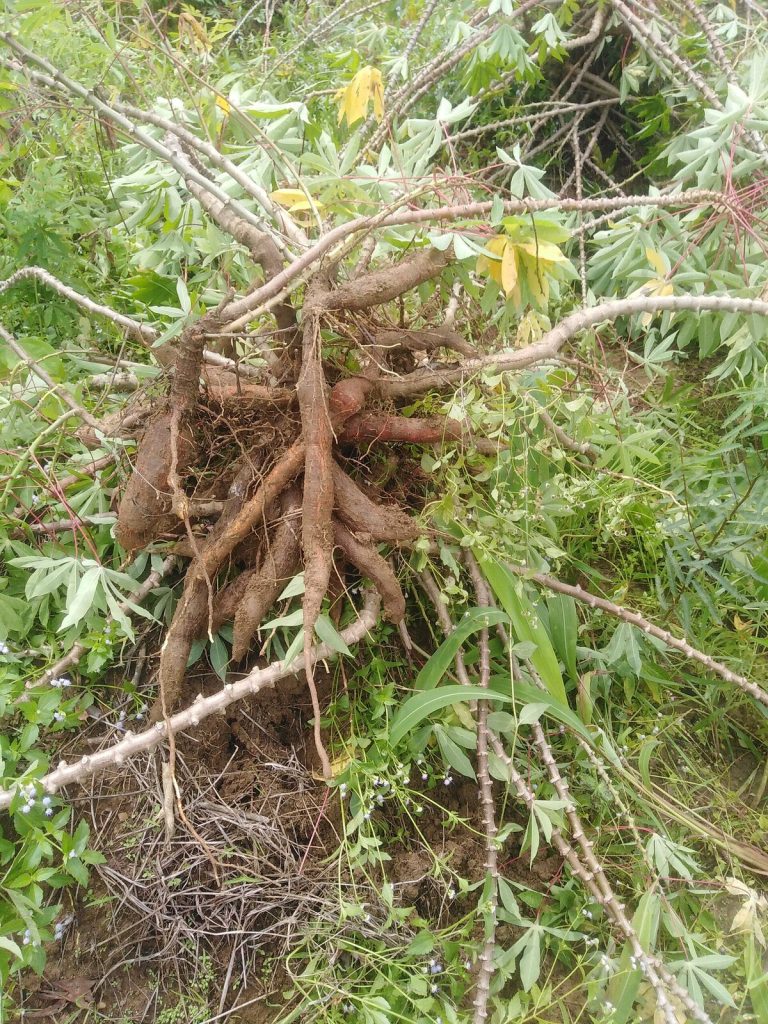
Cassava yield per acre in Uganda is best planned at 3 to 4.5 tonnes of fresh roots, which is where three independent on farm measurements converge. Research stations reach 7 to 10 tonnes an acre with the same varieties. Uganda's official national figure sits closer to 1.3 tonnes an acre, and the reasons it is that low have as much to do with measurement as with farming.
Published cassava yields for Uganda span more than a hundredfold. One countrywide crop cut survey recorded a range of 0.4 to 43.6 tonnes a hectare within Uganda alone. Picking a number out of that spread and printing it is not useful, so this page does the opposite: it lays out every measured figure with the method behind it, then hands you the arithmetic to work out your own.
What Cassava Yield Per Acre Means in Uganda
Before any number, three definitions, because most disagreements between cassava yield figures are definition problems rather than farming ones.
Fresh root weight, not dry. Every figure on this page is fresh storage roots as they come out of the ground. Cassava roots run roughly 36 to 40 percent dry matter in the released Ugandan varieties, so a tonne of fresh roots becomes a little over a third of a tonne of chips or flour. A figure quoted without saying which it is can be out by a factor of nearly three.
Total against marketable. Total root yield is what the plant produced. Marketable yield is what a buyer will take, and brown streak disease drives a wedge between them by rotting the inside of roots that look sound. On a page about tonnes, the marketable figure is the one that pays.
Sole crop against intercrop. Roughly two fifths of Ugandan cassava plots carry a second crop. The national census counted 3.1 million plots under cassava, of which 1.9 million were pure stand, and the average plot ran to 0.28 hectares. A tonnage from a mixed plot is not comparable with a tonnage from a pure one, and the statistics do not reliably tell you which you are reading.
The Measured Cassava Yield Figures, From Lowest to Highest
Here is every Ugandan cassava yield figure I could trace to a named method, with what produced it. One hectare is 2.47 acres, so the second column divided by 2.47 gives the third.
| Source and method | Tonnes a hectare | Tonnes an acre |
|---|---|---|
| National statistic, recent years | 2.0 to 2.3 | 0.8 to 0.9 |
| National census, by region | 3.1 to 3.6 | 1.3 to 1.5 |
| Household survey, two mid west axes | 6.4 to 10.8 | 2.6 to 4.4 |
| Farmer estimate method, on farm | 8.3 to 11.7 | 3.4 to 4.7 |
| Traditional practice, sole crop | 8 to 15 | 3.2 to 6.1 |
| Unfertilised trial plots | 4.2 to 25.7 | 1.7 to 10.4 |
| Multi site variety trial, cohort means | 17.1 to 25.6 | 6.9 to 10.4 |
| District demonstration, by variety | 5.5 to 46.4 | 2.2 to 18.8 |
| Extension brief expectation | 25 to 45 | 10.1 to 18.2 |
Now read the middle of that table, because that is where the answer is. Three of those rows are independent on farm measurements of ordinary Ugandan fields, produced by different people using different methods: a household survey across two supply routes in the mid west, a farmer estimate procedure applied across Ugandan smallholdings, and an extension estimate of what traditional practice returns in a sole crop. They land at 6.4 to 10.8, at 8.3 to 11.7 and at 8 to 15 tonnes a hectare. They overlap at roughly 8 to 11 tonnes a hectare, which is 3.2 to 4.5 tonnes an acre.
Three methods converging is a far stronger basis for a planning figure than any single number in the table, including the ones at the top and the bottom. So plan on 3 to 4.5 tonnes an acre, treat 6 to 10 as what the same varieties do under trial grade management with clean material, and treat anything above that as a claim to be checked.
One caution on the household survey row. The report that produced it states its two district yields as 7.1 and 13.8 tonnes a hectare; recomputing from its own published household means, output divided by acreage, gives 6.4 and 10.8. The difference is what you get from averaging each household's own yield rather than dividing total output by total area, and those two are not the same sum. I have used the recomputed pair, which is the more conservative reading, and mention the published pair so you know both exist.
Why the National Cassava Yield Figure Is Not a Planning Figure
Uganda's reported cassava yield of roughly 2 tonnes a hectare is a real statistic and it should not be your planning number. Four things, taken together, say why.
The neighbours. In the most recent year of the same international dataset, Tanzania reports 6.4 tonnes a hectare, Nigeria 5.8, the Democratic Republic of Congo 8.2, Rwanda 13.9, Kenya 14.7, Malawi 25.5 and Ghana 25.9. Uganda reports 2.0. No account of Ugandan cassava farming explains being seven times below Kenya while sharing a border, a crop and much of a climate.
The figure is not measured. In the dataset's own coding, Uganda's cassava yield carries the flag for an estimate and the area harvested carries the flag for an imputed value. Yield there is production divided by an area that was itself filled in.
The area series does not describe planting. Area harvested reads 852,000 hectares, then 1,628,000, then 966,000, then 758,000 in four consecutive years before settling near a million. Uganda's cassava area did not double and then halve. Whatever that series is tracking, it is not the crop, and the yield figure is its quotient.
The measurement method is documented and fragile. This is the decisive part. Uganda's agricultural census measured cassava from a subplot of 5 metres by 5 metres, and for cassava and banana alone the enumerators were instructed to record only one harvest, which was then extrapolated into an annual yield. Cassava is dug piecemeal over months as a household needs food. A single recorded harvest from 25 square metres, scaled to a hectare, can miss most of the crop.
The Ugandan review that documents that instruction also records two things that follow from it. Crop card production estimates, where farmers log each harvest as it happens, came out 40 to 60 percent below what the same farmers reported from recall, for cassava and banana alike. And one analysis of that dataset produced an average cassava yield of 363 kilogrammes an acre, about 0.9 tonnes a hectare, which the review itself describes as far below the 8.3 to 11.7 tonnes a hectare measured on farm by its own lead author. A researcher publishing the gap between her field result and the national survey instrument is about as clear a warning as this literature offers.
None of that makes the statistic useless. It is the right figure for arguing about national policy and the wrong one for deciding what an acre will give you.
Build Your Own Cassava Yield Per Acre From Two Numbers
Cassava yield per acre is the product of two quantities, and both are things you can count on your own field with a tape measure and a scale. Everything else, variety, fertiliser, weeding, disease, acts through one or the other.
Yield an acre equals the number of plants standing multiplied by the kilogrammes of root per plant. That is the whole model. The table below runs it across the plausible range of each input, in tonnes.
| Plants standing | At 1 kg a plant | At 2.5 kg | At 4 kg |
|---|---|---|---|
| 4,000 | 4.0 tonnes | 10.0 tonnes | 16.0 tonnes |
| 3,000 | 3.0 tonnes | 7.5 tonnes | 12.0 tonnes |
| 2,000 | 2.0 tonnes | 5.0 tonnes | 8.0 tonnes |
| 1,500 | 1.5 tonnes | 3.75 tonnes | 6.0 tonnes |
| 1,000 | 1.0 tonnes | 2.5 tonnes | 4.0 tonnes |
Read what that grid implies. At the recommended population of 4,000 plants an acre and the per plant weights actually recorded in Ugandan trials, an acre should give somewhere between 8 and 16 tonnes. Measured on farm yield is 3 to 4.5. So the whole gap sits in one of two places: plants that are not standing, or plants that are standing and not bulking.
Those two failures have entirely different remedies, and the only way to know which one you have is to go and look.
Plant Population Per Acre and the Stand You Actually Keep
The Ugandan recommendation for a sole cassava crop is one metre by one metre with one cutting per hole. One acre is 4,047 square metres, so that geometry gives about 4,050 stations, and NaCRRI's field brief rounds it to 4,000 plants an acre, expressed as eight bags of 500 cuttings.
Whether 4,000 plants are still standing at harvest is a separate question, and it is the biggest measurement gap on this subject. I could find no Ugandan figure for surviving stand as a share of cuttings planted, which is why the section above asks you to count rather than giving you a number. What the extension guidance does tell you is that losses are expected: NaCRRI's brief instructs gap filling one month after planting, and nobody writes that instruction for a crop that establishes completely.
Four things thin a cassava stand, and all four are decided before or just after planting. Cuttings that had dried out before going in, because they came from the green top of the stem or sat in the sun past ten days. Cuttings from a field older than eighteen months, which sprout badly. Termites and rot taking cuttings underground. And plants pulled out at roguing, which is a deliberate loss you replace rather than absorb. The first two are avoidable at no cost, which makes stand the cheapest part of the yield equation to fix. How to do it is set out in the cassava farming guide.
Doubling up cuttings in one hole does not raise the stand in any useful sense. It puts two plants in the root volume of one and doubles the material bill. Gap filling at one month, when you can see which stations failed, does the same job at a fraction of the cost. For spacings other than a metre square, the working is in the plant population calculator note.
Roots and Kilos Per Plant in Ugandan Cassava Trials
The second half of the equation is what one plant carries, and here there is good Ugandan data from a district variety evaluation across twelve parishes.
Roots per plant ran 7 to 10 across sites, with an overall mean of 8, and 3 to 10 across varieties. Fresh root weight per plant ran 2.42 to 5.78 kilogrammes across sites and 1.95 to 7.1 across varieties, with means near 4. Longest root length ran 42 to 81 centimetres. So a typical Ugandan cassava plant in a research managed field carries about eight roots weighing about four kilogrammes in total, which is around half a kilogramme a root.
The two halves of that weight are fixed at different times. Root count is settled early: swelling starts at three to four months and the tally is complete by about the seventh. Root size then accumulates until you lift the crop. A setback carries a date with it, and the date decides what it costs. A four month setback removes roots that never come back; a ten month setback removes weight, some of which the plant makes up.
Harvest index, the share of total plant weight that ends up as root, ran 0.30 to 0.45 across NARO's release cohorts, and here the older releases did better than the newest. A plant putting more of its growth into stem and leaf and less into root is not necessarily a weaker plant; it is a plant allocating differently, and if you are selling cuttings rather than roots that allocation is in your favour.
Where Cassava Yield Comes From: the Site Beats the Variety
This is the result that should change how anyone reads a cassava yield claim. NARO evaluated 32 varieties spanning eight decades of releases at three Ugandan sites and partitioned the variation in each trait.
Two things follow. First, tonnes an acre is the worst possible basis for a variety ranking, because it is the trait the variety has least hold over, which is the reason the varieties guide declines to rank on it. Second, and more useful, two respectable Ugandan trials can disagree about the same varieties by a factor of two without either being wrong. Take one released variety measured at 41.7 and 46.4 tonnes a hectare over two seasons in a single district, against 17.5 for the release cohort holding that same variety in the national trial. The first figure comes from one place where disease pressure on those varieties was slight and management was close; the second averages three regions, two of them under heavy pressure. That is the 63 percent showing up as an apparent contradiction.
One more result from that trial belongs on a yield page. Regressed against order of release over eight decades, the trend in Ugandan cassava's fresh root yield came out at minus 5 kilogrammes a hectare per year, a slope the authors describe as non substantial. Resistance climbed through the same period. Whatever a released variety buys you, extra tonnes on clean land is not it.
Weeding, Fertilizer and the Yield Gap Per Acre
If the site carries most of the variation and variety carries little, what is left for a grower to move? Two things, and the evidence on both is Ugandan or near enough.
Weeds, in the first two months. The figure to hold onto here is a spread rather than a date. Across nine weeding regimes in one cassava trial, yields differed by 18 to 75 percent according to how long weeds were left standing. That is the widest range any single management decision produced in anything I could find on this crop, and it costs labour rather than cash. The window shuts at roughly sixty days after planting, before the canopy shades the ground. The trial was Zambian, so read the timing as the shape of the problem and the spread as the reason to care; the growing guide sets out the weeding regime itself.
Fertiliser, conditionally, and this is where the arithmetic turns uncomfortable. Take the widest East African measurement of fertiliser on cassava and the striking column is not the treated one. Unfertilised plots across sites and seasons ranged 4.2 to 25.7 tonnes a hectare, a sixfold spread with nothing applied at all. The treatment then shifted yields by anything between minus 0.2 and plus 15.3 tonnes a hectare, and on soils carrying under 10 grammes of organic carbon a kilogramme the shift ran from minus 8.6 to plus 24.4. Fertiliser subtracted tonnes on some fields.
Three things in that dataset tracked the response: soil fertility, rainfall and how well the plot was weeded. Three things did not: the variety planted, the pest and disease pressure, and the age at harvest. Two rainfall thresholds fell out of the same work: response was reduced where total rainfall fell below about 1,500 millimetres, and where rainfall in the first three months after planting fell below about 400 millimetres. On Uganda's national monthly rainfall climatology from the ERA5 reanalysis, planting in March, April, August, September or October puts 440 to 500 millimetres into that first three month window; planting from November through February puts in 223 to 388. The annual total is the more contested number, because two reputable climate datasets disagree about Uganda's annual rainfall by roughly a quarter, so the first three month threshold is the sounder one to plan against and both datasets agree about the seasonal distribution behind it.
The practical reading for yield per acre: on a field with reasonable organic matter, planted at the onset of either rainy season and weeded through the first two months, fertiliser has a measured chance of adding several tonnes an acre. On a depleted field planted into a dry window, the same spend can leave you worse off. A soil test before applying fertilizer and a trial strip on your own field are what separate those two cases, and organic matter through manure, mulch and a legume intercrop does work fertiliser alone does not, as covered in the organic fertilizer guide.
What Harvest Timing Does to Marketable Yield Per Acre
Cassava's reputation as a food reserve rests on leaving it in the ground, and Ugandan extension guidance puts maturity at twelve months with field longevity of two to three years. Where brown streak disease is present, the waiting has a measured price, and it runs in the direction most growers do not expect.
Six varieties were lifted at twelve, sixteen, twenty and twenty four months after planting at two Ugandan sites with different disease pressure. Marketable fresh root yield dropped by 14 to 27 percent over that extra time in the ground, and necrosis scores rose at both sites as it did. Harvest date had no reliable effect on dry matter content, so a later harvest was not compensating with a drier, heavier root.
Total yield and marketable yield part company here. The roots keep growing; a rising share of them is unsaleable. One variety in that trial held its roots almost undamaged out to twenty four months at both sites, which is the finding that matters: in ground storability under disease pressure is a variety trait, so the question is not whether cassava can wait but whether yours can. Cut a few roots open at twelve months and you will know. The disease mechanism behind it is in cassava diseases and pest control.
How Much of Your Cassava Yield Reaches a Buyer
An acre's yield is not what leaves your field, and on this crop the difference is larger than on any Ugandan staple.
Put four tonnes of fresh roots on the ground and a week later somewhere between 1.6 and 2.4 of those tonnes have lost their value. Screening work on Ugandan varieties measured that range, 40 to 60 percent inside seven days, with the remainder going within a further two to five days unless the roots are eaten or processed. The mechanism is internal: dark streaking spreads through the flesh from about the fourth day. No shed fixes it, because nothing is attacking the root. It is the root shutting down.
Two practical consequences for planning. Harvest to a buyer rather than to a calendar, in batches you can move in a day or two, which is one of the reasons piecemeal harvesting is rational rather than backward. And if your market is more than a few hours away, keeping quality is worth more than a tonne of extra yield, which makes it a variety decision taken at planting.
Cassava Yield Per Acre Figures Worth Rejecting
Three claims circulate widely enough that you will meet them, and all three fail a check you can run yourself.
"Cassava yields 10 to 30 tonnes per acre in Uganda." Convert it: 25 to 74 tonnes a hectare. That is above every measured Ugandan figure, including the best single demonstration plot at 46.4 and the best multi site cohort mean at 25.6. The per variety versions circulate too, with one released variety at 18 to 25 tonnes per acre and another at 15 to 18.
Now read those same numbers as tonnes per hectare. Eighteen to 25 and 15 to 18 sit squarely inside NARO's measured multi site range of 17.1 to 25.6 tonnes a hectare, and the local variety figure quoted alongside them, 4 to 5, lands close to the measured 5.5 to 11.9 for a local check in a district trial. The circulating per acre figures are the measured per hectare figures. That looks like a unit relabelling rather than a yield claim, which is an inference rather than something I can prove, and it gives you a test: divide any per acre cassava figure by 2.47 and see whether it suddenly becomes reasonable.
"25 to 45 tonnes a hectare depending on variety." This one is harder to dismiss because it comes from NaCRRI's own extension brief, a Ugandan research source. Audited against NARO's own research, the release cohort means from that eight decade trial across three Ugandan sites run 17.1 to 25.6 tonnes a hectare, and the two most recent released cohorts sit at 17.5 and 18.6. So the brief's floor of 25 is at the trial's ceiling, and its ceiling of 45 is about double the trial's best cohort mean. Against measured on farm yield it is 2 to 5 times higher. Read it as a potential under research conditions rather than as what an acre will give you, and note that a Tier 1 source can carry an inflated planning figure as readily as a blog can.
"Potential of over 50 tonnes a hectare." A global crop potential, quoted in continental literature. It is true of the species and it has no bearing on a Ugandan acre. Its only function on a yield page is to make the gap look like the grower's fault, when the measured gap is mostly stand, weeding, disease and site.
Cassava Yield Per Acre Questions
How many tonnes of cassava can I expect from one acre in Uganda? Plan on 3 to 4.5 tonnes of fresh roots. That band is where three independent on farm measurements converge, a household survey across two mid west supply routes, a farmer estimate procedure applied across Ugandan smallholdings and an extension estimate of traditional sole crop practice. With clean planting material, a full stand, timely weeding and a site that is not depleted, 6 to 10 tonnes an acre is what the same varieties reach under trial grade management. Anything above that is a claim to check.
How many cassava plants fit in one acre? About 4,000 at the Ugandan recommendation of one metre by one metre with one cutting per hole, which NaCRRI expresses as eight bags of 500 cuttings. Buy a margin above that for gap filling in the first month. What matters more than the number you plant is the number still standing at harvest, and that is worth measuring in a ten metre square rather than assuming.
Why is Uganda's national cassava yield so low? Partly farming and substantially measurement. The reported figure of about 2 tonnes a hectare is derived from an imputed area rather than measured, the area series behind it doubles and halves in consecutive years, and the census subplot method recorded only one harvest for cassava and extrapolated it to a year on a crop that is dug piecemeal over months. The Ugandan review documenting that also records crop card estimates coming out 40 to 60 percent below the same farmers' recall. Real yield gaps exist, and they are stand, weeding, disease and soil. The statistic exaggerates them.
What does it cost to produce a kilogramme of cassava in Uganda? The one Ugandan survey that costed a cassava acre line by line came to UGX 320,000, covering ploughing, planting material, planting labour and two weedings, and explicitly excluding harvesting and family labour. That report divides its total by 4.3 tonnes and prints a cost of about 75 shillings a kilogramme. Its own table gives 4.3 tonnes as average output per household from a mean of 1.2 acres, so the per acre figure is about 3.5 tonnes and the cost works out at about 90 shillings a kilogramme, not 75. Both the shilling total and the derived cost are some years old, so treat the structure as the durable part: the two weedings were the largest line at about 37 percent, ploughing about 25 percent, planting material about 22 percent and planting labour about 16 percent. Check current rates against the latest Ugandan farm prices before budgeting.
Is a low input cassava acre the safe option? Not automatically, and the arithmetic is the reason. Cash outlay and cost per kilogramme move in opposite directions as yield falls: spend less and you owe less, but each kilogramme carries more of it. A grower who skips the second weeding saves roughly a fifth of the acre cost and risks a share of the crop that the weeding trials put anywhere from 18 to 75 percent. Cassava's own price behaviour makes this sharper than it looks. In the Ugandan value chain study the grower took about 19 percent of the retail price, and roots not sold on the first day were discounted by up to 93 percent by the third, which means the price offered at the farm gate already carries the trader's spoilage risk. So a low yielding acre sold into a trough can cost more to produce than it returns, which is the same arithmetic that makes the cheapest maize acre in Uganda a loss making one, with maize cost of production running 411 to 647 shillings a kilogramme against a harvest farm gate of 400 to 1,000. The route through this is not to spend more or less on principle but to know your own yield first, which is what the measurement section above is for. The method is in how to calculate a break even point.
Does harvesting later give me more tonnes? More total tonnes, often yes, since roots keep swelling. More saleable tonnes, frequently no. Where brown streak disease is present, the share of roots still fit to sell fell by about 14 to 27 percent between twelve and twenty four months in the ground in a two site Ugandan trial, while dry matter content did not improve. Varieties differ enormously in this, with one in that trial holding its roots almost undamaged to twenty four months. Cut a sample of roots open at twelve months and let what you see decide.
Does intercropping reduce my cassava yield per acre? Per acre of cassava, yes, because you have fewer cassava plants. Per acre of land, often not, because the second crop is also producing. Most Ugandan cassava is intercropped, with only about 61 percent of cassava plots in pure stand, so intercropping is the normal case rather than the exception, and a yield figure quoted for a pure stand does not apply to it. Drop the population of both crops rather than keeping either at its full sole crop rate.
Yield is only half the question and prices move sharply on this crop, so check current Ugandan crop prices before you plan an acre, and look through the supplier listings for clean planting material, which is the input with the largest effect on the stand you keep. Read the companion pages on growing the crop and choosing a variety, and start from the crop growing guides if you are still deciding between cassava and another staple.