
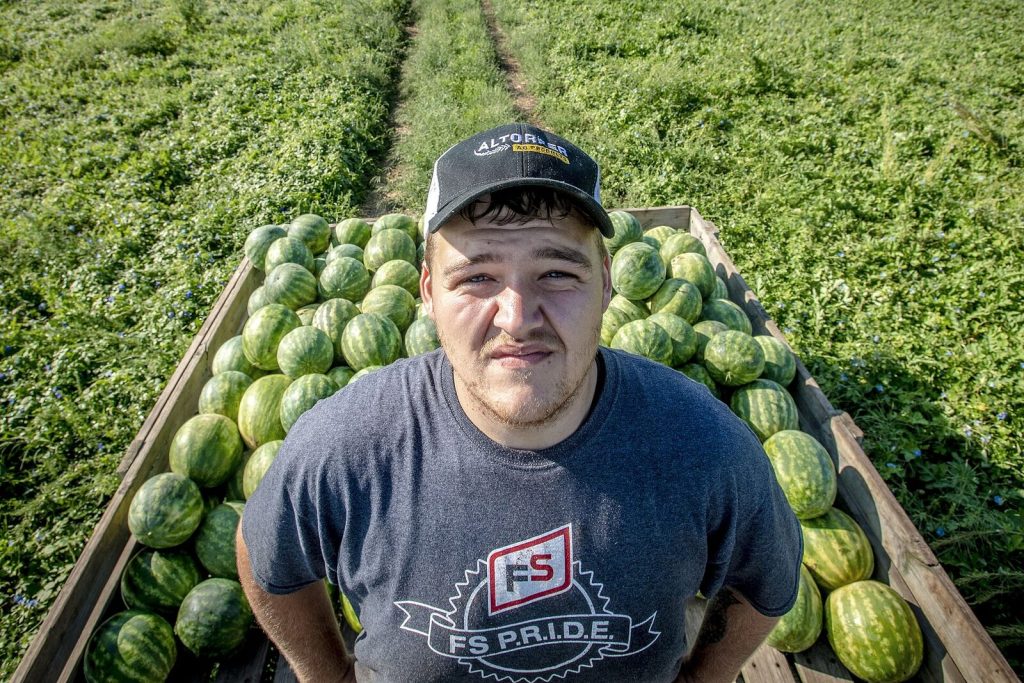
Two thirds of Ugandan watermelon growers in the only published national survey of the crop named pests as their main production constraint, and one insect accounted for most of that. Watermelon farming in Uganda is a pest management problem first and an agronomy problem second. Watermelon is a trailing cucurbit vine grown on the flat for a heavy fruit that reaches maturity in roughly 80 to 120 days.
What Ugandan Watermelon Growers Named as Their Main Constraint
Uganda has one published survey of watermelon production practices, and it is unusually good. Researchers from Makerere University and the national research organisation surveyed 105 fields in 28 districts across nine of Uganda's 11 sub regions, working from a structured questionnaire with agricultural officers identifying the households. Watermelon growers were the minority of that sample, at 14.3 per cent against 85.7 per cent growing pumpkin, which itself tells you how small the crop is.
Asked to rank what limited their crop, watermelon growers put pests first at 66.7 per cent, then diseases and floods level at 13.3 per cent each, then drought at 6.7 per cent. Across both surveyed crops the ranking ran pests, diseases, drought, high transport costs and high labour costs, with low yields, price fluctuation, limited market and poor soils trailing behind.
Note what is not near the top. Not soil fertility, not variety choice, not spacing. The things Ugandan watermelon content spends most of its words on are not the things Ugandan watermelon growers say are costing them the crop.
Where Watermelon Is Actually Grown in Uganda
The same survey is specific about location, and it does not match the district lists in circulation. Watermelon appeared in the Ngenge irrigation scheme in Kween district on the Elgon side, and in Masaka, Mityana and Mukono in the central sub region. Pumpkin turned up in all nine sub regions; watermelon did not.
Where it grows matters because of why it grows there. The survey records watermelon planted in low lying ground close to Lake Victoria in the central sub region, or close to water bodies such as the Ngenge River on the Elgon side, and states the reason growers gave: that low lying land supplies enough moisture and water for irrigation through dry conditions. That siting explains the flood answer sitting level with disease in the constraint ranking. A crop planted for its access to water is a crop planted where water arrives uninvited.
It also creates a second problem the survey names directly. Applying agrochemicals in watermelon fields close to water bodies degrades the water and the low lying habitat around it. A grower choosing a lakeshore plot for the moisture is choosing a plot where a spray decision has consequences beyond the field.
Watermelon was grown as a monoculture, unlike pumpkin, which was almost always intercropped with cassava, maize, banana, sweet potato, coffee or trees. So a watermelon field is a dedicated field, which raises the stakes on every decision taken in it.
Watermelon Varieties Grown in Uganda and Where the Names Come From
Uganda has released no watermelon variety. That was checked rather than assumed. NARO's databank of technologies and publications holds no watermelon entry at all, and the controls show the query itself is sound, because bean returns 40 entries, sweet potato 29 and tomato two. Nor does watermelon appear on the one variety list extract the ministry publishes, which covers roots, tubers and bananas. The survey authors put it plainly themselves: there are no clear production statistics for watermelon in Uganda.
Against that background, two variety names have been recorded on Ugandan farms by research rather than by advertising. The survey found Zebra grown by 86.7 per cent of watermelon farmers and Chairman by the remaining 13.3 per cent. A separate Makerere study of the watermelon trade in six Kampala city markets, covering 90 retailers and 30 wholesalers, independently reports Zebra as the variety being traded. Two studies, one from the field and one from the market, agreeing on the same name.
Ugandan content in circulation names four varieties and attaches countries to them, presenting one as Kenyan, two as Ugandan. None of those attributions can be checked, no Ugandan release exists for any of them to be attributed to, and the two names research actually places here are the two above. Every watermelon variety name available in Uganda comes from a seed company catalogue, which is a legitimate source for the characteristics of that company's seed and never evidence of Ugandan adaptation. Ask the seller which company bred it, and ask whether the pack is a hybrid, because the survey found all watermelon growers in the central and Elgon sub regions buying seed from agro input shops rather than saving it. Our notes on choosing quality seed and hybrid against open pollinated seed cover what else to ask at the counter.
Melon Fly: The Pest in Two Thirds of Ugandan Watermelon Fields
The insect behind that 66.7 per cent answer is melon fly, recorded in 63.2 per cent of the watermelon fields surveyed. Rats and cutworms followed at 10.5 per cent each, with whiteflies and beetles at 5.2 per cent each.
Melon fly repays a close look at how it works rather than at what it is called, because the mechanism dictates what can be done about it. It attacks more than 125 plant species, mostly in the cucurbit family. A female lays over a thousand eggs into young, soft fruit. The maggots develop inside the fruit, out of reach of anything sprayed on the outside. And the puncture the female makes to lay is itself an entry point for fungal and bacterial rots, so a stung fruit often fails twice. Losses of up to a hundred per cent of cucurbit fruit have been recorded.
Ugandan watermelon growers in the survey were using pheromone traps against it, at 16.0 per cent, which is the only pest management method in the survey that was specific to watermelon rather than borrowed from pumpkin. The survey also records the honest limits of the method as growers reported them: the traps did not catch all the adults they attracted, and flies sometimes reached the fruit before reaching the trap. Cultural measures were in use alongside, such as clearing field borders.
Two things follow for a grower. Because the damage happens inside the fruit, a spray programme aimed at adults on the leaf is working on a small part of the problem, which is why field hygiene, removing and destroying stung fruit rather than dropping it in the field, and trapping matter more here than on most vegetables. And because the pest uses more than 125 cucurbit hosts, a watermelon field next to pumpkin, cucumber or a run of volunteer gourds is a field with a resident population. Growers running several cucurbits should read the cucumber farming guide alongside this one.
Bacterial Wilt, Downy Mildew and the Limits of a Photograph
On the disease side the survey recorded bacterial wilt as the most commonly reported watermelon disease at 33.3 per cent, then downy mildew at 20.0 per cent and virus like symptoms at 13.3 per cent. A further 20.0 per cent of watermelon growers could not specify the disease affecting their crop. Across both surveyed cucurbits the list ran bacterial wilt, downy mildew, anthracnose, powdery mildew, virus diseases and gummy stem blight.
Now the caveat, which is as useful as the figures. The survey identified diseases by showing farmers printed colour photographs of cucurbit pests and diseases in the field. That is a sound method for a production constraints survey and a poor basis for buying a product. A name produced that way is a farmer's identification supported by an image, not a laboratory diagnosis, and the survey's own 20 per cent of growers who could name nothing at all shows how hard this identification is in practice. The survey authors separately note that farmers had limited ability to recognise virus symptoms or to connect insect vectors to the diseases they carry.
So the practical instruction is narrow. A wilting watermelon plant, a leaf lesion and a rotting fruit are all symptoms with several possible causes, and the cost of guessing wrong is a product bought against the wrong organism. Take a sample and a photograph to a district agricultural officer. On the field side, the measures that work against several of these at once cost nothing to know: clear out volunteer and old plants so a new crop is not reinfected from the last one, and do not carry a diseased plant across the field by hand.
Spraying a Fruit That Is Eaten Raw
This is the part of Ugandan watermelon production with the best evidence and the least discussion.
The survey found that every watermelon grower in it was using fungicides and bactericides, with copper based products named. It also found that 19.1 per cent of all surveyed farmers were mixing several agrochemicals together in one spray, and that those doing it were mostly the watermelon growers. Alongside that, farmers reported limited or no knowledge of what they were applying, and most drew no distinction between a herbicide, a pesticide, a fungicide and a nutrient booster. The survey's own conclusion is that this raises health concerns from residues on the fruit and on neighbouring crops and field borders.
A separate Makerere study went and looked. Watermelon and green pepper samples bought from stalls at a Kampala market were extracted and analysed by gas chromatography for pyrethroid and organophosphate residues. Pyrethroids dominated: cypermethrin, deltamethrin and lambda cyhalothrin were detected in all three watermelon samples. Organophosphates appeared in two of them. Every residue measured was below its maximum residue limit with one exception: diazinon exceeded its limit for watermelon in two of the three samples, by roughly a third above the limit in both cases.
That was 18 fruit and vegetable samples from a single market, analysed as an undergraduate project, and the author's own recommendation was for continuous monitoring across the country because the evidence base is so thin. It is not a national residue survey. It is the only Ugandan measurement of what actually reaches a watermelon buyer, and it found a limit exceeded.
Hence the rule this page follows. Nothing written here carries a rate, a dilution, an interval or a brand name. Authority sits with the registered label, and with the district agricultural officer who reads that label against the problem actually standing in the field. A watermelon reaches the table raw, with nothing between the flesh and the eater but a rind that gets cut through, so the gap between the last application and the harvest is the entire margin of safety. That mixing finding is the strongest argument there is for reading one label properly instead of combining three, and our pages on agrochemical labels and applying pesticides safely set out the rest.
Watermelon Yield Per Acre: Working the Arithmetic Backwards
Ugandan watermelon content routinely advertises 25 to 40 tonnes an acre. Here is what that figure requires.
A regional seed company's watermelon production guide puts field spacing at rows 2.0 to 2.5 metres apart with 1.0 to 1.2 plants per running metre, which it gives as about 5,000 plants a hectare. Twenty five to forty tonnes an acre converts to roughly 62 to 99 tonnes a hectare. Divide that across 5,000 plants and every single plant in the field has to deliver between about 12 and 20 kilogrammes of marketable fruit, with nothing lost to melon fly, nothing lost to bacterial wilt, nothing split and nothing left unsold.
Now the measured figures. Uganda reports no watermelon production line to the FAO at all, so the comparison has to come from neighbours who do.
| Source | Yield | Basis |
|---|---|---|
| Kenya | 18.0 to 25.9 t/ha | Official |
| Tanzania | 7.5 to 8.1 t/ha | Official and imputed |
| East Africa, cucurbit group | About 11 t/ha | FAO regional mean |
| Promotional claims | 62 to 99 t/ha | Unsourced |
The regional mean of about 11 tonnes a hectare comes from the survey authors' own reading of FAO data for watermelons, pumpkins, squash and gourds together across East Africa, roughly a million tonnes on about a hundred thousand hectares. At 5,000 plants a hectare that is about 2.2 kilogrammes of fruit per plant, and Kenya's official figures work out at roughly 3.6 to 5.2 kilogrammes per plant. The advertised figure asks for three to nine times that.
Even the live content that quotes the high yields undercuts itself. One widely read Ugandan watermelon page states that fruits weigh about 1 to 1.5 kilogrammes and that one plant produces more than three of them. Run its own numbers at 5,000 plants a hectare and you get under 19 tonnes a hectare, about 7.6 tonnes an acre, which is a fifth of what the same body of content advertises elsewhere. The description of the plant and the promise about the harvest are not compatible, and neither figure is sourced.
For a plan, use the officially reported regional range and take your own losses out of it. The same pattern of a promotional figure many times the measured one runs across Ugandan vegetables; our tomato yield per acre page works through the version of it that affects the country's biggest vegetable crop.
Plant Population, Pollination and Irrigation Timing
Three pieces of field practice are worth stating precisely, all from the same regional seed company production guide and attributed as such.
On population, rows 2.0 to 2.5 metres apart with roughly one plant per running metre give about 5,000 plants a hectare. Windbreaks around the crop are described as beneficial. Our plant population calculator converts that to plants per acre against whatever row width your land allows.
On pollination, the guide states that fruit setting improves with three to four beehives placed in the field per hectare. Watermelon carries separate male and female flowers and depends on insects to move pollen between them, which puts it in direct tension with the spray findings above. An insecticide applied across a flowering watermelon field removes the pollinator the fruit set depends on, and poor pollination shows up as misshapen fruit rather than as an obvious failure.
On water, the guide gives an instruction that is the opposite of the instinct. Hold back irrigation from sowing or planting until the first fruit has set, so the roots are driven down to find moisture, then irrigate well through fruit development, and stop irrigating immediately before harvest because water at that point costs fruit quality. Sowing wants warmth: air temperature of at least 25 degrees Celsius for raising transplants, and soil at 20 degrees or above for direct sowing. Transplants go out after three to four weeks at the three to four true leaf stage, hardened off first. Our drip irrigation guide covers the delivery side.
Harvesting and Selling Watermelon at the Farm Gate
Watermelon is cut just short of full maturity and ripens further in transit, taken early in the morning to keep field heat out of the fruit. It should not be held below 10 degrees Celsius, because a watermelon takes chilling injury at cold storage temperatures that suit other produce.
How Ugandan growers sell it is the most useful marketing finding in the survey, and it runs against the advice usually given. Watermelon growers sold at the farm gate, and the survey sets out why that was the rational choice: it saved the grower the time of selling and processing so they could stay on production, and it eliminated the transit losses, bruising, cracking and rotting, that a heavy fruit on a poor road accumulates. The survey names the Mbale to Moroto road that Ngenge scheme growers use as an example of the road quality involved.
The traders who bought at the gate moved the fruit to larger trading centres or took it across the border into Kenya and South Sudan. Uganda's own customs declarations confirm that picture and give it a scale. Declared watermelon exports have run between roughly 3,680 and 5,320 tonnes a year across recent years, worth between about USD 1.08 million and USD 2.06 million. In the most recent year with full destination detail, 3,046 tonnes went to Kenya, 531 tonnes to Rwanda and 175 tonnes to South Sudan. Imports were negligible. Watermelon is one of the few Ugandan vegetables that is a consistent net export, and the buyers are regional rather than European.
Two constraints the survey records alongside the farm gate finding are worth carrying into a plan: high input prices, and no value addition on watermelon at all. A grower who cannot store the fruit and cannot process it is selling into whatever the market is doing on the day it is ready. Our notes on finding produce buyers and negotiating with buyers cover how to hold a better position at the gate, and the vegetable farming hub collects the rest of the section.
Common Questions About Growing Watermelon in Uganda
How long does watermelon take to mature in Uganda?
The Ugandan cucurbit survey puts watermelon and pumpkin at 80 to 120 days to maturity and records that growers in every surveyed sub region were able to plant twice a year. Watermelon growers in the survey planted twice a year unless they were running a rotation. So the crop occupies a plot for about three to four months and the constraint on a second crop is rotation and disease carryover rather than season length.
Is watermelon profitable in Uganda?
The only Ugandan figure available is weak and should be treated as such. An undergraduate survey of 80 watermelon growers in one sub county of Mayuge district reports an average gross margin of 88.94 per cent. A gross margin is revenue less variable costs; it takes out nothing for land, nothing for the grower's own labour, nothing for unsold or rejected fruit and nothing for transit loss, so it is not a profit rate and should never be read as one. It is also hard to reconcile with the national survey finding that pests were the main constraint for two thirds of watermelon growers. Build your own budget from local input quotes and a yield you take from the officially reported regional range rather than from an advertised one.
Which watermelon variety should I plant?
Uganda has released none, so nobody can answer this from a Ugandan trial. Two names have been recorded on Ugandan farms by research: Zebra, grown by 86.7 per cent of watermelon farmers in the national survey, and Chairman by the rest. A separate study of the Kampala market trade reports Zebra as the variety being traded, which is independent corroboration from the other end of the chain. Everything beyond those two names comes from a seed catalogue. Ask which company bred the seed and grow a comparison strip before committing a field.
Do watermelons climb, and do they need support?
No. Watermelon is a trailing vine that runs along the ground, and the production guidance for field crops is rows two metres and more apart on the flat with the vines running between them. Content describing watermelon as a climbing plant that needs to be trained up is confusing it with cucumber, which genuinely does benefit from a trellis. The space a watermelon needs is horizontal.
How do I hand pollinate watermelon if bees are scarce?
Pollen moves from the male flower to the stigma at the centre of the female flower, which is the part that swells into the fruit. Instructions telling you to transfer pollen into the stamen have it backwards, because the stamen is the part the pollen comes from, and a grower following that literally would achieve nothing. Hand work is slow on a crop flowering continuously over weeks, which is why a regional seed guide recommends three to four beehives a hectare instead, and why an insecticide sprayed across a flowering field is expensive in a way that does not show up until the fruit fails to set.
Why do my watermelons rot on the vine?
The likeliest cause in Uganda is melon fly, which was recorded in 63.2 per cent of surveyed watermelon fields. The female lays into young soft fruit, the maggots feed inside, and the entry wound lets fungal and bacterial rots in behind them, so the rot you see may be the second failure rather than the first. Cut an affected fruit open and look for maggots before treating it as a disease. Fruit lying on wet soil in low lying ground is the other common cause, and it is one reason the survey found growers siting the crop for moisture and then losing fruit to floods.
Can I export watermelon from Uganda?
Watermelon already leaves Uganda in quantity, but almost none of it through a formal export company. Declared exports of roughly 3,680 to 5,320 tonnes a year go overwhelmingly to Kenya, with smaller volumes to Rwanda and South Sudan, and the route is traders buying at the farm gate and moving fruit across a land border. Selling into that chain means selling to a trader, not becoming an exporter. Anyone wanting to ship fresh produce formally has to work through a registration system built around a pack house and a traceability system; our agricultural export basics sets out what that involves.
Checking Watermelon Prices and Finding Buyers
Watermelon has no published Ugandan price series, so the price you can get is something only your own market will tell you, and it is worth finding out before the crop is in the ground rather than on the morning it is ready. Ask the traders who already buy at gates near you what they pay, in what quantity, and whether they pay by weight or by the fruit, because that last answer is worth more to your margin than anything you do in the field. Then find a seed supplier who will name the breeder of what is in the pack, and an input dealer close enough to advise on what is registered for a fruit eaten raw. Our produce price pages track what Ugandan produce is fetching, and the supplier directory is where to start on seed and equipment.