
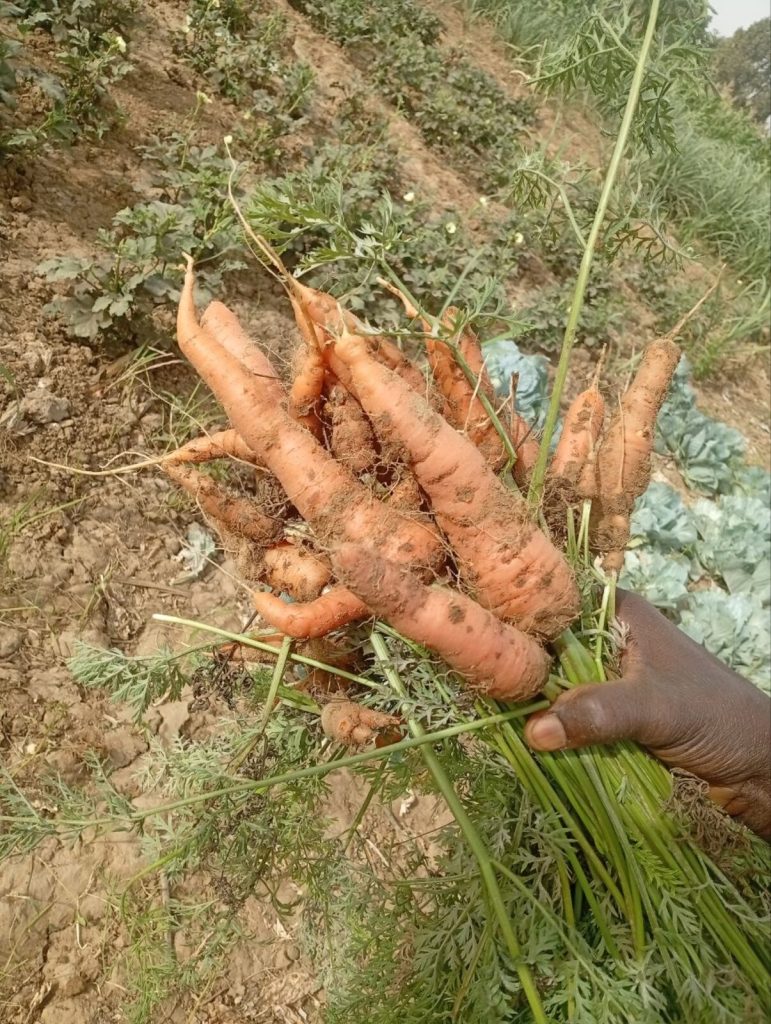
Carrot farming in Uganda works in the cool highlands and struggles almost everywhere else, because carrot root quality is set by temperature rather than by fertilizer. Seed has to be bought fresh every season, since the crop will not produce true seed at this latitude. Carrot is a biennial root vegetable in the Apiaceae family, grown for a taproot that buyers grade on shape, colour and size.
Why Uganda Imports Most of the Carrots on Its Market
Start with the trade figures, because they frame every other decision on this crop. Uganda's own customs declarations to UN Comtrade record imports under the carrots and turnips heading running between roughly 7,400 and 40,600 tonnes a year across recent years, worth between about USD 1.2 million and USD 7.6 million. In the same years Ugandan exports under that heading were negligible, rising above a thousand tonnes only once. Almost the entire import volume arrives from one country: in the most recent year with full detail, 24,357 of 24,390 tonnes came from Kenya.
Now set that against production. Uganda reports no carrot production line at all. The FAO production database carries a separate item for carrots and turnips, and 27 African countries file against it, including Kenya at 92,202 tonnes and Rwanda at 46,412 tonnes, both flagged as official figures. Uganda files nothing. Every carrot grown in the country is folded into a residual category, other vegetables fresh not elsewhere classified, which FAO records at 1,018,386 tonnes on 154,527 hectares and flags as imputed rather than declared.
The reason is not a filing oversight. The Uganda Bureau of Statistics Annual Agricultural Survey states plainly that its crop coverage focuses on 16 major crops, and lists them: bananas, cassava, sweet potatoes, Irish potatoes, maize, sorghum, rice, finger millet, groundnuts, simsim, sunflower, beans, cow peas, pigeon peas, soybeans and coffee. Not one vegetable is on that list. The survey that would produce a Ugandan carrot area or yield figure never asks the question.
Read together, those four lines tell a grower something useful. There is a real domestic market for carrot, large enough to pull in tens of thousands of tonnes across a border, and there is no local research, no local variety and no local statistic to lean on. That combination is the opportunity and the risk in the same sentence.
The Temperature Gate That Decides Carrot Root Quality
Carrot is the vegetable equivalent of the day length trap that catches onion growers. With onion, a variety bred for long summer days grows leaves at this latitude and never forms a bulb. With carrot the gate is temperature, and it acts on quality rather than on whether the crop forms a root at all.
A regional horticulture training manual produced for Ethiopia's agriculture ministry with Japanese technical support, itself revised from an earlier Kenyan edition of the same material, puts the optimum growing temperature for carrot at 15 to 20 degrees Celsius. Below 10 degrees the roots come out longer, more slender and paler. Above the optimum they come out shorter and thicker. The manual states that temperatures above 20 degrees lead to poor quality, and that colour develops poorly whenever temperature sits either side of the band. This is an Ethiopian extension recommendation rather than a Ugandan one, and it is named as such here because no Ugandan equivalent exists.
Uganda's mean annual temperature, from the ERA5 reanalysis over a thirty year reference period, is 23.09 degrees Celsius. That national average sits above the ceiling the manual gives for good quality. It does not condemn the crop, because a national mean is not a field temperature and Uganda's altitude range is wide. It does mean that a grower planning a carrot crop on warm low ground is planning to sell short, thick, pale roots into a market that pays for long, deep orange ones.
Altitude: Where Carrot Growing Can Work in Uganda
The same manual identifies 1,800 to 2,500 metres above sea level as the band that produces high quality carrot in Ethiopia. Uganda has land in that band, and it is not where most horticulture happens.
| Place | Elevation | Against the carrot band |
|---|---|---|
| Kisoro | About 2,014 m | Inside |
| Kabale | About 1,837 m | Inside, at the floor |
| Elgon slopes above Kapchorwa | About 2,405 m | Inside, near the top |
| Kampala | About 1,195 m | Well below |
| Mbale town | About 1,130 m | Well below |
| Soroti | About 1,118 m | Well below |
Those elevations come from a public terrain dataset rather than from a survey beacon, so treat them as the shape of the country rather than as a spot reading for a particular garden. The pattern is what matters. Uganda's southwestern highlands and the upper Elgon slopes sit inside the band. The central belt, the east and the north sit five hundred to nine hundred metres below it, which at ordinary lapse rates is several degrees warmer.
One caution against pushing the altitude argument too hard. The same Ethiopian manual reports Nantes yielding 19.6 tonnes a hectare in highlands above 2,200 metres, 23.2 tonnes at mid altitudes and 21.2 tonnes in lowlands below 1,700 metres, with Chantenay showing a similar flat pattern. Tonnage, on that evidence, is not strongly driven by altitude. Quality is. A lowland carrot crop can bulk up and still fail to grade.
Carrot Seed in Uganda Is Always Bought, Never Saved
Carrot is biennial. It grows a root in the first season and flowers in the second, and that flowering needs a cold period Uganda does not supply. So a grower cannot select and carry forward their own seed the way a bean or a pumpkin grower can, and there is no route to a Ugandan carrot variety through farmer selection either.
Every carrot seed sown in Uganda is bought, and almost all of it is imported. Uganda's customs declarations for the vegetable seed heading show imports of 232,085 kilogrammes valued at USD 10,022,080 in the most recent full year, against exports of 288,651 kilogrammes worth USD 508,100. Uganda ships out more vegetable seed by weight than it brings in, and pays about twenty four times as much per kilogramme for what it buys as it earns on what it sells. That gap is the difference between bulk commodity seed moving across a border and packeted hybrid vegetable seed coming in from a breeder.
Two variety names circulate on Ugandan carrot content, Nantes and Chantenay, and both are genuine carrot types rather than invented names. Neither is a Ugandan release, because no Ugandan release exists. They appear in the Ethiopian manual, where Nantes is described as thinner skinned, sweeter and poorer at storing, and Chantenay as shorter, blunt tipped, longer keeping and better suited to long distance transport. The manual also states that Chantenay suits high altitudes better than lowlands while Nantes suits lower ground, which is the reverse of what most growers assume. Anyone selling seed on a claim about Ugandan adaptation is making a claim no Ugandan trial supports.
The manual carries one more warning that belongs on every Ugandan carrot page. Some carrot seed sold on local markets is not true to type, and off type seed produces bolting, cracking, splitting and short roots. Because carrot identity cannot be checked until the root is lifted, buying from a sealed pack with a legible lot and a supplier who will stand behind it is the only practical safeguard. Our guides on choosing quality seed and on the difference between hybrid and open pollinated seed cover the checks in more detail.
Soil Preparation and the Forked Root Problem
A carrot is sold on its shape, so soil preparation on this crop is not groundwork before the real job. It is the job.
The taproot pushes straight down until something stops it. A stone, a clod, a hard pan or a pocket of undecomposed organic matter each divert the tip, and the root forks. A forked carrot is edible and unsellable. The Ethiopian manual is direct about the cause most growers get wrong: compost causes hairy and forked roots and reduces marketable yield, and a crop grown in humus rich soil puts on excessive foliage and forms forked and hairy carrots. It also records that heavy cracking clay soils were found unsuitable, because they restrict root growth and make lifting and washing difficult.
That advice cuts directly against the instinct to pile manure on a root crop. Fertility for carrot goes in ahead of the crop, worked in and fully broken down, or it goes in as a mineral dressing. Fresh manure on a carrot bed buys leaves and forks.
On acidity, published figures disagree. The same manual gives pH 6.0 to 6.5 in its ecological requirements panel and 6.5 to 7.5 in its land preparation section, with lime applied at least thirty days before planting where the reading is below 6.5. Both numbers are in one document, so the honest instruction is the range that clears both: aim above 6.0 and below 7.5, and get a reading before spending on lime. Our note on soil testing before fertilizer application explains how to get one.
Carrot Spacing and Plant Population Per Acre
There is one Ugandan carrot field experiment I could find, and its result is more interesting than a spacing table.
A Makerere University special project laid out four soil amendments against nine spacing levels in a replicated factorial design. Soil amendment raised plant height, leaf number, root length and root diameter. Spacing raised root length and root diameter. Neither soil amendment nor spacing moved total yield or marketable yield. The combination that performed best, a mineral fertilizer plus an organic amendment at 30 by 10 centimetres, won on root length and root diameter rather than on tonnage. This was an undergraduate project on one site in one season, and it should be read as a single data point rather than a national recommendation.
Taken at face value, it says something a grower can use. Within the range tested, the levers available did not change how many kilogrammes came off the plot. They changed the dimensions of the roots, which is exactly what the market grades on. So the return on careful spacing and careful fertility on carrot shows up in the grade rather than in the weight.
On sowing method, the practical points are consistent across sources. Carrot is sown direct, not transplanted, because moving a seedling bends the taproot. Seed is small and slow, and covering it evenly at one to two and a half centimetres and keeping the surface moist until the stand establishes is the difference between a row and a gap. Mixing seed with dry sand at about one part seed to five parts sand spreads it evenly by hand. Thinning matters and growers dislike doing it, since it feels like throwing away plants; a crowded row produces thin roots nobody buys. Our plant population calculator converts a spacing into plants per acre if you want to price seed against a target stand.
Carrot Pests and Diseases: What Uganda Can and Cannot Confirm
This is where Ugandan carrot content goes badly wrong, and the failure is worth naming because the same pattern turns up on other crops.
Pest lists on Ugandan carrot pages are lifted from temperate sources. Carrot rust fly, aster yellows and parsley worm all appear, presented as Ugandan problems. Carrot rust fly is an insect, not a disease, and pages that head it as a disease send the reader to a fungicide shelf. Aster yellows is a phytoplasma moved by leafhoppers, and its presence on Ugandan carrot has not been established by any source I could reach. Parsley worm is a North American name for a swallowtail caterpillar. None of these is confirmed for Uganda, and none should drive a spending decision here.
What can be said is narrower and more useful. Uganda's only published survey of a vegetable pest complex in this general area covers cucurbits rather than carrot, so it does not transfer. For carrot the honest position is that no Ugandan pest or disease survey exists, that root knot nematode damage on root vegetables is a recognised problem in tropical soils and shows as galled and stunted roots, and that a grower seeing an unfamiliar symptom should take a sample to a district agricultural officer rather than buy a product against a name read online.
On chemicals the house rule holds without exception. You will find no rate, no dilution, no interval and no product name on this page. What the registered label says governs, an extension officer settles it for the local problem, and carrot is often eaten raw, so waiting out the stated interval before lifting is not optional. Handling is covered on our pages about agrochemical labels and about applying pesticides safely.
Carrot Yield Per Acre: What the Region Actually Reports
Because Uganda publishes nothing, the fair comparison is what neighbours officially report.
| Country | Reported yield | Flag |
|---|---|---|
| Kenya | 17.4 to 43.1 t/ha | Official |
| Rwanda | 10.8 to 14.2 t/ha | Official |
| Ethiopia | 3.5 to 4.5 t/ha | Estimated |
| Tanzania | About 2.8 t/ha | Imputed |
Two things stand out. The spread across four neighbours is more than tenfold, so any single figure quoted as the carrot yield is meaningless without the country and the reporting basis attached. And Kenya's series is unstable: its reported production fell from 329,025 tonnes to 97,337 tonnes between two of the years in that range, which is a break in the series rather than a crop failure of that size, so the top of Kenya's yield range should be treated with caution.
The wider gap is the one to plan against. The Ethiopian manual reports varietal yields of 19.6 to 24.1 tonnes a hectare, while Ethiopia's own official national carrot yield is 3.5 to 4.5 tonnes a hectare. Trial plots and national averages differ by roughly five times on the same crop in the same country. That is the same shape as Uganda's tomato problem, where the national figure sits at about 6 tonnes a hectare against yields in the eighties circulating in promotional material. Our page on tomato yield per acre works through that gap in detail.
Harvesting, Washing and Selling Carrots
Carrot is lifted at 90 to 120 days from sowing, or once roots reach usable diameter, and the crop does not wait politely. Left too long, roots crack and split, which is a grading loss rather than a spoilage loss but shows up in the same place.
Handling after lifting decides how much of the crop reaches a buyer. Tops are cut off, because leaves keep drawing water out of the root and a topped carrot holds longer. Roots are washed, since a carrot is bought on colour and colour cannot be seen through soil, and the washing water quality matters on a vegetable eaten raw. Bruises and skin scrapes turn brown, and Nantes types scar more easily than Chantenay types, which is a real argument for growing the blunt tipped keeping type where produce has to travel.
On the market side, the useful instruction is to sell by weight. A price agreed by the basin or the heap is a price the grower did not set, and a record kept in basins cannot be turned into a cost per kilogramme later. Uganda's carrot market is also visibly contestable: the volume coming in from Kenya means a Ugandan grower is competing on freshness, grade and timing rather than on price alone. Growers looking for outlets should read our notes on finding produce buyers and supplying supermarkets, since a washed, graded, uniform carrot is one of the few smallholder vegetables that can meet a supermarket specification.
Carrot also fits into a vegetable rotation rather than standing alone. Growers running it alongside other beds will find the related pages on cabbage farming and onion farming useful, and the wider vegetable farming hub collects the rest.
Common Questions About Carrot Farming in Uganda
How much does it cost to start a carrot garden in Uganda?
No Ugandan carrot budget can be built from published figures, because no Ugandan source publishes a carrot seed rate, a fertilizer recommendation or a farm gate price. What can be said is where the money goes. Seed is the line a grower cannot avoid or substitute, since none can be saved and almost all is imported. Land preparation is heavier than on most vegetables, because forking losses come from clods and stones. Labour for thinning and for washing is a real cost that budgets routinely omit. Build the stack from quotes you collect yourself and check current levels on our produce price pages.
What price do carrots fetch, and how much does it move?
Uganda's national statistics carry no carrot price series, which is itself the answer a planner needs. The two vegetables that do appear in the ministry's monthly market price table give the scale of the risk: round onion prices swing 65.1 per cent across the months of a year and tomato 33.0 per cent, the two most volatile items in that table. A carrot budget built on a single price, whatever the season it came from, is fiction. Price a crop across a band and check what the market is doing when you plant, not when you hope to sell.
Can carrots be grown in Kampala or in the eastern lowlands?
Roots will form. The question is whether they will grade. At about 1,100 to 1,200 metres those areas sit five hundred to nine hundred metres below the 1,800 to 2,500 metre band that Ethiopian extension material identifies for high quality carrot, and warm conditions produce shorter, thicker, paler roots. If you are on low ground, grow a small test strip before committing an acre, and judge it on the shape and colour of the roots rather than on the weight of the harvest.
Should carrots be raised in a nursery and transplanted?
No. Carrot is sown direct where it will grow. Moving a seedling bends or breaks the taproot and produces a forked or stunted root, which is a grading loss on the one part of the plant you are selling. Advice to raise carrots in a seedbed and transplant them is common on Ugandan content and it is wrong for this crop, whatever it may be right about for tomato or cabbage.
Which carrot variety is best for Uganda?
Nobody can answer that from evidence, because Uganda has released no carrot variety and no Ugandan trial has compared the types available here. Nantes and Chantenay are the two real types on the market. An Ethiopian manual describes Nantes as sweeter, thinner skinned and poorer at storing, and Chantenay as shorter, longer keeping and better for transport, and it places Chantenay in higher ground and Nantes in lower. Treat that as another country's extension guidance, ask the seller which type is in the pack, and run your own comparison strip.
Why do carrots come out forked or hairy?
Something interrupted the taproot or the soil was too rich. Stones, clods and hard pans divert the tip. Fresh or partly rotted organic matter in the root zone does the same and also pushes the plant into leaf. Ethiopian extension material states directly that compost causes hairy and forked roots and reduces marketable yield, and that humus rich soil produces excessive foliage with forked and hairy carrots. Put fertility in ahead of the crop, fully broken down, and work the bed deep and fine.
Is there such a thing as Ugandan carrot seed?
Not in any regulated sense. Carrot only flowers after a cold period, so the crop will not set true seed in Uganda and no farmer can carry a line forward. There is no Ugandan carrot release, no Ugandan carrot entry on the ministry's published variety extract and no carrot record in the national research organisation's technology databank. Seed sold locally that is not true to type is a documented cause of bolting, cracking, splitting and short roots, and you cannot detect it until you lift the crop.
Where to Check Carrot Prices and Find Inputs
Because carrot carries no published Ugandan price series and no released variety, the two things worth doing before planting are both external to this page. Check what carrots are actually fetching in the markets you can reach, in the season you plan to harvest, rather than working from any figure written down anywhere. Then find a seed supplier who will tell you which type is in the pack and show you a legible lot number, and an agro input dealer near enough to advise on what is registered for use on a root crop eaten raw. Our price pages track what Ugandan produce is fetching, and the supplier directory is the place to start on inputs. A short comparison strip in your own soil, at your own altitude, will tell you more than any figure published about this crop.