
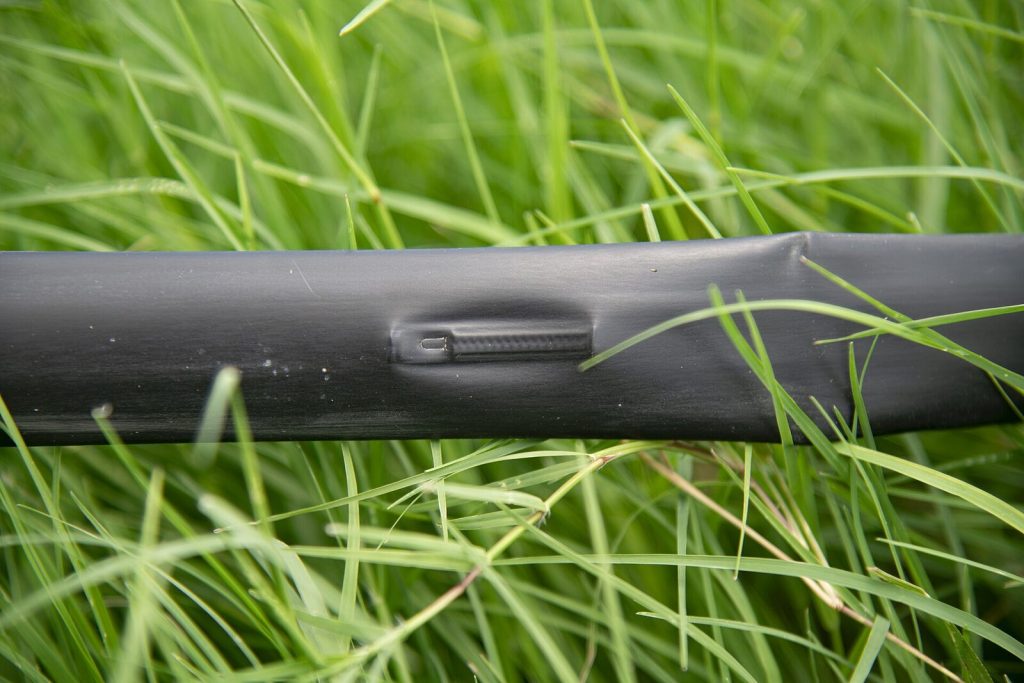
Drip irrigation puts water into the soil slowly, drop by drop, through small openings placed at the base of each plant, so the water reaches the roots and almost nothing is lost anywhere else. Kits range from a few lines on a nursery bed to full field installations. It is the most water efficient irrigation method in common farm use, and the one most likely to fail if the water going into it is not filtered.
That last clause is the part worth reading twice. Everything else about drip is straightforward.
How Drip Irrigation Delivers Water to the Root Zone
Picture a thin plastic tube running along a bed of tomatoes, with a small outlet beside every plant. Water enters the tube under modest pressure and leaves through those outlets, called emitters or drippers, at a trickle rather than a jet. One emitter might release a couple of litres over an hour. A sprinkler would have thrown the same volume across the whole bed in a minute.
What happens underground is the reason this works. Because water arrives slowly, the soil has time to take it in, and it spreads outward and downward from the emitter into a wetted bulb of damp soil roughly centred under the outlet. Roots grow into that bulb and stay there. The soil between the rows stays dry.
Three things follow from that geometry, and they explain nearly every advantage drip has. Water only goes where a root can reach it, so very little is wasted. The leaves never get wet. And the dry strips between rows grow fewer weeds, because a weed seed needs moisture to start.
Slow application also means you can water for hours without runoff or puddling, even on a slope, which is where furrow irrigation struggles. On sandy soils, where water drains away faster than a crop can drink it, short frequent drip cycles hold moisture in the root zone in a way that flooding a furrow never manages.
The Parts of a Drip Irrigation System
A drip system is simpler than it looks, and knowing the parts is how you read a supplier's quote properly.
The head assembly, meaning the filter, regulator, gauge and valves grouped at the start of the system, is where the money should go. Laterals are consumable. A good head protects them.
Why Drip Irrigation Has the Highest Water Use Efficiency
FAO's irrigation training material gives typical field application efficiencies of about 90 percent for drip irrigation, 75 percent for sprinkler and 60 percent for surface methods such as furrow and basin. Those are design figures, and the same source attaches a plain warning: slack management pulls all three numbers down.
The gap comes from where the losses happen. Furrow irrigation loses water sideways past the root zone, downward below it, and off the end of the furrow. Sprinkler loses it to wind drift and to evaporation in the air and off wet leaves. Drip avoids most of both, because the water goes into the soil at the plant and the air never gets a share of it.
| Method | Application efficiency | Main loss |
|---|---|---|
| Drip | about 90% | Drainage below roots |
| Sprinkler | about 75% | Wind and evaporation |
| Surface | about 60% | Runoff and deep seepage |
Read that table as a design ceiling, not a promise. Peer reviewed work on irrigation performance has repeatedly found badly run drip systems delivering no better than gravity irrigation, because a clogged, unflushed, unmonitored drip line is not a 90 percent efficient system by any measure.
The efficiency matters most where water is the binding constraint. If you are lifting every litre off a shallow well with a treadle pump, or paying for fuel to pull it up from a river, then halving the volume you need is the same as halving that cost. Where a farm sits beside a lake with a solar pump, the water saving is worth less and the other drip advantages carry the case instead.
Fertigation: Feeding the Crop Through the Drip Line
Because drip delivers water to a known spot in small measured amounts, you can dissolve fertiliser into it and feed the root zone directly. That is fertigation, and it is one of the strongest arguments for drip on high value vegetables.
The agronomic gain is timing. Broadcasting granular fertiliser puts a crop's whole nutrient supply into the soil in one or two events, where rain can leach it and dry spells can lock it away unavailable. Fertigation splits the same quantity into many small doses, applied to wet soil, exactly where the feeder roots are. Uptake improves and less is lost.
Three cautions, and they matter more than the benefit.
Use fertilisers that dissolve fully. Anything that leaves grit behind will find the emitters, and you have just built a clogging problem into your own irrigation. Second, always flush the lines with clean water at the end of a fertigation run, because fertiliser left standing in a warm pipe feeds bacterial slime. Third, drip concentrates salts at the edge of the wetted bulb, and repeated fertigation without enough water to push those salts past the roots can build up a problem you will not see until the crop stalls.
On rates, take the numbers from the fertiliser product label and confirm them with your local extension officer for your crop, soil and water. Injection rates are product specific and a wrong concentration burns roots. Do not work from a figure you read in an article, this one included. The background on the materials themselves is in NPK fertilizer explained and fertilizer types used in Uganda.
Dry Foliage and Lower Disease Pressure Under Drip Irrigation
Fungal and bacterial leaf diseases need free water on the leaf to get started. Plant pathologists measure this as the leaf wetness period, the length of time a film of water sits on the surface, and the longer it lasts the more likely spores are to germinate and infect. Overhead watering creates exactly that film, right through the dry weeks when the crop would otherwise have had none.
Drip never wets the canopy. In a country where late blight, early blight and bacterial wilt make tomato growing difficult, and where the dry season crop is the valuable one, that is a real reduction in disease pressure rather than a marketing claim. Growers using drip on tomatoes commonly report needing fewer fungicide sprays than they did under a hose or sprinkler.
Two honest qualifications. Drip lowers leaf disease risk, it does not remove it, because dew, rain and splash from the soil all still wet leaves. And soil borne diseases are indifferent to your irrigation method: bacterial wilt travels in soil and water and drip does nothing about it. Powdery mildew is the odd exception that overhead water actually suppresses, since droplets damage the fungus on the leaf surface.
The practical value shows up in your spray programme. Fewer wet leaf hours means fewer protective sprays, less cost, less residue and a shorter list of things that can go wrong in the last three weeks before harvest. The detail for tomatoes sits in the tomato spraying schedule and tomato diseases and their treatment.
Emitter Clogging: What Actually Kills Drip Irrigation Systems
Here is the section most drip articles turn into a footnote. Clogged emitters are the single most common reason a Ugandan drip installation stops working, and the damage is usually done in the first season with unfiltered water from a river, pond or open tank.
The failure is nasty because it is invisible and uneven. An emitter does not announce that it is blocked. Half your line keeps running while a scattered third of it delivers nothing, the plants on those spots wilt, and by the time the pattern is obvious the crop has already lost growth. Worse, you cannot see into the tube, so a farmer often blames the pump, the fertiliser or the seed.
Irrigation research sorts the causes into three classes, and the class tells you what to do about it.
Which one you get depends on your water source, and that is the useful diagnostic. Surface water from streams, rivers, ponds and open tanks carries the heavier physical and biological load: sand, silt, algae, organic matter. Groundwater from a borehole is usually clear but carries more dissolved mineral content, so its risk is chemical precipitation instead. A farmer switching from a river to a borehole has not escaped clogging, only changed which kind to plan for.
Open surface tanks deserve a specific warning. A tank sitting in Ugandan sun with no lid grows algae quickly, and an algal bloom in a header tank will block a drip system faster than the river it was filled from. Cover the tank.
Filtration and Flushing: the Maintenance Drip Farming Demands
Filtration on a drip system is not an accessory. It is the component that determines whether you own an irrigation system or a field of plastic tube.
Emitter openings are small, and manufacturers commonly ask for particles from roughly 75 microns upward to be removed. The working rule used in irrigation extension is stricter: filter out particles about four times smaller than the emitter's own passage, because particles that individually fit through will otherwise group and bridge across the opening and block it anyway. The exact rating your system needs is on the emitter specification sheet, and the supplier should be able to show it to you.
Filter type follows the water. Screen and disc filters handle sand and grit from a clean borehole or a settled tank. Water carrying organic load, algae or fine silt needs a sand media filter, sometimes with a settling pond or tank ahead of it so the heaviest material drops out before the filter ever sees it. A settling tank is the cheapest filtration upgrade on most Ugandan farms and it is usually just a matter of letting water stand.
A blocked emitter can sometimes be recovered by flushing at higher pressure, and chemical treatments exist for scale and slime. Both work better as prevention than as rescue, and acid or chlorine treatment is something to do on advice rather than by guesswork, since the wrong concentration damages the pipe and anything downstream of it.
Pressure for Drip Irrigation: Pump or Raised Tank
Drip will not run on nothing. Water has to be pushed through the laterals with enough pressure to reach the far end and to make every emitter along the way discharge at roughly the same rate. Too little pressure and the emitters nearest the inlet water the crop while the far end of the bed stays dry.
Required pressure depends on the emitter you buy, and this is where the numbers in circulation diverge, so treat any single figure with suspicion. Standard emitters are typically designed around the region of one bar. Pressure compensating emitters, which hold a steady discharge across a range of pressures and are worth having on sloping ground or long runs, usually want more. Purpose made low pressure lines run on a fraction of it. The rated operating pressure is printed on the product specification and that sheet is the only authority worth trusting.
Two ways to create it. A pump, which gives you pressure on demand and costs fuel or electricity or a solar array to run, covered in solar water pumps for farms and petrol against diesel water pumps. Or height, which costs nothing to run at all.
Gravity Fed Drip Irrigation From a Raised Tank
The physics here is worth learning because it saves real money. A column of water about 10 metres high produces roughly one bar of pressure, so every metre of tank height above your beds gives you in the region of 0.1 bar. Raise a tank two metres and you have about 0.2 bar at the bed, less whatever friction the pipes take out.
That is not enough for standard emitters, and it is plenty for drip lines made for low pressure. This is the arrangement that makes drip genuinely reachable for a Ugandan smallholder: a tank on a stand or a bank, filled by hand, by treadle pump, by a small pump running for an hour, or by roof runoff, feeding low pressure drip lines on a vegetable plot. No fuel, no engine, no electricity bill, and the water efficiency of drip on a plot you could not otherwise afford to irrigate.
Practical points that decide whether it works. Match the line to the head you can actually build, by telling the supplier your tank height and asking for laterals rated for it rather than accepting whatever is in stock. Keep the runs short, since friction eats a low pressure budget quickly and long laterals water unevenly. Build the stand properly, because a full tank is heavy and a collapse at height is dangerous. Cover the tank against algae. And fit the filter even here, because gravity does nothing about silt. Tank sizing is covered in farm water storage tanks, and filling it from the roof in rainwater harvesting for farms.
One limitation to be straight about. A gravity system's capacity is set by the tank, so the area you can water in a day is limited by how much water you can get up there. It scales badly. That is a reason to start with it, not a reason to avoid it.
Crops and Spacing That Suit Drip Irrigation in Uganda
Drip fits crops grown in rows with space between plants, because every emitter costs money and a wetted bulb serves a plant rather than a patch of ground.
Vegetables are the natural fit: tomato at spacings around 60 cm by 60 cm, green pepper, cabbage, eggplant, watermelon and cucumber. One lateral runs down each bed and the emitter spacing is chosen to match the plant spacing, so a bed planted at 30 cm by 60 cm takes a tape with emitters every 30 cm while a wider spacing takes a wider emitter interval. Get this pairing right at the quoting stage, because drip tape comes in fixed emitter spacings and the wrong one either wastes water between plants or leaves plants short.
Tree and vine crops work well with individual emitters punched into a lateral, with two or more emitters placed around each plant as it matures. Bananas, passion fruit on a trellis, young coffee and citrus all irrigate this way, and the relevant detail for layout is in passion fruit trellising and avocado spacing per acre.
Soil changes how you run it, not whether you can. Sandy soils spread water narrowly and drain fast, so they want shorter, more frequent applications and closer emitter spacing. Clay soils spread wider and hold longer, so they take fewer, longer runs. Watching where the wet patch actually forms on your own soil, by digging beside an emitter after a run, tells you more than any table.
Where Drip Irrigation Is the Wrong Choice
Drip is not the answer to every irrigation question, and pretending otherwise wastes farmers' money.
Broadcast and densely planted crops defeat it. Maize, beans, rice, pasture and grain crops planted thickly or scattered have no row geometry for an emitter to serve, and putting enough emitters in to wet the whole surface removes the cost advantage. Those crops belong under sprinkler or surface irrigation.
Water you cannot filter economically is the second disqualifier. Very silty river water, water carrying heavy organic load, or a source you cannot let settle first will keep destroying emitters no matter how disciplined you are. Sprinkler nozzles tolerate dirtier water than drip emitters do, and that is sometimes the deciding factor.
Very small or irregular plots can also make drip awkward, since the head assembly is a fixed cost regardless of area, and an awkward patch wastes lateral. And where the crop needs its canopy cooled or washed, overhead water is doing a job drip cannot.
The full comparison, crop by crop, is in drip against sprinkler irrigation, and the wider Ugandan context sits in irrigation farming in Uganda.
Frequently Asked Questions About Drip Irrigation
Can drip irrigation work without a pump? Yes, from a raised tank, provided the laterals are rated for low pressure. Roughly 0.1 bar of pressure comes from each metre of tank height, so a tank a couple of metres above the beds gives about 0.2 bar, enough for drip lines made for that range and not enough for standard emitters. Tell your supplier the height you can build and ask for lines rated to suit it. Keep the runs short and still fit a filter.
My emitters have blocked. Can I save the system? Sometimes. Start by flushing the laterals hard through the open end valves and cleaning the filter, which recovers a system blocked by loose silt. Scale and slime need chemical treatment, and the concentration matters enough that it is worth asking an irrigation supplier or extension officer rather than improvising, since too strong a dose damages the pipe. What will not work is ignoring it and watering longer. Deal with the cause, which is almost always the filtration, or you will be doing this again next season.
Is my water clean enough for drip irrigation? Test it rather than guess. Surface water from a river, pond or open tank carries silt, sand and algae and needs real filtration plus somewhere for the heavy material to settle out first. Borehole water is usually clear but may carry enough dissolved mineral content to precipitate inside the emitters. Either can be used with the right filter; the mistake is assuming clear water is safe water, or that muddy water is hopeless.
How much does a drip irrigation system cost in Uganda? It depends on the area, the emitter spacing, the water source, the filtration the water demands and whether a pump is needed, so a single figure would mislead you. Ugandan irrigation equipment has been costing 30 to 50 percent more than the same kit in Kenya because of low sales volumes, import duties and freight, and the figure moves with the shilling. Price the head assembly and the laterals as two separate things when you compare offers, using the irrigation system cost per acre guide for the component list. Laterals are consumable and the head is the part you are really buying.
Does drip pay on a small plot? It can, and the crop decides rather than the acreage. Where you are growing something valuable and timing it into a market that is short of supply, even a few beds of pepper or tomato under drip will carry the hardware. Where the crop is a staple worth little against the water it drinks, no plot size rescues the arithmetic. The other way drip fails to pay is being bought before there is a buyer.
Can I use drip on maize? Technically yes and usually not worth it. Maize is planted too densely for emitter spacing to serve individual plants economically, and the value of the crop per litre of water is low. If you want to protect maize through a dry spell inside the rains, sprinkler or furrow irrigation does the job at less outlay.
How long should I run a drip system for? Long enough to refill the root zone and no longer, which varies with crop stage, soil and weather rather than following a fixed clock. Dig beside an emitter after a run and look at how deep the wet soil goes. If it is wet well below the roots you are running too long and losing water downward; if the wet zone is shallow, run longer. Work out the volume your crop needs with the irrigation water requirement method and use the digging test to check yourself.
Two things are worth insisting on before you pay for a drip system. First, that the filter grade and the emitter's rated pressure are written into the quotation rather than promised in conversation, because those two figures are what you will need years later when something stops working. Second, that the emitter spacing on the tape matches the plant spacing you actually intend to use, since tape comes in fixed intervals and a mismatch is not adjustable afterwards. Confirm prices near the point of purchase, and the hub of irrigation, greenhouses and water guides covers the pump, tank and water source sitting behind the drip lines.