
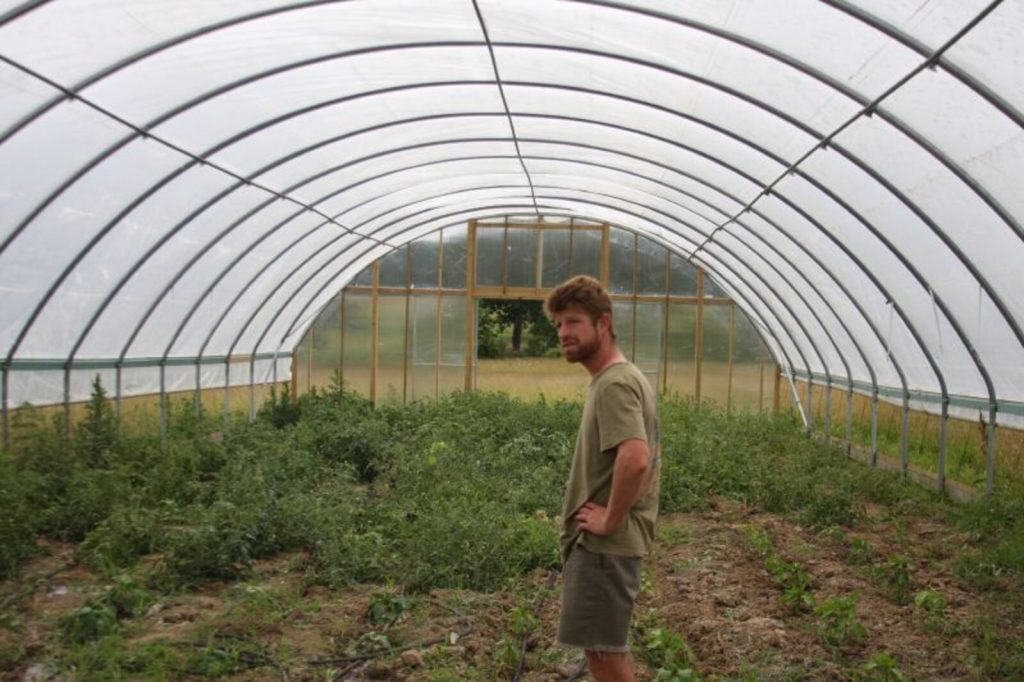
Greenhouse cost in Uganda is set by three things: the floor size, whether the frame is timber or galvanised steel, and how much of the site work and labour you supply yourself. Suppliers here quote an installed package rather than a list of parts, in published bands set out below. What those bands leave out is irrigation, water storage and the crop inputs.
Start with the honest problem. Ugandan published figures for the same nominal size differ by a factor of three to ten, and none of the sources tells you why.
That is not sloppiness on their part so much as a word doing too much work. "Greenhouse" covers a poled polythene shelter a village artisan can build and a galvanised vented commercial house with roll up sides and a drip system, and the two are barely the same product. Some quoted figures include installation and site works, others do not. Some are simply old.
So this page does something different from a price list. It shows you where the quote boundary falls, what each component is worth relative to the whole, and how often you buy it again, so you can read any quote you are handed and tell what is missing from it.
What a Greenhouse Quote in Uganda Covers and What It Leaves Out
Regional fabricators supplying Uganda quote a fairly consistent package: the frame, 200 micron UV treated polythene for the roof and gables, insect netting for the vents, the doors, the locking profile and wiggle wire that hold the film on, and installation. Some include a production guideline and a training visit.
What the client is asked to supply is equally consistent, and it is the part that surprises people. Sand, aggregate and water for the footings. The water connection to the house. Unskilled labour. Transport of the materials to site. None of that is small on a farm an hour off a tarmac road.
| Item | In the quote | Replaced |
|---|---|---|
| Frame | Yes | Rarely |
| Polythene cover | Yes | 2 to 4 years |
| Insect netting | Yes | As it tears |
| Profile, wiggle wire | Yes | Rarely |
| Doors, entry porch | Ask | Rarely |
| Roof vent | Ask | Rarely |
| Installation labour | Usually | Once |
| Sand, aggregate, water | No | Once |
| Transport to site | Often no | Once |
| Drip irrigation | Priced apart | Several years |
| Water storage | No | Rarely |
| Crop inputs | No | Every cycle |
Two rows in that table do most of the damage to a first budget. The doors and the roof vent are marked "ask" because cheaper packages quietly omit a proper entry porch and quote a house with side vents only, and both omissions cost you a crop rather than money. The last four rows are where the overspend lives.
Greenhouse Cost by Frame and Covering Type in Uganda
Ugandan suppliers publish by frame and covering type rather than by exact dimension, which is a fair reflection of how quoting actually works. These are the bands they publish.
| Structure type | Common floor area | Published UGX band |
|---|---|---|
| Timber frame, polythene | 120 to 240 sq m | 4 to 9 million |
| Metal frame, polythene | 120 to 300 sq m | 4.5 to 15 million |
| Commercial metal spec | 240 sq m and up | 20 to 35 million |
| Net house, no film | 120 to 240 sq m | About a third less |
| Above 480 sq m | Any | Priced per sq m |
Read those as bands, not prices. The timber and metal frame bands come from a Ugandan supplier publishing across its whole size range, so the bottom of each band is the smallest house it builds and the top is the largest, which is why the two bands overlap. The commercial specification band comes from a Ugandan agricultural publication describing a modern house of about 8 m by 30 m with installation included, and it sits far above the general metal band because it is a different class of structure with roll up sides, a proper roof vent and a drip system fitted.
The net house figure is a ratio rather than a Ugandan price: regional suppliers put a net covered house at roughly a third less than the equivalent polythene one. It is cheaper and cooler and it does not exclude rain, so it is the wrong structure for wet season tomato no matter what it saves.
At 480 square metres and above, Ugandan published bands run out. Fabricators switch to a rate per square metre and customise, which is worth knowing because it means the per square metre cost of a large house is usually lower than a small one and asking for a rate is a reasonable opening question.
Why Greenhouse Cost Per Size Scatters So Widely in Uganda
If you search for a figure for one size you will find several, and they will not agree. Worth knowing what you are looking at.
None of that is resolvable by finding a better number online. It is resolved by sending one written specification to several suppliers, which the comparison section below sets out.
Greenhouse Frame Cost: Timber Against Galvanised Steel
The frame is the largest single item in any quote and the whole gap between the timber band and the metal band above. It is also the decision most often made on the wrong basis, because the cheap option is cheap once and the expensive option is expensive once.
Timber, usually treated eucalyptus, is the way in for most Ugandan first houses. Locally available, repairable without a specialist, and the frame can be put up by a competent local team. What decides whether it is genuinely cheap is the treatment, not the price of the poles. Ugandan field evidence on treated eucalyptus poles in electricity distribution service, the same species and the same treatment plants, puts the average service life at about ten years, with fungal decay and termite damage causing 85.3 per cent of failures in poles treated with copper chrome arsenate and 67 per cent in creosote treated poles. Regional comparison puts untreated timber in ground contact at roughly two years.
That is the real cost calculation on a timber frame. Properly treated poles give you most of a decade. Poles treated with a brush and a tin give you two seasons, and the difference does not show on the quote.
Galvanised steel costs considerably more up front, arrives as a cut and drilled kit and bolts together rather than welding, which is why there is a second hand market in it at all, and why a steel frame retains value in a way poles never do. Painted steel sits between the two on price and is the option to think hardest about, because the paint is the only barrier, it gets scratched during erection and at every clamp, and repainting a frame with a mature crop trellised to it is not realistic.
A mixed build, steel uprights set in concrete with timber members above ground, puts the money where the rot is. Few suppliers offer it, so you have to ask. The build detail is in our greenhouse construction guide.
Covering Cost: the Polythene You Buy Again Every Few Years
Almost everyone assumes the cover is the expensive part. It is not, and correcting that assumption changes how a budget is built.
Film is sold by the square metre. A house of 120 square metres of floor needs roughly 160 to 200 square metres of sheet once the roof and both gable ends are allowed for, since the sides are netting rather than film. At the rates regional suppliers publish for 200 micron UV treated film, that quantity comes to well under a tenth of what the same supplier charges for the whole installed structure. The frame, the fittings and the labour carry the rest.
The catch is the interval. A frame is capital; a film is stock. Warranties from regional suppliers run to about three years, and independent ageing work on stabilised films puts real service life in the two to four year band, with Uganda's altitude and equatorial sun pushing towards the lower end of it. Which means the cover is not a purchase at all. It is a standing obligation.
Carry it in the budget on that footing, at a small share of the original structure price, falling due sooner than anyone expects. Growers who provisioned for it re cover on schedule. Growers who did not squeeze one more season out of a clouded brittle sheet, lose light, let water back onto the leaves, and then blame the seed.
Two upgrades pay for themselves on arithmetic alone. Thicker film with a stated warranty period costs a little more than the cheapest sheet on the shelf, and that gap is smaller than one extra re cover, so across a decade the cheap option is the expensive one. An anti drip grade costs slightly more again and protects the crop the whole structure exists to protect; what condensation actually does to a crop is explained in our greenhouse construction guide.
Insect Netting, Profiles and Fittings in the Build Cost
These items are individually minor and collectively a real share of the quote, and they are where a cheap package is cheap.
Insect netting covers the side vents and the gable openings. Mesh grade is the whole of it. A net around 40 mesh keeps out the small flying pests that trouble tomato here; a coarser net costs less and admits them. Buying the cheaper net makes every other line on the quote work less well, which is a poor way to save.
Leave out the fixing system and a cheap quote turns expensive. Film held by battens and nails rather than a channel and spring wire is a saving measured in small change, set against a cover that can go whole in one storm; the construction guide explains why the two behave so differently. The ground level skirt and the flat strapping over the film are both minor lines, and both are among the first items a thin quote drops.
Internal fittings are where packages diverge most. Crop support wire and the twine running to it are included by some suppliers and left out by others, so ask which, in writing. A house full of indeterminate plants with nothing overhead to carry them stops working in month three, and retrofitting support around a standing crop is both awkward and expensive.
Labour, Installation and Transport Cost on a Ugandan Build
Most quotes include the installation team and exclude everything that gets them and the materials to you. Assume both are yours to price until a quote says otherwise in writing.
Transport is the item that varies most with where you farm. Steel tube comes in long lengths, film comes on heavy rolls, and poles are bulky. A house going up near a district town and the same house going up at the end of a seasonal road are not the same cost, and the gap is not in any published band. Get transport quoted as a separate line so you can see it.
Unskilled labour is normally the farmer's contribution: clearing and levelling the footprint, digging footings, mixing and placing concrete, digging drainage trenches, and the bed trenching and manure work inside. Price that locally at whatever a day of casual farm labour costs in your area and count the days honestly, because it is several days of work for a team rather than an afternoon. Our note on how to calculate farm labour costs covers the method.
Skilled work, meaning the frame erection and the film fitting, is where paying the supplier's team is usually the right call even when it looks expensive. A frame erected out of square never seats the film cleanly, and a badly fitted cover is a failure you live with for years.
Site Works Cost: Levelling, Footings and Drainage
Site works sit outside almost every quote and nobody publishes a figure for them, so this is an item you have to price yourself. What it consists of is at least predictable.
Clearing and levelling comes first, and what it costs depends entirely on what is growing there now and how much fall the ground already has. Footings follow. Here you are buying cement and hauling sand and aggregate, and the quantity is set by how many uprights the design carries, a number any supplier can give you before you commit. The mix and the depth belong to the build rather than to the budget, and the construction guide carries both.
Drainage gets skipped more reliably than anything else here, because it buys you nothing you can see. It amounts to a trench down both long sides, dug by hand or hired out, and it belongs to you rather than to the installer. Price it as days of labour instead of as a material, and price it before the first heavy afternoon teaches you why it was on the list.
Last, access. Poles, tube and film rolls arrive on a vehicle and the harvest leaves the same way, several times a week for months. If the track in needs work, that is a build cost too.
What Sits Outside the Structure Cost: Irrigation and Water Storage
This is the section most first budgets are missing, and the reason so many Ugandan houses stand empty.
A greenhouse crop receives no rain. Every litre arrives through a pipe, daily, through the dry season, for a cycle that runs eight months or more. Drip is the method inside a greenhouse, because overhead watering puts water back on the foliage and undoes the rain exclusion you just paid for. Regional suppliers quote a basic drip kit for a small house separately from the structure, at roughly a tenth to a fifth of the structure price, and a better kit with filtration and fertigation costs more than that. The components and layout are covered in greenhouse irrigation systems, and broader system costing in irrigation system cost per acre.
Storage is the item behind that. A drip line is only as reliable as what feeds it, and mains or borehole supply that fails for three days in January will cost you flowers you cannot recover. Tank capacity, a stand, pipework and possibly a pump all belong in the structure budget although no supplier puts them in the quote. Sizing and options are in farm water storage tanks.
Underbudgeting these two lines is measurable. Kenyan researchers who interviewed 138 greenhouse farmers put high input costs behind 17.2 per cent of reported constraints and water behind 23.1 per cent, second only to pests, and close to half the structures they visited had stopped producing altogether. Neither line appears on a supplier quote. That is exactly the trap.
Crop Inputs Before the First Greenhouse Harvest
The structure is finished and nothing has been planted yet. Between here and the first picking sits another set of costs, all of which fall due before any money comes back in.
Seed for a house is a small quantity of a hybrid variety, bought by the packet rather than the kilogramme, and it is the wrong place to economise. Then seedling raising trays and media, or bought seedlings. Then manure and ash for the bed trenches, which is a bulky purchase and a haulage job. A soil test before you set the fertiliser programme, since the whole point of an enclosed intensive crop is feeding it properly; our page on soil testing before fertilizer application explains what to ask for. Then fertiliser through the cycle, crop protection products, twine and clips for trellising, and harvest crates.
Add the labour to run it. A greenhouse crop is pruned, trained, watered and picked on a schedule for months, which is a standing labour cost rather than a seasonal peak.
For what the same inputs cost on a field crop, which is the closest published comparison available in Uganda, see cost of tomato farming per acre. For the running cost of the greenhouse enterprise across a full cycle, and the payback question this page deliberately does not answer, go to the cost of greenhouse farming.
How to Compare Two Greenhouse Quotes
Two quotes for "an 8 by 15 greenhouse" can differ by a factor of two and both be honest, because they describe different structures. The fix is to stop asking for a price and start asking for a price against a specification you wrote.
Ask for it in writing and dated. A number given over the phone is not a quote, and both steel and polythene track the import market, so a figure quoted some weeks back may already have moved.
Second Hand and Self Build Greenhouse Savings
Both routes save real money and both have a specific trap.
A used galvanised frame is a reasonable buy, because a bolted and clamped structure was built to come apart and steel that has not rusted is as good as it was. Inspect the tube at ground level where it met the concrete, check that the clamps and bolts are present rather than improvised, and count the members against the supplier's parts list for that size before agreeing anything. Assume the film and the netting are finished regardless of how they look and price a full re cover into the offer, which is where the saving usually disappears if you forget it. A used timber frame is rarely worth moving, since the poles have already spent their life in the ground.
Self building saves the installation charge and lets you put the difference into a taller frame or thicker film, which is a better trade than it sounds. Clearing, footings and a timber frame are all within reach of a competent local team. Where self builders hand the saving back is the cover fixing and the vent sizing, both treated properly in the construction guide. Buy the channel and spring wire system rather than nailing film through battens, and specify vents larger than look necessary.
One route that is not a saving: shrinking the structure to fit the budget. A house too short to vent properly, or too small to carry the labour and water infrastructure it still needs, costs the same to run and returns less. The greenhouse size guide sets out where that line sits.
Frequently Asked Questions About Greenhouse Cost in Uganda
Why do Ugandan greenhouse prices online vary so much for the same size? Because "greenhouse" is being used for several different products. A poled polythene shelter with fixed sides, a timber framed vented house, and a galvanised commercial house with roll up sides and a drip system all appear under the word, and some quoted figures include installation and site works while others are for a supplied kit. Older articles also quote figures that have not survived the imported cost of steel and polythene. Compare specifications, not prices.
How do I tell a real greenhouse from a polythene shelter in a quote? Look for four things the shelter will not have: a roof vent on top of the side vents, insect netting of a stated mesh grade on those vents, a profile and wiggle wire fixing system rather than film nailed through battens, and a two door entry porch. A poled structure with fixed sides, plain film and one doorway is a rain shelter. It has its uses, and it is not what a vented commercial house does.
Does a bigger greenhouse cost less per square metre? Usually yes, and above roughly 480 square metres fabricators price by the square metre rather than from a size list, so it is a fair question to ask. What does not fall with scale is the water, the labour and the buyer. A larger house that you cannot irrigate or pick on schedule is a more expensive way to lose a crop.
Can I trust a supplier's returns table? Read it as a sales document, not as evidence. Yield figures circulating for East African greenhouses are badly inflated, with some tables implying output above what fully climate controlled glasshouses achieve, and returns tables usually assume an uninterrupted harvest across the whole cycle with a good price for all of it. Ask what house the figures were measured in, over what period, and by whom. Enterprise economics and payback are handled on the cost of greenhouse farming.
Should I buy a kit and install it myself? The saving is the installation charge, and on a timber house with local labour it is worth having. Weigh it against two things. A first cover fitted by a beginner rarely seats as cleanly as one fitted by a team that does it weekly, and a poor cover is a fault you live with for years rather than a day. And distance cuts both ways: if an installation crew has to travel far to reach you, their charge rises and self building looks better. Fabricating your own steel frame saves very little, since kits arrive cut and drilled.
Which parts of the specification should I never downgrade? Pole treatment, film thickness and its UV warranty, net mesh grade, vent area, and the entry porch. All five are small lines on a quote and all five are among the documented reasons houses stop producing. The frame material is the honest place to trim, since a properly treated timber frame in Ugandan ground has given about a decade in comparable service. Shrinking the vents or the porch to fit a budget is not trimming, it is removing the parts that make the structure work.
Is a greenhouse worth it on a small plot? It can be, on ground where you already have reliable water and a buyer who wants consistent volume through the wet months. It is a poor fit where water is carried by hand, where the plot is far from a market, or where nobody has grown the crop successfully in the open first. Our overview of greenhouse farming in Uganda sets out who tends to make it work.
Write the specification before you ask anybody for a number. Then read what comes back as an answer to that document rather than as the price of a greenhouse, because anything a supplier has quietly left off the list is a cost you are already carrying without seeing it. The rest of the irrigation and greenhouse guides deal with the build, the sizing and the crop. Confirm what an installed house currently comes to with suppliers directly rather than from any published figure, this page included.