
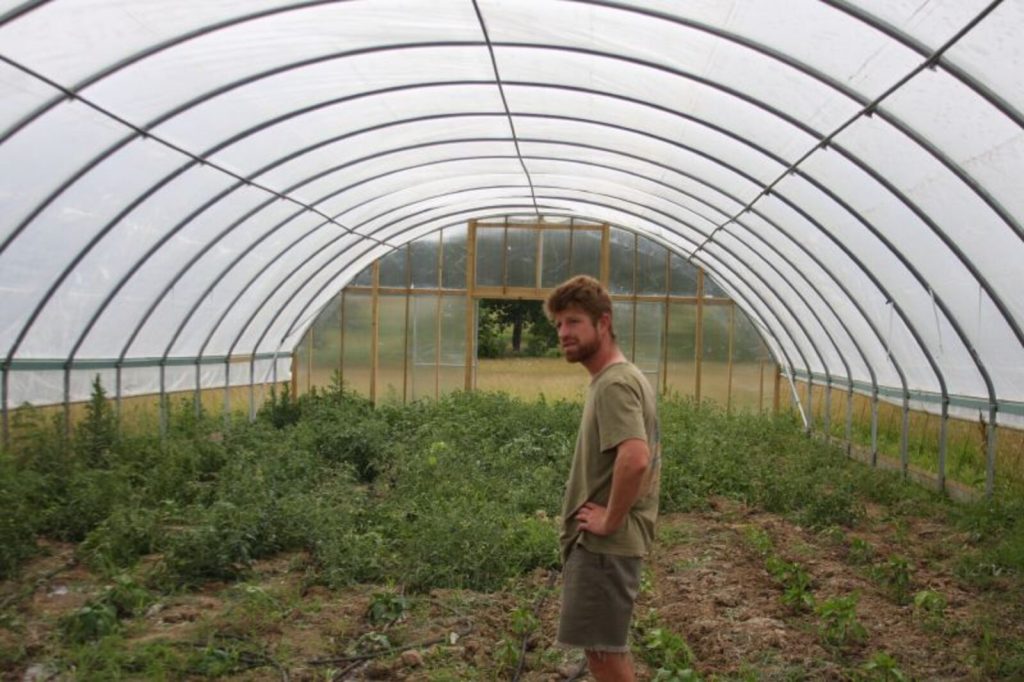
Greenhouse ventilation in Uganda exists to get heat out, not to keep warmth in. Cool air enters through low side openings, hot air leaves through the roof, and the total opening needs to reach 15 to 30 percent of the floor area to do the job. Under ventilated houses cook the crop, drop their flowers and run humid enough to breed rot.
Why Heat, Not Cold, Is the Enemy in a Ugandan Greenhouse
Most growers meet the word greenhouse attached to a picture of a glasshouse in Europe, where the structure exists to trap warmth through a cold season. That idea, carried to Uganda unchanged, is what kills crops. Here the cover traps heat the crop already has too much of, and the whole design problem is getting rid of it.
Look at what the plants can take. FAO puts the bulk of greenhouse vegetables as warm season species adapted to 17 to 27 degrees C, with approximate limits of 10 and 35 degrees C, and states plainly that maximum greenhouse temperature should not exceed 30 to 35 degrees C for prolonged periods. Tomato under cover has its own narrower window: roughly 21 to 29.5 degrees C by day and 18.5 to 21 degrees C at night.
Now set Uganda against the design thresholds. FAO supported work on greenhouses for smallholders in the tropics draws two lines. Where mean minimum outside temperature falls below 12 degrees C, the house needs vents that can be closed. Where it stays above 12 degrees C, the openings can be left open permanently. And ventilation openings are needed wherever mean maximum temperatures pass 27 degrees C. Uganda's annual average temperature sits at about 23 degrees C, which puts most of the country well clear of the cold line and close to or past the heat line. Measure your own site rather than assuming, but the direction is not in doubt.
There is a number that tells you how hard ventilation has to work. Under outside solar radiation above 900 watts per square metre, FAO calculates that holding the inside just 4 degrees C above outside takes a ventilation rate of about 0.06 cubic metres of air per second for every square metre of floor. For a house of 3 metres mean height, that is roughly 60 air changes an hour. Natural ventilation delivers about 40 air changes an hour at best. Read those two figures together and the conclusion is uncomfortable: on a clear bright day, a naturally ventilated house cannot always hold the gap to 4 degrees C, which is exactly why every square metre of opening counts. The wider context sits in the guide to greenhouse farming in Uganda and the rest of the irrigation and greenhouse guides.
How Air Actually Moves Through a Greenhouse
Two forces drive air through a naturally ventilated house, and they take turns depending on the weather.
The first is the stack effect, also called the chimney effect. Air inside the house warms, becomes less dense, and rises. With openings both near the ground and at the roof, cooler outside air pushes in through the low side openings while the hot air escapes through the roof, purely because of the density difference between the two air masses. No wind required. That is why a house with side openings and no roof opening ventilates badly: the hot air has nowhere to go, so it piles up under the ridge and radiates back down onto the canopy.
The second force is wind. Once outside wind passes about 2 metres per second it dominates the process completely, and the temperature driven effect becomes negligible. Buoyancy carries the load only when wind is below roughly 0.5 metres per second. Between about 0.5 and 2.5 metres per second the two work together, with wind doing most of it. The practical reading for Uganda is that still, hot, cloudless mid mornings are the dangerous hours, because that is when wind gives you nothing and the stack effect is all you have.
Which side you open matters. For houses in warm areas, opening on the windward side raises the ventilation rate clearly more than opening on the leeward side, at the cost of a less even internal climate. The first roof ventilator on the windward side does most of the work of the whole roof. Growers reluctant to open into the wind, out of fear for the polythene, end up with a house that ventilates at a fraction of its capacity.
Side vents and roof vents together beat either alone. Research modelling of a gothic house with continuous roof vents found the maximum ventilation rate came when both sides and the roof were open, and that opening both sides raised the rate strongly over roof venting on its own. Width works against you: very wide houses develop a dead zone of low air movement and high temperature where the internal air circulation cells meet, which is why the recommendation is to cap house width at about 50 metres and leave a gap between adjacent houses so hot air can get away. A last, cheap trick from the research: a 1 metre high vertical screen fixed at the ridge, angled to push the incoming air down into the crop instead of letting it skim along the inside of the roof, improved air exchange in the plant zone by about 50 percent on average.
The Vent Area to Floor Area Ratio That Greenhouse Design Depends On
This is the single number to design a house around. Total ventilator area should equal 15 to 30 percent of the floor area, a recommendation FAO carries from White and Aldrich. Past 30 percent the effect on the inside to outside temperature difference becomes very small, so that is the point of diminishing return. Elsewhere in the same FAO volume, a measured house with a ventilator to floor ratio of 9.6 percent is described as small against recommended ratios of 15 to 25 percent, which tells you what the real world tends to look like.
Work it for a real house. A structure of 8 metres by 30 metres has 240 square metres of floor, so the vent opening target is 36 to 72 square metres. If the side walls are netted from ground level to 1.5 metres up, both long sides give 2 times 30 times 1.5, which is 90 square metres of gross opening, and the two ends add more. On paper that clears the target comfortably. It is the net over the opening that takes it away again, and that is the next section.
Where the openings sit is as important as how much there is. FAO's recommendation is ventilators at the ridge, on the sidewalls and on the gable ends, because that combination gives the stack effect a proper path and lets cross ventilation work whichever way the wind is coming from. The type of opening then changes what the area is worth. Measured against a flap ventilator facing into the wind at 100 percent, a flap facing away from the wind delivers 67 percent of the ventilation rate per unit area, and a rolling ventilator delivers just 28 percent. A rolled up side curtain is worth roughly a quarter of a wind facing flap of the same size, which means a house relying on roll up sides needs considerably more opening area than the ratio alone suggests. Dimensions and spans belong to the greenhouse construction guide, and choosing the footprint itself is covered under the greenhouse size guide.
Why Ugandan Greenhouses Are Built With Permanently Open Netted Side Walls
Walk into almost any Ugandan or Kenyan greenhouse and the polythene stops short of the ground, with insect net closing the gap. That is not a shortcut. It is the correct build for the climate, and it follows directly from the 12 degrees C rule. Where mean minimum outside temperature stays above 12 degrees C, FAO supported guidance says ventilation openings can be permanently open, and across most greenhouses in Africa side nets are fixed in place to provide natural ventilation for exactly that reason. Nothing has to close, because nothing gets cold enough to need closing.
Accept what that build gives up, though. A permanently open house has no vent control at all. You cannot shut it against a whitefly flight, you cannot close it down to raise temperature for a cool night in the southwestern highlands, and you cannot use closing and opening as a humidity tool the way temperate growers do. Night humidity is then governed entirely by how much opening you built, which raises the stakes on the ratio.
Roll up side curtains earn their cost in two situations. The first is a cooler highland site, where mean minimum temperatures come close to that 12 degrees C line and a closed night is worth something, which is a matter for measurement at your own location rather than assumption. The second is where you want the option of closing the house for a pest management or spraying operation. Everywhere else in Uganda, fixed net over a permanent opening is the cheaper and better answer.
Insect Netting Mesh Against Airflow: the Trade Every Greenhouse Grower Makes
Here is the heart of it. Net keeps pests out. Net also chokes the airflow you built the openings for. Going finer than the pest you actually face costs you temperature for nothing, and the figures on both sides of that trade are known.
On the exclusion side, FAO gives three thresholds: a mesh of 0.15 mm excludes thrips, 0.35 mm keeps out whitefly and aphids, and 0.8 mm is enough for leafminers. The whitefly Bemisia tabaci, which carries tomato yellow leaf curl virus, is about 0.2 mm wide, and whitefly proof 50 mesh woven screen is described as by far the most efficient mechanical barrier available. That same 50 mesh screen does not exclude western flower thrips, because thrips are smaller. Nobody has a net that stops everything and still breathes.
On the airflow side, the cost climbs steeply as the holes shrink. FAO reports that an anti thrips screen can cut ventilation by approximately 60 to 70 percent, while an anti aphid screen cuts it by about 40 percent. Extension measurements of air reduction across typical screen hole sizes tell the same story from a different direction.
| Hole size | Excludes | Air reduction |
|---|---|---|
| 0.15 by 0.15 mm | Thrips | About 45 percent |
| 0.27 by 0.77 mm | Silverleaf whitefly | About 32 percent |
| 0.40 by 0.45 mm | Whitefly and aphids | About 25 percent |
| 0.60 by 0.60 mm | Leafminers | About 15 percent |
Read that table alongside the 15 to 30 percent vent ratio and the arithmetic gets sobering. The 240 square metre house with 90 square metres of gross side opening is comfortably inside the target. Cover that opening with thrips grade net at 45 percent air reduction and the effective opening drops to something near 50 square metres, which is scraping the bottom of the band. Extension guidance puts it in design terms: a thrips grade screen needs 3 to 4 times the area of material to pass the same air, so the compensation for fine net is more opening, not acceptance of a hotter house.
Three further points decide whether a net performs. Thread diameter matters, because thinner threads make a more porous screen that ventilates better at the same hole size. Screen shape matters, since a concertina or pleated screen set into the same frame passes about 25 percent more air than a flat one at the same pressure drop, which is free performance for a bit of installation care. And screens behave differently under natural ventilation than under fans: fans give a constant pressure difference across the screen, while natural ventilation depends on wind and buoyancy that come and go, so a naturally ventilated house needs a greater amount of screen area for the same result. Uganda is a natural ventilation country, so that penalty is yours.
FAO is explicit about the consequence of getting this wrong. Screens reduce ventilation, which causes overheating and higher humidity, which promotes plant stress and greater susceptibility to pests and diseases, and the higher humidity then calls for more frequent fungicide spraying than an unscreened house needed. A net chosen carelessly raises your spray bill. The exclusion side of this decision, and which pests are worth excluding in the first place, is worked through in greenhouse pest management.
Roof Vents, Ridge Height and Why Taller Greenhouses Ventilate Better
A roof opening is what turns side openings into a working chimney. Several forms are in use. A fixed overlapping vent along the gable ridge gives permanent ventilation while keeping rain and hail out, which suits a Ugandan house with no need to close. Movable options include film rolled up from gutter to ridge, arched vents hinged at the ridge, and vertical openings at the centre of the arch running the length of the roof. The reason for hinging or positioning a vent right at the ridge is straightforward: hot, humid air collects at the top of the house, and that is where it has to leave from.
Height helps in two separate ways. High sidewalls are described as critical for getting the most out of natural ventilation in a house with roof venting, and the reason is the stack effect: the driving force grows with the vertical distance between the low inlet and the high outlet. A taller house also holds a larger volume of air above the canopy, so the hottest air sits well above the leaves rather than sitting in them, and temperature at plant level swings more slowly. A low tunnel with the polythene close over the crop has neither advantage, which is why low structures overheat fastest.
Watch the crop itself, too. FAO illustrates the problem with a photograph caption that says all that needs saying: plants standing in front of the openings prevent airflow. A tomato crop trained up to two metres along a netted wall can block the inlet it depends on, so keep a working gap between the end of the bed and the wall, and do not let a hedge, a maize plot or a store shed grow up against the windward side of the house either.
Signs of Poor Ventilation in the Crop and the Diseases That Follow
The crop reports on ventilation before any thermometer convinces a grower to act. Learn the signs and you can diagnose a house from the doorway.
Dried, bleached patches on the leaves most exposed to the sun are the sign growers usually call scorch. Radiation load and still air together push leaf temperature well above air temperature, so the same house that shows flower drop will often show leaf damage on the upper canopy on the sunniest side. Treat it as one more reading on the same instrument.
One warning about chasing humidity with the irrigation tap. A wet floor raises humidity in an enclosed structure just as surely as a closed vent does, so leaks, spills and overwatering are part of this problem. Keeping the floor dry belongs to greenhouse irrigation management as much as to ventilation, and the two have to be managed as one system.
Shade Netting and Whitewash as Heat Management in the Greenhouse
When opening area has been pushed as far as the structure allows and the house still runs hot, the next move is to let less radiation in. FAO frames shading as the last resort for cooling, because reducing light reduces productivity, though in some cases it improves quality. Take that ordering seriously: fix the openings first.
Between the two common methods, whitewash has an advantage that matters enormously in a naturally ventilated house. Whitewash is a suspension of calcium carbonate painted onto the roof and walls, widely used because it costs so little, and it does not affect ventilation at all. Internal shade nets, by contrast, reduce the performance of roof ventilation, lower the inside wind speed and restrict carbon dioxide availability at the leaf surface. Adding an internal shade net to a house that is already short of airflow can make the temperature problem worse while solving the light problem.
The whitewash figures are worth knowing before you mix a bucket. Plastic cladding normally transmits about 60 percent of incoming solar radiation. Commonly used whitewash rates cut that to 20 to 30 percent through the hottest period and to around 45 percent in the shoulder periods, with the reduction proportional to how thickly it is applied. So whitewash is not on or off, it is a dial, and thickness is how you set it. It also raises the diffuse fraction of the light that does get through, which crops use more efficiently than direct beams. External shade cloth over the roof, rather than a net hung inside, is the middle option, and the material side of that choice is covered under shade nets in agriculture.
Fans and Why Most Ugandan Greenhouse Farmers Will Not Use Them
Forced ventilation works. FAO calls fans the most effective way to ventilate a greenhouse, full stop, and notes that fan systems can hold the inside temperature only slightly above outside. Then comes the electricity. The estimated requirement for ventilating a greenhouse in Mediterranean conditions is about 70,000 kilowatt hours per hectare. Multiply that by your own tariff before you price a fan, and pro rate it for your floor area. For most Ugandan growers, on a grid connection that is both expensive and intermittent, that calculation ends the conversation, and running fans off a generator ends it faster.
There is a second reason fans sit awkwardly in a Ugandan house. Fan ventilation depends on the house being reasonably closed so the air is pulled through a defined inlet, and openings that shut automatically when the fans stop. A house with permanently open netted sides is the opposite of that. Fitting fans to it mostly moves air in and out through the nearest gap.
If you do go that way, the specification is not guesswork. Fans should develop about 30 pascals of static pressure, which is 3 mm on a water gauge. Place them on the lee side or lee end, and keep no more than 8 to 10 metres between adjacent fans. The inlet opposite a fan should be at least 1.25 times the fan area, incoming air speed in the plant area should stay under 0.5 metres per second, and the openings must close automatically when the fans are off. The honest recommendation for almost every Ugandan house remains the cheaper one: more opening, better placed, with the right net over it.
Keeping Vents and Nets Working Through the Growing Season
Ventilation degrades quietly. A house that ventilated properly at handover can be cooking the crop two seasons later with nothing visibly broken.
Frequently Asked Questions About Greenhouse Ventilation
How much vent area does my greenhouse actually need? Aim for total ventilator area equal to 15 to 30 percent of the floor area, with openings at the ridge, the sidewalls and the gable ends. Past 30 percent the extra area buys very little temperature reduction. Then adjust for what covers the opening and what type it is: fine insect net can cut the air passing through by up to about 45 percent, and a rolling side curtain passes roughly 28 percent of what a wind facing flap of the same size passes. The ratio is the starting point, not the finished answer.
Does insect netting really make the house hotter? Yes, measurably. An anti thrips screen can reduce ventilation by approximately 60 to 70 percent and an anti aphid screen by about 40 percent, and the finer the mesh the bigger the loss. That does not mean skip the net. It means choose the mesh for the pest you actually face rather than the finest one on the shelf, add opening area to compensate, pick a screen with thinner threads, and pleat it into the frame rather than stretching it flat.
Should the sides be permanently open or fitted with roll up curtains? For most Ugandan sites, permanently open with fixed net is correct, because vents only need to close where mean minimum outside temperature drops below 12 degrees C. Roll up curtains are worth their cost on cooler highland sites near that threshold, or where you want the option of closing the house for a spray operation. Measure minimum temperatures at your own site before deciding.
Do I need a fan, and what would it cost to run? Almost certainly not. Fans are the most effective way to ventilate, but the estimated electricity requirement for ventilating a greenhouse is around 70,000 kilowatt hours per hectare, which you can multiply by your own tariff and pro rate to your floor area to see the problem. Fans also need a reasonably closed house with controlled inlets, which a permanently open netted structure is not. More opening area is cheaper and works without power.
Is whitewash better than a shade net? For a naturally ventilated house, usually yes. Whitewash does not affect ventilation, while shade nets hung inside reduce roof ventilation performance and lower air movement around the leaves. Whitewash is also adjustable, since the reduction in transmitted radiation is proportional to the thickness applied: plastic cladding normally passes about 60 percent of solar radiation, and common whitewash rates take that to 20 to 30 percent in the hottest period. Shading of any kind is the step after opening area, not instead of it.
What temperature is too hot inside a greenhouse? Inside temperature should not exceed 30 to 35 degrees C for prolonged periods. Tomato wants 21 to 29.5 degrees C by day and 18.5 to 21 degrees C at night, and night temperature above that band cuts pollen viability, which costs you fruit set. Buy a cheap maximum and minimum thermometer and hang it at canopy height in the middle of the house, not by the door where the air is always moving.
What does it cost to add roof vents to a house that has none? That depends on the existing frame, the span, whether the vent is a fixed ridge overlap or a movable roll up, and how much polythene has to be replaced to fit it, so a single figure would mislead. Price it as a modification quote against a written specification, and compare it against what the same money buys as extra netted side opening, which is often the cheaper route to the same air exchange. The cost structure of houses is broken down under greenhouse cost in Uganda.
Which crops suffer most from poor ventilation? The fruiting vegetables that dominate Ugandan houses, because their yield depends on successful fruit set and fruit set is what heat stress destroys first. Greenhouse tomato is the crop where growers notice it, since flower drop and empty trusses are impossible to miss, though sweet pepper responds the same way.
Vent kits, insect netting by mesh grade, shade material and whitewash are all sold by greenhouse suppliers and agro dealers, and prices move with the exchange rate and the season. Take current quotes from more than one greenhouse supplier against a written specification that names your mesh hole size, the vent opening area you are buying and the operating mechanism, so the quotes can be compared on the same terms.