
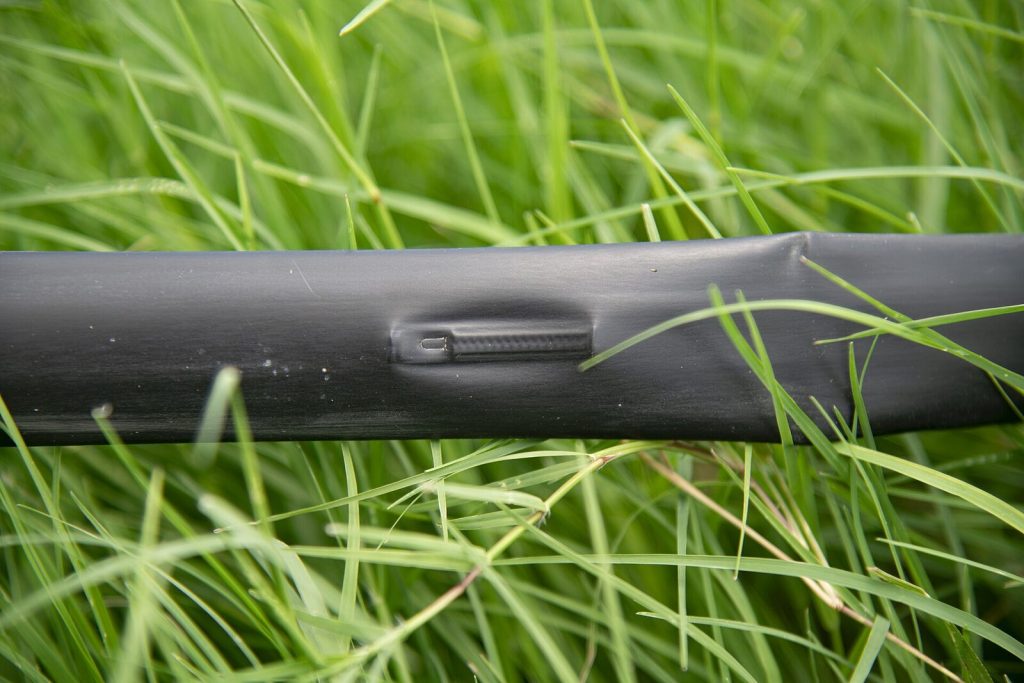
A greenhouse irrigation system is the crop's only water supply, because no rain reaches a bed under polythene. Most Ugandan houses run drip lines fed by gravity from a raised tank, with fertiliser carried in the same water. Greenhouse irrigation systems pull together storage, filtration, driplines and a feeding plan, and the layout gets designed once, when the beds are pegged out.
Why Greenhouse Irrigation Is Not the Same as Open Field Drip Irrigation
Greenhouse irrigation carries a risk that open field drip does not. Outside, a broken pump means a delayed watering and you hope for rain. Inside, nothing falls on the crop at all. FAO's guidance on greenhouse vegetable production makes the point in technical terms: because no rainfall enters and soil water extraction is negligible under high frequency drip, the crop's water requirement inside a house can be treated as equal to its evapotranspiration. Every drop is yours to deliver.
The demand itself is gentler than outdoors. Cover cuts solar radiation reaching the crop by around 40 percent on average, and wind speed inside a house falls to 0.1 to 0.3 metres per second or less. Between them, those two changes put evaporative demand inside at roughly 60 percent of what the same crop would face in the open. FAO's indicative figure for open field tomato is 400 to 800 mm of water across a growing period, so a covered crop needs less than that. It needs it every single day, without a skipped one.
Three other differences matter for design. Beds inside a house are permanent, so the dripline plan is settled at construction and stays put for years of cropping. Feeding through the water is normal practice rather than a refinement, because the same fixed beds get cropped continuously. And root volumes are small: drip wets a limited pocket of soil under each emitter, so the buffer between a stoppage and visible wilting is measured in hours. If you want the mechanics of emitters, laterals and wetting patterns from the beginning, the guide to how drip irrigation works covers that ground, and this page stays on what the enclosure changes. Both sit under the wider irrigation and greenhouse guides.
Dripline Layout That Matches the Beds in Your Greenhouse
Dripline layout in a greenhouse irrigation system follows the bed plan, and the bed plan follows the crop's spacing. FAO works a single span house of 10 m by 50 m as the reference case. For tomato, sweet pepper or cucumber, that house takes about 12 drip lines running the length of the rows, roughly 0.82 m apart, with one emitter per plant at 0.4 m spacing. Plant density lands near 3 plants per square metre and the house holds about 1,500 emitters.
Leafy crops change the whole picture. The same house takes 15 lines at about 0.66 m spacing, with emitters at 0.3 m serving one plant in two, which gives around 10 plants per square metre and about 2,500 emitters.
Those numbers set the flow the pipework has to carry, and that is the part growers skip. At 0.4 m emitter spacing a line delivers 5.0 litres per metre of run; at 0.3 m it delivers 6.66. Across the fruiting vegetable house that adds to roughly 3,000 litres per hour, and across the leafy house roughly 5,000. A submain that cannot pass that much water starves the far end of every lateral, no matter how good the emitters are.
On a sloping floor, or where a lateral runs a long way from the submain, pressure at the far emitters drops and delivery falls with it. FAO's recommendation for both cases is pressure compensating drippers, which hold their flow rate across a band of pressures instead of tapering off down the run. On level ground with short runs, ordinary tape is fine.
Daily Water Use Per Plant and Sizing the Storage Tank
There is one figure worth memorising. FAO states that an emitter delivering 2 litres per hour, run for an hour, is about the daily water requirement per plant for most greenhouse crops. From there the whole system sizes itself by arithmetic.
Sizing for peak rather than average is the discipline. Growers who size on an average end up hand carrying water through the weeks that decide the yield. For a fuller treatment of tank capacity, materials and siting, see the page on farm water storage tanks, and to work the demand from your own crop and area there is a walkthrough on calculating irrigation water requirements.
Gravity Fed Irrigation From a Raised Tank and When a Pump Is Needed
Gravity fertigation combined with drip, fed from an elevated tank, is the method most commonly adopted for greenhouse production across the tropics. It suits Uganda for an obvious reason: it needs no electricity at the moment of watering, which removes the single most common cause of a missed irrigation.
The question is whether gravity gives enough pressure. Drip is a low pressure family to begin with. FAO puts microirrigation as a whole under about 1.5 to 2 bar, and drip line systems at 0.5 to 2.0 bar with emitter flows of 0.5 to 4 litres per hour. One bar is about 10 metres of water head, so a tank sitting on a 2 metre stand delivers in the region of 0.2 bar at the inlet, well under the bottom of that band.
That arithmetic is why the honest answer is: read the specification for the tape you are buying. Low pressure driplines are made to run on a few metres of head and are sold for exactly this setup, while standard tape is not. Nobody can tell you the stand height your system needs without knowing which dripline is going on it, and a guess here produces a house where the last five metres of every bed underperforms all season. Ask the supplier for the operating pressure of the specific product, convert it to metres at 10 metres per bar, and build the stand to that.
A pump enters the picture when the head a long or sloping run needs exceeds what a sensible stand can give, when you are filling the tank from a stream or borehole anyway, or when you want to run several houses off one source. Where mains supply is unreliable, matching the pump to the source and the lift is a job in itself, covered in the guide to choosing an irrigation pump. Solar driven pumping removes the fuel line entirely and is worth pricing against a petrol unit, which the page on solar water pumps for farms goes into.
Water Quality and Filtration in a Greenhouse Irrigation System
Emitters are where a greenhouse irrigation system fails. FAO is blunt about it: suspended or dissolved material in irrigation water is a major cause of irrigation failure, because it blocks emitters, and filtration upstream of the distribution line is not optional. Blockage comes from three directions at once. Physical, meaning silt, sand and organic debris. Chemical, meaning salts that precipitate inside the labyrinth. Biological, meaning algae and bacterial slime, which a warm tank in Uganda grows very willingly.
Filter selection starts from the emitter, not from the water. The narrower the passage inside the dripper, the finer the filtration has to be, and FAO gives both halves of that relationship.
| Emitter flow | Passage width | Filter must pass below |
|---|---|---|
| 1 litre per hour | About 0.7 mm | 0.07 to 0.10 mm |
| 2 litres per hour | About 0.8 mm | 0.08 to 0.11 mm |
| 4 litres per hour | About 1.0 mm | 0.10 to 0.14 mm |
| 8 litres per hour | About 1.4 mm | 0.14 to 0.20 mm |
The third column comes from FAO's rule that filter passages should be below one seventh to one tenth of the emitter orifice diameter, so particles getting through cannot block what they reach. In practice the screen and disc filters used in this technology run at 70 to 200 mesh, counting holes per inch, and soilless systems typically sit at about 80 micron, which is 200 mesh. A finer filter than the emitter needs just blocks more often for no gain.
Match the filter type to the source too. Borehole water carrying sand wants a hydrocyclone ahead of anything else, since a screen will simply fill. Surface water from a pond or channel carries algae and fine organic matter, which suits a sand filter with a screen or disc filter behind it. Piped town water still needs a screen, because pipe scale and grit arrive anyway.
Salinity is the quality problem that filtration cannot touch. FAO groups irrigation water by electrical conductivity, and the bands are worth testing against before a house is built around a borehole.
Fertigation: Feeding the Crop Through the Irrigation Lines
Fertigation in a greenhouse is standard practice, not an upgrade. The beds are fixed and cropped back to back, drip wets only a pocket of soil around each plant, and broadcast fertiliser outside that pocket does very little. Feeding goes where the water goes.
Two delivery methods cover most Ugandan houses. A venturi injector sits in the line and uses the pressure drop across a narrowing to suck concentrated solution out of a drum. It needs no power and costs little, but the suction rate moves with the flow through the line, so it has to be calibrated by timing how much concentrate it draws over a measured period rather than trusted from the box. Tank dosing means dissolving fertiliser into the whole supply tank, which is the natural fit for a gravity system and needs no injector at all. The trade is that the entire tank becomes feed, so you lose the ability to irrigate with plain water, which you need for flushing and for the days a crop wants water without nutrition.
Where an injector carries a ratio, read it as a dilution. FAO's example is a 1:100 injector, which delivers 100 litres of dilute solution for every litre of concentrate metered through it. Get that ratio wrong in your mixing and you have either fed nothing or burnt the roots.
Three habits keep a fertigation system honest. Prefer single fertilisers over compounds, because compounds lock you into ratios that rarely match what the crop and your soil actually need. Keep calcium sources apart from phosphates and sulphates in separate stock containers, since mixing them concentrated precipitates solids that go straight into your emitters. And check the electrical conductivity and pH of the mixed feed rather than assuming the recipe worked. Crop specific feeding sits with the crop guides, including the schedule on tomato greenhouse farming, and the basics of the fertiliser grades themselves are covered under NPK fertilizer explained.
Irrigation Scheduling by Crop Stage, From Transplanting to Harvest
Scheduling greenhouse irrigation means little and often, and the target is a soil that never swings. FAO's management rule is to hold soil water between field capacity and no lower than 75 percent of the water usable by the plant, which is a much narrower band than field crops ever see.
A tensiometer turns that rule into a reading. For greenhouse vegetables under high frequency irrigation, the suggested soil matric potential bands run from minus 10 to minus 20 kPa on coarse textured soil, minus 10 to minus 30 kPa on medium soil, and minus 20 to minus 40 kPa on fine textured soil. Most tensiometers cover 0 to minus 80 kPa, which is ample for a greenhouse, whereas outdoors that narrow range is a limitation. Place one in the wetted zone at root depth and you are scheduling from the soil rather than from habit.
Demand then climbs through the crop. A freshly transplanted seedling has almost no leaf area and a root system confined to the planting hole, so it wants short, frequent pulses close to the stem. Through vegetative growth the volume rises with the canopy. At flowering and early fruit set the crop is least forgiving of swings, since a soil that dries and then floods shows up later as cracked fruit and blossom end rot on tomato. Peak use arrives with a heavy fruit load and stays there. Towards the end of picking, demand falls back.
One practical note for Uganda: the rains do not reduce the crop's need for water inside the house, but they change the air around it. During a wet spell the outside air is already near saturation, transpiration slows, and a schedule left on its dry season setting overwaters. Watching the tensiometer through a rainy week saves both water and a fungal problem.
Flushing and Maintenance That Keeps the Drip Lines Open
The maintenance list for a greenhouse irrigation system is short and it is the difference between three seasons and eight. FAO's own summary reads as common sense applied consistently: flush clear water through the drip lines after fertigation, empty them regularly, repair breakages and slipped pipes at once, and keep the filters working.
Flushing means opening the far end of each lateral and letting water run at full flow until it comes out clear, not trickling it through the emitters. Fertiliser residue and biological slime settle at the end of the run, which is exactly where you cannot see them. Doing it after every fertigation cycle is the habit that matters.
Filters get cleaned on a symptom, not a calendar. A rising pressure difference between the filter inlet and outlet means the element is loading up, and that interval depends entirely on your water source. Borehole water with sand may need daily attention; clean piped water may go a week.
When the problem is material in solution rather than in suspension, filtration stops helping and chemical treatment of the lines is the standard answer. FAO gives three modes and their concentrations: continuous chlorination at 1 to 2 mg per litre to stop algae and bacteria and to precipitate iron, intermittent treatment at 10 to 20 mg per litre for about an hour against a heavier growth of micro organisms or sludge, and superchlorination at concentrations up to 500 mg per litre to dissolve organic concretions already blocking emitters. Acid injection lowers water pH to stop carbonates and iron precipitating. Both chlorine and acid are hazardous to handle and need gloves and eye protection, and on a crop close to picking the sensible step is to have a local extension officer confirm the treatment and the timing before you inject anything.
Walk the lines weekly with your eyes on the emitters. A blocked dripper and a broken line are both invisible from the door, which is FAO's stated reason why drip demands inspection rather than trust. One dry plant in a wet row is the earliest signal you will get.
When the Pump or the Water Supply Fails
This is the section the equipment brochures leave out, and it is the one that costs Ugandan growers crops. Inside a greenhouse there is no weather to rescue you, and the wetted soil under an emitter holds hours of buffer rather than days, less on sandy soil than on clay.
Backup storage is the cheapest insurance on a greenhouse. A second tank costs a fraction of a lost tomato crop at full fruit load, and it converts a two day pump failure from a disaster into an inconvenience.
Reading the Crop for Irrigation Faults in the Greenhouse
The crop reports on the system faster than any gauge. Learn the difference between what the weather is doing and what the pipework is doing.
Midday wilting on soil that you know is wet is usually transpiration briefly outrunning uptake, and the plants recover by late afternoon. Wilting that persists into the evening is a supply problem. One row flagging while its neighbours are fine is almost never weather; it is a crushed lateral, a closed valve or a lateral that has slipped off the submain. A white crust at the outer edge of the wetted patch is salt concentrating where the wetting front stops, which means the volume per irrigation is too small to push salts past the roots. FAO's counter to salt buildup is irrigating with small volumes, cultivating and mulching to stop saline water travelling back up from deeper layers.
Standing water on the floor is the fault growers tolerate for too long. Leaks and spills raise humidity in a closed structure, and humidity is what turns a manageable fungal problem into a lost crop. Keeping floors dry belongs to irrigation management as much as to hygiene, which is where this page meets greenhouse ventilation and greenhouse pest management. All three systems fail together or work together.
Frequently Asked Questions About Greenhouse Irrigation Systems
What does a greenhouse irrigation system cost in Uganda? The price varies too much for a single figure to be honest. It moves with the floor area of the house, the dripline spacing your crop needs, the tank capacity you size for peak demand, the filter type your water source demands, and above all whether a pump and its power supply are part of the job or not. Get quotes against a written specification rather than a house size, listing dripline type and operating pressure, emitter spacing, tank litres, filter mesh and whether fertigation is included. The page on irrigation system cost per acre works through the cost structure, and where to buy irrigation equipment lists the supplier routes.
Can I run greenhouse drip from a raised tank with no pump at all? Often yes, if the dripline is made for low pressure. Drip line systems as a family run at 0.5 to 2.0 bar, and one bar is about 10 metres of head, so gravity from a normal stand sits below that band and only tape rated for low head will perform on it. Ask the supplier for the operating pressure of the exact product, build the stand to suit, and check delivery at the far end of the longest lateral with a measuring jug before you plant.
How often should the drip lines be flushed? After every fertigation, as a rule, by opening the ends of the laterals and running water through until it is clear. Fertiliser salts and biological slime settle at the end of the run where you cannot see them. Filters are separate and get cleaned when the pressure drop across them rises, which depends on your water source rather than the calendar.
Do I still need a filter if my water comes from a borehole? Yes, and possibly two. Borehole water is clean of algae but often carries sand, which a screen filter will simply fill with. A hydrocyclone ahead of a screen or disc filter handles that. Set the filter fineness from the emitter, aiming to pass nothing bigger than one seventh to one tenth of the emitter's passage width.
Can I use the same fertiliser I use in the open field? Only if it dissolves fully and cleanly. Granular compounds sold for broadcasting often leave insoluble residue that blocks emitters, and their fixed nutrient ratios rarely match what a greenhouse crop needs at a given stage. Water soluble single fertilisers, mixed to a checked electrical conductivity and pH, are what a fertigation system is built around. Keep calcium sources in a separate stock container from phosphates and sulphates.
Is hand watering ever the right choice for a small house? It is cheaper to start and dearer to run. Hand watering costs labour every day, applies water unevenly, wets the leaves in a structure where wet leaves drive disease, and cannot carry a fertigation programme. It is the correct fallback during a system failure and a poor permanent plan, even in a house of a few hundred square metres.
How do I know the system is delivering what I think it is? Measure it. Put a jug under an emitter at the start of a lateral and another under the last emitter on the same line, run the system for a timed period, and compare. A gap between the two means pressure is falling down the run, and a gap between both readings and the emitter's rated flow means a filter, a pressure problem or partial blockage. That two jug test takes ten minutes and catches most of what goes wrong.
Prices for driplines, tanks, filters and pumps move with the exchange rate, the supplier and the season, so it pays to collect current quotes from more than one irrigation equipment dealer before committing, and to send each of them the same written specification so the quotes can actually be compared.