
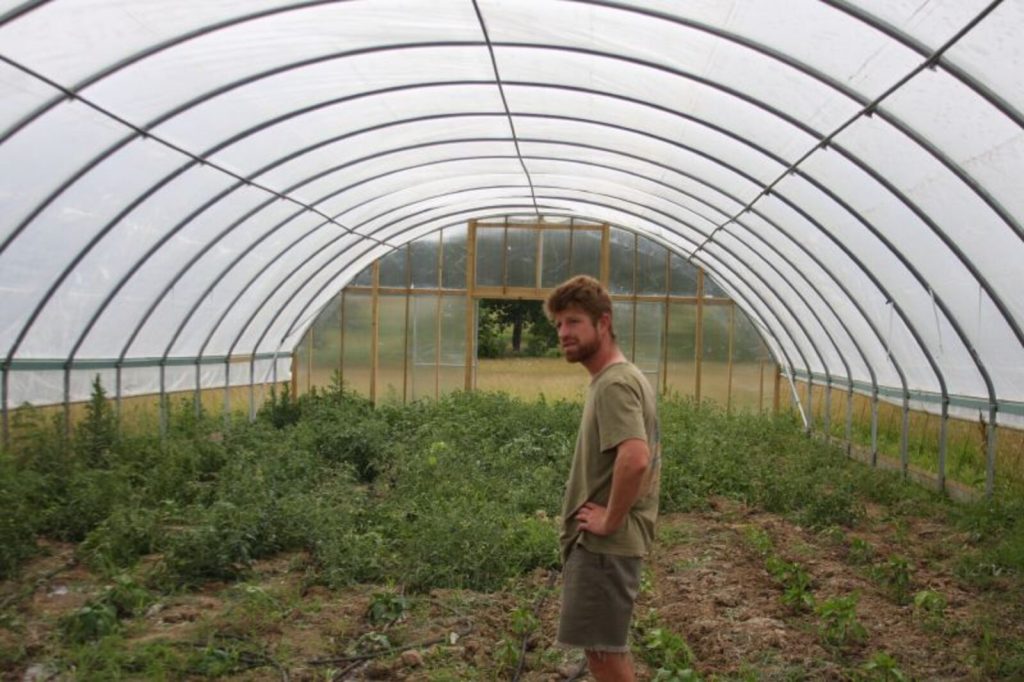
The structure is the part of greenhouse farming everybody budgets for, and it is the part that decides least. The full cost of greenhouse farming in Uganda is the structure plus the irrigation, the water, the first crop's working capital, and then a running cost every cycle for as long as you grow. Greenhouses are used across Uganda for tomato, sweet pepper and cucumber, and most that stop producing do so because the running cost ran out, not because the frame failed.
This page works the whole enterprise. The purchase and build price of the structure itself is covered on the page for what a greenhouse costs to buy and build in Uganda, and it appears here as one line in a capital table. Everything else, the running cost per cycle, the revenue, the payback period and the ways the venture fails, is what this page is for.
The Cost of Greenhouse Farming Is Not the Cost of the Greenhouse
A Ugandan grower who builds his own structures using eucalyptus poles put the numbers plainly: the cover kit for a 20 metre by 8 metre span cost him about 2,200,000 UGX and about 700,000 UGX in labour to erect, but the minimum to build one and have it stocked with a crop was 6,500,000 UGX. He raised 6,200,000 to finish his first one, partly by selling a car.
That ratio is the point. The cover and frame were under half of what it took to get the thing producing, and that was a grower doing his own construction with local timber. Buy a finished metallic structure and the frame gets more expensive while everything else stays the same, so the total climbs without the productive capacity changing at all.
The rest of this page prices a single 160 square metre tunnel, which is a 20 metre by 8 metre span, because that is the size most Ugandan smallholder greenhouses are built at and it is the size the available Ugandan figures describe. Scale up or down from there rather than assuming a larger structure costs proportionally less to run. For choosing a span, the size guide is the better reference.
Capital Cost of Getting a Greenhouse Into Production
Here is the full capital list for one 160 square metre tunnel. The structure line carries the wide band that Ugandan builders quote, roughly 4,000,000 to 15,000,000 UGX depending on whether the frame is timber or metal, and on span and location. Get your own quote and read page 290 rather than planning off the midpoint.
| Capital item | What sets it | Low UGX | High UGX |
|---|---|---|---|
| Structure and cover | Timber or metal | 4,000,000 | 15,000,000 |
| Erection labour | Own build or hired | 500,000 | 1,500,000 |
| Drip irrigation | Lines, filter, fittings | 600,000 | 2,000,000 |
| Tank and stand | Volume and height | 400,000 | 1,500,000 |
| Water source works | Existing or new | 0 | 5,000,000 |
| Trellising fittings | Twine, wire, clips | 150,000 | 500,000 |
| Beds and soil work | Depth and material | 200,000 | 800,000 |
| Hygiene and gate | Footbath, fencing | 150,000 | 600,000 |
| First crop capital | Seedling to harvest | 1,300,000 | 3,000,000 |
That totals roughly 7,300,000 to 29,900,000 UGX for one tunnel actually producing a crop. The grower figure of 6,500,000 sits just below the low end, which is what you would expect from someone using his own timber and his own labour. If a quote you have been given is well under seven million and includes a crop, check what has been left out, and the line usually left out is water.
The greenhouse irrigation page covers the system side and where greenhouses are supplied lists the channels for getting quotes.
Running Cost of One Greenhouse Crop Cycle
No Ugandan source publishes a running cost for a greenhouse cycle, so this figure has to be built rather than quoted, and you should see how it was built before you use it.
Start from open field. A standard Ugandan one acre tomato budget of about 5,500,000 UGX across 4,047 square metres works out at roughly 1,360 UGX per square metre per season. A greenhouse crop is more intensive on almost every line: plant density is about four per square metre against roughly two and a half in an open field at recommended spacing, water and nutrients are delivered by fertigation rather than by rain, crop protection is more frequent because the enclosed space favours certain pests, and the crop needs daily attention rather than weekly. Allowing for all of that puts a greenhouse cycle somewhere around 8,000 to 19,000 UGX per square metre, which on 160 square metres is 1,300,000 to 3,000,000 UGX per cycle.
Treat that as a clearly labelled assumption and redo it with your own prices. What goes into it is the same list every time: 600 to 650 seedlings, fertigation products across the whole cycle, crop protection, twine and trellising consumables, labour for training, pruning, pollination assistance and picking, pumping or hauling water, crates, and transport to the buyer. The open field cost stack on the page for an acre of tomato is the easiest place to get per item prices you can scale down.
Greenhouse Crop Cycle Economics: Plant Population, Yield and Harvest Window
A 160 square metre tunnel holds 600 to 650 plants, about four per square metre. For tomato the cycle runs about two and a half months from transplanting to first picking, then a harvest window of four to six months depending on how well the house is managed. Add the turnaround between crops and that is roughly seven to nine months of tunnel time per cycle, so you get about one to one and a half cycles a year, not the three or four that the year round production language implies.
That cycle length is the quiet economics of the whole thing. A greenhouse does not give you more crops per year than an irrigated open field; it gives you a longer harvest from one planting, better fruit quality, protection from rain driven disease, and the ability to pick in months when open field supply is thin. The value is in the price you get and the loss you avoid, not in the number of cycles.
Temperature is the constraint nobody budgets for. A closed tunnel in Uganda gets hot, and above roughly the low thirties in Celsius tomato stops setting fruit properly, which turns a full house of healthy plants into a poor harvest. Ventilation is not an optional extra on a tropical greenhouse. The ventilation page covers it, and a grower who budgets for a sealed house and no ventilation has bought a yield problem.
Revenue From a Greenhouse Tomato Cycle
Revenue is yield times price, and one of those two is honestly uncertain in Uganda. The Ugandan grower quoted earlier sold greenhouse tomato at 1,800 to 3,500 UGX per kilogramme, which is above the open field farm gate band because greenhouse fruit is cleaner, more uniform and often available when field fruit is not. Check the living tomato price page for where the market sits before you use any figure.
Yield is the problem. Take a mid band price of 2,500 UGX per kilogramme and a running cost of 2,000,000 UGX per cycle, and the whole venture turns on kilogrammes per square metre.
| Yield kg per sq m | Cycle revenue UGX | Cycle margin UGX | Payback years |
|---|---|---|---|
| 3 | 1,200,000 | loss 800,000 | never |
| 6 | 2,400,000 | plus 400,000 | about 17 |
| 10 | 4,000,000 | plus 2,000,000 | about 3.5 |
| 15 | 6,000,000 | plus 4,000,000 | under 2 |
The payback column assumes capital of 9,000,000 UGX, near the low end of the band above, and about 1.3 cycles a year. Every row is an assumption and the table is here so you can find your own row rather than be handed a number.
Why the Yield Claims Do Not Add Up
Now the uncomfortable part. Ugandan material quotes greenhouse tomato at 10 to 15 kg per plant over the plant's life. At four plants per square metre that is 37 to 60 kg per square metre. Fully climate controlled glasshouses in the Netherlands, with computer managed temperature, humidity, carbon dioxide enrichment and artificial lighting, operate near the top of that. A polythene tunnel over Ugandan soil, ventilated by rolling up the sides, will not match a Dutch glasshouse.
Run the order of magnitude check yourself, because it is the most useful habit on this whole subject. Uganda's national open field tomato yield is about 5.7 to 6.0 tonnes per hectare, which is about 0.6 kg per square metre. A well managed open field acre reaches roughly 2 kg per square metre. A claim of 37 to 60 kg per square metre is sixty to a hundred times the national average from the same soil under a plastic sheet. It is not a stretch; it is a different order of magnitude.
What is the right figure? This page could not verify one from research for a simple naturally ventilated tunnel in Uganda, and says so rather than picking a number and asserting it. What can be said with confidence is which row of the table to plan on. Plan on the 6 kg row, treat 10 kg as what good management might reach after a few cycles of learning, and treat anything above 15 kg as marketing. If the venture only works at 15 kg, it does not work.
This matters because the 6 kg row pays back in about seventeen years and the cover lasts about three. Read that sentence again, because it is the finding the ranking pages leave out. At a conservative yield on a mid band price, a greenhouse does not repay its capital before you have to buy the cover twice more.
Payback Period on a Greenhouse in Uganda
So what makes the arithmetic work? Three things, and they are the three questions worth answering before you spend anything.
Yield per square metre. Getting from 6 kg to 10 kg roughly halves the payback period five times over. That gain comes from ventilation that keeps the house below the temperature where fruit stops setting, fertigation that actually feeds the crop, disciplined pruning and training, and pest management inside an enclosed space. All of it is skill rather than spend. The Ugandan grower quoted earlier named lack of knowledge as one of his three main challenges alongside wind and capital, and he was right to.
Price per kilogramme. Greenhouse fruit sold into the same market at the same time as everybody else's field tomato earns an ordinary price and the whole premise collapses. The premium comes from picking when field supply is short, from fruit good enough for a supermarket or a hotel, and from a buyer who pays for consistency. That is a marketing job, and it has to be arranged before the first transplanting, not after the first harvest.
Capital kept low. Every million shillings you do not spend on the frame is a million you do not have to earn back. A timber framed house built with local poles, from a grower who understands what he is building, reaches production for a fraction of a finished metallic span, at the cost of a shorter frame life and more maintenance. The build cost page compares the options properly.
Find your own break even quantity before you commit, using the break even calculator. For a greenhouse the useful version is kilogrammes per square metre per cycle at the price you have actually been offered.
The Replacement Costs Nobody Budgets For
A greenhouse is not a one time purchase, and the recurring capital is where first time growers get caught.
The cover is the big one. Ugandan accounts put structure life at about three years, and what that really describes is the polythene, which degrades under ultraviolet light, tears in wind and loses light transmission long before it visibly fails. Recovering the house costs a large share of the original kit price and it falls due whether or not the last cycle made money. Budget it as a cost per cycle from the first cycle, the way you would treat depreciation, rather than as a shock in year three.
After that: drip lines block and get replaced, filters need cleaning and eventually swapping, twine and clips are consumed every cycle, pumps fail, and timber frames need treating or partial replacement. Soil is the least obvious one. Crop the same ground under cover season after season and pathogen and nematode loads build, so growers end up either replacing bed soil, treating it, or switching to grafted seedlings, and all three cost money the original plan did not carry.
What Makes a Greenhouse Farming Venture Fail
Note what is not on that list. Nobody fails because the frame rusted. The greenhouse pest management page covers the enclosed space problems, and where any product is used the rate, interval and pre harvest interval come off the label, with a local extension officer confirming what is registered for the crop. Greenhouse fruit is eaten fresh, so the pre harvest interval is not negotiable.
Choosing the Greenhouse Crop Decides the Economics
Crop choice moves the answer more than anything else you can buy. Tomato is the default and it is the hardest case, because tomato is also grown in open fields everywhere in Uganda, so your expensive fruit competes with cheap fruit.
Sweet pepper is the obvious comparison. At the same plant population in the same 160 square metre house it runs a roughly six month crop, and it sells in a far higher band than tomato, with Ugandan figures of 6,000 to 9,000 UGX per kilogramme reported against 1,800 to 3,500 for tomato. Even at a lower yield per square metre, two to three times the price per kilogramme changes the payback table completely. Cucumber sits between them. The crop options page and the dedicated pages for greenhouse tomato and greenhouse pepper go into the agronomy.
There is also a cheaper structure that suits some growers better. A net shed costs about 40 percent less than a greenhouse and cuts incoming sunshine by roughly 35 percent, which reduces water stress without creating the heat problem a sealed tunnel has. It gives less protection from rain driven disease and it is a far smaller bet. Shade netting is worth pricing before you commit to a full house, and so is running drip irrigation on an open field acre instead, which buys off season production at a fraction of the capital.
Greenhouse Against Open Field Per Square Metre
Compare the two honestly and the trade is clear. A greenhouse multiplies your yield per square metre by roughly three to ten times over open field. It multiplies your cost per square metre by considerably more than that.
The arithmetic: a standard open field tomato acre costs about 1,360 UGX per square metre per season and a well managed one yields about 2 kg per square metre. A greenhouse cycle costs somewhere around 8,000 to 19,000 UGX per square metre in running cost alone, before any capital, and on a conservative planning figure yields about 6 kg per square metre. So yield roughly triples while running cost rises perhaps six to fourteen times, and the capital sits on top of that.
Which means a greenhouse only pays when at least one of two things is true: the yield per square metre is well above the conservative figure, or the price per kilogramme is well above the open field farm gate. Growers who make greenhouses work in Uganda have both. They run high yields because they know how to manage heat, water and pests inside a house, and they sell into buyers who pay a premium for consistent quality out of season. Growers who have neither have bought an expensive way to grow ordinary tomatoes. Before committing this much capital to one structure, it is worth setting it against the other enterprises on the farming business ideas hub, several of which reach production on a fraction of the money.
Greenhouse Farming Cost Questions Ugandan Growers Ask
Can I start greenhouse farming with five million shillings? You can put up a small timber framed house for that. What you probably cannot do is put it up and also fund water, drip lines and a first crop through to harvest. If five million is the whole budget, a net shed or drip irrigation on an open field plot gets you closer to production than an empty greenhouse does.
How much land does one greenhouse need? A 20 metre by 8 metre house occupies 160 square metres, so land is rarely the constraint. Access to water, shelter from wind and distance to a buyer are the site factors that matter. A greenhouse in a windy exposed spot with no water nearby is a bad site whatever the land costs.
Will a metal frame last longer than timber? Metal lasts longer and needs less maintenance, and the cover on top of it still needs replacing every few years either way. Timber with good local poles reaches production for far less capital, which shortens your payback. If capital is tight, timber and a better cover beats metal and a thin one.
Do I need drip irrigation, or can I water by hand? Hand watering a house of 600 plants daily is possible and it is a labour cost every single day, plus wet foliage raises disease risk in an enclosed space. Drip is capital that buys down labour and disease at the same time, which is why it appears in almost every working greenhouse.
What skills do I actually need before building one? Managing temperature and ventilation, running a fertigation schedule, pruning and training an indeterminate crop, and recognising pests early inside a closed space. None of it is exotic and none of it is intuitive. Growers commonly report that their first cycle is a learning cycle, so plan your cash flow as though the first crop underperforms, because it usually does.
Can I reuse the same soil cycle after cycle? Not indefinitely. Continuous cropping of the same ground under cover builds soil borne disease and nematodes, and bacterial wilt in particular cannot be sprayed out once it is established. Rotation is hard inside a fixed structure, which is why growers turn to grafted seedlings, treated beds or replaced soil, and why the footbath at the door matters more than it looks.
Why do published greenhouse yield figures look so much higher than this page? Because they repeat the 37 to 60 kg per square metre claims without checking them, and the plans built on them leave out the running cost, the cover replacement and the learning curve. Check any greenhouse figure you read against Uganda's national open field yield of about 0.6 kg per square metre. If the claim is sixty times that, ask what is producing the difference.
Greenhouse prices and input prices in Uganda change constantly, so use the figures here as a structure rather than a quote. Before you commit, get written quotes from at least two builders for the frame, the cover and the irrigation separately, price the first crop through to harvest as its own line, check the living tomato price page for where the market sits, and work out which row of the payback table your own yield and price put you on. If you land on the 6 kg row, price a net shed or an acre under drip before you order a greenhouse.