
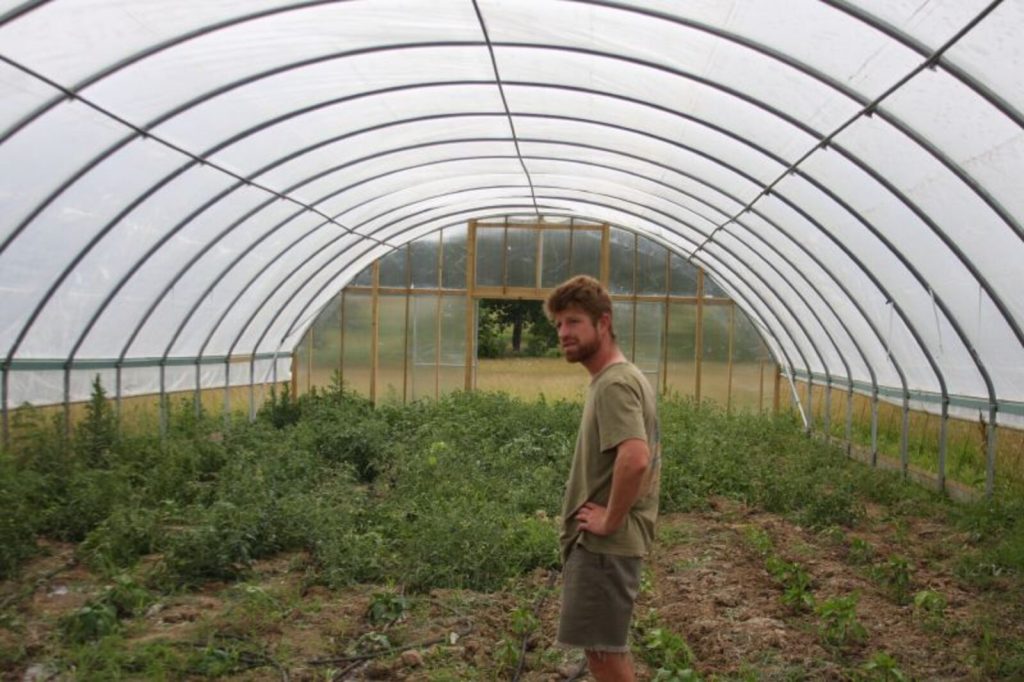
The crops to grow in a greenhouse in Uganda make a short list: tomato and sweet pepper first, then chilli, cucumber, and herbs or leafy vegetables where a named urban buyer already exists. Selection rests on value per square metre, because the structure has to be paid back by whatever grows under it. Bulk staples and cheap field vegetables never clear that bar.
That answer disappoints people. Most lists of greenhouse crops run to fifteen or twenty entries and imply that anything green will do better under plastic. Plenty of those lists were written for Europe or North America, where a greenhouse is bought for warmth. Uganda does not need warmth.
What Makes a Crop Worth Growing in a Greenhouse
Four questions settle whether a crop belongs in a Ugandan greenhouse, and a crop needs a yes to at least three of them. Run any candidate through these before you buy seed.
Tomato passes all four. Sweet pepper passes all four. Cabbage passes none of them, which is why the vendor pages listing cabbage as a greenhouse crop should be read with care.
Scored against those tests, the shortlist and the rejects separate cleanly. Read the table with the sections below, because the buyer column is the one that decides whether a technically suitable crop is a commercially sensible one.
| Crop | Trains upward | Rain gain | Main buyer |
|---|---|---|---|
| Tomato | Yes | High | All markets |
| Sweet pepper | Yes | High | Hotels, shops |
| Hot pepper | Partly | High | Exporters |
| Cucumber | Yes | Medium | Urban retail |
| Herbs | No | Medium | Restaurants |
| Leafy greens | No | Medium | Urban retail |
| Cabbage | No | Low | Open market |
| Maize | No | Low | Grain traders |
Value Per Square Metre Is the Test That Settles Your Greenhouse Crop
Start with the arithmetic that most crop lists skip. A greenhouse is a fixed capital item sitting on a very small footprint. The polythene cover has a working life of a few seasons, the frame lasts longer, and both have to be recovered from the produce grown inside. Spread that cost over an acre and it is trivial. Spread it over two hundred square metres and it is the single biggest line in your budget.
So the crop has to be worth a lot per kilogram, or yield a lot of kilograms per square metre, and ideally both. Maize fails on both counts at once. A greenhouse full of maize would produce a few sacks of grain worth roughly what the plastic cost, which is why nobody does it and why you should be suspicious of any crop list that does not mention this constraint at all.
Tomato clears it because the crop grows vertically for months, fruiting continuously, and because Ugandan tomato prices swing hard. Research from the National Crops Resources Research Institute surveying 240 tomato farmers across eight districts found farm gate prices reported by growers spanning more than twentyfold between the worst glut and the tightest scarcity. That spread is the commercial case for protected production. You are not buying higher yield so much as buying the ability to harvest when almost nobody else can.
Rain Exclusion, Not Warmth, Is What a Ugandan Greenhouse Buys
This is the point that temperate crop lists get backwards, and it changes which crops make sense. A greenhouse in a cold country traps heat so a summer crop can be grown in spring. A greenhouse in Uganda keeps water off foliage during the two rain seasons, roughly April to June and September to November, and that is a different job entirely.
The NaCRRI survey is blunt about why it matters. Farmers themselves linked high tomato disease incidence to peak rainfall, and the culprits they listed all travel in wet weather: bacterial wilt, early blight, late blight, leaf spots and viral infections. Many Ugandan growers deliberately plant towards the end of the rains to dodge blight, which tells you how completely the wet season defeats an unprotected tomato crop. Some spray three times a week during the rains trying to hold it back, far above what any label recommends, and they still lose fruit.
A crop that suffers from wet foliage gains enormously under cover. A crop that does not suffer gains almost nothing. That single distinction removes most of the field vegetables from your shortlist before you even reach the money question.
The second thing rain exclusion buys is timing. With cover plus irrigation, you can plant when the weather would normally stop you, and harvest into the gap that opens when the open field crop has drowned or dried out. Supply collapses twice in a Ugandan year: once when the rains destroy the field crop, once in the deep dry season when growers without irrigation simply cannot plant. A greenhouse with a working irrigation setup inside it covers both windows.
Tomato Is the Default Greenhouse Crop in Uganda
If you have one greenhouse and no experience, plant tomato. It is the crop a Ugandan greenhouse exists to protect. Wet season disease destroys it in the open, it trains up a string for months, it carries a high value per kilogram in scarcity, and every market in the country takes it.
The variety matters more than most beginners expect. Most of what Ugandan growers plant outdoors was bred to crop heavily and finish, and finishing early is the last thing you want from a structure you paid for by the year. A greenhouse wants an indeterminate type that keeps growing and keeps setting fruit up a trellis, harvested over months rather than weeks. Our full guide to tomato greenhouse farming covers spacing, trellising, pruning and yield, and the tomato seed guide covers what to actually buy.
Be warned that it is the most demanding crop on the list. Tomato under plastic wants attention several times a week for the whole cycle and punishes neglect quickly.
Sweet Pepper Farming as the Second Greenhouse Crop
Sweet pepper, which most Ugandan buyers call green pepper or capsicum, is the usual second crop and a sound one. A peer reviewed trial in the tropical forest zone of Ghana grew nine sweet pepper varieties side by side in a greenhouse and in the open field, and measured greenhouse yields running 50 to 150 percent above the same varieties outside, at 8.2 to 21.3 tonnes per hectare under cover against 5.0 to 12.6 tonnes outside. Those are measured numbers from a research station, which makes them worth more than the far larger figures circulating on vendor websites.
Pepper is slower than tomato to establish and slower to first harvest, it is fussier about temperature, and its buyer base is narrower. It is also cleaner and better presented under cover, which is exactly what hotel and supermarket buyers pay for. The pepper greenhouse farming guide goes through the agronomy, which differs from tomato more than the two crops' family resemblance suggests.
Chilli and Hot Pepper Farming for the Export Market
Hot pepper is the one greenhouse crop with a genuine export story behind it. Uganda is a recognised supplier of habanero, African bird's eye chilli and Scotch bonnet into European markets, and the growing conditions across much of the country at around a thousand metres above sea level produce the heat and aroma those buyers want.
Protected production helps here for a reason unrelated to yield. Ugandan hot pepper consignments have repeatedly been intercepted at European borders carrying false codling moth larvae, and the Ministry of Agriculture, Animal Industry and Fisheries responded by restricting exports to traders meeting a tight set of requirements. Consignments also face heightened checks on pesticide residues. A screened house that physically keeps the moth off the fruit addresses the pest problem without adding spray, which addresses the residue problem at the same time.
The catch is that none of this helps without a buyer. Export chilli is a contract crop, not a market day crop, and a grower who plants it hoping to find an exporter later usually ends up selling into the local market at local prices. Read the chilli farming guide and the bird's eye chilli guide before committing a house to it.
Cucumber Farming Under Plastic
Cucumber earns a place on the shortlist on speed. It climbs, it uses the height, it fruits within a couple of months of transplanting, and the fruit bruises and rots easily in the open where rain splashes soil onto it. Under cover the fruit comes out straight, clean and unmarked, and that appearance is most of the price difference at supermarket level.
Its weakness is the market. Cucumber demand in Uganda is thinner than tomato demand and concentrated in urban retail, hotels and the salad trade. A single grower harvesting a whole house at once can move the local price against themselves in a week. Stagger your planting, or split the house, and confirm the buyer before the seed goes in the tray. The cucumber farming guide covers the field version of the crop.
Herbs and Leafy Crops for Urban Market Buyers
Herbs are where the honest answer gets conditional. Basil, coriander, mint, rosemary, lettuce and spinach all grow well under cover, cycle fast, and command real prices from restaurants, hotels and the better supermarkets. Cleanliness and consistent weekly supply are what those buyers are actually purchasing, and a greenhouse delivers both.
Against that, the volumes are small and the buyers are few. A restaurant might take a few kilograms of basil a week. Fill a house with it and you need several such buyers, all of whom expect delivery on a schedule. Herbs pay well per square metre only when a supply relationship exists first, which is the reverse of how most growers plan. Look at the commercial herb guide and think hard about supplying hotels and restaurants before you plant a single seed.
Microgreens and strawberries appear on international greenhouse crop lists and are usually a poor fit in Uganda for the same reason: the buyer base barely exists outside a handful of Kampala outlets. Passion fruit under cover is a different problem, being a perennial vine that will fill the roof space and occupy the structure for years.
Crops That Do Not Pay for a Greenhouse
This section is missing from almost every article on greenhouse crops, and it is the part that saves money. A crop can grow perfectly well under plastic and still be a bad commercial decision.
Bear in mind that Uganda's open field tomato production sits at roughly 6 tonnes per hectare nationally, against a regional potential of 16 tonnes, so the gap protected production is closing is real. For cabbage or onion, no equivalent gap exists.
Matching the Crop to Your Greenhouse Size and Planting Season
One crop per house, per cycle. Mixing tomato and pepper under one cover sounds efficient and creates a spray and irrigation headache, since the two crops want different schedules and share pests that will bounce between them. If you want two crops, you want two houses or a partition.
Plan the harvest date backwards from the price window rather than forwards from when you happen to have money for seed. Work out when your local market runs short, count back the weeks the crop needs in the nursery and in the house, and plant to that. The greenhouse size guide helps you work out how many plants a given span holds, and the plant population calculator does the arithmetic. Ventilation deserves attention too, because a badly vented house in Ugandan sun gets hot enough to stop fruit setting whatever crop is inside, which the ventilation guide covers.
For context on the structure itself and how it fits into a wider farm plan, the irrigation and greenhouse hub collects the construction, cost and equipment material in one place.
Frequently Asked Questions About Greenhouse Crops in Uganda
Which crop should a first time greenhouse grower plant? Tomato, almost always. It has the widest market, the clearest gain from rain exclusion, and the most available information, so mistakes are recoverable. Start with one crop in one house and keep written records of what you spent and what you picked. Those records are what tell you whether the second house is a good idea.
What does it cost to set up a greenhouse and its first crop? The total depends on span and length, frame material, cover specification, whether the house is screened, and the irrigation fitted inside it, which is why a lone figure lifted off a website tells you nothing useful. Seed for a greenhouse crop costs more than field seed because you are buying hybrid material sold in small counted packs. Get at least three written quotes for the structure and price the seed, growing media and irrigation separately. The greenhouse cost page and the cost of greenhouse farming page break the components down.
Can I grow two different crops in the same greenhouse? You can, and most growers who try it regret it. Tomato and pepper share whitefly, thrips and several diseases, and they want different watering and feeding. If the house is large, partition it. If it is small, run one crop and rotate between cycles instead.
Do greenhouse crops still need spraying? Yes, less than the same crop outside, but yes. Rain exclusion cuts fungal and bacterial disease sharply; it does nothing about whitefly, thrips, red spider mite or tomato leafminer, all of which thrive in a warm sheltered house and can build up faster than in the open. Read the label rate and observe the pre harvest interval, which matters especially for tomato and pepper because both are eaten raw. Ugandan surveys of tomato growers make the scale of the problem plain: almost a third sprayed on the day of picking and getting on for half sprayed inside the last week, where labels call for several days. Whichever crop you choose, do not follow that example. The greenhouse pest management guide covers control properly, and safe pesticide application covers the handling side.
Do I need hydroponics to grow greenhouse crops? No. The great majority of Ugandan greenhouse crops are grown in soil or in soil based beds inside the house, and that is the sensible starting point. Soilless growing adds cost, technical demand and a dependence on bought nutrient solution. If it interests you later, the hydroponics guide explains what is involved.
How soon does a greenhouse crop start paying? Cucumber is quickest, with fruit within roughly two months of transplanting. Tomato takes around two and a half months to first picking and then keeps producing for months. Sweet pepper is the slowest of the three to first harvest. Herbs cut fastest of all, though the volumes are small. Plan cash flow around the slowest crop you intend to grow, not the fastest.
Is a shade net an alternative to a greenhouse for these crops? For some, yes. A shade net cuts light and heat and gives partial protection, at much lower cost, but it does not exclude rain, so it does not deliver the disease benefit that makes tomato worth growing under cover in the first place. It suits nursery work and leafy crops better than fruiting crops. See shade nets in agriculture and nursery shade house construction.
Choosing Your Crop and Getting Greenhouse Quotes in Uganda
Pick the crop before you pick the greenhouse, because the crop decides the height you need, the ventilation you need and the irrigation you need. Once the crop is settled, compare written quotes from more than one installer and price the structure, the cover, the irrigation and the screening as separate items so you can see what you are paying for. Current prices for equipment and for the produce itself move with season and supplier, so check both close to the time you plan to buy. Listings of greenhouse suppliers and the current tomato price page are the two places to start.