
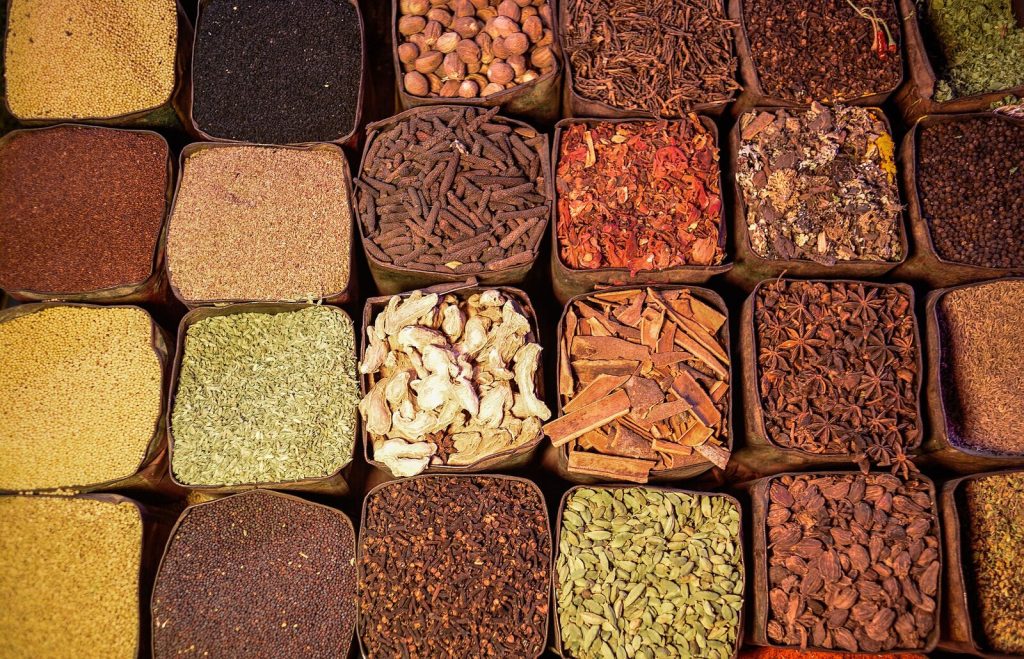
The best herbs to grow commercially in Uganda are the ones with a buyer already in place: dhania for the open market, and rosemary, mint, basil and thyme for Kampala and Entebbe kitchens. What decides the money is how much that trade absorbs, not what the plants yield. Herbs are leaf and aromatic oil crops, cut repeatedly from a small plot, and the demand for them sits in a narrow band of hotels, restaurants and supermarkets.
Which Herbs Uganda Actually Grows and Sells Commercially
Walk onto a working Ugandan herb plot and the list is fairly consistent. Rosemary, thyme, mint, basil, oregano, sage, chives, tarragon, chamomile, lemongrass and aloe vera turn up again and again, usually together, usually on well under an acre. Ugandan farm press profiles of herb growers describe exactly that pattern: many species, small blocks, one household managing the lot.
That tells you something before you read a single price. Nobody is growing forty acres of basil. The people making a living from herb farming in Uganda are running a mixed block and selling into a handful of buyers they know by name, and most of them also sell seedlings.
Set that against the wider spice and herb sector and the scale becomes clearer still. The founder of the Uganda Fruits and Spice Growers Association puts the number of Ugandans in commercial spice cultivation at fewer than twenty, with fewer than eight on plots above five acres, and says roughly 98 percent of the spices used in the country are imported. Herbs sit inside that same thin sector. There is no national herb acreage, no published tonnage, and no Ugandan released variety for any culinary herb.
So this page ranks in bands rather than in a false order of one to ten. A precise profit ranking would need Ugandan yield and price data that does not exist for most of these crops.
Herbs or Spices: Where the Growing Line Falls in Uganda
The split matters commercially, not just botanically. A herb is grown for its leaf or its aromatic oil. It is soft, it wilts, it is usually sold fresh in small bunches or dried and milled into a light powder. A spice is grown for seed, bark, rhizome or fruit. It dries hard, it stores for months, and it travels.
That difference sets the whole business model. A dried spice can wait for a better price; a cut bunch of basil cannot wait a week. A spice has a wider and more tradeable market because storability creates traders; a herb has a concentrated urban market because perishability keeps the buyer close. If you want the crops on the other side of that line, the companion page on the spices that pay best on Ugandan land ranks seed, bark, rhizome and fruit crops on the same tests used here.
Coriander is the one crop that sits on both sides, and it is worth knowing which half you are farming. Cut at about six weeks for leaf, it is dhania and it is a herb. Left to set and dry, it is coriander seed and it is a spice. The agronomy diverges at that point and so does the buyer.
How to Judge a Herb Before You Plant It
Profitability is not price per kilogram. A herb with a high retail price and no bulk buyer earns nothing. These six tests are what this page scores against, and you are free to weight them differently for your own site and your own market access.
Dhania and Coriander Leaf: The Cheapest Commercial Herb to Start Growing
Among the best herbs to grow commercially in Uganda, dhania is the only one with a genuine mass market. It is already in every market stall, in sauces and in salads, and the buyer does not need educating. That makes it the lowest risk entry point of any herb on this list.
It is also the cheapest to establish by a wide margin. Indian government cultivation guidance for coriander puts the seed rate at 12 to 15 kg per hectare under irrigation and 20 to 25 kg per hectare rainfed, which works out at roughly 5 to 10 kg of seed per acre. Compare that with a perennial herb where you are buying thousands of individual plants. For leaf, the same guidance records a dual purpose variety giving about 1,000 kg of green leaf per hectare at 40 days of crop growth, so in the region of 400 kg per acre from an early cut.
Those are Indian recommendations, not Ugandan ones, and they are labelled as such throughout this page because no Ugandan coriander trial was found. What carries across is the shape of the enterprise: cheap seed, a cut inside two months, and several plantings a year on the same ground.
The catch is the price. Dhania is the one herb where everyone can grow it, so the price collapses whenever a district plants at the same time. Staggering plantings every two or three weeks rather than filling the plot at once is what keeps a supply steady and a buyer loyal. The full agronomy sits on the coriander growing guide.
Rosemary Farming in Uganda: What Documented Growers Actually Earn
Rosemary is the herb with the most Ugandan evidence behind it, and the evidence is sobering in a useful way. Ugandan farm reporting on a Wakiso herb enterprise records the practical timings clearly: rosemary reaches maturity at about five months, and from then on it can be cut every week for the rest of the year. That is a real perennial advantage, because one establishment pays for many harvests.
The same reporting gives the numbers that matter more. Planting material was bought at about 3,000 shillings a seedling from NARO's Kawanda research station. The finished product was sold as dried milled rosemary in retail packs of 100 g and 140 g, at roughly 6,000 and 10,000 shillings, which puts the packed retail value somewhere around 60,000 to 70,000 shillings a kilogram. Output ran to about a hundred packets per production run. Two workers were paid in the region of 100,000 shillings a month. Net earnings from the whole operation came to about 400,000 shillings a month.
Read those four figures together and the herb business appears in its true proportions. The per kilogram value looks handsome. The monthly income is a few hundred thousand shillings. And the gap between the two is entirely accounted for by volume: a hundred small retail packets is somewhere between ten and fourteen kilogrammes of dried leaf, which is nothing next to what an acre grows.
Rosemary carries two other costs worth naming. Root rot and bacterial wilt were both reported as problems on that farm, and so was theft, because the smell advertises the crop from the road. Neither appears in any of the enthusiastic herb articles circulating online. More detail on the crop itself is on the rosemary farming guide.
Mint, Basil and Thyme for the Kampala Hotel and Restaurant Market
Mint, basil and thyme are the fresh culinary herbs with the most reliable buyer in Uganda, and that buyer is a kitchen. Hotels and restaurants in Kampala and Entebbe use them fresh and dried to dress fish, meat and poultry, and they buy small quantities on a regular schedule rather than large quantities occasionally.
That schedule is the whole deal, and it is the part new growers underestimate. A kitchen contract is a promise to deliver the same weight every week of the year. Miss three weeks in a dry spell and the chef finds another supplier, so you have not lost a harvest, you have lost the market. Which means irrigation is not an upgrade on a herb plot supplying kitchens, it is the condition of entry.
Mint is the easiest of the three to keep going, because it spreads from runners and regrows hard after cutting. Basil is the fastest to a first cut but the most perishable once cut, and it bruises if it is packed tight. Thyme is slow to fill out and then steady for years. Each has a growing guide of its own, and the mint farming guide covers the runner system that makes mint the cheapest perennial to multiply.
One note on pricing into kitchens. These buyers pay per bunch or per small pack, not per kilogramme, and the bunch price is what sets your income. Work out what a bunch weighs before you agree a price, because a buyer quoting a generous sounding figure for a very light bunch is quoting you a low price per kilogramme.
Lemongrass, Oregano and Sage: Where the Herb Market Saturates
These three sell in Uganda, and they sell in quantities that fill up fast. Oregano and sage go into the same kitchen trade as thyme but in smaller volumes, because fewer dishes use them. Lemongrass has a wider outlet as a tea leaf and a flavouring, and it grows almost anywhere in the country with no bought planting material at all, since it splits from clumps.
Lemongrass raises the processing question in its sharpest form. The high value lemongrass product is not the leaf, it is the distilled oil, and distilled oil needs a still. That is a capital purchase, a fuel or steam supply, and a skill, and it is a different business from farming. Growing lemongrass for oil without access to a still means growing a crop with no product at the end of it. Growing it for dried tea leaf is a real and much smaller business. The lemongrass farming guide separates the two.
Sage is worth a specific warning because it is the herb most often bought for reasons that have nothing to do with cooking. This page makes no health claims for any herb on it, and a buyer who is buying on a health story is a buyer whose demand can vanish when the story does.
Moringa and Aloe Vera: When the Seedling Is the Only Thing Selling
Moringa deserves its own section because the Ugandan pattern around it is documented and it repeats with other crops. ECHO, an agricultural development organisation that has promoted moringa for decades, published an account of Ugandan farmer groups that had planted large numbers of moringa trees and then wrote in asking where to sell the product. The same account records a Western Ugandan episode in which promoters sold moringa seedlings at about five US dollars each, later coming down to about one dollar.
ECHO's own answer to whether there is an international market for moringa leaf or seed that a farmer group can sell into was, with very few exceptions, no. Its published rule is worth carrying into every herb decision on this page: never plant a seed until you know where you are going to sell the product, and for how much money.
Aloe vera sits in the same band for the same reason. It grows easily, it is widely promoted, and the buyer is usually a small processor whose volumes are modest. Neither crop is worthless. Both are crops where the seedling trade has run well ahead of the produce trade, and where a new grower is far more likely to be the customer than the supplier. The moringa growing guide and the aloe vera guide cover the agronomy.
The broader lesson applies across this whole page. A herb nursery selling planting material is a good business in Uganda, and its owner's income is not evidence that growing the herb pays. If the nursery is what attracts you, read how a seedling nursery works as a business and treat it as the enterprise it is.
Why an Acre of Herbs Grows More Than Uganda Can Buy
This is the arithmetic that decides herb profitability in Uganda, and no competitor page does it. Work it in the open.
None of those yield figures are Ugandan and the article does not pretend they are. They are used only to establish the order of magnitude of the mismatch, which is large enough to matter whichever end of the range you take.
Planting Material Costs and Why Growers Root Their Own Cuttings
Put the seedling price and the plant population in the same sentence and you see why every working Ugandan herb grower propagates their own material. At the reported Kawanda price of about 3,000 shillings a rosemary seedling, an acre at commercial density would cost tens of millions of shillings in planting material alone, before land, water or labour. Nobody does that, and nobody should.
What growers do instead is buy a small number of mother plants, then multiply from cuttings and divisions. Rosemary, thyme, sage, oregano and mint all root from cuttings. Mint and lemongrass split from clumps. That turns planting material from the largest cost on the budget into a labour cost and a waiting period, and the waiting period is the real price you pay.
Dhania is the exception that proves the point. Because it is grown from cheap seed at a few kilogrammes an acre, it has no establishment problem at all, which is exactly why it is the sensible first herb.
Irrigation, Cold Storage and the Cost of a Weekly Herb Contract
The real capital in a commercial herb plot goes into water and into keeping cut leaf cool, and both are driven by the promise of weekly supply rather than by the plants.
Uganda's two rain seasons, roughly March to May and September to November, leave two dry stretches when an unirrigated herb block stops producing. A kitchen buying every week does not have two dry stretches. So a herb enterprise selling into that trade needs a water source, a pump or a gravity line, and enough pipe to reach the block. Costs vary a great deal with the distance to water and the lift required, so price it for your own site rather than working from a figure someone else published. The irrigation water requirement calculator gives you the volume to design around.
Cut leaf is the other half. Herbs lose condition within hours in Ugandan afternoon heat, which is why cutting happens early, why the produce moves the same day, and why growers far from Kampala struggle with this trade at all. A shaded, ventilated holding area costs little and buys a few hours. Anything more than that means a cold room, which is a serious purchase and rarely justified at smallholder volume.
Drying and Packing Herbs: Where the Price Per Kilogramme Comes From
Fresh herb bunches earn a modest price and dried packed herbs earn a high one, and the difference is not magic. It is drying loss, labour and packaging.
Leafy herbs lose most of their weight on drying. For rosemary the published relation of dried to fresh material is roughly one to three, and softer leaves such as basil and mint lose considerably more than that. So a kilogramme of dried product represents several kilogrammes cut, carried and handled, which is most of the reason the dried price looks so much better.
The Ugandan operation described earlier dried leaf for about a week, milled it, sieved it and packed it, using a blender and a sieve rather than machinery. Packaging was named as one of the larger recurring costs, with packs at about 3,000 shillings and a roll of polythene at about 2,500 shillings, and packing was described as the most tedious part of the cycle. That is the honest picture of value addition at this scale: it works, it raises the price per kilogramme a long way, and it is slow manual work that caps how much you can put through.
Drying badly is worse than not drying. Leaf dried in direct sun loses colour and aroma, and leaf packed before it is dry moulds in the bag. General technique for both is on the spice and herb drying guide.
Selling Herbs in Uganda: Hotels, Supermarkets and the Export Gate
Three channels exist and they are not equally open.
Kitchens are the most reliable and the most demanding, and they are reached by turning up with the product. Supermarkets take herbs but in small quantities; the Ugandan horticultural export study that surveyed growers around Luweero, Mpigi, Mukono and Wakiso recorded growers who had already tried supermarkets and found the volumes required were quite small. Packing your own retail brand and selling it directly, at conferences, to offices and through social media, is what the documented Ugandan herb enterprises actually do, and it is a selling job more than a farming one.
The export channel is the one most often dangled and the one hardest to reach. Uganda's documented horticultural export basket is hot pepper, chillies, okra, matooke, apple banana, sweet potato, ginger, pickled sweet pepper, pineapple, passion fruit, avocado and mango. Culinary herbs do not appear in it. On top of that, exporting fresh produce to Europe means certification, a registered packhouse, a cold chain and an airline slot, and Uganda has previously placed a self imposed ban on chillies and other horticultural exports over plant pests and pesticide residues, with a CABI managed programme afterwards putting inspectors at Entebbe around the clock to hold compliance. None of that is a reason never to export. It is a reason not to plant an acre of basil on the assumption that an exporter will appear.
Practical routes into all three channels are covered in supplying hotels and restaurants, selling produce to supermarkets and finding produce buyers.
Herb Farming Costs and Returns Per Acre in Uganda
No Ugandan herb enterprise budget is published anywhere this research could reach, so what follows is the cost structure rather than a total in shillings. A single total would be false precision, because the two largest lines both swing by several multiples depending on your site.
| Cost line | Size | What moves it |
|---|---|---|
| Mother plants | Small | Species, nursery |
| Propagation labour | Large | Plot size, rooting time |
| Water and pump | Largest | Distance, lift |
| Cutting labour | Large | Weekly frequency |
| Drying and packing | Medium | Packs, polythene |
| Transport to buyer | Medium | Distance, spoilage |
Two things follow. First, buying planting material instead of propagating moves the largest line from labour to cash and can sink the enterprise before the first cut. Second, irrigation is the line that decides whether you have a business at all, and it is a one time capital cost that then serves the plot for years, which is a far better deal than it looks on a single season budget.
On the income side, the only Ugandan figure this research could verify is the roughly 400,000 shillings a month net reported from a value added rosemary operation on a small block, and that came from packing and selling retail rather than from selling leaf in bulk. Treat it as the documented order of magnitude, not as a target or a ceiling. Current herb prices vary with season, with how many other growers are cutting, and with whether you are selling fresh bunches or packed dried powder, so price your own market before committing ground. To build the numbers for your own plot, use the farm profit calculator and the labour cost calculator.
What to Settle With a Buyer Before You Plant a Herb Plot
Every failure mode described on this page comes back to one thing: the plot was planted before the buyer was real. Four questions settle it.
Common Questions About Growing Herbs Commercially in Uganda
Which herb should a first time grower start with? Dhania, on a small staggered planting. Seed is cheap at a few kilogrammes an acre, the first cut comes inside two months, and the buyer already exists in every market. It teaches you the cutting and selling rhythm at low risk before you commit to a perennial that ties up ground for years.
How much land do I need to grow herbs commercially? Far less than most people assume, and that is the point of the crop rather than a limitation of it. Documented Ugandan herb enterprises run on well under an acre, often as a block inside a mixed farm. Match the area to the weekly quantity your buyers take, and expand only when they ask for more.
Do herbs really need irrigation in Uganda? If you are supplying a kitchen or a shop every week, yes. Uganda's two dry stretches will otherwise stop your cutting for weeks at a time, and a buyer who cannot get supply finds another grower. If you are selling to the open market when you happen to have leaf, you can manage rainfed, but you will take whatever price the day offers.
Can I sell dried herbs without buying machinery? Yes, and the documented Ugandan examples do exactly that, drying under shade for about a week and then milling and sieving with kitchen equipment. What limits you is throughput rather than quality. Milling and packing by hand caps how many kilogrammes a month you can turn out, so the machine becomes worth buying only once the orders exist to fill it.
Can herbs be exported from Uganda? Not easily, and not by a grower acting alone. Culinary herbs do not appear in Uganda's documented horticultural export basket, and reaching Europe with fresh produce means certification, a registered packhouse, a cold chain and an airline slot, all of which sit with an exporter rather than a farm. Uganda has also previously suspended its own horticultural exports over plant pests and pesticide residues, so market access is something to confirm rather than assume.
What does it cost to establish a commercial herb plot? The two lines that matter are planting material and water, and both vary so widely that a single figure would mislead. Buying thousands of seedlings at the kind of price a research station charges per plant runs into many millions of shillings an acre, which is why growers buy a few mother plants and propagate from cuttings instead. Water is the genuine capital cost and depends entirely on how far you have to bring it and how high you have to lift it. Price both locally before planting anything.
What can I realistically earn from herbs in a month? The one Ugandan figure this research could verify is roughly 400,000 shillings a month net from a small value added rosemary operation that dried, milled, packed and sold its own retail product. That is a documented order of magnitude rather than a promise, and it came from the selling and packing work rather than from the growing. Claims of millions of shillings an acre from herbs were checked and could not be traced to any Ugandan production or sales record.
Are herbs more profitable than spices in Uganda? They are quicker and cheaper to start, and they hit their market ceiling much sooner. A dried spice stores and travels, so it has traders and a wider market; a cut herb has to reach a kitchen the same day. Most growers who stay in herbs end up doing both, using the fast herb block for cash flow while a slower storable crop builds.
Checking Current Herb Prices and Finding Buyers Before You Plant
Every figure on this page is a range because herb prices in Uganda move with the season, with how many growers are cutting at once, and with whether you are selling fresh bunches, dried leaf or packed retail powder. Before any planting material is bought, walk the market you intend to sell into. Ask Kampala and Entebbe kitchens what they buy weekly and what they pay per bunch, weigh a bunch yourself, and check what packed herbs are selling for on supermarket shelves so you know where the retail ceiling sits. Current Ugandan produce prices are tracked on the prices section, the buyers section covers how to open a conversation with bulk buyers, and the spices and herbs hub collects the individual crop guides. A buyer confirmed before planting is worth more than any yield figure on any page, including this one.