
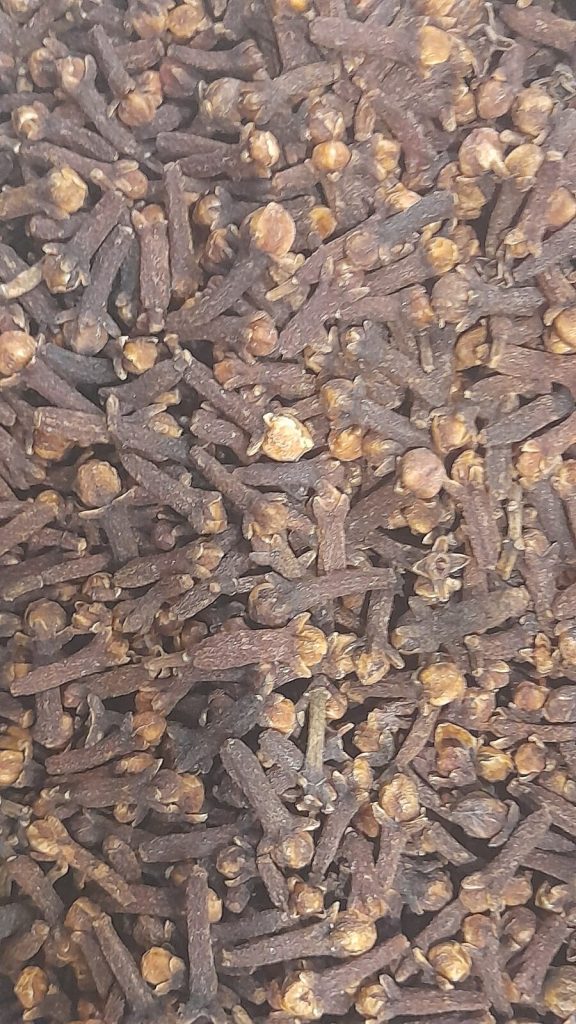
Uganda does not produce cloves commercially, and no national harvest figure exists. Clove farming in Uganda amounts to a handful of trial plantings and a busy trade in seedlings sold online. Clove is the dried unopened flower bud of Syzygium aromaticum, a lowland tropical tree from the Maluku Islands that wants more rain and steadier heat than most of the country gives. Whether it can pay on your land comes down to altitude, rainfall and patience.
That is a blunt opening, and it is deliberate. Search for this crop in Uganda and you will mostly meet nurseries with a phone number, not growers with a harvest. Before spending money on trees that will not be picked for the better part of a decade, it is worth knowing exactly what the plant demands and how far your land sits from it.
Where Clove Production Actually Happens, and Why Uganda Is Not On the List
Clove production is one of the most concentrated in world agriculture. FAO's production series for the crop carries only seven countries. Indonesia sits far out in front at roughly 137,600 tonnes a year, followed by Madagascar at roughly 24,300 tonnes, Tanzania at roughly 8,600 tonnes, Comoros at roughly 7,100 tonnes and Sri Lanka at roughly 5,700 tonnes. Kenya and China make up the tail with around 2,000 and 1,300 tonnes.
Uganda is not on that list. Not as a small producer, not as a marginal one. Absent.
Trade records tell the same story from the other side. Comtrade figures reached through the World Bank's trade database show Uganda buying small quantities of cloves from its neighbours, volumes measured in a tonne or two, and shipping none out. Cloves also do not appear among the priority commodities the Ministry of Agriculture, Animal Industry and Fisheries has built its extension work around, and I could find no NARO variety release, no NARO agronomic package and no Ugandan extension pamphlet for the crop. For a country with published recommendations on maize spacing and coffee pruning, that silence is informative.
Note where the East African clove tonnage actually comes from. Tanzania's crop is overwhelmingly Zanzibar and Pemba, islands sitting at sea level in permanently humid air. Kenya's small volume comes off the coastal strip. Both are warm, wet and low. Neither looks anything like the Ugandan plateau.
The Rainfall, Heat and Altitude Clove Farming Demands
The requirements for clove farming are narrow, and they are the reason the world map looks the way it does. The Indian Spices Board pamphlet on the crop, the Tamil Nadu Agricultural University package and the CABI derived datasheet published through PlantVillage all converge on the same numbers: a humid tropical climate with annual rainfall of 1,500 to 2,500 mm, spread through the year rather than dumped in two bursts, and a mean temperature in the 20C to 30C band. PlantVillage gives the optimum more tightly, at 16C to 27C, and flags that clove trees are very sensitive to stress.
Altitude is where the sources argue. Kerala Agricultural University puts the crop from mean sea level up to 800 to 900 m. Tamil Nadu Agricultural University allows up to 1,000 m. The Indian Spices Board stretches it to 1,500 m for Indian conditions, which works there because the wet Western Ghats stay warm and humid well up the slope. The safest reading is that clove is a lowland tree that tolerates moderate elevation only where humidity stays high and the dry season stays short.
Now set Uganda against that.
| Condition | What clove needs | Uganda typically |
|---|---|---|
| Annual rainfall | 1,500 to 2,500 mm | about 1,197 mm |
| Rain pattern | well spread | two dry seasons |
| Mean temperature | 20C to 30C | about 22.8C |
| Altitude | to about 900 m | 900 to 1,500 m |
| Humidity | high, year round | high near lakes |
Those Ugandan figures come from the World Bank's climate data for the country and from FAO's own country paper. The national average rainfall of about 1,197 mm sits a full 300 mm below clove's floor. Southern Uganda ranges from 600 to 2,200 mm and the north from 400 to 1,600 mm, so the wettest corners do clear the bar, but the national picture does not. Mean temperature of about 22.8C is comfortably inside clove's band. Altitude is the harder problem: vast parts of the country lie between 900 and 1,500 m, which starts at the top of clove's comfortable range and climbs out of it.
Which Parts of Uganda Come Closest for Growing Cloves
If growing cloves is going to be attempted anywhere in Uganda, the sensible place to look is wherever cocoa already does well. Cocoa occupies almost exactly the same niche as clove: warm, humid, low, shaded, no long drought. It is a crop with a proven Ugandan record, so its districts double as a map of the country's humid tropical pockets.
Ugandan cocoa research consistently names the same areas. The Semliki side of Bundibugyo, along with Ntoroko and parts of Kasese, sits in a hot low basin behind the Rwenzori with heavy rainfall. The Albertine belt through Hoima, Kibaale and Masindi carries a second cluster. The third and largest runs along the Lake Victoria crescent through Mukono, Buikwe, Jinja, Iganga, Kamuli, Mpigi and Luwero, where the lake pushes annual rainfall towards 2,100 mm and holds humidity up through the dry months.
Those are the candidates. They are not endorsements. Cocoa tolerates a cooler, higher site than clove does, so a district that grows good cocoa is a place worth a trial rather than a place where clove is known to work. The honest position is that nobody has published a Ugandan clove trial result, and until someone does, every planting is the trial.
One practical read on this: the same lake basin districts already carry cinnamon. The Daily Monitor has reported cinnamon growing around Mukono, Kayunga, Wakiso, Buikwe and Masaka, which is useful because cinnamon and clove want similar warmth and moisture, and cinnamon starts paying years sooner.
How Many Years a Clove Tree Takes Before the First Harvest
This is the part most seedling pitches leave out, and it matters more than any other single fact on this page. A clove tree is not a season crop. The wait to a first pickable harvest runs to years, and the wait to a full crop runs much longer.
The sources disagree on the front end, which tells you something about how much site quality decides it. The Indian Spices Board says trees start flowering from the fourth year after planting in fertile soil under good management. Tamil Nadu Agricultural University puts bearing from the sixth year. Kerala Agricultural University says seven to eight years. The McCormick Science Institute gives about six years to flowering and about twenty to full maturity, while the Spices Board pamphlet puts full bearing at about the fifteenth year.
Take the middle of that honestly and you get a plan, not a promise.
Read against the timeline, the sums change shape. Between the nursery and the first real crop sits close to a decade of inputs with nothing coming back. That is fine for a farmer planting a few trees at the edge of a banana plot. It is a serious risk for anyone borrowing to put an acre under clove on the strength of a social media post. Once trees do come into bearing, the picking and drying work is where the money is made or lost, and that is covered separately in the guide to how cloves are picked at the right stage and dried down to grade.
Raising Clove Seedlings From Seed
Clove is raised from seed, and the seed is unusually unforgiving. There is no widely used commercial cutting or graft method in any of the recommendations I checked, so a nursery either has viable seed or it has nothing.
Seed comes from fruits called mother of clove, which are left on the tree to ripen fully and drop. Collectors gather the fallen fruit, soak it overnight and peel off the pericarp, which lifts germination noticeably compared with sowing the whole fruit. Only fully developed, even sized seeds showing a pink radicle are worth sowing. Here is the catch: clove seed dies fast. Heaping the fruit or tying it in airtight bags kills it, and the Spices Board is explicit that seed should go into the ground immediately after harvest. A bag of clove seed that has travelled for weeks is very likely dead.
Beds are raised, fertile, high in humus and shaded from direct sun. Sowing depth is about 2 cm, with seed spaced a few centimetres apart in beds or dropped straight into polybags filled with a soil, sand and well rotted manure mix. Germinated seedlings move into polybags roughly 25 cm by 15 cm, then often into larger bags a year later. They need steady watering and real shade, then hardening off with gradually increasing sun before they go out.
Nursery losses are the main risk. Kerala Agricultural University records seedling wilt, caused by a mix of Cylindrocladium, Fusarium and Rhizoctonia, killing 5 to 40 percent of seedlings across the majority of nurseries it surveyed. Affected seedlings lose their leaf gloss, droop and die, with discoloured collars and roots. Infected plants spread it, so they come out of the nursery immediately rather than being nursed along.
Spacing, Shade and Planting Out a Clove Orchard
Field spacing for clove is wide, because the tree gets big: 8 to 12 m tall at maturity, sometimes 15 m. The Indian Spices Board specifies pits 75 cm cubed at 6 to 7 m spacing. Kerala Agricultural University uses 60 cm pits at 6 m by 6 m. PlantVillage cites 8 m as the recommended spacing while noting closer plantings are common. Pits are dug ahead of time, left to weather, then part filled with compost, green leaf or well rotted cattle manure mixed back with topsoil.
At 6 m by 6 m you fit roughly 110 trees per acre. Stretch to 8 m by 8 m and it falls to about 60. That spread matters when you are costing seedlings and planning shade, and it is worth working out before buying, using the same arithmetic as any other plant population calculation for a block of land.
Shade is not optional for young clove. The recommendations are consistent: clove prefers partial shade, young trees need temporary shading against sun stress, and the classic nurse crop is banana, which throws the cool humid microclimate the tree wants. Gliricidia works too and has the advantage that it can be pruned to open or close the canopy through the season. In its home systems clove is a mixed crop, grown under older coconut, areca or coffee. In Uganda the obvious parallel is a banana plot or a shaded coffee garden, which is also the most sensible way to trial the crop: a few trees inside a system that is already earning, rather than a clean field of clove earning nothing for eight years.
Planting goes in at the start of the rains. Sites want protection from strong wind, which damages the brittle branch structure, and slopes facing away from the hottest afternoon sun. Waterlogging kills clove as surely as drought, so drainage is checked before the pit is dug, not after.
Soil, Manure and Fertilizer for Young Clove Trees
Clove wants deep, rich loam with plenty of humus and free drainage. Laterite soils and the black loams of semi forest ground are both named as suited. Shallow soil is the killer, because the tree has no tolerance for water stress and needs depth to ride out a dry spell.
There is no Ugandan fertilizer recommendation for clove, so the only published schedule available is Indian. Kerala Agricultural University applies cattle manure or compost at 15 kg per tree per year at the start of the main rains, with mineral nutrition rising as the tree ages: a small dose in year one, roughly double in year two, climbing gradually to a much heavier annual dose for a well grown tree of fifteen years or more, split across two applications and placed in shallow trenches about a metre to a metre and a quarter out from the trunk. Tamil Nadu Agricultural University follows the same shape with different numbers, pairing farmyard manure with a nitrogen, phosphorus and potassium split and adding biofertilizer inoculants.
Two things follow from that. The specific gram figures are calibrated to Indian soils and are not a Ugandan recommendation, so treat them as an indication of the ratio and the escalation rather than a prescription. And the practical core of it, heavy organic matter every year plus potassium leaning nutrition on a bearing tree, is sound anywhere. A soil test before committing land is worth far more here than on an annual crop, because you cannot move a tree you have already waited six years for.
Pests and Diseases of Clove Farming
The pest and disease list for clove is short but the entries are serious, and most of them hit either the nursery or the flower buds, which is to say the two things that decide whether you get a crop.
Stem borers and shoot borers attack young trees. The stem borer girdles the trunk near the base and tunnels downward, covering the wound with a mat of frass, and an infested tree usually dies. Shoot borers take tender shoots. Scale insects, including wax, shield, masked and soft scales, cluster on tender stems and leaf undersides in the nursery and on young field trees, draining sap and leaving yellow spots and wilting shoots.
On the disease side, leaf spot, twig blight and flower bud shedding all come from a single fungus, Colletotrichum gloeosporioides, and the bud shedding stage is the one that costs money because it strips the crop during heavy continuous rain. Leaf rot caused by Cylindrocladium quinqueseptatum defoliates trees. Dieback moves down a branch from a wound until it reaches a junction and kills everything above it, which is one reason careless harvesting damages next season. Sumatra disease, a bacterium spread by sucking insects, kills a tree within about three years of infection.
On chemicals, a warning that applies to this whole page. The published control measures are Indian recommendations reaching for copper based sprays such as Bordeaux mixture as a prophylactic, carbendazim for leaf rot and the nursery wilts, and organophosphates such as quinalphos and dimethoate for the borers and scales. None of that transfers automatically to Uganda. A product has to be registered for use here, the rate and interval come off the label and nowhere else, and on a food spice there is a pre harvest interval to respect before picking. No number from a foreign package should go into a Ugandan sprayer without a local extension officer or a qualified agronomist confirming both the product and the dose. Buying from a licensed agro input dealer who can show you the label is the baseline.
Most of the honest protection here is cultural anyway: sound shade, no waterlogging, clean nursery beds, pruned out dead wood, and burning infected material rather than leaving it in the plot.
Clove Yield Per Tree and What a Small Plot Gives
Yield figures for clove are published per tree rather than per acre, which is the right way round for a tree crop and awkward for anyone used to bags per acre. Tamil Nadu Agricultural University gives 2 to 3 kg of dried buds per tree. Kerala Agricultural University gives 3 to 4 kg. Call it 2 to 4 kg of dried buds from a mature tree in a good year, and note that both figures describe trees at full bearing, so fifteen years and up, on Indian sites under Indian management.
Two things bend that number. Clove is an alternate bearing tree: a heavy crop drains the tree and is followed by a light year of vegetative recovery, so averaging across two seasons is more honest than quoting a peak. And dried weight is roughly a third of picked weight, since clove loses about two thirds of its fresh green weight in drying. Four kilos dried started as something over twelve kilos of picked buds.
Multiplying out at 110 trees an acre is tempting and misleading, because it assumes every tree survives to full bearing on a site nobody has tested. A more useful way to hold it: a handful of trees inside an existing banana or coffee plot, reaching a few kilos each in a decade, is a plausible Ugandan outcome. An acre of pure clove hitting Indian full bearing yields is a projection with no Ugandan evidence behind it.
Buying Clove Seedlings in Uganda Without Getting Burned
Almost everything published about clove farming in Uganda is a seedling advertisement. That is not a conspiracy, it is just what happens when demand for a crop runs ahead of any agronomy: the only people with a reason to write about it are the people selling the trees. It does mean a buyer has to do the verification nobody else has done.
One more thing. Clove seedlings and clove the spice are different markets, and it is easy to confuse the two when reading prices online. If what you actually want is cloves to trade, grind or resell, the route is the supplier side of the spice rather than a nursery, and if you do eventually get a crop off your own trees, the outlet is the buyer side.
Spices That Already Earn in Uganda If Clove Does Not Suit Your Land
Most readers who reach the end of this page will conclude their land is wrong for clove, and for most Ugandan land that is the correct conclusion. It is worth saying what does work, because the underlying interest, a high value spice on a small plot, is entirely reasonable.
Cinnamon farming is the closest substitute and the strongest candidate. It is a tree, it likes the same warm humid conditions, it is already grown in the Lake Victoria basin districts, and the harvest is bark rather than a flower bud, so the picking window is far more forgiving. Black pepper is a vine and suits the same shaded systems, with Ugandan growers around Mukono having worked with it for years. Cardamom is the interesting one for higher ground, since it wants the 900 to 1,300 m band that clove struggles in, and it starts producing in a fraction of clove's time.
For anyone weighing several options against their own altitude and rainfall rather than against a single crop's pitch, the comparison across the spices that actually return money in Ugandan conditions is the better starting point, and the wider spice and herb growing section covers the rest of the family.
Clove Farming in Uganda: Questions Growers Ask
Can cloves really grow in Uganda? A clove tree can survive in the warm humid pockets of the country, particularly the low basins around Lake Victoria, the Albertine belt and the Semliki side of Bundibugyo. Growing and bearing a worthwhile crop are different things. Uganda appears in no clove production dataset, has no published trial result and no research recommendation for the crop, so the honest answer is that it is unproven here rather than impossible.
How many years before a clove tree produces? Four years at the very earliest on excellent soil under good management, six to eight years more commonly, and full bearing at about fifteen to twenty years. Add two years in the nursery before that if you are starting from seed. The tree then lives for over a century.
What does it cost to start a small clove plot? The cost is driven by three things, none of which has a fixed Ugandan price: the number of seedlings, which at 6 m by 6 m spacing means roughly 110 an acre, the shade and land preparation, and the years of weeding, manure and dry season watering before any income arrives. Seedling prices in Uganda vary widely by nursery and have no published benchmark, so it is worth checking two or three current quotes locally and reading the current input and produce price pages before budgeting. The dominant cost on a clove plot is not cash, it is the years.
Where can I buy genuine clove seedlings in Uganda? Nurseries do advertise them, mostly through social media rather than through the established seed trade, and there is no certification scheme for clove planting material in the country. Use the four checks above, buy small on a first attempt, and treat any nursery that cannot show you a bearing tree as an unproven supplier rather than a fraud. Starting your own seedlings is only realistic if you can get fresh seed, which means seed from a fruiting tree within days.
Is clove worth more than cinnamon or black pepper for a Ugandan grower? Per kilo, dried clove trades well on the world market, and premium grades do better than bulk. Per acre and per year, the picture reverses for Uganda, because cinnamon and black pepper begin returning money years earlier, both have a Ugandan track record, and neither depends on hitting a precise flower bud stage. A crop that pays more per kilo but nothing for eight years is not the higher earner.
Do clove trees need shade? Yes, especially when young. Temporary shade at planting and partial shade afterwards are both standard, and banana is the usual nurse crop because it holds humidity while cutting light. Full exposure stresses young trees, and clove handles stress badly.
Can I grow a clove tree in my compound in Kampala? As an ornamental and a curiosity, quite possibly. Kampala sits at roughly 1,200 m, above the altitude band most recommendations give, so a tree may grow perfectly well and still never set buds worth picking. If the aim is a crop rather than a tree, a lower and wetter site gives you a far better chance.
Clove prices move with the world market and with grade, and the Ugandan retail spice price has little to do with what a grower would be paid, so the useful habit is to watch current spice prices and talk to bulk buyers and input suppliers directly before committing land to any spice. On a crop this slow, that conversation is worth having before the seedlings go in the ground rather than eight years later.