
Black pepper farming in Uganda is not an established industry, and the useful starting point is why. Piper nigrum is a climbing vine that wants 2,500 to 4,000mm of rain a year, a tree or post to climb, and three to four years in the ground before it bears anything. Uganda's long term average rainfall is about 1,286mm. No Ugandan planted area, tonnage or released variety has been published anywhere.
That is not a reason to dismiss the crop outright. It is a reason to test it carefully rather than plant an acre on the strength of an article. What follows is the crop's real requirements, what can and cannot be established about it in Uganda, and how a grower could trial it without losing four years.
What Black Pepper Needs to Grow, in Numbers
The requirements for Piper nigrum are well documented, because it has been cultivated commercially for centuries in south and southeast Asia. The figures below come from the reference crop database maintained by the Food and Agriculture Organization.
| Requirement | What the vine wants | Tolerates |
|---|---|---|
| Annual rainfall | 2,500 to 4,000mm | 2,000 to 5,500mm |
| Daytime temperature | 22 to 35 degrees | 10 to 40 degrees |
| Altitude | Up to 500m | Up to 2,000m |
| Soil pH | 6 to 7 | 5 to 7.5 |
Two of those four rows are comfortable in Uganda. Temperature is fine across almost the whole country. Altitude is fine, since the tolerance reaches 2,000m and most Ugandan farmland sits below that. Soil pH between 6 and 7 is achievable on many Ugandan soils and the tolerance band is wide. It is the rainfall row that does the damage, and it does it twice: once on the total, and once on how the rain is spread.
Beyond the climate figures, three structural facts about the crop matter more than any of them. It begins bearing in three to four years. It reaches full production around year seven. It then has an economic life of roughly twelve to twenty years. This is a tree crop's cash flow wearing a vine's shape, closer to a vanilla or cocoa decision than to a chilli or ginger one.
Uganda's Rainfall Measured Against the Crop
Uganda's national mean annual rainfall, from the long run climate record held in the World Bank climate portal, is about 1,286mm. That is roughly half the low end of what black pepper prefers, and it sits under even the bottom of the tolerance band at 2,000mm.
Be careful with that comparison, though, because a national average does not settle a crop's fate on its own. India's national mean rainfall is about 1,110mm, lower than Uganda's, and India is one of the world's established black pepper producers. The reason is that Indian pepper is not grown on the national average. It is grown in the Western Ghats, a narrow belt of very high rainfall, while most of the country is far drier. So the honest question for Uganda is not whether the average clears the bar. It is whether Uganda contains a zone that clears it.
Uganda's wettest country lies on the Rwenzori foothills, the Semliki side of Bundibugyo, the higher slopes of Mount Elgon, the Lake Victoria shore and islands, and the far southwest. Those places are wetter than the national figure, and none of them reaches the 2,500mm the crop prefers. Some of the very wettest pockets may sit near the bottom of the tolerance range. That is a materially different proposition from the conditions in Kerala, Vietnam or Sarawak, and it means any Ugandan pepper planting is a marginal one relying on irrigation and shade to close the gap.
The second rainfall problem is distribution. Uganda's rain arrives in two pushes, roughly March to May and August to November, with a dry stretch from December to February and a drier gap in June and July. Black pepper wants moisture that is consistent, because it flowers and sets fruit over an extended period rather than in one burst. A crop that is dry for eight to ten weeks in the middle of its year carries a handicap that no fertilizer corrects.
What Is Actually Documented About Black Pepper Farming in Uganda
Here is where the research stops giving comfortable answers, so the state of the evidence is set out plainly rather than smoothed over.
There is a regional comparison worth knowing. Tanzania does grow black pepper, and researchers at Sokoine University of Agriculture surveyed growers in Morogoro Rural, Muheza and Zanzibar, documenting farmer named genotypes, where planting material comes from and what the constraints are. Their findings are instructive for anyone in Uganda: planting material moves informally between neighbours and from growers' own stock rather than through any formal system, farmer names for genotypes do not correspond to genetic distinctness, and the leading constraints growers reported were low price, a knowledge gap and drought. Tanzania is further along with this crop than Uganda and still has none of the infrastructure a new grower would want.
Black Pepper Is Grown From Cuttings, Not From Seed
This is the single most common error in writing about black pepper, and it will cost a grower a season if believed. Commercial black pepper is propagated from stem cuttings. Seed germinates, in two to three weeks from ripe shade dried seed with the flesh removed, but it is not the commercial route. Seedlings raised from seed are not true to the parent vine, they take longer to come into bearing, and nobody in the established producing countries starts a plantation that way.
Any guidance telling you to buy high germination, disease free black pepper seed and sow it at the start of the rains is describing something other than commercial pepper growing. What you need instead is cutting material taken from a vine that is already performing, which in Uganda means finding a vine at all. That, rather than agronomy, is the first practical obstacle: there is no described source of Ugandan black pepper planting material, and importing vegetative material brings its own plant health clearance requirements through the plant health division at the Ministry of Agriculture.
The wider point holds for any perennial: on a crop you will live with for fifteen years, planting material quality compounds. A poor choice on an annual costs you one season. A poor choice here costs you the decade.
Planting Black Pepper Against a Support Tree or Standard
The vine climbs. It attaches by adventitious roots along its stems, and in cultivation it is normally held to three or four metres although it can reach ten. So every plant needs a standard, meaning either a living support tree or a post, and the choice of standard is a real decision rather than a detail.
A living standard gives shade, which the crop wants, and it grows with the vine. It also competes for water and nutrients and has to be pruned to keep the shade right, which is annual work. A dead post or concrete standard competes for nothing and needs no pruning, and it gives no shade at all, which in Uganda's light means the vine carries more heat stress in the dry months. Where black pepper is grown as a secondary crop in the shade of something taller, which is the traditional pattern, the standard and the shade come as one.
In Uganda the obvious candidate is a coffee or cocoa system that already has shade trees in it, and the regional research institutes that work on coffee and cocoa have looked at spices as intercrops in those systems. Realistically that is how a Ugandan grower would start: a small number of vines on existing shade trees in an established plantation, not a new field laid out for pepper.
The Years Before a Black Pepper Harvest, and What They Cost
Three to four years to first bearing, seven to full production. Read those two numbers as a cash flow rather than as agronomy and the crop looks different.
For three or four years the planting takes labour, water, mulch, pruning and standard maintenance, and returns nothing. In year four or five it returns a fraction of its eventual output. It reaches its real yield around the time a farmer who planted an annual crop on the same land would be into their fourteenth harvest. The land is committed throughout, so whatever else that ground would have earned is part of the cost.
Anyone who has grown vanilla knows this shape of decision already: a long establishment, a demanding crop, and a return that depends on a world price you do not influence. The difference is that vanilla has a Ugandan industry behind it, with known buyers, known practice and a curing trade. Black pepper in Uganda has none of that, so the establishment years carry the ordinary risk of a perennial plus the risk that no buyer chain exists when you finally have a crop.
Soil, Shade and Water for a Black Pepper Planting
Assuming a site has passed the rainfall test, the management is not exotic. The vine wants a neutral soil rich in organic matter, free draining, with no standing water at any point. Mulching around the base holds moisture and adds organic matter as it breaks down, and it is the cheapest intervention available in a Ugandan dry season.
Partial shade is what the crop prefers, not full sun and not deep shade. Getting that balance is why the living standard needs pruning: too much canopy and the vine does not fruit, too little and it cooks. Water delivery matters more than water volume, since the requirement is consistency rather than quantity at any one moment, which is what makes drip attractive on a permanent planting.
Beyond that, the honest position is that nobody has published a fertilizer rate, a manure rate or a mulch depth for black pepper under Ugandan conditions. Rates from Indian or Vietnamese practice exist, and they were developed under two to four times Uganda's rainfall, which changes how nutrients move and how much the plant can take up. Anybody quoting a confident Ugandan fertilizer rate for this crop is quoting something that does not exist.
Pests and Diseases That End a Black Pepper Planting
The disease to know by name is foot rot, caused by Phytophthora, and it is the one that kills whole plantings rather than reducing yield. Research on black pepper in India has quantified the farm level economic damage it does. It is a soil and water borne problem, which ties it straight back to drainage: a site that holds water is a site that will get it. Sucking pests including mealybugs and aphids also occur on the crop.
On control, the only responsible thing to say is what is true. Uganda has no registered crop protection programme for black pepper, because Uganda has no black pepper crop to register one for. That means there is no Ugandan label to read for this crop, and it means a grower should not assume a product registered for coffee or cocoa is appropriate or legal on pepper. Take that question to the Agrochemicals Control Division at the Ministry of Agriculture or to a district extension officer before applying anything, and never take a rate, a dilution or a preharvest interval from a guide written for another country. On a perennial in a food crop, the interval between a last spray and harvest is not a formality.
The cultural controls are the ones a Ugandan grower can rely on: plant on ground that drains, keep the base clear and mulched rather than waterlogged, prune the standard so air moves through the canopy, and remove and destroy diseased material rather than leaving it in the row.
Harvesting and Drying Peppercorns
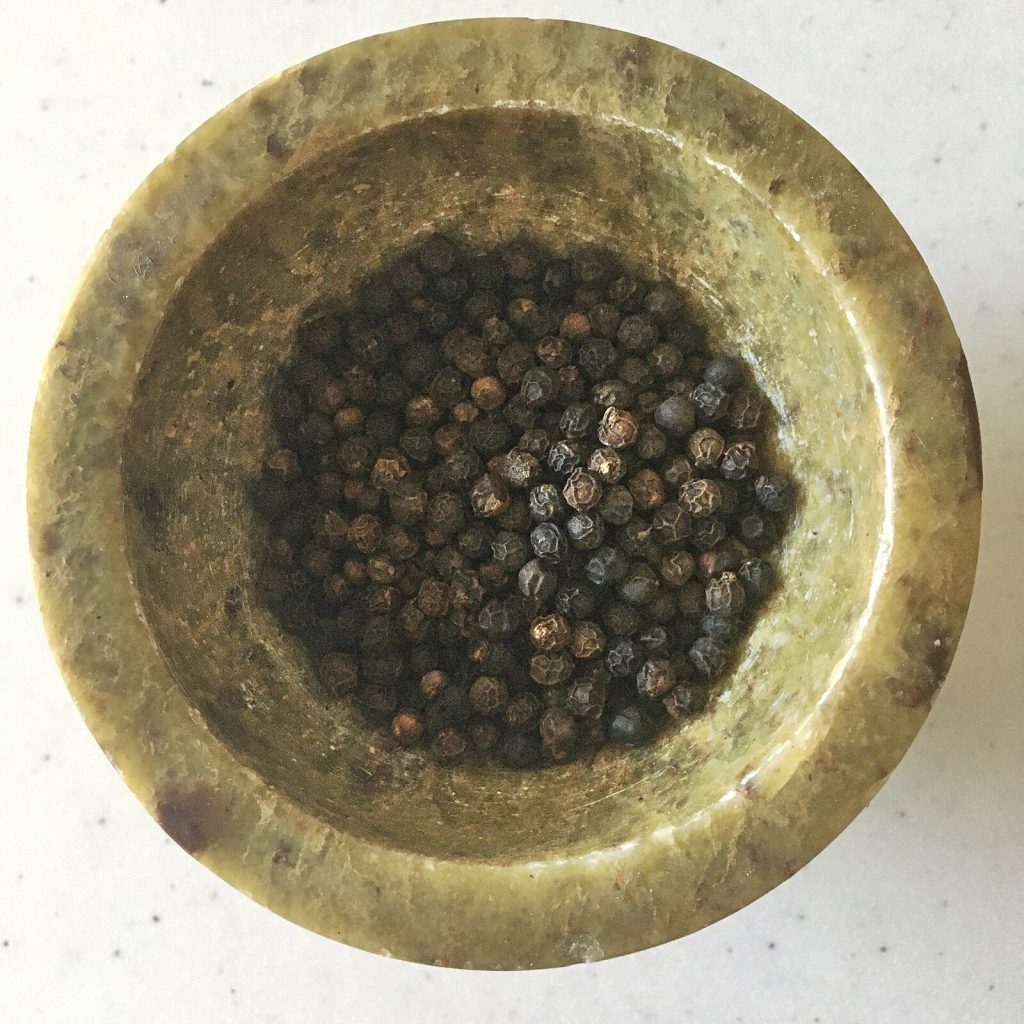
The same vine yields black, green and white pepper, and the difference is when you pick and what you do next. Black pepper comes from berries picked mature but before full ripeness, then dried whole in the sun until the skin blackens and wrinkles. Green pepper is the immature berry, preserved rather than dried. White pepper is the fully ripe berry with the outer skin removed by soaking before drying, and it fetches more than black.
The yield relationship between the three is worth knowing because it explains the price gap. The reference figures for a low input planting are about 6 tonnes per hectare of fresh green berries, which reduce to roughly 2 tonnes of sun dried black pepper or about 1.67 tonnes of washed and dried white pepper. Under high input garden conditions the same reference gives 8 to 9 tonnes of fresh berries at first harvest rising to 12 to 20 tonnes by the sixth or seventh. Those are figures from established producing systems under two to four times Uganda's rainfall, and there is no Ugandan number to set against them.
Drying discipline is the same as for any spice and the consequences are the same. Dried pepper is a low moisture food and the recognised hazard in international trade is salmonella, which has no tolerance at all in a spice specification and reaches the crop through contaminated water, manure, hands and animals walking over a crop dried outdoors. Black pepper from one major origin has been subject to increased European border testing for salmonella at 50 percent of consignments, which tells you how seriously buyers treat it. Dry off the ground, dry thin, keep the crop dry through storage and transport. The general principles are in our guide to spice drying and processing.
Black Pepper Markets and Prices Uganda Growers Would Face
Black pepper is a genuine world commodity with a transparent price, which is both the good news and the bad. The international pepper body publishes daily indicative prices from the main producing origins, and those have recently run in a band of roughly 5,800 to 9,300 United States dollars a tonne for black pepper depending on origin and grade, with white pepper higher at roughly 8,400 to 12,200. Those prices move, so treat the band as an order of magnitude rather than a quote.
What that transparency means for a Ugandan grower is that there is no premium available for being Ugandan. Pepper is bought on grade, moisture, cleanliness and bulk density, and a buyer comparing origins compares numbers. The origins reported in those daily prices are Indonesia, Brazil, Malaysia and Vietnam. Uganda is not among them, and a new origin entering a mature commodity market with small volumes and no track record negotiates from a weak position.
The realistic market for any Ugandan black pepper in the near term is domestic and regional rather than intercontinental: supermarkets, spice grinders and packers who currently source imported product. That is a smaller market, and it is one where a grinding and packaging operation or an established spice trading business is the likelier buyer than any exporter. Pepper also has a longer shelf life than most farm produce, which does at least mean a small quantity can be held rather than dumped.
How to Trial Black Pepper on a Ugandan Farm Without Betting the Field
If you have read this far and still want to grow it, do it as a trial. That is a legitimate thing to do and it is how new crops arrive anywhere.
For a broader comparison of which spices have a real Ugandan basis and which do not, see the spices and herbs hub, the most profitable spices to grow in Uganda and our page on cardamom, which faces a similar evidence gap.
Frequently Asked Questions About Black Pepper Farming in Uganda
Does Uganda grow black pepper commercially? Not at any documented scale. No planted area, no production tonnage, no released variety, no yield trial and no planting material system exist for this crop in Uganda. There is an export line in the customs data under the whole pepper heading, and Uganda does declare it, but two things about it still make it poor evidence of a Ugandan crop: it prices at around half the world black pepper level, and it moves inversely to the dried chilli heading while the two together stay steady, which is what re-labelling looks like rather than production. None of that amounts to evidence of a Ugandan crop.
Can black pepper grow in Uganda at all? Temperature and altitude are fine and soil pH is workable. Rainfall is the problem. The crop prefers 2,500 to 4,000mm a year and tolerates down to 2,000mm, while Uganda averages about 1,286mm, and even the wettest parts of the country fall short of the preferred range. So yes, individual vines can grow in wet, shaded, irrigated sites, and no, the country does not have a natural climate for it the way Kerala or Sarawak does.
How long before black pepper produces? Three to four years to first bearing and around seven years to full production, with an economic life of roughly twelve to twenty years after that. Plan the finance accordingly, because the planting returns nothing for the first three or four years while still costing labour, water and mulch.
What would it cost to trial black pepper? Nobody has published a Ugandan establishment cost for this crop, and any figure quoted for it is invented. The costs you can foresee are cutting material, labour to plant and train the vines, a water source for the dry months, mulch, and the pruning of whatever standard you use. Kept to ten or twenty vines on existing shade trees in an established plot, a trial is a small outlay. Laid out as a new field with new standards and irrigation, it is a large one with no Ugandan yield figure to justify it. Look at current input and produce prices when you cost your own version.
Is black pepper grown from seed? No. Commercial black pepper is propagated from stem cuttings taken off a vine that is already performing. Seed does germinate, in about two to three weeks, but seedlings are not true to type and take longer to bear, and no producing country establishes plantations that way. Any guide telling you to buy black pepper seed is not describing commercial practice.
What kills black pepper? Foot rot caused by Phytophthora is the disease that takes out whole plantings, and it travels in water and soil, which makes drainage the primary defence. Standing water, a shallow soil over rock, and diseased material left lying in the row are the three site and management failures behind most losses. Uganda has no registered crop protection programme for this crop, so control has to be cultural and any product use has to be checked with the Agrochemicals Control Division at the Ministry of Agriculture first.
Would there be a buyer for Ugandan black pepper? That is the question to answer before planting rather than after. The world market is transparent, supplied from Indonesia, Brazil, Malaysia and Vietnam, and it pays for grade rather than origin, so a small new origin has little leverage. The nearer market is domestic and regional: spice grinders and packers who currently buy imported pepper. Identify one and talk to them before committing four years of a plot.
The sensible next step here is a conversation rather than a purchase. Take the rainfall record for your own site to your district production office and ask whether anybody in the district has a bearing pepper vine, because if the answer is nobody then you are the trial and you should size it accordingly. Ask spice grinders and packers what they currently pay for imported pepper and what they would need to switch, and compare that against what the same ground would earn from a crop that pays this year. Current price information for the alternatives is on our produce price pages, and finding produce buyers covers how to open that conversation.