
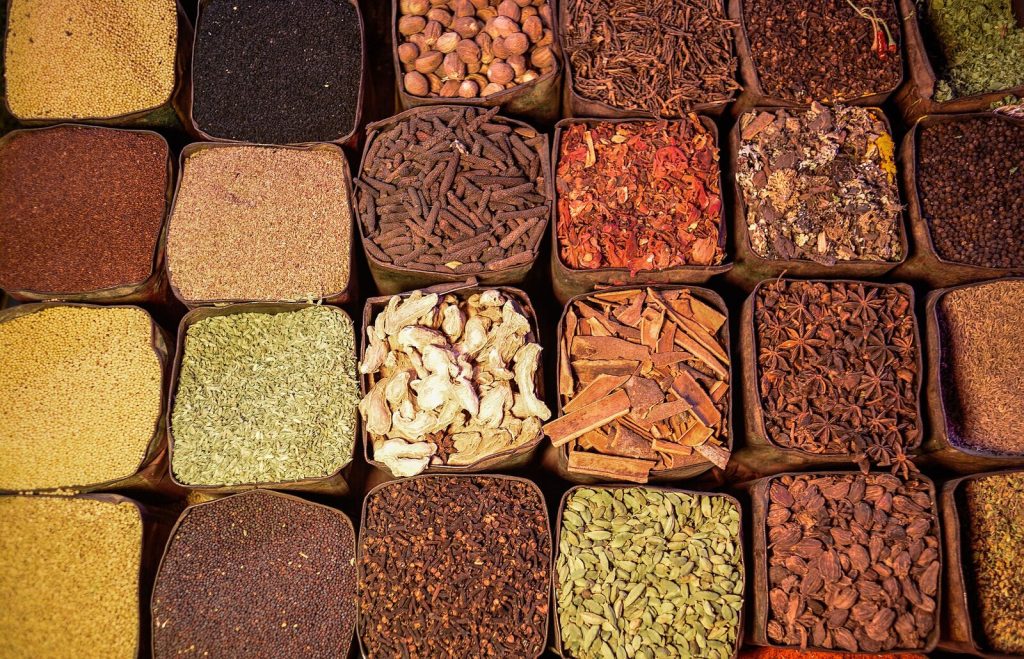
Spice drying and processing is the work of pulling water out of a harvested spice crop down to the ceiling that crop's own specification sets, then cleaning, grading and packing it without losing the aroma compounds a buyer is paying for. Most Ugandan growers do it on mats, racks, drying yards and locally built solar dryers rather than in a plant. The ceiling differs from one spice to the next, so the first job is finding out which number applies to yours.
What Drying Does to a Harvested Spice Crop
Drying a spice is not the same operation as drying grain, and the reason is what you are selling. Maize is sold as starch by weight. A spice is sold as flavour, colour and pungency carried in a small fraction of the crop's dry matter, and those compounds are volatile. So spice drying has two targets at once: get the water low enough that moulds and bacteria cannot grow, and do it gently enough that the aroma stays in the product.
The water figures involved are large. A freshly picked red chilli fruit carries somewhere around 65 to 80 percent moisture, and a peer reviewed review of dried red chilli processing puts its shelf life at that moisture at about two to three days at ambient temperature, stretching to roughly fifteen days under chilled storage. That is the whole problem in one sentence. A fresh spice harvest is a perishable crop with days of life in it, and drying is what converts it into something that keeps for a season and travels.
Two things happen as the water leaves. Microbial growth stops, because there is no longer free water for an organism to use. And the crop loses most of its weight, which is why a drying loss figure is a business number and not a technical footnote.
Every Spice Crop Has Its Own Moisture Ceiling
There is no single spice moisture figure, and a page that gives you one is guessing. Each spice sits under its own specification with its own limit, and across the spices grown or traded in Uganda those limits run from about 5 percent up to about 14. Carrying a number across from one crop to another is the commonest technical error in this whole field.
The Codex standard for black, white and green peppers sets the moisture maximum for whole black pepper at 12.0 percent for the top two grades and 13.0 percent for the third, with white pepper following the same pattern and green pepper capped at 12.0. Ground black pepper is capped at 12.0 and ground white at 13.0. Read the grade column, because the third grade is allowed a full percentage point more water than the first.
| Spice | Moisture ceiling | What sets it |
|---|---|---|
| Turmeric, for storage | 5 to 6 percent | Indian research guidance |
| Turmeric, for milling | about 10 percent | Indian research guidance |
| Chilli powder | 10 percent max | Indian standard IS 2322 |
| Black pepper, whole | 12.0 to 13.0 by grade | Codex standard CXS 326 |
| Cloves, whole | 12 percent max | ISO 2254 |
| Cinnamon | 14 percent or below | Sri Lankan authority |
Notice what that table does not contain: a Ugandan figure. The national standards body's catalogue refuses every automated request, so no Ugandan or East African moisture limit for a dried spice could be read for this page. Turmeric has a Ugandan specification listed, which our turmeric processing and drying guide names, and its numeric limits are behind the same locked door. Where the limit for your crop cannot be looked up, ask the buyer for the specification in writing before you dry a single bag to it.
One figure that is worth treating carefully sits in that table already. The 10 percent chilli powder ceiling comes from an Indian national standard quoted inside a peer reviewed review, not from a document read directly, and it is an Indian limit rather than a Ugandan or European one. Our bird's eye chilli guide declined to publish a moisture target for dried chilli at all, because the European trade figure sits behind a members' document. That page was right to withhold it and this one is not overturning that.
Drying Surfaces, Soil Contact and the Grit a Buyer Can Measure
Bare ground is the cheapest drying surface and the most expensive mistake on a spice crop. Soil brings in three separate problems. It carries the moulds that make aflatoxin. It carries spore forming bacteria, which matters most for roots and for anything picked close to the ground, and the microbiological literature on dried spice says so explicitly for garlic and ginger. And it leaves mineral grit in the product that a laboratory can measure and put a number on.
That third one surprises people. Buyers do not just look at your spice and form an opinion. The Codex pepper standard caps acid insoluble ash at 1.5 percent for whole black pepper and 1.2 percent for ground black pepper, against 0.3 percent for white. Acid insoluble ash is, in plain terms, the sand. A crop dried on a swept earth floor can fail that line while looking perfectly clean, and no amount of winnowing afterwards gets fine mineral dust back out of a ground product.
Mats, tarpaulins, raised racks, a cemented drying yard or a dryer tray all solve it. So does keeping poultry, goats and dogs away, because the same standard caps mammalian and other excreta at 1.0 milligramme per kilogramme for the top grades and 2.0 for the third.
Sun Drying, Shade Drying and Solar Dryers on Ugandan Farms
Open sun drying is what almost every Ugandan spice grower uses, and for some crops it is fine. For others it destroys the thing being sold. Direct sun bleaches colour and drives off volatile oil, which is why shade drying and enclosed solar tunnel designs repeatedly test better on aroma and pigment retention than open sun for the same crop. Where colour is the product, as in turmeric and paprika, that difference decides the price.
Rain is the other half of it. A crop that gets to 15 percent moisture, takes a shower and goes back to 25 is in worse shape than one that never started, because it has now been wet and warm twice. An enclosed dryer earns its keep in a bimodal rainfall year mainly by removing that risk rather than by drying faster.
There is one documented Ugandan result worth knowing. In a chilli project in the Lira area, locally built solar dryers were what lifted dried quality to a level traders would actually buy, and young people were trained to build and sell the dryers locally. That is the honest shape of the opportunity: the technology is buildable in country, and what it buys is market access rather than a yield gain.
How Much Weight a Spice Crop Loses in Drying
Every spice loses most of its harvested weight, and the fraction is crop specific. You need the figure before you agree a price, because a buyer quoting for dried product and a grower thinking in fresh baskets are talking about different quantities of the same harvest.
Two consequences follow. Buying fresh and selling dry is a different business from buying dry, and the two cannot use one price list. And a grower who has never weighed a fresh batch in and the dried result out does not know their own recovery, which our guide to farm weighing scales deals with directly.
Heat, Volatile Oil and the Aroma You Harvest
Drying faster is not the same as drying better. Volatile oil is the aroma, it leaves with heat, and the published trials on spice drying keep landing on the same shape of answer: moderate temperature with good airflow beats high temperature, and enclosed designs that hold a warm but not hot air stream retain more oil and colour than either open sun or a hot dryer.
How much oil is at stake is written into the standards. Whole black pepper has to carry a minimum of 2.0 millilitres of volatile oil per 100 grammes for the first grade, 1.5 for the second and 1.0 for the third. Lose oil in drying and you do not just lose quality in the abstract, you drop a grade against a measured line.
No drying temperature ceiling appears on this page, and that is deliberate. The ministry's own crop manuals carry a temperature instruction whose figure is broken in the printed document, rendering as a four digit string where two digits and a degree symbol belong. Reconstructing a number from a typographic fault is exactly the kind of guess that gets a crop ruined, so the direction is published and the figure is not: keep the air warm rather than hot, keep it moving, and take the setting from the machine's own operating manual or from the person you hire the dryer from.
Judging Dryness on a Farm Without a Moisture Meter
Few smallholders own a moisture meter, and the traditional tests are what actually get used. They are worth knowing precisely, including what each one cannot tell you.
The honest summary is that the field tests are all one sided. They are good at telling you a batch is still wet and poor at confirming it has reached a specific ceiling. On a crop where the difference between grade one and grade three is one percentage point of water, that gap matters.
Mould, Aflatoxin and Ochratoxin Limits on Named Dried Spice Crops
This is where figures get borrowed across crops and readers get misled, so each number below is printed with the crop it belongs to.
The European Union's rules on contaminants in food set, for dried Capsicum species including chillies, chilli powder, cayenne and paprika, for pepper of the Piper genus, for nutmeg and for turmeric, a maximum of 5.0 micrograms per kilogramme of aflatoxin B1 and 10.0 for the sum of the four aflatoxins. Dried ginger carries the same pair of figures under its own entry. For ochratoxin A the same rules set 15 micrograms per kilogramme for dried spices in general and 20 for dried Capsicum. Those are limits written for dried spices, by name.
Uganda's own position is different in shape. A peer reviewed review of mycotoxin regulation across Africa records Uganda's national limit as total aflatoxins at 10 micrograms per kilogramme applied to all foods, with no separate B1 figure and no ochratoxin A entry. So a Ugandan grower is working to a single blanket number at home and a two part number plus an ochratoxin limit on anything headed to Europe. Do not mix the two up, and do not quote a cereal limit at a spice buyer.
Uganda's own ministry treats this as a spice problem rather than only a cereal one. Its aflatoxin handbook for extension workers names the produce these moulds invade when it is not well dried, and spices are on that list, alongside maize, groundnuts, sorghum, soybean, millet, cassava and sweet potatoes. So a Ugandan grower drying chilli or ginger is working on a commodity the ministry has already flagged.
Where the contamination comes from is the part worth acting on. It is generated upstream, on the drying surface and in a damp store, not conjured inside a sealed pack later. A crop that touches soil, gets rained on part dried, or goes into a bag before it has cooled is where the toxin is made. Our grain moisture management guide works through the same mechanism on the grain side.
Why Drying Is Not a Kill Step for Bacteria
A dried spice has too little available water for bacteria to multiply. That is not the same as being free of them, and the distinction has cost exporters real consignments.
Pathogens survive in low moisture products for very long periods. One study tracked Salmonella in ground ginger held at a water activity of 0.53 and still recovered it after 365 days. Contaminated black pepper added to a cured meat after the step that was supposed to kill pathogens caused a multi state outbreak, precisely because the spice went in downstream of the kill. And European border notifications over a recent five year window included 250 Salmonella findings on black pepper alone, around four fifths of all such findings in the dried spice group, with paprika, coriander, cumin, chilli, ginger, turmeric, basil, dill, mint and fenugreek leaves all appearing as well.
What does kill them is heat with moisture present, and the published work puts more than a five log reduction within a minute of vacuum steam treatment at around 75 to 83 degrees. That is process plant, not farm equipment. For a grower the practical reading is simpler: you cannot fix contamination by drying harder, so keep the crop off the soil, keep animals and hands away from it, wash and dry the tools, and treat a dried spice as a raw ingredient rather than a finished food.
Grading Dried Spice and What Buyers Actually Measure
Grading is not a matter of opinion once a real specification is in play. The Codex pepper standard gives a useful picture of the kind of lines a buyer works to, because the tolerances are all published by grade.
Two lessons transfer to any spice. A grade is a bundle of separate measured limits and you can fail on one while passing the rest. And several of those limits are set by how you dried and stored the crop rather than by how you grew it, which means the processing end of the chain is where the grade is won.
Do not assume a grading premium exists until you have asked. On Ugandan produce this varies by crop rather than following a rule, and our guide to pricing produce covers how to find out whether your buyer pays for quality or only for weight.
Storage and Packing of Dried Spice Before Sale
A dried spice will pull water back out of humid air until it reaches equilibrium with the store, so the drying job is only as good as the container it goes into. Whole spice keeps far better than ground, because grinding opens up surface area for both moisture and oxygen.
Pack into clean food grade material, close and seal each package, and keep one spice and one grade per package rather than mixing. Keep the store dry, dark and free of anything with a smell, because a dried spice takes up odours from fuel, soap and agrochemicals sitting nearby. Stack off the floor on pallets or poles. Inspect for damp patches on the wall and roof after every heavy rain, and open a pack occasionally to smell it rather than relying on how it looked going in.
Where a crop will be ground and packed for retail, that is a different operation with its own equipment and its own failure modes, and the spice grinding and packaging business guide takes it from here.
Selling Dried Spice by Weight in Ugandan Markets
An unweighed sale is a price you did not set. Spice moves in tins, basins and unmarked bags at village level, and every one of those is a unit the buyer defines. It also makes your own costing impossible, because a record kept in basins cannot be turned into a cost per kilogramme, and a cost per kilogramme is the only figure that tells you whether drying paid.
Weigh the fresh harvest in. Weigh the dried product out. Write both down against the batch, with the date and the drying method. Three batches of that and you know your own dry recovery, which no published table can give you for your own crop and your own weather. Our farm record keeping guide has the format.
Where Ugandan Spice Processing Loses Money
The losses cluster in a handful of places and none of them is exotic. Drying on the ground, which costs a grade on measurable lines. Part drying, rain, and finishing a second time, which is where mould gets its chance. Bagging warm, which sweats the inside of the bag. Mixing grades and varieties into one lot, so the whole lot prices at the worst part of it. Grinding early, which starts the aroma clock running before a buyer is found. Selling by volume rather than weight. And going at an export specification without having read it, on a crop where Uganda is already in a strict testing band: half of Ugandan chilli consignments are checked for pesticide residues at the European border, against a fifth for Kenya and Rwanda.
Most of those are decisions rather than investments, which is the encouraging part. The surface you dry on and the moment you bag matter more than the equipment you own. The rest of our value addition guides work through the other crops and operations that sit in the same part of the chain.
Frequently Asked Questions
How do I know when my spice is dry enough to sell? Get the moisture ceiling for your specific crop from the buyer in writing, then measure against it with a meter rather than a field test. The snap test tells you a batch is no longer wet. It cannot distinguish 10 percent from 14, and on most spices that is the difference between two grades.
Can I dry spice in the sun, or do I need a dryer? Both work and they suit different crops. Where colour and aroma are the product, shade or an enclosed solar dryer holds quality better than open sun. Where the risk is rain interrupting the dry, an enclosed dryer is worth more for the interruption it prevents than for the hours it saves.
What does a solar dryer or a moisture meter cost in Uganda? No reliable published figure exists for either, and prices move with the exchange rate, the specification and where you buy. Collect three written quotations against one written specification before committing. A meter and a dryer are both realistic group purchases where they are out of reach for one household.
Is aflatoxin a real risk on spices, or only on maize and groundnuts? It is real enough that the European Union writes limits for dried Capsicum, pepper, nutmeg, turmeric and dried ginger by name, at 5 micrograms per kilogramme for aflatoxin B1 and 10 for the total. Drying on bare ground and storing damp are what produce it. Do not apply a maize or cereal figure to a spice, and do not apply a spice figure to a cereal.
My dried spice smells weaker than it did last season. What changed? Volatile oil left it. The usual causes are too much heat in drying, too long in open sun, grinding too early, or a pack that was not sealed. Whole spice holds aroma far longer than ground, so hold stock whole and grind close to the sale.
Does washing a spice crop before drying help or hurt? It removes soil, which is worth a lot on roots and rhizomes. It also adds water that then has to come off again, so a washed crop must go onto a drying surface immediately rather than sitting in a heap. Never wash a crop you cannot dry the same day.
Should I sell dried or fresh? That depends on your own dry recovery and on whether a dry buyer exists near you. Weigh three batches in fresh and out dry, work out the kilogrammes of fresh behind one kilogramme of dry, then compare the two prices on the same basis. For ginger that ratio sits somewhere between four and six to one, so a dry price under four times the fresh price is not an improvement.
Before you dry another batch for sale, get the moisture ceiling and the defect tolerances for your crop from the buyer in writing, and ask a local equipment fabricator or packaging supplier what a rack, a small solar dryer and sealed food grade packaging would cost for the volume you actually handle. Current prices for both equipment and dried spice vary by season, specification and supplier, so collect more than one quotation before you commit.