
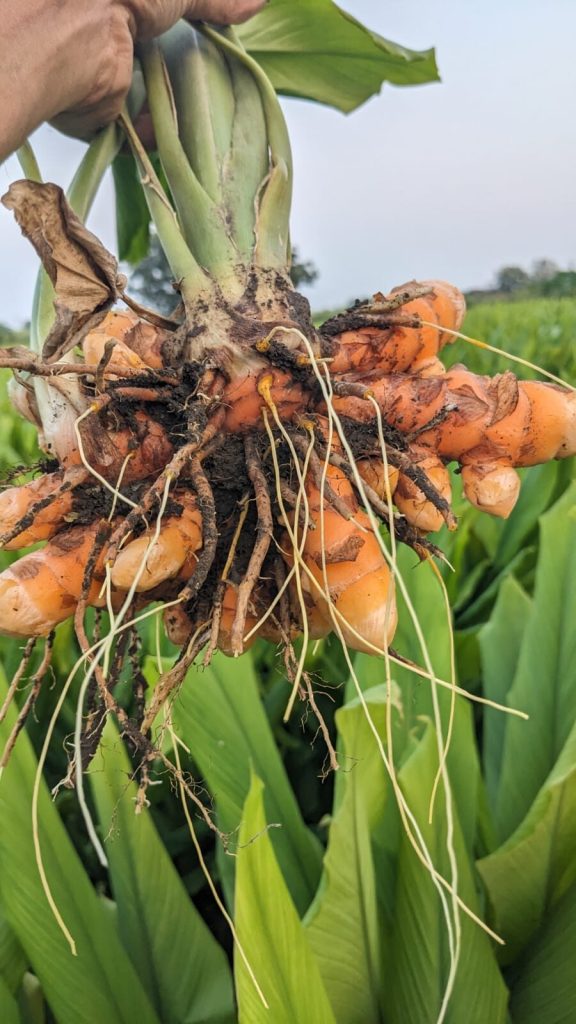
Turmeric processing and drying converts fresh rhizomes into the dried spice that buyers trade, and it takes about four fifths of the harvest weight away along the line. The line is fixed in order: wash, boil or steam, slice, dry, polish. Every one of those steps can either protect the curcumin the price is set on or destroy it, which is why two growers with an identical field crop can end up two grades apart.
What Turmeric Processing and Drying Does to the Harvest Weight
Get the conversion straight before anything else, because almost every wrong turmeric income figure comes from mixing the two weights up.
Fresh rhizomes come out of the ground at 70 to 80 percent moisture. Dried turmeric has to come down to about 10 percent for milling and 5 to 6 percent for storage. Work that through and dried product lands at roughly 20 percent of fresh weight, a figure that matches Indian research plots where 25 to 30 tonnes of fresh rhizomes per hectare give 5 to 6 tonnes cured. One curing trial measured 21.3 percent recovery directly. So five bags of fresh rhizomes become one bag of dried spice.
That loss is not waste. ICAR's work on the subject puts dried and powdered turmeric at four to five times the price of fresh rhizome in the Indian market, which is why the processing step is where a small grower's money actually sits. The dried product also stops being perishable, so it can wait for a buyer instead of the grower taking whatever is offered on harvest week.
Washing and Sorting Rhizomes After Harvest
Curing starts 2 to 5 days after lifting. Two Tier 1 sources put it at 2 to 3 days and 3 to 5 days, and the reason for the window is simple: the rhizomes need a day or two to wilt, which makes them easier to handle and cook, but leaving them longer invites rot to start from any break in the skin.
Washing is done in clean water, by hand or in a drum washer, until the soil, root hairs and loose skin are off. Damaged, rotted and cut pieces come out here, not later. Anything with a soft brown patch goes on the reject heap, because one rotting rhizome in a boiling batch taints the lot and then dries into a mouldy pocket in the store.
Then separate mother rhizomes from fingers. This is a processing decision, not just a field one. Mother rhizomes are thicker and need roughly twice the boiling time, so cooking the two together guarantees that one half is under done and the other over done. Grade by size beyond that where you can, because published work finds smaller uniform batches cure to better quality than large mixed ones. The field side of that decision, which material to keep back for planting, sits in the guide to turmeric farming in Uganda.
Boiling or Curing Turmeric After Harvest: Water, Time and Heat
Boiling is the step everything else depends on, and it is misunderstood more than any other. It is not cooking for softness alone. Heat gelatinises the starch in the rhizome, which cuts drying time hard, spreads the colour evenly through the flesh instead of leaving it concentrated near the skin, kills the rhizome so it will not sprout in store, and knocks back the insects and microbes that would otherwise ride into storage.
The mechanics, from the Indian Institute of Spices Research recommendation as reported by ICAR: clean rhizomes go into water standing 5 to 7 cm above them, and they boil for roughly 45 to 60 minutes, or until froth comes out and white fumes appear with a characteristic odour. That odour and froth endpoint is the real instruction and the clock is only an expectation, because the time depends on rhizome size, type, variety, age and the method you are using. Mother rhizomes take around 90 minutes.
Test the endpoint rather than trusting the clock. A properly cured rhizome has gone soft enough to break under finger pressure and has turned yellow all the way through when you snap one open. Pull the batch there.
| Curing method | Time | What it favours |
|---|---|---|
| Water boil, fingers | 45 to 60 min | Colour, curcumin |
| Water boil, mothers | About 90 min | Even cooking |
| Steam, whole | About 30 min | Curcumin, fuel |
| Steam, longer | Beyond 30 min | Skin removal |
Both directions from the endpoint cost you. Under boil and the rhizome turns brittle as it dries, breaking into fragments that grade low. Over boil and the curcumin degrades, which is the pigment and the active compound both. One review states the relationship plainly: curcumin content falls as boiling time rises. So a grower who leaves the pot on "to be safe" is paying for it in the only number a serious buyer measures.
Alkaline boiling is worth knowing about and worth being careful with. Adding 0.05 to 1.0 percent sodium carbonate or lime to the boiling water gives the finished powder a more intense colour, and it is standard in parts of India. Two cautions. Any additive has to be food grade, and some buyer specifications do not accept added colouring matter at all, so confirm with the buyer before treating a lot you intend to sell on specification.
Steam Curing Against Water Boiling on a Small Farm
If you are choosing equipment, this is the choice that matters, and the research leans one way.
In the trial that is most often cited, water boiling gave its best result at 40 to 45 minutes, retaining around 5.9 percent curcumin and 3.6 percent volatile oil. Steam cooking for 30 minutes did better on the broader package, at around 6 percent curcumin, 3.3 percent volatile oil and 14 percent oleoresin. Another study measured colour loss in the curcumin fraction at 1.5 to 2.5 percent under steam against 1.6 to 3.5 percent under boiling. And the practical argument is stronger than either: steam treatment used less than half the fuel of the traditional water method for the same quantity of rhizomes.
Less than half the firewood, for a step that runs for an hour a batch through a whole harvest, is the kind of saving that pays for a vessel. A steam setup is a sealed drum or perforated basket sitting over boiling water rather than in it, which a local fabricator can build.
One honest caveat. Improved equipment is not the variable on its own. In one comparison an improved boiling pot retained more volatile oil but slightly less curcumin than the traditional pot it replaced. What drives the result is time and temperature control, and a careful operator with a plain drum will beat a careless one with a purpose built boiler.
Slicing Rhizomes Before Drying and What It Saves
Cured rhizomes can be dried whole or sliced to 4 to 5 mm, by knife or with a slicer. Slicing is the cheapest way to cut drying time, and drying time is where mould and rain spoil lots.
The physics is straightforward: thinner pieces have more surface for their volume and a shorter path for moisture to travel out, so they lose water faster and more evenly. Measured work on turmeric confirms it, with sliced samples showing a higher effective moisture diffusivity and a smoother, more uniform drying curve than whole rhizomes. Curing itself does the same job from the inside. One comparison found rhizomes cured for 30 minutes dried in 18 hours where uncured rhizomes took 108.
The trade is that sliced turmeric cannot be sold as whole fingers. Whole dried fingers command their own grade and their own buyers, so if that is your market, dry whole and accept the longer drying. If you are selling into powder, slice, because nothing is lost and days are saved.
Drying Turmeric in the Sun, Under Shade Net and in Dryers
Here is the rule the whole section rests on: curcumin is degraded by heat and by direct light. Every drying decision is a trade between speed and pigment.
Open sun drying is what most Ugandan growers will use, and it works if it is done properly. Spread the boiled rhizomes or slices in layers 5 to 7 cm thick, on a raised rack or a clean tarpaulin, never straight on soil. Thin layers are worse, not better, because the pieces at the top take the full radiation load. Turn them. Heap them up or cover them at night so they do not take moisture back out of the dew, which is the commonest way a drying batch goes mouldy. Ugandan practice runs 10 to 15 days to dry.
Shaded and enclosed drying does better on quality. Research comparing methods found shade net drying giving the highest retention of both curcumin and dry recovery, and a solar tunnel dryer retaining maximum curcumin against open sun drying, with less drying time. One Ethiopian trial put its best result, close to 7 percent curcumin, on a local variety cured conventionally and dried in a solar tunnel. A solar tunnel is a simple structure: a black floor, a clear cover, an air inlet and an outlet, which raises the air temperature without exposing the slices to direct sun.
Mechanical drying has a ceiling you should not cross. Convective trials on turmeric found 60 C at an air speed of about 2 m per second gave the best overall quality, reaching target moisture in 29 hours. The curcumin numbers in the same work show why 60 C is the ceiling and not the starting point: about 2.96 percent at 50 C, 2.92 at 60 C and 2.80 at 70 C. Faster drying, less pigment. A solar conduction dryer running at 39 to 51 C air temperature took the crop from around 79 percent moisture to about 6 percent in 12 hours of effective drying, which is the best of both.
The published record on solar drying does contradict itself and it is worth knowing why. One review reports a solar dryer degrading curcuminoids by 36.5 percent, while the same table credits a solar tunnel dryer with retaining the most curcumin of any method tested. Those are different machines. Enclosed, shaded designs holding moderate temperatures protect the pigment; designs that put slices under direct high heat destroy it. Judge a dryer by the air temperature it actually holds and whether the product sees direct sun, not by the word solar on it. For the shared principles across other crops, the general spice drying and processing guide covers the same ground for the rest of the spice shelf.
Moisture Targets for Dried Turmeric and Safe Storage
Two targets, not one, and mixing them up is expensive in both directions.
| Stage | Moisture target | Why |
|---|---|---|
| At harvest | 70 to 80 percent | Starting point |
| For grinding | About 10 percent | Mills cleanly |
| For storage | 5 to 6 percent | No mould growth |
Dry to 10 percent and grind straight away and you are fine. Dry to 10 percent and store for three months in a Ugandan wet season and you are growing mould. If the lot is going into a store rather than a mill, take it to 5 or 6 percent and seal it.
Judging it without a meter: properly dried turmeric is hard, snaps rather than bends, and makes a distinct metallic click when two pieces are knocked together. A piece that bends or feels cool and leathery is still wet inside. A moisture meter is the only way to be sure, and any buyer working to a specification will have one, so it is better to know your own figure before they tell you theirs.
Polishing and Grading Dried Turmeric for the Market
Dried rhizomes come out of the drying yard rough, dull and scaly, and nobody pays a premium for that. Polishing rubs the outer skin off to expose the bright flesh underneath.
Two ways to do it. Manual polishing puts the dried rhizomes into a sack and rubs them against each other or against a hard surface, which is labour but costs nothing. Mechanical polishing tumbles them in a rotating drum lined with expanded mesh, which is faster, more even, and the right choice once volumes justify it. Either way there is weight loss, because the skin and dust leaving the rhizome is real weight, and that loss is the cost of the grade improvement.
Uganda has its own published specification for dried turmeric, US EAS 917, which covers the whole rhizome, pieces and ground turmeric, and which replaced the older ISO 5562 adoption. If you are selling to a processor, an exporter or a supermarket, that document is what your lot will be measured against, so buy it from the national standards body or ask the buyer for the specification sheet in writing before you deliver. Working to a written specification also gives you something to argue with when a buyer downgrades a lot verbally.
Curcumin and Colour: What Buyers Actually Pay For
Turmeric is bought on two things, and both are set in the processing yard as much as in the field.
Curcumin is the yellow pigment and the compound the health market wants, measured as a percentage of the dry weight. Across the peer reviewed literature, reported values run from around 2.3 percent to around 7 percent, and that spread is three things stacked: variety, curing method and drying method. The same rhizomes cured and dried two different ways have come out at measurably different curcumin levels in trial after trial. Steam curing at 30 minutes, water boiling at 40 to 45 minutes, and shaded or enclosed drying at moderate temperature are the combinations that keep the most.
Colour is what the buyer judges by eye, and it is closely related but not identical, because a bright surface can sit on a lot that has lost pigment inside. That gap is exactly what adulteration exploits.
No Ugandan measurement of curcumin in locally grown turmeric exists that I could find, so a grower here cannot look up their number, they have to have a lot tested or accept the buyer's figure. If you are serious about the higher value end of this market, budget for one laboratory test on a representative sample, because it converts an argument about colour into a number.
Adulteration, Lead Chromate and Why Buyers Test Every Lot
This is the part of turmeric processing nobody covers and every buyer now worries about, so a Ugandan producer needs to understand it before somebody offers them a shortcut.
Lead chromate is a bright yellow industrial pigment. It has been added to turmeric during post harvest polishing and grinding to brighten dull or poorly cured lots, and the research on it is peer reviewed and specific. A study published in Environmental Research assessed adulteration at Bangladesh's largest turmeric wholesale market and at polishing mills across the country. Before enforcement, 47 percent of market samples carried detectable lead, out of 631 samples, and 30 percent of mills had the pigment physically on site. After a combined programme of publicity, trader education and rapid lead testing with penalties, both figures reached zero. Blood lead levels in mill workers fell by a median of 30 percent, and the ninetieth percentile dropped from 18.2 to 9.2 micrograms per decilitre.
Lead is a neurotoxin with no safe intake, and it is worst in children. Adulteration surveys have also documented the practice across parts of India. I found no Ugandan survey either way, so nobody can say what the position is here, and the honest statement is that the practice is documented in the countries Uganda imports most of its turmeric from and that Ugandan buyers screen for it regardless.
What that means for you, practically. Never accept a colouring agent from anyone at the polishing or grinding stage, whatever it is called and whatever it is claimed to be. A brighter yellow than your crop has earned is not a quality gain, it is a contamination risk and a permanent loss of the buyer. Do your polishing yourself or in a mill you can watch. Keep your batches traceable, so a lot can be tied back to a field and a drying date. And treat the request for very bright colour from a trader who is also offering the means to achieve it as the warning sign it is. If you are grinding and packing for retail, the spice grinding and packaging business guide covers the hygiene and traceability side of running a mill.
Grinding, Packaging and Turmeric Powder Storage
Grinding is the last step and the simplest, which is why it gets rushed. Clean the dried rhizomes again before they go into the mill, because grit that survives to this point is now permanently in the powder and cannot be sieved out. Grind at 10 percent moisture or lower; wetter rhizomes gum the mill and the powder cakes in the pack.
Powder has a shorter useful life than whole dried rhizomes, because grinding opens up surface area to air and light. Whole dried fingers held at 5 to 6 percent moisture in a sealed container keep for a long time without noticeable loss, so the sensible pattern for a small producer is to store whole and grind to order.
Pack into moisture proof, food grade material, seal it, and keep it out of direct light and off the floor. Turmeric fades in light and picks up moisture from the air, and both are reversible only in the sense that you cannot reverse them. Labelling and pack format decide whether the product can go into a shop at all, which the packaging guide sets out, and if you are buying from other growers to process and resell, the spice trading guide covers the buying side.
Questions About Turmeric Processing and Drying in Uganda
How long after harvest can I leave turmeric before boiling it? Two to five days. The rhizomes want a short wilt first, which makes them easier to handle and cook, but beyond that window rot starts from any bruise or cut. If you cannot boil within five days, keep the crop in shade and airflow, and expect to reject more.
How do I know the boiling is finished? By the pot, not the clock. Froth comes out and white fumes appear with a distinct odour. A test rhizome pulled out should be soft enough to break under finger pressure and yellow all the way through when snapped. Expect 45 to 60 minutes for fingers and around 90 for mother rhizomes, but treat those as expectations and let the pot tell you.
Is steaming better than boiling? On the research, yes, on two counts. Thirty minutes of steam has retained more curcumin, oleoresin and volatile oil than the best water boil in the same trial, and steam treatment used under half the fuel for the same quantity. On a small farm the fuel saving alone usually justifies building a steaming vessel. Careful time control matters more than the equipment itself.
Can I just dry turmeric in the sun without boiling it? You can and the result is poor. Uncured rhizomes take many times longer to dry, as much as 108 hours against 18 in one comparison, the colour stays concentrated near the skin instead of spreading through the flesh, and the rhizomes can sprout in store. Some research has found higher curcumin in unboiled slices, so there is a niche argument for it, but it is not what regional buyers grade to.
What equipment do I actually need to start? A wide vessel you can boil in, a clean drying surface off the ground, sacks for manual polishing and somewhere dry and dark to store. That is the whole minimum, and a farmer group can share it. A steaming drum, a slicer, a solar tunnel or shade net dryer, a drum polisher and a mill are each worth adding as volume justifies them, in roughly that order. Get local quotations rather than trusting a published price, because fabricated equipment prices vary widely by workshop and by how much of it you can improvise.
Is processing worth the extra work over selling fresh rhizomes? On the Indian price relationship, dried and powdered turmeric has traded at four to five times the price of fresh rhizome, and the dried product stops being perishable, which removes the pressure to accept the first offer at harvest. Against that, you are carrying a fuel bill, two to three weeks of drying labour and the risk of losing a lot to rain or mould. Process a small batch first, weigh the recovery yourself and price both forms with real buyers before committing a whole harvest.
Will a buyer test my turmeric for lead? Any serious processor, exporter or supermarket supplier will screen for heavy metals, and rapid lead testing is cheap enough now to be routine. That protects you as much as them, so long as you have never let a colouring agent near your product and can trace a lot back to a field and a drying date.
Before investing in processing equipment, find out what dried whole fingers and ground powder are currently fetching from the processors and bulk buyers you can reach, and ask each of them for their written specification. The turmeric buyer listings and the wider spices section are where to start that comparison.