
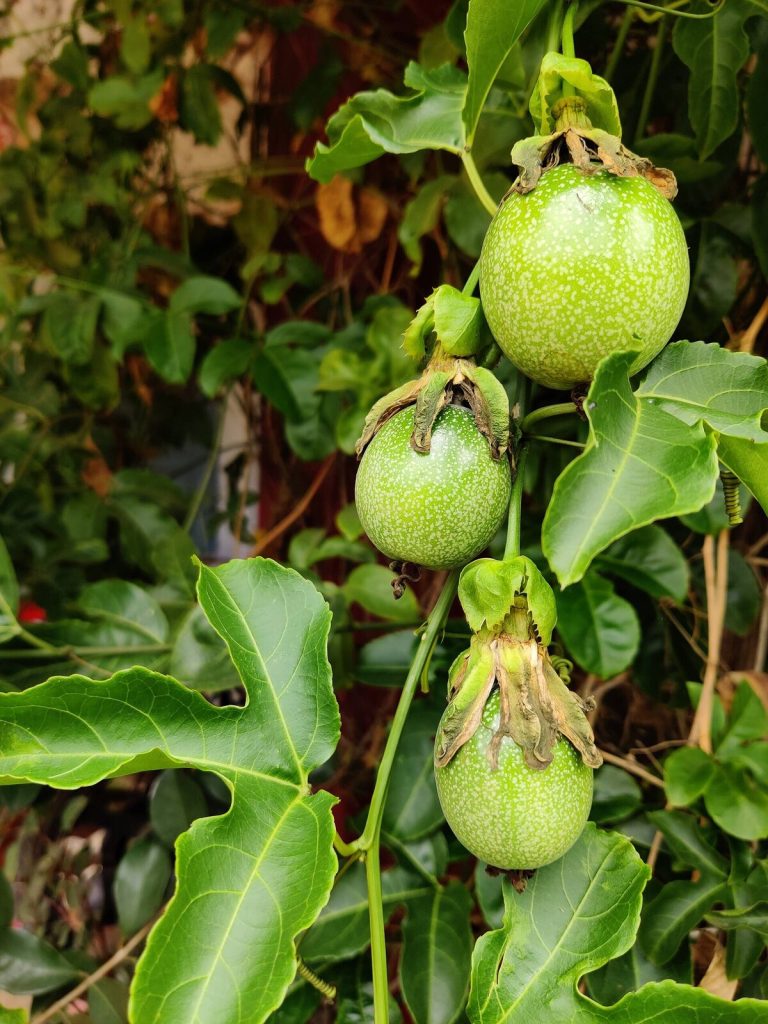
Passion fruit farming in Uganda means paying for a trellis, planting material and a year of weeding before a single fruit is sold. The crop is a perennial vine, mainly the purple type, grown from grafted or cutting raised plants on wire supports. Every cost lands first and the first harvest arrives months later, which is the shape of the whole enterprise.
How Long Before a Passion Fruit Vine in Uganda Earns Anything
Start here, because every other decision on a passion fruit farm follows from it. Uganda's National Agricultural Advisory Services describes the crop as giving back to the farmer in eight to twelve months. A university extension publication on the same species is more cautious, reporting that seedlings set out in the field spend most of the first season in vegetative growth, with a few flowers and fruit appearing late in that season only on the yellow type, and that vines raised from cuttings flower and set more fruit in their first year than seedlings do. A third published figure puts first bearing anywhere from one to three years.
Those are not contradictions so much as a range with a condition attached. The condition is what you planted. A grafted or cutting raised plant is already a mature piece of vine and starts flowering sooner; a seedling has to build itself first. So the honest answer is eight to twelve months at best and up to three years at worst, and the thing that decides which end you land on is your planting material, not your fertilizer.
Then add the lag nobody counts. A passion fruit takes 60 to 80 days from flowering to a ripe fruit. So the first flower is not the first income. It is the start of another two to three months.
That ratio is the reason a passion fruit budget cannot be written like a bean budget. With bean farming you find out inside one season whether the acre worked. Here you find out in year two, and by then the trellis money is gone.
Purple Against Yellow, and What Uganda Actually Grows
Two forms of one species are grown in Uganda: the purple passion fruit and the yellow. Researchers at Makerere University working with the National Crops Resources Research Institute state plainly that the local purple type is the predominant variety in the country, and their disease imaging work was built around it for that reason. NARO's own biotechnology group at Kawanda describes the yellow form as widely cultivated, disease tolerant, larger fruited and vigorous, and the purple as the one kept for aroma, flavour and taste.
Both statements can hold at once, and together they explain the pattern on Ugandan farms: the purple is what buyers want, the yellow is what survives. The bridge between the two is grafting, and that gets its own section below.
The yield consequence of growing the purple is large and rarely mentioned. Extension work on both forms reports that the best production reasonably expected of the yellow type is 3.5 to 7 kg of fruit per plant, and that the purple would likely produce only about a third as much. Individual fruits differ the same way: purple fruit weighs 30 to 45 g, yellow 60 to 90 g. A Ugandan grower planting purple for its market price is accepting a yield penalty to get it. That is a reasonable trade, but it has to be a decision rather than a surprise, and it is why choosing between the two forms is the first thing to settle.
Where Passion Fruit Growing Happens, and How Thin the National Record Is
When NaCRRI and Makerere set out to sample Ugandan passion fruit fields across the country's growing regions, the districts they went to were Masaka, Buikwe, Jinja, Kayunga and Mbale. That is a research sampling frame chosen to reflect variation, not a production league table, and it should be read as such. It is still the most defensible published list of where the crop is grown, because a proper one does not exist.
Here is how thin the record really is, and it matters more than any single figure.
So there is no official Ugandan acreage, no official national yield and no official farm gate series for this crop. Anyone quoting one has taken it from somewhere else. Say that out loud, because it changes how you should read every number below.
Planting Material Is the Decision That Settles the Orchard
For most Ugandan fruit there is no certified nursery scheme a grower can be pointed at, and passion fruit is one of those crops. No Ugandan licensing or certification list for passion fruit planting material surfaced in any of the four national sources checked above. That absence is the single biggest risk in the enterprise, and it is worth being blunt about why.
Passion fruit woodiness disease is caused in East Africa by a group of viruses, one of which was first described from Ugandan fields and named after the country. A survey in a neighbouring country using the same virus found it in 53 percent of leaf samples taken from plants showing no symptoms at all, against 56 percent of symptomatic samples. Read that twice. A vine can carry the virus and look healthy.
Cuttings are taken from vines that look healthy. Extension guidance on propagation says exactly this: cuttings root easily but must be selected carefully from healthy, productive plants to avoid spreading virus disease, and looking healthy is not the same as being clean. Without a testing scheme there is no way for a Ugandan buyer to tell, which means the commonest way an orchard fails is that it was infected on the day it was planted and the grower did not find out until the fruit came in small and hard.
What you can do is limited but not nothing. Buy planting material raised where you can see the mother plants. Reject any plant with mottled, distorted or puckered leaves. Plant a smaller area than you can afford so that a bad batch does not take the whole farm, and keep the rest of the money for replacement. And assume some proportion of what you plant carries virus, because on the published evidence some proportion does. The detail on symptoms sits on the passion fruit diseases page.
Spacing and Plant Population Per Acre for Passion Fruit
Spacing is where imported figures cause real damage, because the spacings published for passion fruit vary by a factor of five between countries and the plant population follows.
| Spacing | Area per plant | Plants per acre |
|---|---|---|
| 2 m by 2.5 m | 5 sq m | about 809 |
| 2 m by 3 m | 6 sq m | about 674 |
| 2.5 m by 3 m | 7.5 sq m | about 540 |
| 3 m by 3 m | 9 sq m | about 450 |
| 3 m by 4.5 m | 13.5 sq m | about 300 |
| 4.5 m by 6 m | 27 sq m | about 150 |
Those figures are straight division: an acre is 4,047 square metres, so divide by the area each plant occupies. The last two rows are the spacings published for Florida, where vines go 3 to 4.5 m apart in rows 4.5 to 6 m apart. The top rows are what East African practice looks like. A grower who reads a Florida guide and a Ugandan guide on the same afternoon is looking at populations that differ by four or five times, and the trellis, the fertilizer and the water all scale with whichever one you pick.
NAADS implies a population of about 650 vines an acre in its own yield paragraph, which lands close to 2 m by 3 m. That is a defensible Ugandan working figure. What matters more is that you count your own plants rather than assuming a number, and the method is on the plant population calculator.
Building the Passion Fruit Trellis Before Anything Goes in the Ground
The vine clings by tendrils to whatever it reaches and must have strong support, and extension guidance is explicit that a trellis goes up before planting rather than after. The reason is practical. Once a vine is growing, you cannot dig a post hole under it, and you cannot re-erect a collapsed structure without cutting the canopy off the wire.
The essentials: posts stout enough to hold the weight of the vines through a season that includes strong wind, a working trellis height of about 1.5 m with 45 to 75 cm of the post buried, and galvanized steel wire of number 9 or 10 gauge. Wires run along the row, two or three of them, or across a cross piece at the top of each post. Which system you pick changes the yield, the spray coverage and the cost, and the full comparison with post spacing and wire heights is on the passion fruit trellising guide.
One thing belongs here rather than there, because it is a budget point and not an engineering one. The trellis is a capital cost incurred in the year with no revenue, and it has to last longer than the vine or you will be rebuilding under a standing crop. That is the argument for treating wooden poles against termites before they go in.
Fertilizer Rates for Passion Fruit That Do Not Reconcile
Two published sources on this crop give fertilizer rates that are nowhere near each other, and a grower following the higher one at Ugandan plant populations would spend far more than the crop can return.
The Ugandan advisory page recommends a compound fertilizer applied at 1.5 kg per plant, four times a year. Work that through at the 650 vines an acre the same page implies and it comes to 6 kg per plant per year, or about 3,900 kg an acre a year. That is roughly 78 fifty kilogramme bags on one acre in one year.
The university extension publication on the same species takes the opposite line. It warns that passion vines are heavy feeders but that over fertilizing will damage the roots and possibly destroy the plant, and it caps a single application at 110 to 170 g of low analysis fertilizer until experience on that site shows more can be applied safely. A single 1.5 kg dose is roughly nine to fourteen times that ceiling.
Both figures are on the record and this site publishes both rather than picking one silently. Neither is a rate to follow off a web page. Get a soil test and have the district extension officer set the rate for your soil, and read the NPK explainer so you know what the numbers on the bag mean. Note that the Ugandan page warns in its own text that too much nitrogen gives leaf growth at the expense of flowering, which is an argument against its own rate. Farmyard manure and compost carry less risk of that, and the vine is shallow rooted, so mulch does real work.
Passion Fruit Yield Per Acre and the Figure Everyone Repeats
The number in circulation for Uganda is 20 kg of fruit per vine, which at 650 vines gives 13,000 kg an acre. It is repeated on Ugandan advisory and commercial pages alike. It does not survive a check against the published yield range for the crop.
What to plan on instead. Take the published per plant range for the form you are growing, multiply by your own counted plant population, and then knock off for the vines that die, the vines that carry virus and the fruit that falls and rots before you collect it. That gives a number you can defend. It will be a fraction of 13,000 kg, and finding that out now is cheaper than finding it out in year two. The method is on the break even calculator.
The Passion Fruit Export Story Cannot Be Sized From Any Published Series
Passion fruit sits in Uganda's documented horticultural export basket alongside hot pepper, okra, matooke, apple banana, pineapple, avocado, mango, sweet potato and ginger. That much is solid. What cannot be done is putting a tonnage or a value on it, and it is worth grasping before anyone plants an acre for export.
Customs classification is the obstacle. There is no tariff line for passion fruit anywhere in the international commodity nomenclature at the level countries report. It falls into a residual subheading for other fresh fruit, shared with tamarind, jackfruit, lychee and several more. Uganda does declare trade under that subheading, genuinely rather than by estimate from partner countries, which is the test worth applying before trusting any trade series. But the subheading, all fruits in it combined, moved between roughly 200 and 2,100 tonnes a year across six years of declarations, a tenfold swing between adjacent years, with implied unit values inside single years spanning about one dollar a kilogramme to figures no fresh fruit trade supports.
Work through the whole fresh fruit heading one subheading at a time and the problem shows up sharply. Uganda declares imports of strawberries, raspberries, cranberries, kiwifruit, durians and persimmons, and declares almost no exports of any of them. In one year its total declared fresh fruit exports under that heading came to about 754 tonnes, and 99.9 percent of it sat in the single subheading that names no fruit at all. The named lines accounted for under a tonne between them. So the entire export trade is inside the one code that cannot tell you what the fruit was, which is why no passion fruit export tonnage exists to quote.
Uganda's own statistical abstract is no better resolved: it reports one aggregated fruit export line worth between eight and fourteen million dollars, covering every fruit the country ships.
Against that, a peer reviewed paper by NARO researchers states that Uganda earns over 200,000 dollars a year from passion fruit exports and that the crop employs over a million farmers. Chase the citation and it goes to a trade promotion website and, as an alternative, to a social media post whose headline is that two acres will give you 28 million shillings in twelve months. That is not a criticism of the scientists, whose subject was tissue culture. It is a warning about what happens to an economic figure that no statistical agency produces: it gets sourced from promotional material and then acquires the authority of the journal that printed it.
The juice trade is the one part of this that can be read with any confidence, and it points inward. Under the customs line covering juice of other single fruits, the line passion fruit juice belongs to, Uganda's declared imports climbed from about 74 tonnes to about 1,200 tonnes across five years. Declared exports over the same stretch ran between about 77 and 580 tonnes. And in every one of those five years the imported juice cost between 1.40 and 2.40 dollars a kilogramme while the exported juice fetched between 0.35 and 0.84. Some of that gap is product rather than quality, since bulk pulp leaving the country and packaged or concentrated juice arriving are different goods in the same code. That is the point. Uganda is shipping out the cheap end of its own juice line and buying back the dear end, and no passion fruit page mentions it.
So treat the export angle as unsized rather than as large. Fresh fruit export needs certification, a packhouse, a cold chain and an airline slot, and none of that is arranged by planting. Domestic and regional fresh sales are where almost all Ugandan passion fruit actually goes, and juice processing is the nearer market and the one where the trade figures suggest room to move.
Disease Is Why Ugandan Growers Abandon Passion Fruit
NARO researchers describe declining yields from passion fruit farming, driven by viral disease, pests and environmental stress, as having initiated widespread enterprise abandonment by Ugandan farmers. That sentence should be read as the central risk of the enterprise rather than as a footnote to it.
The scale is documented. The first Ugandan survey to characterise woodiness disease found symptoms on 32 percent of plants in producing areas. Across the border, a survey of eight districts found brown spot on 55 to 100 percent of farms and dieback on 64 to 100 percent, with yield losses of 80 to 100 percent attributed to the disease complex as a whole. Over half the growers surveyed did not prune, burn infected material or disinfect their tools, and most did not scout, so control was applied only once the crop was already under heavy pressure.
That last finding is the useful one, because it is free to fix. Sanitation and early scouting cost labour rather than money, and they are the part of disease management the evidence actually supports. Pruning tool hygiene in particular does more than spraying does, for reasons set out on the diseases page. Anything involving a product belongs on the label and with an extension officer, never off a web page, and the general rules are on safe pesticide application.
Harvesting Passion Fruit and Getting Paid by the Kilogramme
Ripe fruit of both forms drops to the ground. Published practice splits on what to do about that, and the split is about your market. One extension line says not to pick before the fruit falls, because fruit taken off the vine early tastes woody, and to collect from clean weed free ground once or twice a week. The other, from a commercial fresh fruit trade, is to pick from the vine two or three times a week in warm weather while the fruit is still light purple, so it reaches the market before it wrinkles, and to let fruit for juice colour fully first.
Resolve it by asking who is buying. Juice processing wants full colour and does not care about skin; fresh market wants unwrinkled fruit and will not wait. Either way, collect daily in hot weather, because fruit lying in the sun scalds and fruit on soil picks up rot organisms. Use rigid containers rather than sacks, because sacks make the fruit sweat.
Then the part that leaks the most money. Passion fruit in Uganda is commonly traded by the sack, and a sack is not a weight. A price quoted per sack that you cannot convert to a price per kilogramme is a price you did not set, and a record kept in sacks can never become a cost per kilogramme. Weigh what leaves the farm. Keep it in a production record so that by year two you know what your own vines actually yield, which is the figure no published source can give you. The difference between a farm gate price and a market price is explained on the farm gate against retail page.
Frequently Asked Questions About Passion Fruit Farming in Uganda
How much does it cost to start a passion fruit garden in Uganda? No credible Ugandan cost figure per acre could be sourced, so here is the structure instead, with every line priced locally by you. The capital items are the trellis, which is posts, wire, staples and labour for roughly the plant population in the table above, and the planting material, which is the number of vines plus a replacement allowance. The recurring items are land preparation, planting holes, manure, weeding, water in dry spells, pruning labour and harvest labour. All of the capital and most of the first year recurring cost falls before any income. Price posts and wire at a hardware dealer and planting material at a nursery on the day you buy, because both move with the season, then use the farm profit calculator. Do not build the budget from a per acre total you found online.
What does passion fruit sell for in Uganda? It varies by season, by district, by whether the fruit is going fresh or to a processor, and by how the sale is measured. The one national survey based figure ever computed for the crop came from samples of ten and seven households in a whole country, with a standard deviation larger than the median in the second season, and it is old enough that quoting the shillings would mislead. The direction it shows is still real: the same crop was worth very different money in the two seasons of the same year. Check current prices at your nearest market and at a juice processor, and never accept a price quoted in sacks without weighing one.
Is passion fruit farming profitable in Uganda? On the published evidence the answer is conditional and the condition is disease. The only zonal gross margin ever computed for Ugandan passion fruit made it the most profitable crop enterprise in one production zone, on a sample of five households, while the national figure for the other season of the same year was small. Set that against NARO's description of widespread abandonment because of declining yields. A vine that bears for four seasons pays; a vine that gets woodiness disease in year one never does. The enterprise is a bet on planting material and sanitation more than on price.
How many passion fruit vines can I plant on one acre? Between about 450 and 809 depending on spacing, per the table above, with roughly 650 at the spacing Ugandan guidance implies. Count your own rather than assuming, because the trellis, fertilizer and water all scale with the count.
Do I need to graft passion fruit, and does grafting make it disease resistant? Grafting the purple onto a yellow rootstock is standard practice and it does one specific job: the yellow root system tolerates soil borne wilt and nematodes better than the purple root system does. A survey in the region found wilt incidence lower on farms using grafted seedlings for exactly that reason. It does nothing about woodiness disease, which infects the top of the plant, and nothing about brown spot. Grafted material is not disease resistant material, and a seller who tells you otherwise is describing something that does not exist.
How long does a passion fruit vine last? Three to five years is one published expectation and five to seven the other. Ten years has been recorded and described as exceptional. Plan replanting from the start and stagger it, so the farm is not entirely out of production in the year every vine reaches the end at once.
Can I grow passion fruit from the seed of a fruit I bought? You can germinate it, in ten to twenty days if the seed is less than a year old, but you will get a seedling of unknown parentage that takes longer to bear, may yield poorly, and in the yellow form may not set fruit at all without a compatible partner vine nearby. Seedlings are the cheapest start and the slowest. They are also, awkwardly, the safest from a virus point of view, because the disease travels in cuttings.
Does passion fruit need bees? Pollination decides fruit set, and the most effective pollinator for this crop is the carpenter bee, a large solitary bee, rather than the honeybee, which is too small to do the job well. Wind does nothing, because the pollen is heavy and sticky. The purple form sets fruit from its own pollen; many yellow vines will not set unless dusted with pollen from a different, genetically compatible vine, and two plants raised from cuttings of the same mother vine cannot pollinate each other. That is a reason to think twice before filling an acre with one clone, and a reason to be careful with broad spectrum insecticides during flowering.
For a sense of how this enterprise compares with the other tree and vine crops in the same section, start at the fruit farming hub, where pineapple and avocado sit alongside it with their own establishment periods to compare.
Before committing money, check current prices for posts, wire and planting material with local suppliers and check what a juice processor or fresh market trader in your district is paying per kilogramme this season. Both sides of that arithmetic move, and both are worth a morning of asking before an acre goes in.