
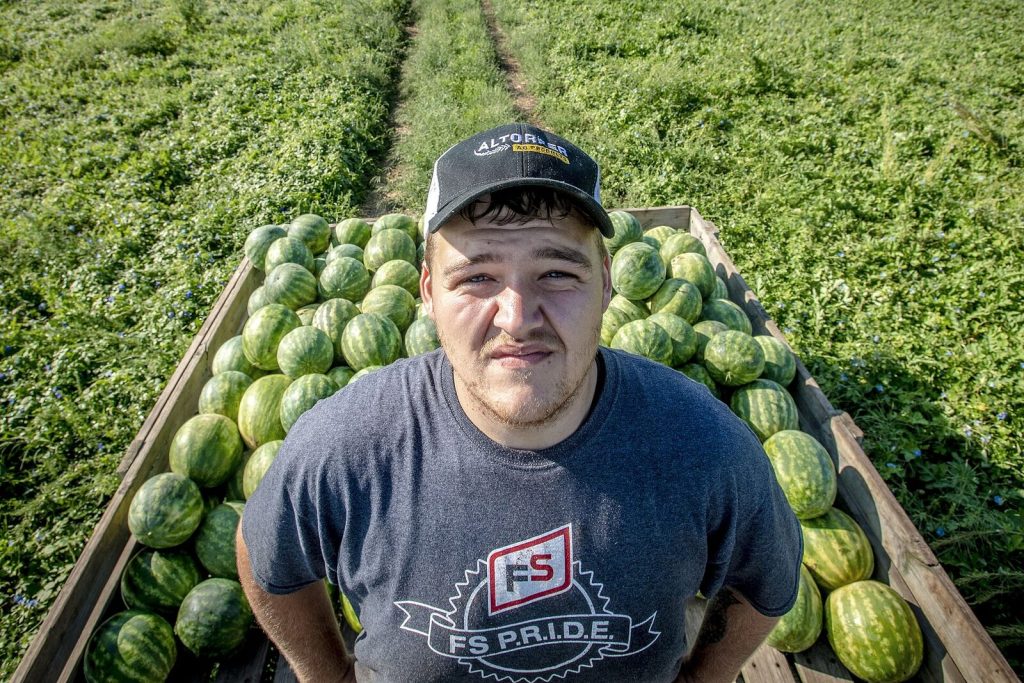
Watermelon farming costs are quoted by the acre and settled by the field. In the only
national survey of the crop, every watermelon grower sold the whole standing field at the farm gate rather
than fruit by the kilogramme. So the output of a cost calculation is not a price per kilo you need to beat.
It is the lowest lump sum you can accept for the field and still be paid for your year.
What You Are Actually Selling: Why Watermelon Costs Are Paid Per Field
A survey by Makerere University and the National Crops Resources Research Institute walked 105 watermelon
and pumpkin fields across 28 districts in nine sub regions of Uganda. Watermelon was grown by 14.3 percent
of the respondents, so about fifteen growers, and that small sample is worth keeping in mind for everything
that follows. On one point those fifteen were unanimous: they all sold the whole field. Of the whole sample
of 105 growers, only sixteen sold at the farm gate, and fifteen of those sixteen were the watermelon
growers.
Everybody else, the pumpkin growers, sold in local open markets or to traders, by the load. Watermelon
alone is sold standing.
That changes what a cost sheet is for. If you sell by weight, your costs divide by kilogrammes and give
you a price to hold out for. If you sell the field, your costs divide by nothing: they are simply the sum
you have already spent, and the offer on the table is either above it or below it. You get one number and
one conversation, usually with one buyer, usually with fruit lying in the field that will not wait.
every day of hired labour, added up, before the buyer arrives.
fruit left in the field is your loss disguised as their grading standard.
transport to market at 300,000 shillings an acre and advises negotiating for the buyer to carry it. That is
a real line either way.
a price, it is a position. High transport cost was named as a constraint by growers in the national survey,
and it is the buyer's lever.
into shillings a kilogramme. It is the only way to compare a field price against anything published.
A Published Ugandan One Acre Watermelon Budget, Line by Line
There is one full Ugandan one acre watermelon costing in circulation, published by an agricultural input
business. It is worth working through carefully rather than either adopting or dismissing it, for two
reasons. First, the arithmetic holds: I added every line and the stated total of 8,730,000
shillings is exactly right, and the revenue chain reconciles too, which is more than can be said
for most farm budgets on the Ugandan web. Second, its publisher sells inputs, so the assumptions deserve
the harder look, and the assumptions are where the problem is.
Grouped into blocks, here is where that 8,730,000 sits.
| Cost block | Amount, UGX | Share of total |
|---|---|---|
| Solar water pump | 3,500,000 | 40 percent |
| Field labour, five operations | 2,950,000 | 34 percent |
| Fertilizer, three products | 520,000 | 6 percent |
| Crop protection and traps | 440,000 | 5 percent |
| Land rent and preparation | 420,000 | 5 percent |
| Marketing and transport | 350,000 | 4 percent |
| Seed, 500 grammes | 340,000 | 4 percent |
| Sprayer, protective kit, rope | 210,000 | 2 percent |
Two of those eight blocks carry three quarters of the money, and neither of them is the thing most
people worry about when they think about watermelon. Nobody plans a melon crop around a pump and a weeding
gang. They plan it around seed and spray, which together come to 9 percent.
The land preparation lines are worth checking against Ugandan norms, because they are the easiest to
verify and they set the credibility of the rest. This budget puts ploughing at 140,000 shillings an acre
and a second pass at the same. Ugandan government crop establishment rates put bush clearing at about
150,000 shillings an acre with land opening a further 150,000, and private tractor ploughing across Ugandan
sources runs 70,000 to 150,000 shillings an acre per pass, with subsidised hire quoted from about 40,000.
So this budget's tillage sits at the top of the verified band but inside it. That is a reasonable sign.
Where the Money Goes on a Watermelon Acre: Labour Against Crop Protection
Take the pump out for a moment, because it is a capital item and the next section deals with it
separately. On the remaining 5,230,000 shillings of running cost, labour is 2,950,000, or 56
percent. Everything else together is the other 44.
Now look at what that labour is doing. Weeding runs ten times at 100,000 shillings a round, for a
million. Spraying runs twelve times at 100,000, for 1,200,000. Fertilizer application is four rounds at
100,000. Transplanting is 100,000 and harvesting 250,000.
So the single largest operation on a watermelon acre is walking the field with a knapsack, and
it costs 1,200,000 shillings to apply 440,000 shillings of product. You are paying two and three
quarter times as much to put the chemicals on as you paid for the chemicals themselves. That ratio is the
most useful thing in the whole budget, and it points somewhere unexpected: the way to cut a watermelon
spray bill is not to buy cheaper products, it is to spray fewer times. Every round you can justify dropping
saves you 100,000 shillings of labour and only a fraction of that in product.
It also explains why the mistake in the next section is so expensive.
Pests Are the Top Cost Driver, and Mixing Products Is Where the Money Leaks
Among the fifteen Ugandan watermelon growers in the national survey, pests were named as the main
constraint by 66.7 percent, with diseases at 13.3, floods at 13.3 and drought at 6.7. That
is a sharply different profile from the pumpkin growers in the same survey, where diseases led at 52.2
percent and pests followed at 31.1. Watermelon is an insect problem before it is a fungal one.
The insects the survey names as most limiting are the whitefly, the aphid, the melon fly and the
cutworm. The diseases it names are bacterial wilt, the downy mildews, anthracnose, the powdery mildews and
virus diseases, in that order of reported importance. Note what is on that pest list and what is not: the
melon fly is there, and it is the reason the published budget carries ten fruit fly traps at 8,000
shillings each. The survey separately records that pheromone traps and pesticides were the methods
frequently used in watermelon fields, while pumpkin growers mostly used ash.
And then the finding that costs Ugandan watermelon growers real money. The survey observed
several agrochemicals being mixed together in watermelon fields, alongside what it describes as a
gross lack of knowledge of the proper usage or purpose of those chemicals. Its authors flag the
consequences as pesticide resistance and health and environmental hazards. Add the labour arithmetic above
and there is a third consequence they do not mention: a grower mixing products without knowing what each
one does is paying 100,000 shillings a round to apply them.
The most common version of this error is worth naming plainly, because it appears in Ugandan writing on
watermelon as though it were advice. Fungicides and bactericides do not control insects. Microbial
inoculants are not pesticides at all. An acaricide targets mites. A grower told that the way to deal with
beetles, borers, thrips and aphids is to apply fungicides, bactericides and inoculants will spend the
season spraying the wrong things at the wrong targets, and will conclude that watermelon is unprofitable
when what was unprofitable was the programme. Our explainers on
insecticides and
fungicides set out which does what, and
how to read an agrochemical label
covers the rest. No rate or interval appears on this page: the rate is on the label, the label is the
authority, and a watermelon is eaten fresh so a pre harvest interval applies.
The Seed Line and Why Watermelon Growers Cannot Save Their Own
Seed is only 4 percent of the published budget, at 340,000 shillings for a 500 gramme rate, but it is a
cost with a particular character: you pay it again every single season, and you have no choice.
The national survey makes this vivid. Of all 105 growers, 69.5 percent used their own farm saved seed,
and only fifteen bought from agro input shops. Those fifteen were the watermelon growers, all of
them. Every watermelon grower in the survey bought seed from a shop, and the paper adds a caution
worth quoting the substance of: that seed may not necessarily be certified.
The reason is that commercial watermelon is grown from hybrid seed, and hybrid seed does not come true
from a saved fruit. The pumpkin grower next door saves seed from last season and starts at nearly zero. The
watermelon grower starts at 340,000 shillings an acre and will start there again in four months.
On provenance there is no comfortable answer to give. Seven crops are certified in Uganda and all seven are field crops:
maize, beans, sorghum, soybean, sunflower, groundnut and rice. No fruit and no vegetable is on that list. The national
variety list covers twelve field crops plus roots, tubers and banana, with no melon on it. So no Ugandan
release record stands behind any watermelon variety name you will be offered, and every one of those names
belongs to an imported commercial hybrid from a seed company rather than to a Ugandan release. Any page
presenting a watermelon variety as Ugandan is telling you something the record does not support. Our guide
to choosing quality seed covers what to check
on a packet, and germination rates
explains the one number on it that matters most when you are paying this much.
The Pump Problem: Irrigation as Capital or as a Cost
The largest single line in that budget, 3,500,000 shillings for a portable solar water pump, is 40
percent of the total, and how you treat it decides what the whole page means.
Charged in full against one acre in one season, as the published budget does, it makes the enterprise
look marginal. Spread across the life of the pump and the number of crops it waters, it almost disappears.
Both readings are defensible and the budget's own choice is the conservative one, which is worth saying in
its favour: it errs toward the answer that undercuts its own conclusion.
Whether you need the pump at all is the real question, and the Ugandan evidence says mostly yes. In the
national survey, the districts where watermelon actually turned up were an irrigation scheme in Kween and
a group of central districts. Drought was named as a constraint by growers. Watermelon needs water through
fruit filling, and the size of the fruit is what the water buys, which matters a great deal for the
break even arithmetic below. Our page on
irrigation system cost per
acre sets out the alternatives, and
solar water pumps covers the kit
this budget chose.
The honest way to handle it in your own figures is to run the acre twice, with and without, and know
which number you are looking at. That is what the next section does.
Watermelon Break Even Cost Per Fruit and Per Kilogramme
The published budget plants at two metres by one metre with two plants per hole and takes one fruit per
plant, giving 4,000 fruits an acre. I checked that: an acre holds about 2,023 holes at that spacing, so
4,047 plants, so the figure stands. It then removes 10 percent to field losses and 10 percent to harvest
and post harvest losses, leaving 3,200 fruits marketed, and sells them at 4,000 shillings each at the farm
gate for 12,800,000 shillings and a profit of 4,070,000.
Divide the cost by the fruit instead and you get the number that is actually useful, because it needs no
assumption about price at all.
| Average fruit weight | Break even, pump in | Break even, pump out |
|---|---|---|
| Per fruit, any weight | 2,728 UGX | 1,634 UGX |
| 3 kg fruit | 909 UGX a kg | 545 UGX a kg |
| 5 kg fruit | 546 UGX a kg | 327 UGX a kg |
| 7 kg fruit | 390 UGX a kg | 233 UGX a kg |
Read the first row as the reserve price for a standing field: divided across 3,200 marketable fruits,
the acre has to return at least 2,728 shillings a fruit to cover everything including the pump, or 1,634
shillings a fruit if the pump is treated as capital. Multiply whichever applies by your own fruit count and
you have the lump sum below which an offer is a loss.
Then read down the column, because this is the mechanism nobody explains. The break even price
per kilogramme falls as the fruit gets bigger, and fruit size is what the water and the nutrition buy.
At three kilogrammes a fruit you need 909 shillings a kilogramme to cover a fully loaded acre. At seven you
need 390. Nothing about the cost sheet changed between those two rows. Under watering a watermelon crop does
not just reduce the tonnage, it raises the price you need for every kilogramme of what is left, and that is
how an acre with a perfectly sensible budget turns into a loss.
The Loss Assumption That Cuts the Profit by Four Fifths
Now the assumption I would question hardest. The published budget allows 10 percent for losses after
harvest. Ugandan researchers have measured cumulative loss from farm to market on comparable fruit by
sorting a set quantity at every stage of the chain, and the answers were 27.6 percent for mango and
34.1 percent for banana, with most of the loss happening in transport between farm and market.
Watermelon has not been measured here. A heavy fruit that splits and bruises, loaded loose, has no obvious
reason to do better than a mango.
So run the same budget at the measured rates for other Ugandan fruit and change nothing else.
| Post harvest loss | Fruits marketed | Break even a fruit | Profit at 4,000 |
|---|---|---|---|
| 10 percent, as published | 3,200 | 2,728 UGX | 4,070,000 UGX |
| 20 percent | 2,880 | 3,031 UGX | 2,790,000 UGX |
| 27.6, mango measured | 2,606 | 3,350 UGX | 1,694,000 UGX |
| 34.1, banana measured | 2,372 | 3,681 UGX | 758,000 UGX |
At the loss rate measured on Ugandan bananas, the same acre with the same costs and the same selling
price returns 758,000 shillings instead of 4,070,000. The profit falls by 81 percent and not one shilling
of the cost sheet moved. That is the whole argument for spending money on crates, careful loading and a
buyer who collects, rather than on another spray round.
What Watermelon Sells For in Uganda and How Far the Price Moves
The national monthly price series does track watermelon, which makes it one of the few Ugandan fruits
with a published number. Across the twelve months of the latest recorded year it averaged 1,170
shillings a kilogramme at retail, moving between a low of 1,019 and a high of 1,377. That is a
spread of about 35 percent between the cheapest month and the dearest.
Put that in context. In the same series matooke sold by the bunch swings about 56 percent across the
year and by the kilogramme about 31 percent. Ndiizi, the sweet finger banana, moves only about 10 percent.
So watermelon is neither the volatile end of the Ugandan fruit trade nor the stable end. There is a modest
seasonal gain in timing a crop, and not enough of one to gamble a planting on.
Now hold the budget's selling price against that retail figure, because this is where it strains.
4,000 shillings a fruit divided by 1,170 shillings a kilogramme is 3.42 kilogrammes. In
other words the budget assumes a grower selling a standing field at the farm gate is paid the full national
retail price per kilogramme, on a fruit of about three and a half kilogrammes. Farm gate prices sit below
retail everywhere, and there is no single Ugandan figure for how far below: for maize the farm to nearest
market spread has been put at about 33 percent of the market price, widening by roughly two percentage
points for every extra driving hour from that market. The general Ugandan rule is that the faster a crop
dies, the more of the retail shilling the chain keeps. Our page on
farm gate price against retail price works
through why.
There is a neat coincidence in the numbers that makes the risk easy to remember. With the pump charged
in full, the acre breaks even at 2,728 shillings a fruit against a planned 4,000, so the price can fall
about 32 percent before the acre loses money. That is almost exactly the size of the measured Ugandan first
hop price spread. The margin of safety and the discount you should expect are the same number, which means
this budget is balanced on a knife.
Uganda's declared exports give a second reading on price and it is a sobering one. Customs records show
about 5,317 tonnes of watermelon declared as exports in the latest year, of which Kenya took 4,394 tonnes
and Rwanda 782, and Uganda filed those movements in its own customs returns rather than
having them reconstructed from what its neighbours reported. The declared unit
value works out around 0.20 United States dollars a kilogramme. Five years earlier the Kenya line ran at
about 0.38. So the volume going to Kenya has grown while the price per kilogramme has roughly halved, and
anyone planning an acre on the strength of regional demand should plan it on the current unit value rather
than the old one.
Two Harvests a Year and Whether the Second Crop Pays
Watermelon and pumpkin take 80 to 120 days to mature, and the national survey records that growers in
all the regions it covered can plant twice a year. That matters for the pump line above all: a capital item
watering two crops a year carries half the burden per crop that a single crop would give it.
The second crop is not a free repeat though. Seed is bought again, in full, because you cannot save
hybrid seed. Labour is paid again, in full, including the twelve spray rounds. Land preparation happens
again. What you do not pay twice for is the pump, the sprayer, the protective kit and the rope, which come
to 3,710,000 shillings of the first crop's 8,730,000.
So a rough second crop cost is the running total of 5,020,000 shillings, that being everything except
the pump, sprayer, kit and rope, and the break even falls to about 1,569 shillings a fruit at 3,200 fruits.
Run the two crops together across the year and the pump is carried by both. That is the real case for
irrigation on a watermelon plot, and it is an argument about the calendar rather than about yield.
all five labour operations, land preparation, transport and marketing.
equipment, and the planting rope. Together 3,710,000 shillings of the first crop's total.
your buyer and your real fruit weight, so the spray programme and the reserve price can both be set from
evidence instead of a template.
where a cucurbit follows a cucurbit, and bacterial wilt was the disease growers ranked first. Rotate the
block rather than repeating it in the same ground.
Frequently Asked Questions About Watermelon Farming Costs
How much does an acre of watermelon cost in Uganda, and where does the money
go? The one published Ugandan one acre budget totals 8,730,000 shillings, of which 3,500,000 is a
solar water pump charged entirely to a single crop; strip the pump out and the running cost is 5,230,000
shillings an acre. Those figures come from an agricultural input business, the arithmetic reconciles
exactly, and the land preparation lines sit inside the range verified from Ugandan government establishment
rates, so treat it as a sound structure with an optimistic price and an optimistic loss allowance. Where the
money goes is the surprise. Field labour is 2,950,000 shillings of that 5,230,000 running cost, or 56
percent, and the largest single operation inside it is spraying at 1,200,000 shillings for twelve rounds
against 440,000 shillings of product, so applying the chemicals costs nearly three times what buying them
does. Seed and spray together, the two lines everybody worries about, are under a tenth of the budget.
What is the break even price, and is watermelon farming profitable? Break even
on the published acre is 2,728 shillings a fruit with the pump charged in full, or 1,634 a fruit with the
pump treated as capital, across 3,200 marketable fruits; converted to weight that is 546 shillings a
kilogramme on a five kilogramme fruit, or 327 without the pump. Those are derived figures rather than quoted
ones, arrived at by dividing the published cost total by the published marketable fruit count. On
profitability, the budget's own answer of 4,070,000 shillings an acre rests on two assumptions that both
push the same way: only 10 percent post harvest loss, against 27.6 percent measured on Ugandan mango and
34.1 on Ugandan banana, and a farm gate price per fruit that works out at the full national retail price per
kilogramme. Move the loss allowance alone to the banana figure and the profit falls to 758,000 shillings.
Nothing here says the crop loses money. It says the margin is thinner than the headline, and that handling
rather than yield is where it is won.
How many watermelons can I get from one acre? The published budget plants 4,000 and
markets 3,200 after losses, at two metres by one metre with two plants per hole and one fruit taken per
plant. Be careful with any tonnage built from that, because there is no Ugandan yield statistic for
watermelon at all: Uganda files no watermelon production figure with FAO while 24 other African countries
and territories do, and the survey paper itself states plainly that there are no clear production
statistics for the crop here. The nearest regional figure is a mean of about 11 tonnes a hectare for East
Africa, and that is for watermelon, pumpkin, squash and gourd counted together, not for watermelon
alone.
Why do all the watermelon growers sell the whole field? The survey does not say why,
only that they do. The likely reasons are visible in the same data: watermelon is heavy, it is perishable,
high transport cost was named as a constraint, and a standing field transfers both the harvesting labour
and the post harvest loss to the buyer. What it also transfers is the price setting, which is the part that
costs you. Weigh a sample so you can convert any offer into shillings a kilogramme, and get a second offer
before the fruit is ready.
Do I need irrigation to grow watermelon in Uganda? In practice, mostly yes, and the
break even table above shows why it is not just about tonnage. Fruit size is what the water buys, and the
price you need per kilogramme falls sharply as fruit size rises, so under watering raises your break even
twice over. In the national survey, watermelon turned up in an irrigation scheme and in a cluster of
central districts, and drought was named as a constraint by growers.
Can I save seed from my own watermelons? No, not from the hybrids the crop is grown
from, and this is why every watermelon grower in the national survey bought seed from a shop while 69.5
percent of the pumpkin growers in the same survey saved their own. It is also why Uganda has no released
watermelon variety: the certified seed programme covers seven field crops and no fruit or vegetable, so
every variety name offered to you belongs to an imported commercial hybrid rather than a Ugandan
release.
Should I plant the same block twice in one year? The crop matures in 80 to 120
days and two plantings a year are normal, but put the second one on different ground. Bacterial wilt was the
disease Ugandan growers ranked first, and soil borne problems build where a cucurbit follows a cucurbit. The
second planting is also cheaper, because the pump, the sprayer, the protective kit and the rope are already
bought, which brings the running cost to roughly 5,020,000 shillings and break even down to about 1,569
shillings a fruit.
What should I settle with a buyer before they harvest my field? Four things, and settle
them before the fruit is ready rather than on the day. Who counts and who carries the fruit left behind,
because a buyer's grading standard is your loss in disguise. Whether the transport is inside the price, since
one published budget puts it at 300,000 shillings an acre. What a second buyer would offer, because a single
offer on a perishable crop is a position rather than a price. And the weight of a sample of ten fruits, so
you can turn a lump sum for the field into shillings a kilogramme and compare it with anything
published.
Which pests actually matter on a Ugandan watermelon crop? The national survey names four
insects as the most limiting: the whitefly, the aphid, the melon fly and the cutworm. On diseases it ranks
bacterial wilt first, then the downy mildews, anthracnose, the powdery mildews and the virus diseases. Two
thirds of watermelon growers named pests rather than diseases as their main constraint, which is the reverse
of the pumpkin growers in the same survey. Get the identification right before buying anything, because a
fungicide does not control an insect and the survey found growers mixing products without knowing what each
one was for.
Checking Watermelon Prices Before You Cost an Acre
Do two things before you commit money to an acre of watermelon. Find out what the fruit is fetching this
week in the markets you can actually reach, in a unit you have converted to shillings a kilogramme, because
watermelon is one of the few Ugandan fruits with a published national series to check yourself against and
our price pages track how far it moves between months. Then price your own version of
the budget above with local quotations for seed, fertilizer, crop protection and a day of hired labour,
which our supplier pages can start you on, and put your own fruit count and your
own loss allowance into the break even lines rather than borrowing anybody's. If you want the growing side
rather than the money, our guide to
watermelon farming in Uganda covers the
agronomy, cucumber farming covers the other
cucurbit grown for the same buyers, and the fruit farming hub puts this
crop alongside the perennials, which ask for years of spending before they pay anything at all.