Apple banana farming in Uganda means growing Sukali Ndiizi, a small sweet dessert banana of the Musa AAB group that fetches roughly three times what matooke does by the kilogramme. One thing decides whether a planting lives: Fusarium wilt. The fungus behind it is already in much Ugandan soil, this cultivar is highly susceptible to it, and no treatment removes it once it is there.
Apple Banana Is Sukali Ndiizi, and It Is Not a Cooking Banana Variety
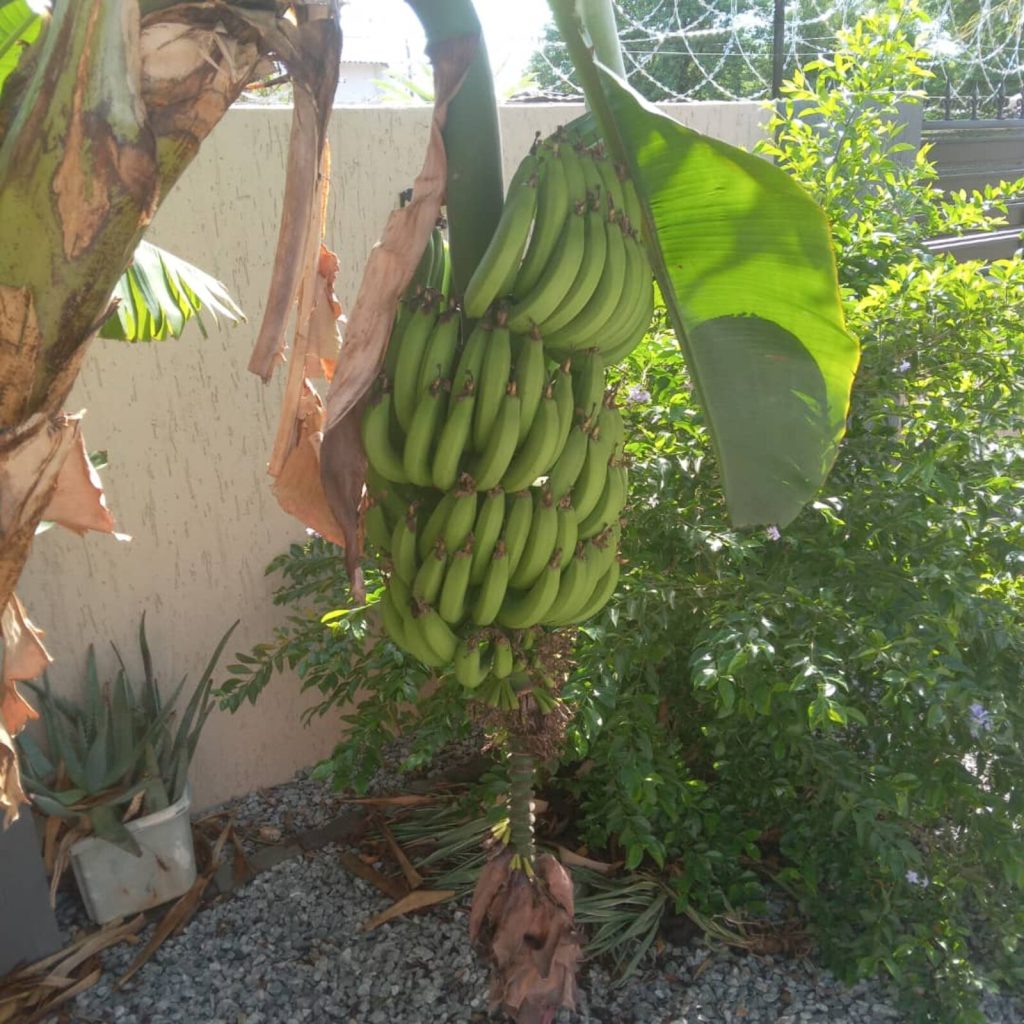
Apple banana is the trade name most often used in Uganda for the cultivar written as Sukali Ndiizi, Sukari Ndizi, or simply Ndizi. Ugandan research papers place it in the Musa AAB genome group, which separates it from the AAA East African highland bananas that make up matooke and mbidde. Its fingers are short, thick skinned and noticeably sweet, and it is eaten ripe rather than cooked.
Its subgroup is not settled in the published record, and that is worth saying rather than picking one. A study published by Ugandan and regional plant pathologists describes it as Silk, AAB. A separate study by national research and IITA staff lists it under the Ney Poovan grouping alongside Kisubi (AB). Both agree on AAB. Where two peer reviewed sources give a crop's classification differently, the honest thing is to publish both and say the genome group is the part everyone agrees on.
How much of Uganda's banana crop is apple banana is not separately counted. The nearest published breakdown, carried in a recent Ugandan and IITA study and sourced there to earlier work, puts the East African highland cooking types at about 70 percent of Ugandan banana production and brewing types at about 20 percent, with the dessert group, covering Bogoya (Gros Michel, AAA), Kayinja (Pisang Awak, ABB), Sukali Ndiizi and Kisubi together, at about 9 percent and plantains at 1. So apple banana sits inside a single digit share of a very large crop.
Fusarium Wilt Decides Whether an Apple Banana Planting Survives
Fusarium wilt of banana, also called Panama disease, is caused by the soil fungus Fusarium oxysporum f. sp. cubense. The strain that matters here is race 1, described in the Ugandan literature as the primary cause of Fusarium wilt in Ugandan dessert bananas. Sukali Ndiizi is classed as highly susceptible to it in every Ugandan study that uses the cultivar, which is precisely why researchers use it as the susceptible check when they screen other material.
The clearest picture of what that susceptibility does comes from a two year field experiment at the National Agricultural Research Laboratories at Kawanda. Read the numbers with the study's own condition attached: the field had been deliberately inoculated in the past to screen cultivars, so it carries a heavier pathogen load than an ordinary garden, and these are not national incidence figures.
| Stage | Plants with wilt symptoms | Note |
|---|---|---|
| Day 250 after planting | 26 to 41 percent | First wave of symptoms |
| Day 314 | 2 to 6 percent | Apparent recovery, in every plot |
| Day 433 | 66.2 to 83.8 percent | End of mother plant monitoring |
| First ratoon crop | 100 percent | Every treatment and every control |
Three things in that table matter more than the headline. The apparent recovery at day 314 was real and it was temporary, so a planting that looks like it has come through has not. Of the plants monitored to the end, 60 to 80 percent had internal corm discolouration running from a few spots to two thirds of the corm, which is damage a grower walking the plot would never see. And the ratoon crop, which is where a banana planting is supposed to start paying, reached total incidence. Only a handful of Sukali Ndiizi plants in that field produced a mature bunch at all.
Wider figures put alongside those. Ugandan and IITA authors report an estimated yield loss above 60 percent in Ugandan dessert bananas from race 1, citing earlier Ugandan work, and the disease is described in the general literature as capable of total yield loss. Neither is a measurement this page made, and both are attributed as reported.
Why Fusarium Infested Soil Stays Infested
The fungus survives in soil for decades. It does that in two ways: as thick walled resting spores called chlamydospores, and as an endophyte living harmlessly inside various weed species that then sit in the field as a reservoir. Neither is reached by anything a smallholder can apply.
That is not a counsel of despair so much as a redirection of effort. Because soil treatment does not work, the decisions that do work all happen before planting, when you choose the ground and the planting material. Everything after that is management of a risk you already took.
It is worth knowing what has been tried and failed, because promising results from pots get repeated as though they were field results. Spent substrate from oyster mushroom growing suppressed the fungus convincingly in laboratory co culture and in potted plants, where corm damage on Sukali Ndiizi fell from 3.75 to 1.25 on a six point scale. Taken to the field at the same site, applied at planting and every two months across an eight month period, it produced limited and inconsistent reductions in symptoms, no improvement in bunch development, and no effect on growth or yield at all. It also increased pseudostem splitting, with every treated plant showing a mild split by one assessment date. The researchers' own conclusion names the confounding factors, including heavy weevil damage in the treated plots. A biological control that works in a pot is a research lead, not a recommendation.
Choosing Ground for Apple Banana: Soil History Beats Every Other Input
Ask what died there. That single question is worth more than any input decision on this crop.
Nothing in that list is expensive. All of it is information, and it has to be gathered before you buy suckers rather than after.
What Resistance Looks Like, and Which Banana Varieties Have It
Resistance to race 1 exists in banana, and Ugandan screening work has identified where. Two East African highland cultivars, Mbwazirume and Mpologoma, both Musa AAA, are used as the resistant checks in Ugandan Fusarium studies and hold up in the same infested fields that take Sukali Ndiizi apart. Kayinja is used as a susceptible check.
Whether that resistance can be bred into a dessert banana is a harder question than it looks. A screening of 22 accessions held by national research and IITA in Uganda, followed by a cross between a resistant and a susceptible parent producing 142 progeny, found that resistance to race 1 is controlled by at least two dominant genes with an epistatic interaction and that heritability is low. Low heritability means selection in a breeding programme moves slowly. It is the reason no resistant apple banana is sitting on a shelf.
The practical reading for a grower is unwelcome but clear. There is no resistant version of this cultivar to buy, and swapping to a resistant cultivar means swapping to a different product with a different market. A highland cooking banana is not an apple banana and will not sell at an apple banana price. The matooke plantation management guide covers that alternative if you decide the ground rules it out.
Planting Material for Apple Banana, and Why Provenance Decides the Outcome
Sucker quality is the one control point on this crop that a grower fully owns, and nothing official stands behind it. The clearest evidence of that comes from a peer reviewed Ugandan study whose own closing recommendation is that fruit nurseries in the country should be established and certified. A recommendation to create something is a statement that it does not yet exist. A regional banana disease manual says the same from the other direction about the whole of Eastern and Central Africa, and the ministry's certified seed listing confirms it by omission: field crops are covered, fruit is not.
So nobody can hand you a certificate, and anyone claiming to is claiming something the country does not operate. What replaces it is inspection and provenance. Take material only from a block with no history of wilt. Pare the corm back to clean white tissue and reject anything with heavy internal spotting. Prefer narrow leaved sword suckers, which the national production manual identifies as carrying fewer weevils and nematodes than larger material. Plant within about a week of lifting.
Tissue culture plantlets are the one route that starts from material grown in a laboratory rather than lifted from a field, and Ugandan research trials use them for exactly that reason. Two honest caveats. A clean plantlet planted into infested soil still gets infected, which is what the Kawanda field experiment demonstrates, because every plant in it was tissue culture derived. And a plantlet needs more careful nursing through its first months than a sucker does. Clean material solves the carriage problem, not the soil problem. Sucker selection and hot water treatment are set out on the banana farming guide.
Spacing and Plant Population for an Apple Banana Garden
The national production manual gives banana spacing as 3 m by 3 m or wider, which works out at about 1,111 plants a hectare and roughly 450 an acre. Apple banana is a smaller plant than a highland cooking banana, and growers do plant it more closely, but no Ugandan spacing recommendation specific to the cultivar could be verified, so the manual's figure is the one to plan from until a local extension officer gives you a district specific alternative.
Planting holes are 30 by 30 by 30 cm at minimum, commonly 45 cm and up to 60. Manure goes into the hole. Time the planting so the young plant gets four to six months of unstressed growth through the rains rather than going in during the last weeks of a wet season, because that establishment window is what sets the first bunch. Working out a population for an irregular plot is on the plant population calculator page.
Growing the Mat: Desuckering, Propping and Bunch Care
Mat work on this cultivar follows the same rules as on a cooking banana and asks less of you, because the plant is smaller. Three stems per stool is the ceiling. Leaf numbers at flowering and at harvest matter as much here as anywhere, and a filling bunch wants its prop early rather than once it starts to lean. The full treatment, including the leaf counts, is on the matooke plantation management guide.
Two things differ. A thin skinned sweet banana bruises more easily, so the way a bunch is cut down and carried is part of its price rather than an afterthought. And because Fusarium wilt works from inside the corm, a plant that starts to yellow from the older outer leaves upward, then splits at the base of the pseudostem, is showing you the disease rather than drought. Cut one such plant across the corm and you will see the brown vascular discolouration. That is the diagnosis, and it is free.
The Apple Banana Market in Uganda: Premium, Stability and Shelf Life
The reason growers keep planting a cultivar that a soil fungus can take is that the price is genuinely better and genuinely steadier. In the national consumer price series published in the ministry's statistical abstract, banana short finger, which is Ndiizi, averaged 2,790 shillings a kilogramme across the twelve monthly figures, against 1,890 for Bogoya, 1,240 for matooke by cluster and 1,000 for matooke by the bunch. Those are consumer prices collected across urban centres, not farm gate prices, and a farm gate figure will be lower and will move with the district and the season.
The month to month behaviour is the more interesting half. Ndiizi's monthly values run from 2,636 to 2,896 shillings a kilogramme, a spread of about 10 percent between the cheapest and the dearest month. Matooke by the bunch runs from 773 to 1,210, a spread of about 56 percent. So apple banana is the dearer product, and it is also by far the more predictable one to budget against. For a grower deciding what to plant, price stability is worth real money, because it is the thing that makes a harvest plannable.
Set against that, a short shelf life. A ripe apple banana moves fast or it is lost, which pushes growers toward buyers close by and toward selling on a schedule rather than a glut. Handling matters more than it does on a cooking banana: bruises show. Packing guidance is on the produce packaging page, current figures on the banana and matooke price page, and the difference between what a market pays and what a farm receives on the farm gate against retail explainer.
Other Pests and Diseases That Reach an Apple Banana Planting
Fusarium wilt is the decision, not the whole list.
Banana Xanthomonas wilt does not care which cultivar you planted. Every cultivated banana variety is susceptible, and resistance is known only from a wild progenitor. It travels on cutting tools and through insects visiting the male bud, so the measures are tool sterilisation with a 20 percent household bleach solution, flaming, or a minute in boiling water, plus removing the male bud with a forked wooden stick rather than a blade. Ash, stabbing a blade into soil and cold water washing are all recorded as ineffective.
Banana bunchy top disease deserves a mention because of how it spreads. Ugandan work at Kawanda on the banana aphid that carries the virus found that mechanical disturbance simulating routine farm operations such as removing dead leaves and roguing strongly increased aphid movement, and occasionally triggered flight. Winged aphids turned up across colonies of every size, so a small colony is not a safe colony. The other route is the movement of infected planting material between fields, which puts this disease in the same category as the last two: it arrives with the suckers.
The banana weevil and nematodes both attack the corm and the roots, and the Kawanda Fusarium trial recorded heavy weevil damage in the same field, alongside plants snapping and toppling from pest damage during bunch filling. On a plant already fighting a vascular fungus, corm damage compounds. The plantation scale treatment of both sits on the matooke plantation management guide.
On chemicals for any of these, the site's position is fixed and worth restating. Uganda's register of agricultural chemicals lists products, their active ingredients, their registrant and their expiry date, and it has no crop column, so a product being registered never means it is cleared for use on bananas. The label decides that. How to read one is on the agrochemical labels guide.
Apple Banana Farming Against Apple Growing in Uganda: Two Different Crops
Searches for apple banana and for apples in Uganda collide constantly, and a grower who acts on the wrong one wastes years on a tree.
Apple banana is a banana, a herbaceous perennial that fruits within about a year to eighteen months of planting and is propagated from suckers or tissue culture. The temperate apple is Malus domestica, a woody deciduous tree that does not come true from seed, is grown on grafted rootstocks, and needs a winter chilling period that almost nowhere in Uganda provides. Anything advising that apple trees be raised from apple seed, or quoting a thousand fruits from a tree, is not describing a crop that works. There is also a naming trap: winter banana is a registered apple cultivar name, and bell apple is a name used in the region for a passion fruit relative rather than for any apple. Neither has anything to do with Sukali Ndiizi.
If what you want is a sweet dessert banana that sells at a premium and can be planted this season, apple banana is the crop on this page. The wider set of Ugandan fruit options is on the fruit farming hub.
Frequently Asked Questions
Can I plant apple banana where Fusarium wilt has already killed bananas? No, and this is the one hard rule on the crop. The fungus survives in soil for decades as resting spores and inside weed species, nothing a farmer can apply removes it, and every biological control tried in Uganda has failed once it reached the field. Use that ground for a crop outside the banana family, or for a resistant highland cooking cultivar, and plant your apple banana somewhere with no wilt history.
How long before an apple banana planting starts paying? A new planting needs four to six months of unstressed growth to establish, and a bunch then takes three to four months from flowering, so the first harvest is well over a year from planting and the plot earns nothing in between. Do not read the 122 to 160 day column in the national variety list as time to first crop: that column is flowering to harvest, and reading it the other way would promise a bunch in four months. Under Fusarium pressure the wait stretches further, with one Kawanda trial recording a resistant cultivar taking around 617 days from planting to harvest in one treatment.
Is apple banana more profitable than matooke? Per kilogramme the price is clearly better, at about 2,790 shillings against about 1,000 for matooke by the bunch in the national consumer series, and the price is far steadier month to month at roughly 10 percent spread against 56. Whether that becomes profit depends on something the price cannot tell you: how many crop cycles the planting survives. A high value block that collapses in the first ratoon earns less than a cooking banana block that runs for years. No verified Ugandan gross margin for apple banana exists, so treat the premium as the upside and the plantation's life expectancy as the risk, and price both before planting.
Where can I buy certified apple banana suckers? Nowhere, because Uganda has no certified banana or fruit nursery scheme, and this page will not imply one exists. What you can do is choose a source block with no wilt history, inspect and pare every corm to white tissue, reject spotted material, and consider tissue culture plantlets where you can get them, knowing that clean material protects against carriage and not against infested soil.
Does apple banana need different spacing from matooke? Probably closer, given the smaller plant, but no Ugandan spacing recommendation specific to the cultivar could be verified. The national manual's 3 m by 3 m or wider, giving roughly 450 plants an acre, is the defensible planning figure, and a district extension officer is the right person to tighten it for local conditions.
Why do my apple banana leaves turn yellow from the bottom up? Older outer leaves yellowing first, hanging down the pseudostem, with a split at the base of the stem, is the classic picture of Fusarium wilt. Cut the corm across and look for brown staining in the vascular tissue. If the yellowing starts on young leaves instead, or the male bud wilts first, or cut tissue oozes cream coloured fluid, you are looking at Xanthomonas wilt, which spreads on tools and needs a different response.
Can I intercrop a young apple banana planting? Yes, in the months before the canopy closes, and the national manual lists intercrops while warning in the same passage about soil exhaustion and competition for nutrients, water and light. Keep anything in the same susceptible banana group out of the plot entirely.
Prices and planting material availability both move with the season and the district, so check the prices section before you budget and the suppliers section when you are sourcing material. Then go and ask what died on the plot.