
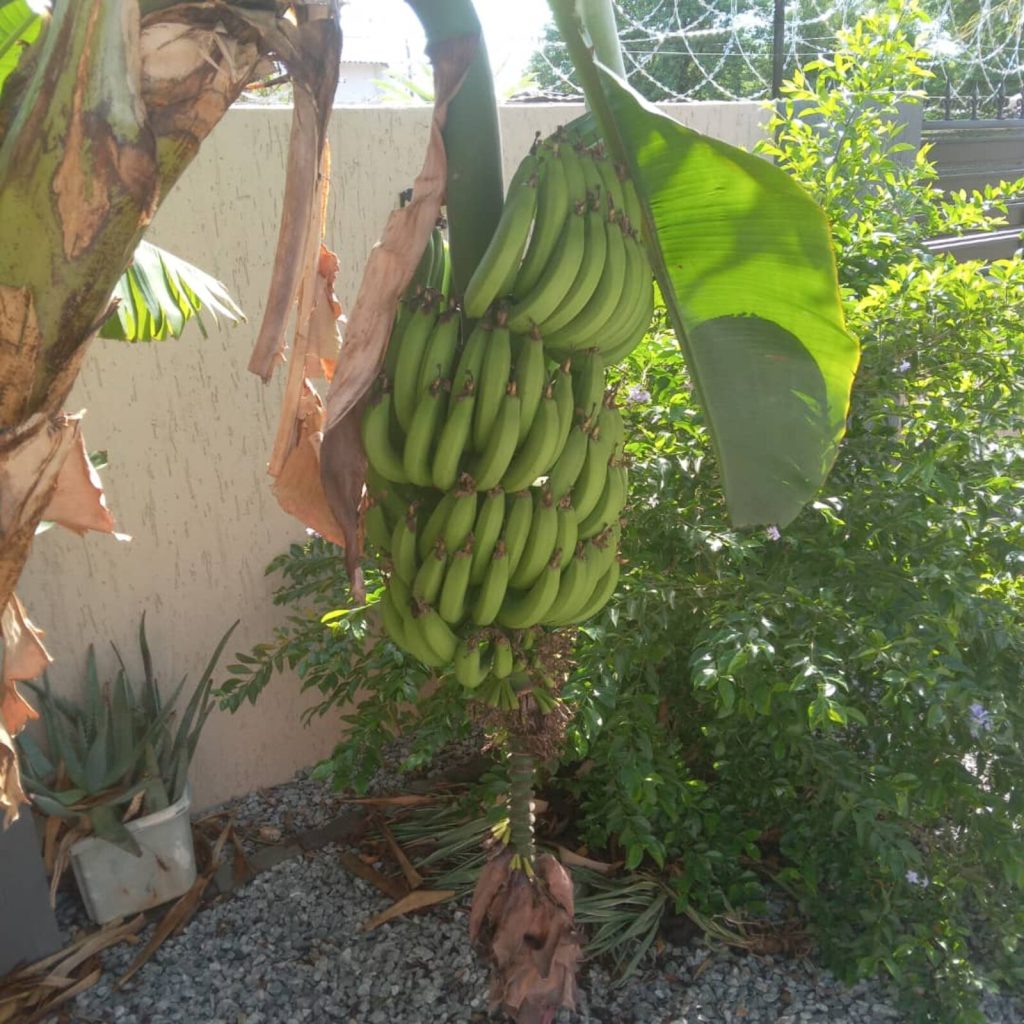
Matooke plantation management is the work done on a mat that is already planted: desuckering to a set number of stems, feeding the stool, keeping the weevil population down, and deciding when a tired mat should be replaced rather than nursed. Uganda's measured national banana food yield sits at 12.33 to 15.4 tonnes a hectare. Research stations put the attainable figure several times higher. Almost all of that gap is made after planting.
Matooke Yield Per Hectare in Uganda Against What Research Says Is Possible
Two sets of numbers exist and they do not sit anywhere near each other. The ministry's own abstract, drawing on the national agricultural survey, prints banana food yield at 12.33, then 12.46, then 15.4 tonnes a hectare, and its prose settles on 15.4 as the national estimate. Ugandan and international research teams publishing on East African highland banana give on farm productivity as 10 to 20 tonnes a hectare a year in one paper and 5 to 30 in another, against attainable yields those same papers put at 60 to 70 and above 60.
Both attainable figures come from published work by teams that include Ugandan national research and IITA staff. Neither is a farm figure. Read them as what the crop can do when water, nutrients and pest damage are all handled, which is the point: a matooke mat in Uganda commonly delivers between a sixth and a third of what the plant is capable of.
| Source | On farm yield | Attainable |
|---|---|---|
| National survey, in the ministry abstract | 12.33 to 15.4 t/ha | Not stated |
| Weevil and nutrition study, central and south west Uganda | 10 to 20 t/ha/yr | 60 to 70 t/ha/yr |
| National banana distribution mapping study | 5 to 30 t/ha/yr | Above 60 t/ha/yr |
One caution about the denominator. Ugandan banana area is published at three widely different values by three Tier 1 sources, and the yield you get depends on which area was used. That argument is set out in full on the banana farming guide, and this page simply takes the survey figures because they are the ones measured on Ugandan plots rather than divided out of an estimate.
Desuckering: How Many Plants to Grow on One Banana Mat
A banana mat is a queue. The corm throws suckers continuously, and every sucker left standing draws water and nutrients from the same stool. The national production manual's instruction is to desucker to three: one mother carrying or about to carry a bunch, one daughter following her, and one granddaughter behind that. Three is a ceiling, not a floor.
That distinction has real money in it. The live page this article replaces told readers to leave "at least three" pseudostems per stool, which points a grower in the opposite direction and produces exactly the small bunches desuckering exists to prevent. Keep three. Cut the rest.
Choose which three by shape. Sword suckers, the narrow leaved ones with a well attached base, are the ones the manual prefers for planting material and the ones to keep on the mat. Water suckers, broad leaved and shallowly attached, have a weak connection to the corm and do not build a good bunch.
Banana Weevil Damage Builds Across Every Harvest Cycle
The banana weevil is the reason plantation management is a cycle by cycle argument rather than a yearly one. Its larvae tunnel through the corm, which is the organ the plant uses to take up and move water and nutrients. Published work on East African highland banana reports that weevil damage can cost up to 44 percent of yield by the third crop cycle, and that a damaged plantation may not respond to fertilizer at all until the weevil is dealt with first. Feeding a corm that has been hollowed out is money spent on a pump with a hole in it.
Two findings from a pair of Ugandan field trials, run at Kawanda in the centre and Ntungamo in the south west, are worth carrying into a plantation plan. In the first, an organophosphate insecticide reduced corm damage while nitrogen fertilizer increased it, and phosphorus and potassium made no statistically reliable difference. In the second trial, where potassium was varied against a moderate nitrogen rate, potassium and silicon both reduced damage relative to the untreated control. The authors' conclusion is a combination, on sites where nutrient availability is low, rather than any single measure.
The uncomfortable half of the same literature: weevils attack vigorously growing plants about as readily as drought stressed or nutrient starved ones. Good husbandry does not make a mat unattractive to them.
How damage is actually measured is useful to know, because it tells you what to look at when a mat comes out. Assessment is done on the freshly cut corm still attached to the harvested pseudostem, with two cross cuts, one at the collar where stem meets corm and one about 5 cm below it. On each cut face the share of tissue eaten is estimated separately for the central cylinder and the outer cortex, and the four estimates are averaged. Cut a corm at harvest and look. It costs nothing and it tells you where in the decline your plantation sits.
Nematodes, Root Loss and Why Old Banana Plants Topple
Nematodes do the same kind of harm lower down. They feed on and inside the roots, and a mat with its root system eaten is a mat that cannot anchor a bunch. Toppling in an established plantation is usually read as wind damage. Often it is root damage that the wind merely finished.
The national manual's rotation advice for nematodes is cassava and sweet potato, which is only usable where a grower is replanting a block rather than maintaining one. On a standing mat the available measures are the ones that reduce carry over: clean planting material at establishment, prompt removal of dead material, and not moving suckers from an infested block into a clean one. The manual is blunt about chemical nematicides, treating them as economic only in commercial export plantations, which is not the situation most Ugandan matooke growers are in.
All of which raises an awkward question about where replacement suckers come from, and the answer has to be given plainly rather than dressed up. There is no certificate to ask for. A regional banana disease training manual puts it directly: certification programmes for banana planting material across Eastern and Central Africa are close to non existent, with no regulated or practical framework reaching smallholders. The ministry's own certified seed listing bears that out, since it runs to field crops and stops there. On a plantation you are maintaining, the substitute is your own eye: pare each corm back to white tissue, throw out anything heavily spotted, and never lift material out of a block you already suspect. Sucker selection and hot water treatment are detailed on the banana farming guide.
Mulch and Manure on an Established Matooke Plantation
Every bunch that leaves the plot takes nutrients with it, and matooke is harvested continuously rather than once, so the export never stops. The manual describes a heavy nitrogen and potassium demand with much lower phosphorus need, and declines to publish a fertilizer rate, which is an honest position this page keeps rather than filling in.
What is documented is what Ugandan smallholders in a multi farm study actually applied. In that work, across plots in Sembabule, Nakaseke and Kiboga districts, 10 kg of air dried cow manure went into each mat at planting, and farmers then followed with 8 to 10 kg of goat manure per plant each year. Mulch came from whatever the farm produced: maize stover, cut grass, shrub and tree trimmings, and fodder the goats had left. The published result of mulch and manure on those plots was larger bunches and higher total yield, and a separate report from the wider set of 54 farms puts the yield effect of on farm trees and shrubs at 50 to 100 percent. Treat that band as a reported figure from that programme rather than a national average.
Two placement rules from the manual matter more than the quantity. Mulch goes off the mat, not piled against the stool, because mulch sitting on the mat raises pest attack and toppling. And a thick mulch applied early encourages shallow rooting, which is the last thing a plant that has to hold up a 30 kg bunch needs. Compost and manure preparation is covered on the compost making guide and the cow manure page.
Deleafing, Propping and Harvesting the Bunch Without Wrecking the Mat
Leaves are the bunch. The manual's figures are 9 to 12 functional leaves at flowering and 4 at harvest, with no complete deleafing before the bunch comes off. Removing sound leaves to tidy a plantation or to feed livestock takes fingers off the bunch that is filling.
Bunches take three to four months from flowering. During that fill a heavy bunch pulls the plant's centre of gravity forward, and a prop is cheap against the loss of a whole bunch plus the stem carrying it. Props go in before the bunch is at risk, not once it is leaning.
At harvest, the pseudostem comes down and what happens to it next decides the weevil pressure on the next cycle. Cut it, chop it and spread it across the plot. An intact stem left lying is a sheltered, moist breeding site, and the manual is explicit that chopping and spreading removes it. Cutting to ground level and walking away, which is what the live page advises, leaves the habitat standing.
One genuine tension shows up in the Ugandan research record and it deserves stating rather than hiding. A field experiment at Kawanda deliberately withheld desuckering and deleafing for the duration of the trial, to avoid introducing or spreading Xanthomonas wilt from neighbouring fields. Cutting tools move that bacterium. So the right answer is not to stop desuckering but to sterilise between plants, which is the next section.
Keeping Xanthomonas Wilt Out of a Standing Banana Plantation
Banana Xanthomonas wilt reached banana in Uganda and eastern DR Congo in 2001 and every cultivated variety is susceptible, with complete resistance known only in a wild progenitor. The regional training manual behind most of what is known about managing it gives three measures that work on tools: a 20 percent household bleach solution, flaming the blade, or a minute in boiling water. It also records what does not work, which is the more useful half of the list: ash, stabbing the blade into soil, washing in cold water, plant extracts, and simply leaving a tool unused.
Sterilise when you move to an apparently healthy plant, not between two plants you already know are infected. Remove the male bud with a forked wooden stick, twisting rather than cutting, and never with a metal blade. A delay of about two weeks in removing buds raises transmission risk substantially. Inspect plant by plant, weekly or fortnightly, because the bacterium can reach the corm in about five to six weeks and incubation of up to 24 months has been observed, so a plantation that looks clean is not proof of anything.
The single stem removal method, which takes out the symptomatic stem rather than uprooting the whole mat, has been compared against whole mat uprooting across four Rwandan sites. Single stem removal lost 15 percent of productive stems against 35, and took about 4.2 minutes a stem against 36.5 minutes a mat. Both brought incidence under one percent. Those measurements are Rwandan: the direction transfers, the labour rates do not. The full disease package sits on the banana farming guide.
When to Rehabilitate a Matooke Plantation and When to Replant
This is the decision a plantation management page exists to answer, and the published evidence points one way. A documented attempt to rehabilitate a heavily weevil infested banana plantation failed because the interventions began beyond the fifth crop cycle, and the researchers involved recommended replanting instead of rehabilitation. Put beside the finding that weevil damage can already cost up to 44 percent of yield by the third cycle, the window for rescuing a mat is early and it closes.
Replanting is not a small decision on a perennial. Bananas need four to six months of unstressed growth after planting before they are established, and bunches then take a further three to four months from flowering, so the first harvest off new ground is well over a year away and there is no income from that block in between. Phasing a plantation, replacing a portion at a time, is how growers carry that gap. The variety list's column giving 122 to 160 days for banana is flowering to harvest, not planting to first crop, and reading it the other way would promise a bunch in four months.
Where Uganda Grows Its Matooke, and Why That Ground Is Shifting
A mapping study by IITA and national research laboratory staff compared banana distribution across five decades. In the recent map, 44 percent of banana cultivation sat in the western region and 36 percent in central, with 18 percent eastern and 2 percent northern. Of the increase since the earlier survey, about 60 percent was in the west. Of the decrease, about 50 percent was in the east, where annual crops including cassava, sweet potato, beans, maize and groundnut have taken over banana ground. Around 44 percent of continued cultivation is in the central region.
That is not geography for its own sake. A crop that has retreated from one region and advanced into another is telling you something about what happens to banana ground over decades, and the mechanisms named in the same literature are soil nutrient depletion, drought, and pest and disease pressure. A grower in a long established central or eastern banana area is farming ground that has already carried the crop for generations, which raises the return on mat management and lowers the return on assuming the soil will carry it.
Selling Matooke From a Managed Plantation: Bunches, Weight and the Market
Almost all of it stays here. Against national production of 11,797,000 tonnes in the latest year the abstract prints, recorded banana exports are a small fraction, and the export destinations are concentrated in COMESA at 49.9 percent with Kenya alone taking 39.6 percent of banana exports, Europe at 23.4 percent and the United Kingdom at 15.9. A smallholder planning around export is planning around a rounding error in the national figure.
The domestic market is where plantation management shows up in money, and it shows up through bunch size and through weight. Matooke moves both by the bunch and by the cluster, and those are priced differently in the national series. Selling a bunch by eye is selling a weight you did not measure. A plantation that has been desuckered to three stems produces heavier bunches, and heavier bunches only pay if the sale reflects the weight. Buying a scale is the cheapest piece of price discovery available, and the matooke price page and the farm gate against retail explainer cover what the gap between a farm price and a market price is made of.
Where a harvest runs ahead of demand, the processing routes are real but they are separate businesses with their own arithmetic, covered on the banana chips page.
Plantation Records That Tell You Which Mats to Replace
None of the decisions above can be made from memory. Crop cycle count is per mat, not per plot, and a plantation planted over three seasons is three different plantations sharing a fence. Mark a sample of mats, record the date each bunch came off, note the corm condition at harvest, and note which mats toppled. After two years that record tells you which block to phase out first.
Records do not get you a loan, and nobody should be told they will. What they do is let you argue about your own plantation with evidence instead of impressions. Templates are on the crop production record template and the wider method sits on the farm record keeping guide.
Chemical Control, and What Uganda's Register Does and Does Not Tell You
The Ugandan weevil trials used a named organophosphate insecticide, applied monthly per mat. This page does not print the rate, and the reason is that a rate lifted off a research plot is not a label instruction.
There is a more useful thing to say, and it came out of reading the ministry's own register of agricultural chemicals registered under section 4 of the Agricultural Chemicals (Control) Act, 2006. That register lists, for each product, a registration date, an expiry date, a registration number, a trade name, the active ingredients and their concentration, the registrant and the local agent. It has no crop column. A control check confirms it: the word banana does not appear anywhere in its 68 pages, while mancozeb appears 57 times and glyphosate 65. So a product being on the register tells you it may legally be sold in Uganda. It does not tell you it is cleared for use on bananas, and the two are constantly confused at a counter.
The edition reachable at the time of writing is dated to December of its own year and every expiry date printed in it falls no later than 2025, with most in 2023 and 2024. Registrations lapse. So the operative authority is the current register plus the product label, read together, and a district extension officer who knows both. What goes on a banana is a question for the label, and the guide to reading agrochemical labels covers how to read one.
Frequently Asked Questions
How many suckers should I leave on a matooke mat? Three, at most: a mother, a daughter and a granddaughter. The national production manual frames three as a ceiling. Advice to keep "at least three" inverts the instruction and produces the small bunches desuckering is meant to prevent. Choose narrow leaved sword suckers with a firm base over broad leaved water suckers.
How long does a matooke plantation last before it needs replanting? There is no single number, and anyone quoting one is guessing. What is documented is that weevil damage can reach up to 44 percent of yield by the third crop cycle, and that a rehabilitation attempt starting beyond the fifth cycle failed, with replanting recommended instead. Count crop cycles off marked mats and inspect corms at harvest rather than working from the plantation's age.
Can I feed my way out of a declining matooke plantation? Not reliably. Ugandan research reports that East African highland bananas may not respond to fertilizer at all while weevil damage goes untreated, and one of the trials found nitrogen actually increasing corm damage. Potassium and silicon reduced damage in the second trial. Deal with the breeding sites and the stem count first, then feed.
What does matooke sell for, and does bunch size change what I get? The national consumer price series in the ministry's abstract gives an average of about 1,000 shillings a kilogramme for matooke sold by the bunch, with monthly values running from about 773 to 1,210, and about 1,240 a kilogramme for matooke by cluster with a range of roughly 1,085 to 1,427. Those are consumer prices across urban centres, not farm gate prices, and a farm gate figure will be lower and will vary by district, season and how far the buyer has to travel. The month to month spread on bunch matooke is wide, at roughly 56 percent between the cheapest and dearest month, so when you sell matters. Bunch size only pays if the sale is by weight.
What does it cost to maintain an established matooke plantation for a year? The honest answer is that no Ugandan figure for annual matooke plantation maintenance could be verified, so here is the structure rather than a total. The recurring lines are labour for desuckering, deleafing and slashing; mulch, which is usually cut on the farm and costs labour rather than cash; manure, where the documented Ugandan practice is 8 to 10 kg per plant each year; props for heavy bunches; and any pest control, which the national manual treats as conditional on monitoring rather than routine. Price each line locally and note that labour dominates. Break even arithmetic is on the break even calculator page.
Do I need to buy certified banana planting material? You cannot, because no certification scheme for banana planting material exists in Uganda or the wider region. A regional disease training manual states that such programmes are basically non existent with no regulated framework available to smallholders. So inspection replaces certification: pare the corm back to white tissue, reject heavily spotted material, and never move suckers out of a block with wilt or heavy weevil damage.
Is it worth keeping records on individual mats? Yes, and it is the one thing on this page that costs nothing. Crop cycle count is what the replant decision turns on, and cycle count is a property of the mat rather than the plot. Mark twenty mats, log each harvest date and the corm condition, and you will know which block to phase out before the yield tells you.
Can I intercrop an established matooke plantation? Only with care, and less than you can in a young one. The national manual lists intercrops and warns in the same passage about soil exhaustion, plant health problems and competition for nutrients, water and light, and confines intercropping mainly to the period before the canopy closes. On an established plantation the canopy has closed, so an intercrop is competing with the mats you are trying to feed.
Prices for matooke and for inputs move with the season and the district, so check current figures on the prices section before committing to a replanting programme, and look at the suppliers section when you need planting material or a scale. If you are starting rather than maintaining a plantation, the fruit farming hub and the sibling pages on apple banana and banana farming cover establishment.