
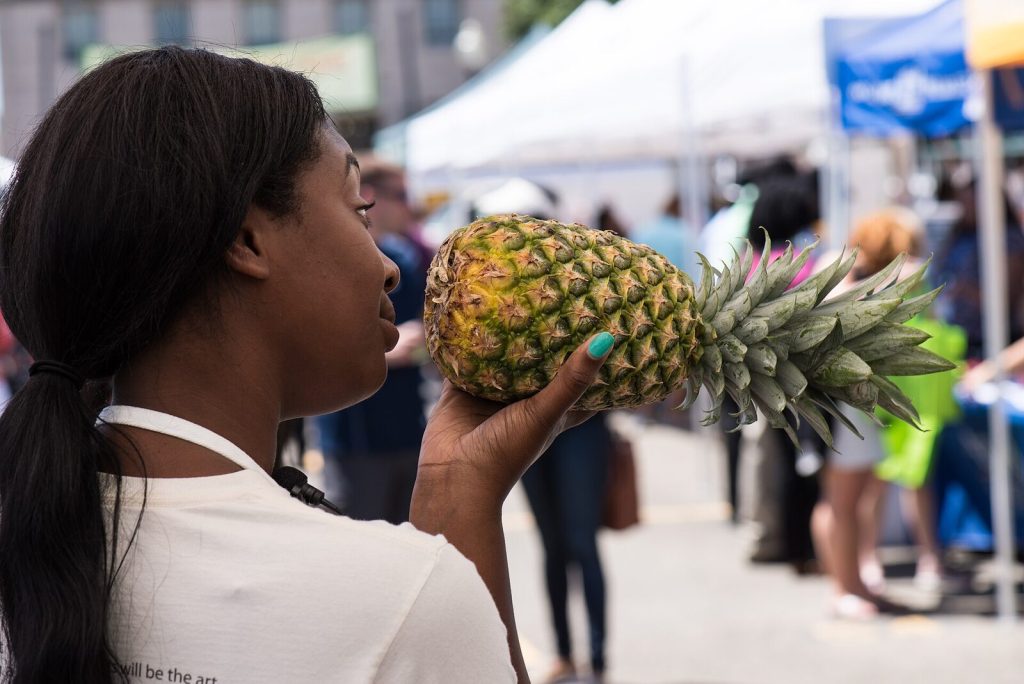
Pineapple farming in Uganda runs on an eighteen month cycle from planting material to first fruit, and the central problem is not growing the crop but the fact that a whole district ripens inside the same fortnight. Suckers, spacing, mulch and the flowering treatment are all decisions about when fruit arrives. Central Uganda around Kayunga, Luwero, Mukono and Masaka carries most of it.
A grower who solves timing solves pineapple. A grower who solves agronomy and not timing watches good fruit go for whatever the trader offers on the day.
The Pineapple Growing Cycle in Uganda From Sucker to First Fruit
Three independent sources put the first harvest at about eighteen months from planting, which is unusually good agreement for a Ugandan crop figure. The FAO organic manual for Sugarloaf growers gives 18 months when large planting material is used. The UN in Uganda describes the traditional wait for returns as about eighteen months. And a survey of 308 pineapple producers in Benin found flower forcing happening 11 to 13 months after planting, with fruit development following, which lands in the same place.
Eighteen months is a long time to hold land, and it explains most of what is distinctive about the crop. Weeding runs for a year and a half. Intercropping is normal rather than exceptional, because nobody can leave an acre idle that long. And the plot does not clear at the end of the first fruit either: a ratoon crop follows, and the FAO manual recommends a break of two or three years under fallow or another crop after each pineapple cycle, which means the acre is committed for a good deal longer than the eighteen months on the label.
Choosing Pineapple Planting Material: Suckers, Slips, Crowns and Hapas
Pineapple is propagated vegetatively, which is a genuine advantage for a smallholder: the crop supplies its own planting material and there is nothing to buy each cycle. It is also where most of the variation in a field comes from.
Four kinds of material come off one plant. Suckers arise from buds near the base of the parent. Slips come from the base of the fruit stalk. The crown is the leafy top of the fruit itself. Hapas grow at the junction of the stem and the fruit stalk, and Beninese Smooth Cayenne growers named these as their own planting material. They do not behave the same way. The ordering is consistent across sources: suckers bear soonest, slips later, crowns last of all. Month figures for each type circulate widely and none of the sources carrying them names where they were measured, so the ordering is what to plan on and not the numbers.
Size is the lever a grower actually controls. The FAO manual is direct about it: select the large grades, 500 to 550 g, for early bearing at 18 months. Small material goes in the ground at the same time as large material and comes out months later, which in a crop whose whole problem is timing is a very expensive way to save nothing.
So grade your material before planting and plant a block of one size together. A field planted from mixed grades ripens across a spread of weeks, which sounds like a solution to the glut and is not: it means every picking is small, no picking fills a truck, and the labour repeats.
Pineapple Varieties in Uganda and What the Names Actually Mean
Ugandan research names three cultivars, citing extension sources: Smooth Cayenne, Queen and Red Spanish, with Smooth Cayenne taking the largest share of growers. Smooth Cayenne is the large spineless type valued for uniformity, juice content and its sugar to acid balance. Queen is the square shouldered spiny type, and it is recorded as producing a small fruit of 0.5 to 1.0 kg.
Now the awkward part, which no page answering this query mentions. The name Ugandan traders and growers use most often is Sugarloaf, for the sweet pale fleshed fruit with a thin core. That name does not appear in the Ugandan research naming at all, and the two best agronomic manuals for it are written for Ghana and Benin, where Sugarloaf is treated as a cultivar in its own right. No source reached here reconciles Sugarloaf with Smooth Cayenne, Queen or Red Spanish.
Which means a grower buying suckers by market name does not reliably know which cultivar they are getting, and that matters because the cultivars differ in fruit size, spine, core and how they handle. The practical move is to buy material off a standing field you have seen in fruit, and to judge the fruit rather than the name. Ask what the fruit weighed and cut one open.
Here the Ugandan measurements are genuinely useful, because someone weighed them. Fruit collected at full maturity from Kangulumira in Kayunga, Buyaga in Masaka and Kabanyi in Luwero ran 1.278 to 2.013 kg overall, with Smooth Cayenne averaging 1.90 kg. Diameter ran 11.63 to 13.75 cm and circumference 37.5 to 43.72 cm. Variety, district and the interaction between them all mattered to the result, which is a measured way of saying that the same cultivar performs differently in different places. Masaka fruit was heaviest at 1.90 kg and Luwero fruit lightest at 1.57 kg.
One more figure from that work deserves attention from anyone thinking about processing. The pulp to peel ratio ranged from 0.45 to 2.02, Kayunga highest at 1.47 and Luwero lowest at 0.70. At a ratio of 0.45, more than two thirds of what you carry to a factory is waste. Where a buyer pays on peeled weight rather than field weight, that single figure moves the price more than anything else on this page.
And a note on ambition. The Ugandan study observed that its Smooth Cayenne weights sat within a published range of 1.8 to 4.5 kg for the cultivar. Its measured mean of 1.90 kg is just inside the floor of that band. So Ugandan Smooth Cayenne is at the small end of what Smooth Cayenne does elsewhere, and there is headroom here that has nothing to do with buying a different variety.
Plant Population and Double Row Spacing in a Pineapple Field
Pineapple is planted at a density that surprises people who have only grown field crops, in double rows separated by paths wide enough to walk and carry fruit through.
The geometry in the FAO organic manual is 30 cm between plants using alternating planting holes, 30 cm between the two rows of a pair, and 75 cm between one double row and the next. Working that through, one double row plus its path occupies 1.05 m of width for two rows of plants, so each plant holds (1.05 divided by 2) multiplied by 0.30, which is 0.1575 square metres. An acre is 4,046.86 square metres, so that geometry gives about 25,700 plants per acre, or about 63,500 per hectare.
That is my arithmetic from a Ghanaian manual's spacing rather than a figure any Ugandan source prints, and it is worth saying so. Two other spacings circulate on pages answering this query and they disagree with each other, neither naming a source. Since the population is what drives everything downstream, derive yours from your own rows rather than inheriting one: count plants along ten metres of row, measure your path width, and do the division. The pineapple spacing and plant population page works through the variants properly.
Two things the double row is for. Every plant sits within arm's reach of a path, which matters in a crop where each plant is handled individually at planting, at forcing and at harvest. And the paths let you get fruit out without walking on the beds.
Soil, Mulch and Fertiliser Across a Long Pineapple Cycle
An eighteen month crop at 25,000 plants to the acre takes a great deal out of the ground, and pineapple growing in Uganda is documented as being linked with soil nutrient depletion. The rotation break the FAO manual recommends after each cycle exists for that reason and not for pest reasons alone.
The organic manual's method is worth knowing whether or not you farm organically, because it is specific about timing rather than rates. All crop residue goes back on the soil as mulch or compost. Compost is split in two, half worked in before planting and half applied at the point of flower induction, or applied in one lot before planting if splitting is impractical. Splitting it puts nutrients in at the moment the plant switches from making leaves to making fruit, which is when fruit size is decided.
On mineral fertiliser this page gives no rate, for a straightforward reason: no rate for a Ugandan pineapple crop was sourced, and a rate invented here would be a rate somebody spends money on. What is available is the shape of the answer. Get a soil analysis before planting a crop you will hold for eighteen months, because that is the only point at which a deficiency can be corrected cheaply. Mulch heavily, since a long cycle means long weed pressure and a pineapple field is a poor place to be hoeing repeatedly among spiny leaves. And put something back after harvest rather than replanting into a depleted bed.
Forcing Pineapple to Flower in a Ugandan Crop, and the Calcium Carbide Problem
This section carries the most useful information on the page and the most serious warning, and both come from the same body of evidence.
Pineapple flowering can be triggered deliberately. Flower formation in pineapple is induced by ethylene and by nothing else, which means a grower who can deliver ethylene to the heart of the plant can choose the month the fruit arrives. In a crop whose economics are wrecked by everything ripening at once, that is the single most valuable technique available.
What growers in the best documented comparable system actually use is calcium carbide. In a survey of 308 producers in Benin, forcing took place 11 to 13 months after planting on most farms of both the Sugarloaf and Smooth Cayenne cultivars, and calcium carbide was the compound most used, dissolved in water and poured into the heart of the plant, where it releases acetylene. Some growers had begun adding petroleum or motor oil, cooking salt, a liquid organic fertiliser or urea to it, on advice from friends, with no study documenting what those additions do to the treatment or to the fruit.
Calcium carbide is explosive, difficult to handle, and contains arsenic. The survey asked producers about their own health and the answers are the reason this section exists.
Two things this page will not do. It will not give a rate, a dilution or a repeat interval for calcium carbide or for anything else, because a quantity is the one part of this a reader could act on and the evidence above is a reason to act less rather than more precisely. And it will not claim that Ugandan growers use carbide at any particular rate of prevalence, because no Ugandan survey of forcing practice was reachable. The Beninese evidence is the best documented there is, in a comparable smallholder system growing the same two cultivars. It is not a measurement of Uganda and it is not presented as one.
What the evidence does support, in order. Ethylene is the active principle, so the question is which registered product delivers it. An activated charcoal preparation carrying ethylene is the promoted alternative in Benin; producers there reported it as less effective than carbide and about twice the cost, which is an honest account of why uptake is low. Ethephon exists and is used by a small minority, under 1 percent of Sugarloaf growers and 7 percent of Smooth Cayenne growers in that survey, and most growers know it as a ripening product rather than a flowering one. Carbide is not permitted under organic certification at all, so any grower selling into an organic chain has the decision made for them.
If you intend to force a crop, the rate and the protective equipment are on the product label and nowhere else, the product has to be one registered in Uganda for use on pineapple, and a district extension officer is the person to confirm both before anything is bought. The guide to reading an agrochemical label covers what to look for. Store nothing of this kind in a dwelling.
What Uganda's National Pineapple Yield Figure Is Actually Measuring
You will meet a figure of about 8.5 tonnes per hectare for Ugandan pineapple. It comes from the international production database, and it should not be used to plan a plot. Here is why, and the reasoning is arithmetic rather than opinion.
Start with the flags the database itself attaches. Uganda's pineapple yield cells across the last six years are all marked as estimates, its area cells mostly as imputed, and its production as estimate or imputed. Not one cell carries the official flag. Kenya's equivalent rows carry official flags throughout, and Kenya's pineapple yield runs 29.3 to 34.5 tonnes per hectare, about four times Uganda's.
Now do the division. Multiply Uganda's reported area by its reported yield and you get its reported production, to within rounding, in every single year: 1,038 hectares times 8.5027 gives 8,825.8 against a printed 8,828.37. So one of those three columns is derived from the other two, and there is no independent measurement of all three. Then look at the yield column across eleven years: it moves only between 8,441 and 8,515 kg per hectare, a spread under 1 percent, while area moves from 405 hectares to 1,469. A yield that holds constant to within 1 percent while area more than triples is a constant being applied to an area estimate, not a measurement of Ugandan fields.
And the check that needs neither flag nor division. In the most recent full year Uganda declared 17,462 tonnes of pineapple exports to its customs authorities, against a reported national production of 8,828 tonnes. The country declared roughly twice as much pineapple leaving as it is recorded as growing. One of the two is wrong, and the export figure is Uganda's own declaration.
For completeness, run the national yield against the plant population above and watch it fail. At about 25,700 plants per acre and the measured Ugandan fruit weight of 1.278 to 2.013 kg, 8,502.7 kg per hectare works out at 3,441 kg per acre, which needs somewhere between 1,709 and 2,692 fruits. That is 6.7 to 10.5 percent of the plants producing a marketable fruit. No managed pineapple field behaves like that. The figure is not describing managed fields. For a band you can actually plan against, see pineapple yield per acre.
Harvest Timing and the Pineapple Glut
Everything above converges here. Fruit is harvested green ripe to half ripe where it is going to a packhouse or a factory, cut rather than torn, straight into crates to limit bruising, with stalks trimmed to about 2 cm. That part is simple.
The hard part is that your neighbours are picking the same week. A Luwero grower interviewed by the UN put it as pineapples having a habit of ripening at the same time, and described bumper harvests bringing anxiety rather than celebration, with fruit spoiling or selling at giveaway prices while everyone looked for a buyer. That is the crop's central economic problem and it is not an agronomic failure.
Three levers exist against it, and only the first two are within a single grower's reach. Stagger your planting, so that blocks come in weeks apart by design. Use forcing to place the harvest where the market is thin rather than where the rain put it. And process, or sell to someone who does, which converts a perishable glut into something with a shelf life.
Where Ugandan Pineapple Actually Sells
Uganda's declared pineapple exports have grown from 6,791 tonnes to 17,462 tonnes over four years, across 35 partner countries. Those are Uganda's own customs declarations at the level of the individual trading partner, not a figure reconstructed from what other countries say they received, so the growth is real. Its direction is not what most articles suggest.
| Destination | Tonnes | Share of weight | Declared USD per kg |
|---|---|---|---|
| Kenya | 15,262 | 87 percent | 0.16 |
| Rwanda | 1,690 | 10 percent | 0.17 |
| South Sudan | 129 | 0.7 percent | 0.96 |
| Israel | 107 | 0.6 percent | 1.86 |
| Germany | 59 | 0.3 percent | 2.06 |
| China | 44 | 0.3 percent | 3.09 |
| Netherlands | 23 | 0.1 percent | 5.07 |
| United States | 13 | 0.1 percent | 10.93 |
Ninety seven percent of the declared weight goes overland to two neighbours at around a sixth of a dollar a kilo. The high value destinations are real, they are declared, and they are measured in tens of tonnes. A business plan built on Europe or the United States is a plan for a market that currently takes less pineapple from Uganda in a year than one large lorry load a week. A business plan built on Kenya and Rwanda is a plan for what is actually happening.
The processing route is the more interesting development. A dedicated canned pineapple factory in Luwero processes up to 500 tonnes of fruit a day using Smooth Cayenne, and Uganda's first commercial consignment of canned pineapple to China was 104 tonnes. A factory buying at that scale changes what a glut means for the growers within reach of it, which is the argument for selling to processors rather than only to traders, and for the small scale versions of the same idea in dried fruit production and fruit juice processing.
One finding on scale worth knowing before you take on more land. A Makerere study of 192 pineapple farmers in Kayunga found the enterprise returned large positive net present values at both small and large scale, and that small scale farmers had both a higher yield per hectare and a higher unit cost of production than large scale farmers, both differences large enough to be statistically reliable. Profitability rose with farming experience, off farm income, group membership, extension access, family labour and holding a land title, and fell with a higher household dependency ratio and with greater use of hired labour. Bigger is not automatically better in this crop, and hired labour is the line to watch.
Ratoon Crops and When to Replant Pineapple
After the first fruit is cut, the plant produces shoots that carry a second crop. That ratoon crop is cheaper than a replant, since there is no planting labour and no new material, and it is also where next cycle's planting material comes from: growers in the Benin survey kept ratoons on for exactly that purpose, to throw shoots of the right size for the following round.
Ratoons do not last indefinitely. Fruit size falls, the stand becomes uneven, and the field eventually earns less than the ground is worth. The FAO manual's instruction at that point is unambiguous: break for two or three years under fallow or another crop before pineapple returns to that ground. Given soil nutrient depletion is a documented feature of Ugandan pineapple growing, that break is doing real work rather than being a precaution.
Which reframes the land question. A pineapple enterprise needs more ground than the area under fruit at any one time, because part of the holding is always resting. Anyone planning on a fixed acreage should plan the rotation before the first sucker goes in. Other options for the resting ground sit in the fruit farming section.
Questions Ugandan Pineapple Growers Ask
How long does pineapple take to mature in Uganda? About eighteen months from planting to first fruit when large planting material is used, and three sources agree on that. Small planting material takes longer. After the first harvest a ratoon crop follows, and the ground then needs a break of two to three years before pineapple returns to it.
How many pineapple plants fit on an acre? About 25,700 at the double row geometry in the FAO organic manual, meaning 30 cm between plants, 30 cm between the paired rows and 75 cm between double rows. Other spacings circulate and they disagree, so measure your own rows and divide rather than trusting a published figure, including this one.
Which pineapple variety should I grow in Uganda? Ugandan research names Smooth Cayenne, Queen and Red Spanish, with Smooth Cayenne dominant and preferred by processors. The complication is that the name most used in Ugandan trade, Sugarloaf, does not map onto those three in any source available. Buy material from a field you have seen in fruit and judge the fruit itself.
What does one pineapple weigh? Measured at full maturity in three central Ugandan districts, 1.278 to 2.013 kg, with Smooth Cayenne averaging 1.90 kg. Masaka fruit was heaviest and Luwero fruit lightest in that sample. Ugandan Smooth Cayenne sits at the small end of what the cultivar produces in other countries.
Is it safe to use carbide to make pineapples flower? Calcium carbide is explosive, contains arsenic, and releases acetylene on contact with water. In a survey of 308 producers in a comparable West African system, more than half reported feeling unwell after using it, with fatigue, eye irritation, skin injury and headache the commonest complaints, and 8 percent reported a household member affected after contact with carbide stored at home. Ethylene is what actually induces flowering, so the question is which registered product delivers it. Use a product registered in Uganda for this purpose, follow the label rate and protective equipment exactly, and have a district extension officer confirm both first. No rate is given here on purpose.
What price does pineapple fetch, and why does it vary so much? Local trade prices pineapple per fruit rather than per kilo, which hides the variation in fruit weight and hands the advantage to whoever is counting. Prices swing hard between a glut week and a thin one, which is the whole argument for staggered planting and forcing. The one verifiable price anchor is what exporters declared at the border, around 0.16 to 0.17 US dollars a kilo for the Kenya and Rwanda trade that carries 97 percent of the volume, rising into dollars a kilo for the tiny overseas consignments. Ask local traders and any processor within reach what they pay this season, and ask whether they pay on field weight or peeled weight, because the pulp to peel ratio measured in Uganda ranged from 0.45 to 2.02 and that alone can halve or double what a tonne is worth to you.
Does pineapple pay better at a larger scale? Not reliably. In the Kayunga study of 192 farmers, small scale growers achieved a higher yield per hectare than large scale growers, and also a higher unit cost of production, with both findings statistically reliable. Greater use of hired labour was associated with lower profitability. Scale up the market before the acreage.
Before planting, find out who is buying pineapple in your district and on what terms, and settle the timing question first: staggered blocks and a legal forcing product do more for the price you get than anything else in this article. Check current planting material availability and prices locally, because both move between seasons.