
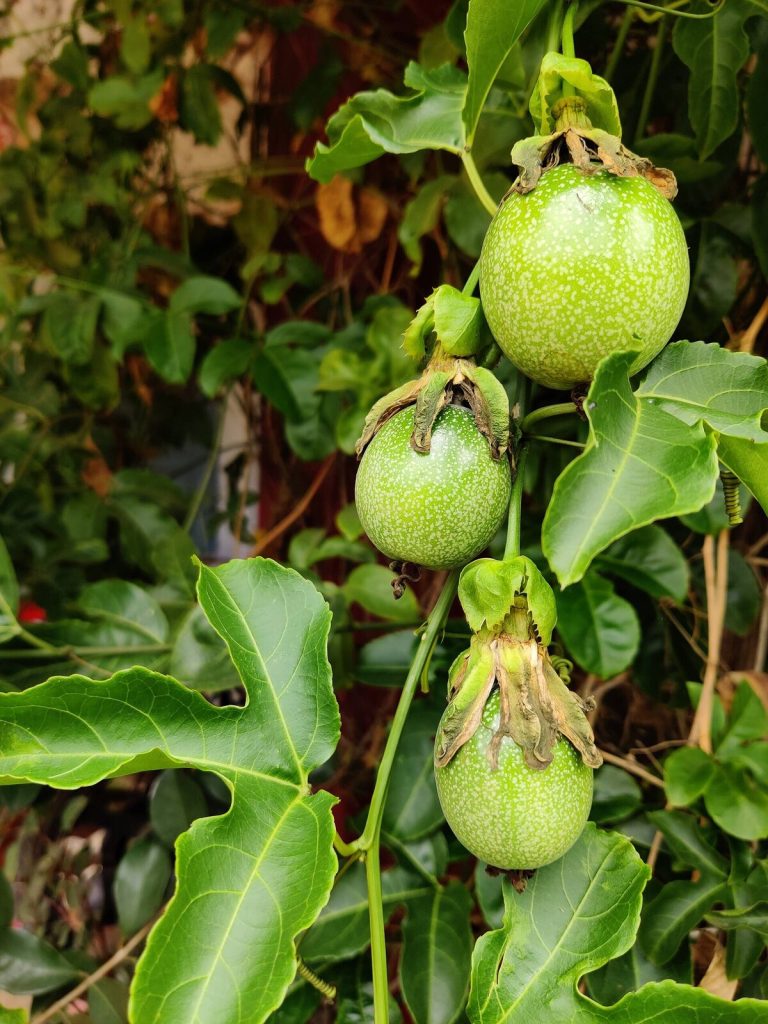
Two diseases account for most Ugandan passion fruit losses: woodiness, caused by a group of viruses including one first described in Uganda, and brown spot, a fungus. Neither is cured by spraying. Both are managed by what you plant, what you cut with and what you clear away, which is why this page spends its length on those three things.
Woodiness Disease and the Virus That Was Named After Uganda
Start with the disease that ends orchards. Passion fruit woodiness makes fruit small, misshapen and thick skinned with a shrunken pulp cavity, and it shows on leaves as mosaic mottling, distortion, upward curling and puckering of young growth. The fruit is still a fruit. It is just not saleable, and there is no treatment.
In East Africa the disease is caused by potyviruses, and one of them was described from Ugandan fields. A study that surveyed producing areas in Uganda found symptoms on 32 percent of plants, examined the particles under an electron microscope, sequenced the coat protein gene of eight isolates, and established that the virus responsible was not either of the two potyviruses then blamed for woodiness elsewhere. Its closest relatives by amino acid identity were viruses of beans and cowpeas rather than of passion fruit. The authors concluded it was a previously unreported species and proposed the name Ugandan Passiflora virus.
Three things follow from that piece of work, and all three are practical.
Losses are put at up to 100 percent where the disease complex takes hold, and coinfection by more than one virus in the same plant has been flagged as part of why it is so damaging. Ugandan researchers describe declining yields from viral disease, pests and stress as having driven widespread abandonment of the enterprise, which is the honest context for every management sentence below.
Half of Infected Vines Look Healthy, Which Breaks Cutting Grown Planting Material
This is the single most useful finding on this page, and no competing page carries it.
A survey in Rwanda tested leaf samples from passion fruit fields by two independent methods. Serology detected potyvirus in 43 percent of symptomatic samples and 47 percent of samples from plants showing no symptoms. Molecular testing detected the Ugandan Passiflora virus in 56 percent of symptomatic samples and 53 percent of asymptomatic ones. Read the pairs, not the numbers: infection was about as common in plants that looked healthy as in plants that looked sick.
Now connect that to how passion fruit planting material is made. Vines are propagated from cuttings, and the standard instruction for taking cuttings is to select them from healthy, productive plants to avoid spreading virus disease. That instruction assumes the eye can tell. On this evidence it cannot. A cutting taken from a vigorous, clean looking, heavy bearing mother vine has roughly a coin flip's chance of carrying the virus, and the graft makes no difference because the scion is the infected part.
There is no Ugandan certification, indexing or virus testing scheme for passion fruit planting material that this research could find in the national catalogues, the ministry's document library or the statistical record. So there is no way for a buyer to resolve this, and pretending otherwise would be worse than saying it plainly. What is left is risk reduction: inspect several plants rather than one, reject the whole batch if any plant shows mottling or distortion, split the purchase so that one poor batch does not settle the whole block, and keep money aside to fill gaps. Seed raised plants are slower and more variable, but these viruses travel in vegetative material rather than in seed, so a seedling block starts cleaner. That trade is discussed on the passion fruit varieties page.
Brown Spot Is the Fungal Disease Found on the Most Farms
Brown spot, caused by Alternaria passiflorae, is the fungal counterpart to woodiness and it is everywhere. A survey across eight East African districts found it on 55 to 100 percent of farms. Ugandan researchers at Makerere University working with the national crops research institute picked woodiness and brown spot as the two locally prevalent diseases when they built an image dataset for the crop, and they sampled fields in Masaka, Buikwe, Jinja, Kayunga and Mbale to do it.
What it looks like: spots on the leaves, lesions on the branches, and crinkling of leaf tissue. Published descriptions associate it with dry weather and name it as a leading problem on the yellow form. Because it attacks leaves, stems and fruit, it costs you twice, first in the photosynthetic surface the vine needs to fill the wire and then in fruit you cannot sell.
Septoria spot is the disease most often confused with it. The distinguishing feature given in the literature is the spots themselves: Septoria produces more of them and smaller ones. Septoria is described as spread by dew, rain and overhead irrigation, which is a management fact rather than a diagnostic one. Overhead watering on a crop with two leaf spot diseases is watering the disease, and that is one argument for drip irrigation on a passion fruit block that has nothing to do with water saving.
Dieback, Collar Rot and Wilt Are Three Different Fusarium Problems
Ugandan and regional sources routinely collapse these into "Fusarium wilt", and the collapse causes real mistakes, because the three have different pathogens and only one of them is addressed by grafting.
| Disease | Pathogen | Where it attacks |
|---|---|---|
| Wilt | Fusarium oxysporum f. sp. passiflorae | Roots and vascular system |
| Crown or collar rot | Fusarium solani | Stem base at soil level |
| Dieback | Fusarium species with Phytophthora nicotianae var. parasitica | Shoots and branches downward |
| Anthracnose | Colletotrichum passiflorae | Stems and fruit |
Dieback is the one most growers underestimate. In that same eight district survey it was found on 64 to 100 percent of farms, a higher hit rate than brown spot, and it involves an oomycete alongside the Fusarium species, which matters because the two respond to different management. Across the whole complex the survey attributed yield losses of 80 to 100 percent.
Wilt is recognisable by splitting of the trunk and shedding of bark, with chlorosis, necrosis and leaf drop as the first signs. Collar rot sits lower, at the point where the stem meets the soil, and it is frequently started by mechanical injury at the base of the plant. So the weeding method around the stem becomes a disease decision. Slashing or hoeing hard against the collar makes the wound that the fungus needs.
What a Grafted Rootstock Protects on a Passion Fruit Crop, and What It Does Not
Grafting the purple onto a yellow passion fruit rootstock is the standard commercial response to soil borne disease, and there is survey evidence behind it. In the eight district study, wilt turned up on fewer farms than either brown spot or dieback did, and the authors put that gap down to the number of growers who had bought seedlings worked onto yellow roots. Their word for what the rootstock confers is tolerance. The yellow form is also reported as rather resistant to root knot nematodes, which is the second reason the graft exists.
Tolerant is the operative word, and the scope is narrow. A rootstock changes what happens below the graft union. Woodiness viruses infect the shoot and are moved by sap feeding insects and cutting tools, so they arrive above the union and the rootstock is irrelevant to them. Brown spot, Septoria and anthracnose attack leaves, stems and fruit, all of which are scion. Dieback works downward from the shoots.
So a grafted plant is protected against one disease out of the several on this page, and partly rather than fully. Any seller describing grafted material as disease resistant is describing something that does not exist, and a grower who believes it will skip the sanitation that actually decides the outcome.
Pruning Tools and Old Vines Move Disease Faster Than Insects Do
Here is where the evidence points, and it is not where most growers spend their money.
In the eight district survey, over half the growers did no field sanitation at all: no pruning to reduce inoculum, no burning of infected plant parts, no disinfection of tools. Most did not scout for early symptoms either, so control was applied only once the crop was already under heavy disease pressure. The authors name that sequence as the reason fungal disease ran through those farms so fast. A separate survey on the Kenyan coast found woodiness symptoms on every farm visited and listed the aggravating practices explicitly: not sterilising pruning tools, intercropping with target crops, and rotating with the same target crops.
Extension guidance on this crop says to disinfect the cutting tool between each pruning. Not each day, not each row, each cut into a new vine. A blade that has just cut an infected vine is carrying sap, and sap is how these viruses move mechanically.
Aphids are the vector for these viruses and they are efficient at it. Work on a related woodiness virus found that eight aphids carrying the virus transmitted it to three quarters of the plants they were placed on, and twelve aphids transmitted it to all of them, and that the aphid species involved also breeds on passion fruit rather than merely visiting. Small numbers are enough. That is a reason to remove infected vines rather than to reach for a spray, because you cannot kill your way out of a vector that needs so few individuals, and broad spectrum products also kill the carpenter bees this crop depends on for fruit set.
Which Neighbouring Crops the Ugandan Virus Can Infect
This is a detail worth carrying, because the standard intercropping advice for passion fruit comes from a different virus and may point the wrong way in Uganda.
When Ugandan researchers tested the host range of the virus they had described, the plants that became infected were species in two families, the nightshades and the goosefoots. Cowpea and common bean, which are relatives of the virus's nearest genetic neighbours and are hosts of the Brazilian woodiness virus, did not become infected.
Two cautions before acting on that. A laboratory host range from mechanical inoculation tells you which plants can be infected, not which plants actually spread the virus in a field, and those are different questions. And it was a defined set of test species rather than every crop in Uganda.
What can reasonably be said: advice to keep beans and cowpeas away from passion fruit, which is sound where the Brazilian virus is the problem, is not supported by the Ugandan work on the Ugandan virus. Meanwhile the nightshade family, which includes tomato, sweet pepper, eggplant and Irish potato, contains the species that did become infected, so siting a passion fruit block against a tomato field deserves more thought than siting it against a bean field. The Kenyan coastal finding that rotating with and intercropping with target crops aggravates the disease points the same way. If you intercrop at all in the establishment year, an annual that is not a nightshade is the safer filler, and there is no need to invent a rule stronger than the evidence.
Post Harvest Rots and What a Ugandan Survey Found on the Fruit
Disease does not stop at the farm gate on a thin skinned fruit that ripens by falling.
A Ugandan study examined the fungi carried on passion fruit and in passion juice, comparing fruit of what Ugandan growers call pure and hybrid origin. It recorded 34 fungal species across 21 genera on the fruit. The pure type carried the wider range, 28 species in 16 genera, against 21 species in 15 genera on the hybrid, and the pure type also carried more fungal propagules on average, and it did so while being the smaller fruit of the two. Yeasts and Cladosporium dominated on the pure type, followed by Phoma, Penicillium, Fusarium and Alternaria. On the hybrid only three dominated: Cladosporium cladosporioides, Fusarium solani and yeasts. In juice, yeasts were the main contaminant rather than moulds.
Two lessons from that. The organisms causing your field diseases, Fusarium and Alternaria among them, are riding on the harvested fruit too, so post harvest rot on this crop is often the same problem arriving later. And the study found that a surface treatment with a hypochlorite solution reduced the fungal load on fruit of both types, which is the sort of finding that belongs in a juice processing operation with the right dilution worked out on site rather than copied off a page.
The handling practices that follow are unglamorous and they work. Collect fallen fruit daily in hot weather, because fruit lying on soil picks up soil organisms and fruit in the sun scalds. Keep the ground under the rows clean so fruit can be found. Sort out the damaged and immature fruit before it travels, since one rotting fruit in a box infects its neighbours. Use rigid containers rather than sacks, because sacks make the fruit sweat and sweating fruit rots.
Pests That Arrive With the Passion Fruit Diseases
Several of the pests on this crop matter mostly because of what they carry or what they open up.
Aphids are first, as the virus vector, and their importance is out of proportion to the feeding damage they do. Mites defoliate younger growth in warm dry weather and blemish the fruit skin, which costs you on the fresh market. Thrips injure and stunt young plants in the nursery, which is exactly the stage you cannot afford a setback, and in dry weather they scar leaves and fruit so that it shrivels and drops early. Sap sucking bugs feed on flowers and young green fruit or on growing tips. Leaf beetles and weevils chew foliage. Root knot nematodes thicken and distort the roots, and the yellow form's better tolerance of them is one of the reasons the purple gets grafted onto it.
The pattern across that list is that feeding wounds and vector activity do more harm than tissue loss. So an insect problem on passion fruit is worth diagnosing before it is worth treating, and the general principles sit on the insecticides explainer.
Why This Disease Page Names No Product, and What Scouting Does Instead
You will find pages, including Ugandan ones, that name specific fungicides for passion fruit blight and tell you to spray weekly through the rains. This page does not, and the reason is not squeamishness.
A product recommendation is only safe with four things attached: the registration status of that product for that crop in Uganda, the rate on the label, the interval, and the pre harvest interval before the fruit can be picked and eaten. None of those can be verified from a web page, all four differ between products, and the pre harvest interval on a crop that is eaten fresh and is picked continuously is not a detail. A named product without its label figures is worse than no advice, because it looks actionable.
Weekly calendar spraying is separately a bad instruction. The survey evidence is that growers losing crops were the ones who never scouted and then treated under heavy pressure, and routine blanket application is how resistance is selected for in a pathogen population. It also removes the carpenter bees that set the fruit, which on a crop whose yellow form is often self sterile can cost more than the disease.
What to do instead: identify what you have, decide whether it is one you can do anything about, and take any product question to the label and to your district extension officer or plant clinic with a sample in hand. The rules for reading a label are on how to read agrochemical labels and the handling rules on safe pesticide application. On woodiness there is nothing to buy at any price, which is the whole argument for spending on planting material and sanitation instead.
Sanitation and Scouting on a Ugandan Passion Fruit Farm
Pulling the evidence together into what you actually do, week by week, on an acre.
Walk the rows once a week and look at young leaves first, because mottling, puckering and distortion show there before anywhere else. Look at the stem base while you are there, since collar rot starts at the soil line and is easy to miss from standing height. Mark anything you are unsure about and come back to it, rather than deciding on one glance.
Carry two blades and a container of disinfecting solution when you prune, and alternate them. Bag what you cut out and burn it away from the block. Keep a hand's width clear around every stem without cutting into the stem. And when a vine has woodiness, take it out, because there is nothing else to do with it and leaving it standing feeds the aphids that will move it along the row.
Then keep a record of what you found and where, because the second year of that record is what tells you whether your block is getting better or worse. A production record is the cheapest diagnostic tool on the farm, and on a perennial with a three to seven year life it is the only way to see a trend at all.
Frequently Asked Questions on Passion Fruit Diseases
Can passion fruit woodiness disease be cured? No. There is no treatment for a virus in a standing plant, no product to buy, and the vine will not grow out of it. The options are prevention through planting material and sanitation, and removal of infected vines. Any page selling a cure for woodiness is selling something that does not exist.
My fruits are small and hard with almost no pulp. What is it? That description matches woodiness closely, especially alongside mottled or distorted young leaves. Take a sample with leaves attached to your district extension officer or a plant clinic rather than diagnosing off a photograph, because brown spot on fruit and physiological problems from water stress can look similar to an untrained eye, and the management differs completely.
Will grafted seedlings stop disease? They reduce one disease. A yellow rootstock is tolerant to soil borne wilt and better against root knot nematodes, and a regional survey credits grafted planting material with the lower wilt incidence it measured. It does nothing about woodiness, brown spot, Septoria, anthracnose or dieback, because those attack the part of the plant above the graft. Grafted is not disease resistant.
How much does disease cost a Ugandan passion fruit grower? The published loss figures are large and they come from surveys rather than from farm accounts. Yield losses of 80 to 100 percent have been attributed to the disease complex in a regional survey, and up to 100 percent to woodiness alone. On a perennial the cost compounds, because a vine lost in year one takes the establishment spending with it: the trellis is already built and paid for, as set out on the passion fruit farming guide. That is why sanitation, which costs labour rather than money, has the best return of anything on this page.
Should I spray every week during the rains? No, and the published evidence is against it. The growers whose crops were overrun in the regional survey were the ones who never scouted and then applied control under heavy pressure. Calendar spraying selects for resistance, costs money on weeks when nothing is happening, and removes the carpenter bees that set your fruit. Scout weekly; treat on a finding, against a named target, at the label rate.
Can I plant passion fruit where a diseased block used to be? Treat it as the worst option available. The wilt and collar rot organisms are soil borne and persist, and a regional survey names rotating with the same target crop among the practices that aggravate disease. If there is no other ground, grafted material on yellow rootstock is the one measure with evidence behind it, and it addresses wilt only.
Is there anywhere in Uganda to get virus tested passion fruit plants? No scheme for certifying, indexing or virus testing passion fruit planting material surfaced in NARO's technology catalogue, the ministry's document library, the Statistical Abstract or the national agricultural survey. Saying so plainly is more useful than implying a scheme exists. Inspect several plants, reject the batch on any symptom, split your purchase across sources, and budget for replacements.
Do the same diseases affect the fruit after harvest? Often the same organisms, yes. A Ugandan survey of the fungi on passion fruit found Fusarium and Alternaria among the dominant genera on the fruit itself, alongside yeasts and Cladosporium. Collect daily in hot weather, sort before transport, and use rigid containers rather than sacks.
The three decisions that matter most against disease are made before planting: which form you grow, where the plants came from, and a trellis you can see into and prune cleanly. Those sit on the varieties page and the trellising guide, with the rest of the section on the fruit farming hub. Growers who have met the same problem on other perennials will find it discussed on mango orchard management.
If you have symptoms now, take a sample with leaves and fruit attached to the nearest district extension office or plant clinic and get the diagnosis before you buy anything. Check current prices for planting material and for disinfecting supplies locally, and treat the diagnosis as the purchase that comes first.