
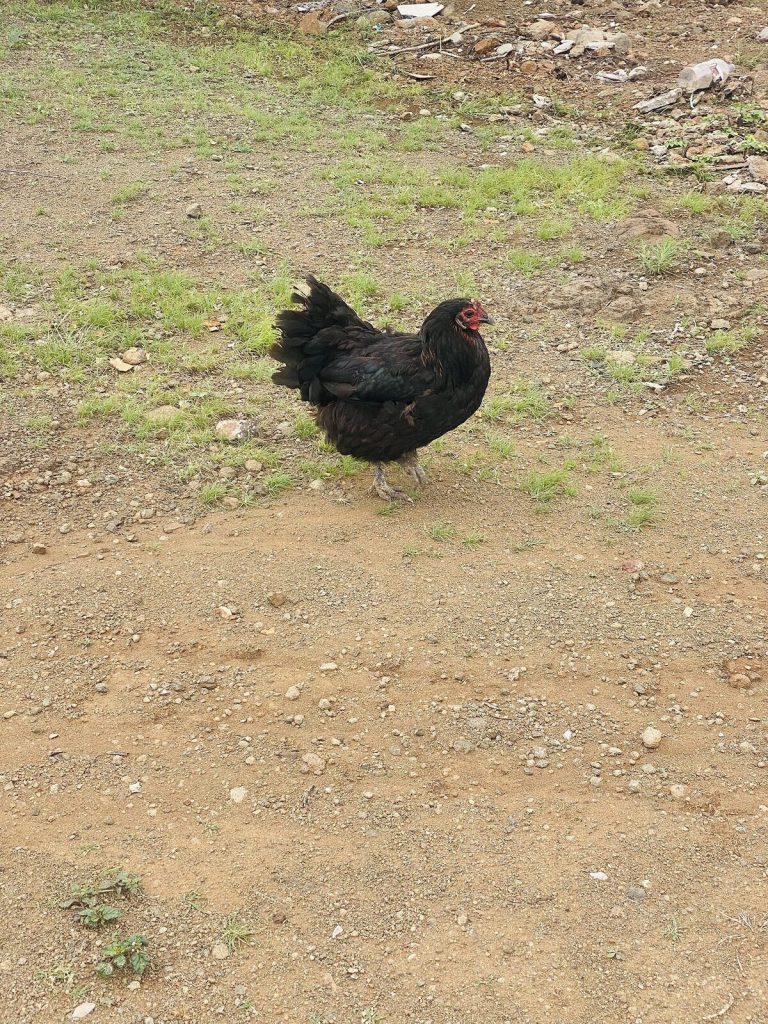
Local chicken farming in Uganda means keeping a scavenging flock of indigenous birds that find most of their own food, sleep under shelter at night, and are hatched by their own mothers. The national livestock census counted 40.4 million indigenous chickens against 17.4 million exotic, so this is the ordinary Ugandan poultry enterprise. Managed as an afterthought, it loses birds faster than they hatch.
What Local Chicken Farming in Uganda Actually Involves
Most writing about poultry assumes a house, a bag of mash and a delivery of day old chicks. That is not what is happening in the majority of Ugandan homesteads. The census recorded 4.8 million chicken keeping households, seven in every ten households that keep any livestock at all, with an average flock of 10.8 birds. Among households that keep indigenous chickens, the average holding is eight birds. Almost every one of those flocks scavenges.
So the enterprise is not really "poultry production" in the commercial sense. It is a small self replacing stock of birds that converts kitchen scraps, spilled grain, termites and greens into meat, eggs and cash at short notice. Ugandan research describes the chicken as the household's most liquid asset, sold when school fees fall due or a debt has to be settled.
Two things follow from that, and they run through the rest of this guide. The first is that the returns come from stopping losses, not from pushing output. The second is that the birds are worth more per kilo than exotic chicken in Ugandan markets, which is the reason the enterprise survives commercial competition at all.
If you are weighing indigenous birds against an improved crossbreed, the head to head comparison with measured Ugandan trial data sits on our page on how Kuroilers compare with local chickens, and the breed categories themselves are unpicked in what improved local chicken breeds actually are. This page stays on the husbandry of the indigenous flock.
Scavenging and What Supplementary Feeding Really Buys
The feeding system in local chicken farming is scavenging, with grain thrown in when there is grain. FAO calls the resource the birds live off the scavengeable feed resource base: household cooking waste, cereal and cereal by products, roots and tubers, insects, termites, snails, worms, seeds, grass and tree leaves. It swings with the season. Under free range conditions the dry season supply is usually too thin to support production above simple maintenance, which means birds hold their weight and lay very little.
FAO records a grain supplement of about 35 g per hen per day as the typical village practice, and MAAIF's poultry training manual gives the quantities a Ugandan farmer would use at each stage. Those numbers are worth knowing, but the honest finding is more awkward than the usual advice admits.
| Stage | Feed | Quantity per bird |
|---|---|---|
| Chick to two months | Chick mash | Up to 2 kg total |
| Cockerel, two to five months | Supplement | About 10 kg total |
| Pullet, two to five months | Supplement | About 7 kg total |
| Breeding hen | Layers mash | 100 g a day |
A study of 593 Ugandan smallholders in five northern districts tested which husbandry practices actually moved output. Once flock size was accounted for, supplementary feeding had no statistically reliable effect on the number of birds a household sold, ate or gave away over a year, and none on egg offtake either. Deworming showed nothing either. Vaccination and housing did.
That result does not mean feed is useless. It means the small, irregular handfuls that most households throw down are too small and too irregular to show up in annual output, while the money spent on them is real. A Makerere survey in Kumi district found that where supplementation happened at all it was seasonal, tied to the harvest, and that most farmers who supplemented poured the feed on bare ground where much of it was wasted or contaminated. Put feed in a container, and if you are going to supplement, concentrate it on the animals that convert it: chicks in their first weeks, and hens you want back into lay.
One other Ugandan option deserves a mention because MAAIF publishes it as a technique rather than folklore: growing maggots in a pot of blood, offal and cow manure, and drawing termites into an upturned pot of cow dung and straw overnight, then emptying it in front of the house in the morning. Both are protein, both are free, and both are what the scavenging diet is short of.
Night Housing Against Predators and Theft
Of all the improvements available to a local chicken farmer, a lockable night shelter has the best measured return per shilling. In that same Ugandan study, owning a poultry house for overnight shelter was associated with a 36 percent increase in the number of birds taken out of the flock over a year, after flock size was accounted for. Feed supplementation, in the same model, did nothing.
The reason is simple. Chickens are taken at night, and they are taken by things a shelter excludes. Ugandan farmers in Kumi attributed roughly a fifth of their losses to wild animals, naming foxes, wild cats, eagles and kites. FAO adds rats, mongooses, snakes and domestic dogs, and notes that in many households the birds are brought inside the dwelling or the kitchen precisely to keep them from being stolen. The central Uganda mortality study found that pattern in the field: about three quarters of the 240 households had a purpose built chicken house, a fifth of flocks slept in the kitchen, and in some homes the birds shared the family's room.
The shelter itself can be cheap. MAAIF's specification for local chicken housing is mud and wattle walls, a roof of iron sheets or thatch, and a litter floor of wood shavings, rice husks or coffee husks, used as night shelter only while the birds scavenge by day. Stocking is 5 mature birds per square metre, or 10 growers, with the young partitioned off from the adults. FAO's free range figure is three to four birds per square metre on deep litter, so somewhere in that band is safe. Perches matter as well, since birds roost off the ground by instinct to avoid night predators, and fowls drop more than half their manure overnight where you can collect it. Construction detail is in our poultry house construction guide.
Newcastle Disease Vaccination and Why Farmers Rank Diseases Wrongly
This is the part of local chicken farming where experience misleads people, and there is Ugandan evidence to prove it. Researchers from NARO, Mukono Zonal Agricultural Research and Development Institute and Makerere University followed 240 chicken keeping households in Mubende and Mpigi for twelve months. They recorded 27,024 birds and 6,226 mature deaths, and they took organ samples from every single dead bird for laboratory examination.
At the start, the same farmers were asked what had been killing their chickens. Their answers and the post mortem findings pointed in different directions.
| Cause of death | Farmers ranked it | Post mortem found |
|---|---|---|
| Newcastle disease | 28 percent | 46 percent |
| Salmonellosis | 37 percent | 7 percent |
| Mixed infections | 16 percent | 30 percent |
| Coccidiosis | 14 percent | 4.6 percent |
Read the first column and you buy antibiotics. Read the second and you vaccinate. Farmers with years of birds behind them put salmonellosis first and Newcastle second; the laboratory reversed it, and made Newcastle disease the single largest killer in the study by a wide margin. Fowl pox accounted for 1.3 percent, fowl cholera for 0.3 percent, and about a tenth of deaths were never diagnosed at all. Of everything on that list, only Newcastle could not be treated.
The same study found that vaccinated birds were 3.7 times more likely to survive an outbreak, and that the shorter the gap since the last Newcastle vaccination, the better a flock came through. Deaths clustered in the two wet seasons, March to May and again from October into late November. A Makerere survey in Kumi found the opposite seasonality, with most losses reported in the dry season, so the timing varies by region while the killer does not.
The practical obstacle to vaccinating village chickens has always been refrigeration. Conventional Newcastle vaccine loses potency within about two hours off ice, which rules it out for a homestead an hour's walk from the nearest agrovet. The I2 strain was developed to survive that. It is thermotolerant, keeps without refrigeration at temperatures up to 37 degrees Celsius, and is given as a drop into the eye or nostril rather than by injection, so a trained village vaccinator or the farmer can administer it. It is manufactured in Kampala by Brentec, a private vaccine producer working with GALVmed, and sold in small vials through agrovet shops.
MAAIF's schedule for local chickens puts the first Newcastle vaccination in the week after hatching, then at six weeks, then at three months, with adult birds done twice a year, alongside cover for fowl pox, Marek's disease and infectious bronchitis, and monthly deworming after two months of age. Field programmes in Uganda commonly work to three Newcastle rounds a year for adults instead of two. Both figures come from credible sources and they disagree, so the operative authority is the vial's own label and the veterinary officer or hatchery advising you, not this page. No dose, dilution or withdrawal period appears here, and eggs and meat from any treated bird are subject to whatever withdrawal period the product label states. More on how the vaccines themselves work is in poultry vaccines explained, and the wider picture of what kills birds is in poultry mortality causes and prevention.
One habit the Ugandan data quietly condemns: buying grown birds from the market to add to a flock. FAO identifies the introduction of infected live birds as the most likely way Newcastle enters a village at all, and live bird markets as the main route the disease travels. If you must bring birds in, keep them well away from the flock for a fortnight first.
Broodiness, Natural Hatching and the Laying Time It Costs
An indigenous hen replaces herself, which is the quiet genius of the system and also its ceiling. She lays a clutch, goes broody, sits about three weeks, hatches, then mothers the chicks for roughly two months before she starts laying again. Makerere's Kumi survey measured a clutch of 13 eggs on average, ranging from 4 to 19, with two to three months between laying cycles, giving three to four clutches a year and something near 40 eggs. Age at first egg ran from five and a half to seven months.
The hidden cost is in that sentence. A brooding hen is not a laying hen. She stops laying the moment she settles on the nest, and she does not resume until the chicks can look after themselves. Every chick that then dies represents both an egg you could have eaten or sold and weeks of her laying life spent producing nothing.
MAAIF's own recommendation follows that logic: keep chicks with the broody hen for two weeks, then remove the hen and brood the chicks artificially, feeding hens and chicks on chick mash with vitamins in the water. Makerere's researchers put it more bluntly, recommending that prolific birds be stopped from brooding and incubating their own eggs at all if egg output is what you want.
For hatching, choose a large, healthy hen with a record of sitting tight and mothering well. FAO puts a workable maximum at 14 to 16 eggs under one hen, with hatchability falling off above about ten depending on her size, and normal hatchability from natural incubation at around 80 percent. Kumi farmers reported a mean near 90 percent, which is high but plausible under a good hen. Keep feed and water close to the nest so she does not have to leave and let the eggs cool, and check her for mites before she settles. Eggs held back for hatching keep no longer than seven days, at 12 to 14 degrees Celsius and high humidity. Advice to store them a fortnight before setting is wrong and costs you the hatch. MAAIF says to reject eggs that are too small, too large, too round or too pointed.
MAAIF also documents a trick worth knowing if you want a batch of chicks the same age. Place one boiled, marked egg in each nest so the hen keeps sitting, collect and date the real eggs daily into cool storage, then set them all under the sitting hens together. Ten hens prepared that way can hatch 150 chicks on one day, which is a brooding batch rather than a trickle. Brooding technique is covered in our poultry brooding guide.
Chick Mortality in a Scavenging Flock and What Reduces It
Chicks are where the flock leaks. In Kumi, farmers named chicks as the age group with the heaviest losses on nearly three quarters of farms, against 15 percent for mature birds and 11 percent for growers. Work published through the joint FAO and IAEA programme measured Ugandan rural chick mortality at close to 40 percent in one agro ecological zone and in the high twenties in another. On those numbers, four chicks out of every ten hatched never reach sale.
Nothing about that is mysterious, and three things move it. Shelter is the first: a coop or basket for the mother hen and her brood keeps chicks away from hawks, rats, thieves and rain, and lets you feed and water them separately. Vaccination is the second, since Newcastle reaches chicks as readily as adults and MAAIF starts the schedule in the first week of life. Feed is the third, and this is the one place where supplementation clearly earns its keep, because a chick has no reserves and cannot scavenge competitively against adult birds. Kumi's data showed chick survival tracking feeding level closely, with poorly fed chicks stunted and then vulnerable to whatever came through.
Ugandan researchers also point out that predation and malnutrition are not separate categories. A slow growing, underfed chick is the one the kite takes. Counting that death as predation hides the cause.
Local Chicken Breeds and Flock Performance in Uganda
MAAIF recognises seven local breeds in the country. Four are named by plumage colour, the Black and Red, the Brown, the Red and the White. The other three are the Nsesere, the Teso chicken of the east, and the Short Legged bird of Bunyoro, usually called Nyoro. Regional names such as Nganda, Nsoga, Nkore and Nkooki attach to several of them. Kuroiler, Sasso and Rainbow Rooster are not Ugandan local breeds, whatever the market calls them; MAAIF lists those separately as improved dual purpose birds, and two of the three are foreign crossbreeds that cannot be bred on.
What the indigenous flock actually produces is better than its reputation in one respect that surprises most people. The national census measured egg output by breed of layer, and the indigenous hen came out ahead per week.
| Laying hens | Share of laying flock | Eggs per hen per week |
|---|---|---|
| Indigenous | 33.8 percent | 5 |
| Exotic | 65.5 percent | 4.3 |
That is not evidence that indigenous genetics beat exotic genetics. An exotic layer is bred to produce six eggs a week and more on a full ration, and the census figure says Uganda's commercial layers are being under managed, on poor feed, in the wrong housing, or both. The same census shows the sharpest exotic underperformance in Lango, Teso and Karamoja at three eggs a week, against six in Elgon. What the finding does establish is that an indigenous hen in lay is not the feeble producer she is often described as. Her limitation is the number of weeks a year she spends in lay, which is a broodiness problem, not a laying problem.
For carcass and growth figures, a Ugandan field trial recorded indigenous cocks at 1.6 kg at 25 weeks and 2.2 kg at 43 weeks under scavenging. MAAIF gives cockerel market age as 18 to 20 weeks and first lay for pullets at about five months.
Selecting Breeding Hens and Cocks for the Flock
Nobody sells improved indigenous stock in Uganda, so flock improvement means choosing your own breeders and culling the rest. MAAIF's selection criteria are practical enough to use in a yard with no equipment.
A hen worth breeding from looks lively, carries a reddened comb, has clean dry beak and nostrils and clean feathers around the vent, stands on straight legs and toes with no scaliness, has a breastbone that is not sharp, and is broad across the bottom. There is a check you can do with your hand: in a hen that is laying, two fingers pass between the pubic bones, and in a hen that is not, only one. A cock worth keeping is alert and protective of the flock, large relative to the hens, smooth and shiny in feather, clear eyed, clean at the vent, and sound on his legs.
Beyond conformation, keep records of which hens hatch and rear well, because mothering ability varies a great deal between birds and it is heritable enough to select for. FAO notes that a hen with a good record can be given newly hatched chicks after she has sat for a few days, freeing another hen's eggs for a better sitter. A simple flock book pays for itself, and our poultry record keeping template is set up for exactly this.
The Market for Local Chicken and Local Eggs in Uganda
The reason this enterprise survives is price. Makerere studies of the Kampala market found the price of local chickens running at roughly two to three times the price of exotic birds, and about 80 percent of Kampala consumers preferring local chicken meat to meat from exotic strains. The two published figures from the same research group differ, one describing local prices as more than double and the other as almost triple, so treat the gap as a band rather than a constant.
The preference is not simple nostalgia. Consumers gave three reasons: the taste, the firmer texture, and a belief that local birds carry no drug residues. Gender, education level and where the consumer grew up made no difference to the preference. Local chicken is bought to be stewed, while broiler meat is bought to be roasted or fried, and consumers said broiler meat loses its texture when cooked in Ugandan ways. Where dressed local chicken was offered, 78 percent of consumers ranked yellow skin colour as their first selection criterion, with carcass size next.
The trade itself is informal, and worth a look before you plan around it. In a survey of 50 local chicken traders across five Kampala markets, birds were sold alive to piecemeal consumers, about half the traders bought through middlemen and the rest directly from rural households, and just over half sourced their birds from Eastern Uganda. Chicken trading was the main household income for 72.7 percent of them, and in peak weeks a single trader moved an average of 120 birds. Demand peaked in December and April and fell away in February and March. The traders named their own constraints in order: bird mortality and disease at 43.5 percent, transport cost at 22.4 percent, and irregular demand at 15.3 percent.
Two things in that paragraph are useful to a farmer. Demand is seasonal, so time your cockerels to reach 18 to 20 weeks before December or Easter rather than after. And the market is short of reliable volume, which is what an aggregated group of neighbours can supply and one household usually cannot. Current prices move week to week, so check the live chicken price in Uganda and egg price pages before agreeing anything with a buyer.
Where Local Chicken Farming Stops Working
Three honest limits, because pages on this subject tend to skip them.
Scale is the first. A scavenging flock is limited by the feed the compound generates, and past that point you are running a semi intensive unit on bought feed, at which stage an indigenous bird's slow growth stops paying for the mash it eats. The flock size the census records, around eight indigenous birds per household, is roughly what a homestead's scavenging supports without help.
Replacement rate is the second. Natural hatching gives you three or four clutches a year from each hen, minus a chick mortality rate near 40 percent, so a flock rebuilds slowly after an outbreak. This is why the usual promise that a rooster and two hens become hundreds of birds inside two years is arithmetic with the deaths removed.
Records are the third, and they are free. The Ugandan mortality study only produced its result because every dead bird was examined. You will not run post mortems at home, but you can write down what died, at what age, in which month, and whether it had been vaccinated. That is the difference between knowing what is killing your birds and guessing, and the guess in Uganda was measurably wrong.
Frequently Asked Questions About Local Chicken Farming in Uganda
How many eggs will a local hen lay in a year in Uganda? Around 40, from three to four clutches averaging 13 eggs each, based on Makerere survey data from Eastern Uganda. Per week in lay she averages five eggs, which is better than Uganda's exotic layers manage, but she spends a large part of the year brooding and mothering rather than laying. Shortening the mothering period is the only lever that changes the annual figure much.
Do local chickens really resist disease better than exotic birds? Less than the marketing suggests. Indigenous birds tolerate Ugandan heat, humidity and rough feed far better than commercial stock, which is real hardiness. They do not resist Newcastle disease, which caused 46 percent of the deaths in a year long central Uganda study, and they do not resist coccidiosis or salmonellosis. A Ugandan field trial found survival of vaccinated indigenous birds at 83 percent against 85 percent for a vaccinated improved crossbreed, a gap too small to matter. Hardiness buys tolerance of a hard life, not immunity.
Should I let the hen brood her own chicks or buy day old chicks? Natural hatching costs nothing and needs no equipment, which is why almost every Ugandan flock uses it. Its price is the hen's laying time and a chick mortality rate near 40 percent. Buying chicks gives you a batch of one age that you can brood, vaccinate and feed as a unit, at the cost of cash up front and the risk of bringing disease onto the homestead. Most households sensibly do both: hatch the replacement stock, buy in when they want a batch for a particular market date.
How much space does a local chicken flock need at night? MAAIF's figure is five mature birds per square metre, or ten growers, with the young partitioned away from the adults. FAO's free range recommendation is a little more generous at three to four birds per square metre on deep litter. A shelter for up to 20 birds can be attached to an existing kitchen or outhouse. Allow 15 to 20 cm of perch per bird, and in a wet area raise the floor and extend the roof overhang over the doorway.
Can I keep local chickens without buying any feed at all? Many Ugandan households do, and their birds survive. The measured evidence says the small irregular supplements most farmers give make no reliable difference to annual output, so going without is not the disaster it is made out to be. What you cannot skip without paying for it is feed for chicks in their first weeks, since a chick cannot compete with adults at a scavenging patch and cannot ride out a shortage. If your budget stretches to one bag a year, spend it on chick mash. Our poultry feed requirement calculator works out the quantity for a given number of birds.
Is local chicken farming profitable in Uganda? It can be, and the margin comes from the price premium rather than from volume. Local birds fetch roughly two to three times the price of exotic chicken in Kampala markets and local eggs carry a similar premium, against feed costs close to zero in a scavenging system. What destroys the margin is mortality, which the traders themselves named as their single biggest problem. Live bird and egg prices vary by season, market and festive demand, so work from the current chicken price rather than any fixed figure.
What does it cost to start a small local chicken flock? Less than any other livestock enterprise in Uganda, because the birds, the shelter materials and most of the feed can come from the homestead. The costs that are unavoidable are the shelter, Newcastle vaccination, and feed for chicks. Vaccine is sold in small vials through agrovet shops at a price low enough that a single surviving bird covers many rounds of it. Prices for feed and stock move with the maize market and the season, so check the poultry feed price page and a local supplier before budgeting.
Start with the two things the Ugandan evidence actually ranks first: a shelter that shuts at night, and Newcastle vaccination on a schedule a vet or your agrovet confirms for your area. For everything else, work from current prices rather than old figures. Our poultry feed supplier directory and the current egg price page will tell you what inputs and outputs are worth this month, and the wider poultry farming hub covers the other birds and systems alongside this one.