
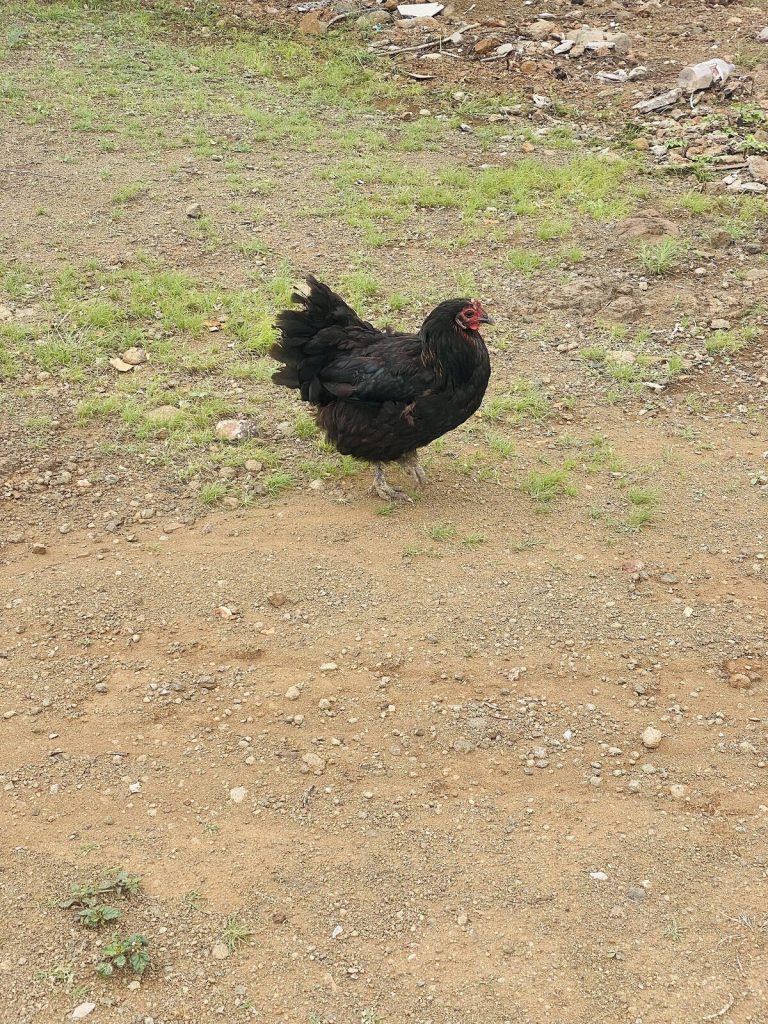
Improved local chicken breeds in Uganda covers three different things sold under one label: a true indigenous ecotype, a selected indigenous line bred up by a research programme, and an imported exotic crossbreed. Only the third is widely on sale here. Which one a farmer buys decides whether they can ever hatch their own replacements, so that distinction is the whole decision.
Three Different Birds Sold as Improved Local Chicken Breeds
Start with the label, because the label is doing the lying. "Improved local chicken" is a sales category, not a genetic one, and three unrelated kinds of bird sit inside it. A farmer who buys the wrong one does not get a worse bird; they get a bird that behaves nothing like the one they were picturing.
The commercial crossbreeds are perfectly good birds. The problem is that they are sold using the word "local", which tells a farmer they can keep a cock and carry on, and they cannot. That single fact settles whether improved birds suit a household, and it is covered in full further down this page.
Uganda's Seven Local Chicken Breeds and Their Ecotypes
MAAIF's poultry training manual names seven local breeds commonly reared in Uganda: Ugandan Black and Red, Ugandan Brown, Ugandan Red, Ugandan White, Nsesere, the Teso chicken, and the Ugandan Short Legged bird, also called Nyoro. Regional names attach across several of them, including Nganda, Nsoga, Nkore and Nkooki, which is why the same bird can be described by two different names in two districts.
These are ecotypes rather than standardised breeds in the European sense. They were never bred to a written standard; they are populations that settled into a shape because of where they live and what has killed their relatives. The national livestock census counted 40.4 million indigenous chickens against 17.4 million exotic, so the ecotypes remain the great majority of Uganda's poultry genetics.
Their measured performance is modest and consistent. Makerere researchers surveying flocks in Kumi district recorded a clutch of about 13 eggs, three to four clutches a year, and first egg between five and a half and seven months of age. Under scavenging in a national field trial, indigenous cocks reached 1.6 kg at 25 weeks and 2.2 kg at 43 weeks. The husbandry that lifts those numbers is set out in our guide to local chicken farming in Uganda.
Worth noting before moving on to the improved birds: the census also measured egg output per laying hen per week, and the indigenous hen came out at five eggs against 4.3 for Uganda's exotic layers. That says more about how badly commercial layers are managed here than about indigenous genetics, but it does mean the bird being "improved" is not the feeble producer she is usually described as.
Kuroiler: an Indian Crossbreed Measured in Ugandan Flocks
The Kuroiler is a dual purpose scavenger cross developed in India by Keggfarms of Gurgaon, made by crossing several genetically uniform pure lines and selecting for a bird that would thrive on village scavenging while looking like the local Desi chicken. It became commercially available in the early 1990s and was brought to Uganda in 2009, hatched at the National Animal Genetic Resources Centre and Data Bank at Entebbe.
Two things about the Kuroiler are well established in Uganda. It gains weight faster than an indigenous bird under identical scavenging conditions, which a field trial across five districts measured directly. And its famous egg figure is not a Ugandan measurement. The claim of 150 to 200 eggs in a laying cycle traces to a Harvard Business School case study of Keggfarms, the company that owns the cross, and the Ugandan trial that carried the breed into the country states plainly that it did not quantify egg production at all, because Kuroilers and indigenous birds shared one flock per household and the eggs could not be told apart.
The head to head comparison between Kuroilers and local chickens, with the measured Ugandan weights and survival figures, belongs on our dedicated page on Kuroiler against local chicken, and the management detail sits in Kuroiler chicken farming and Kuroiler weight by age. What matters on a breed selection page is narrower: the Kuroiler is an Indian commercial hybrid, it is not a Ugandan local bird, and its headline egg number is a breeder's estimate rather than a field result.
Sasso: a French Meat Cross Sold as a Dual Purpose Breed
Sasso is a brand rather than a breed. The name is an acronym for Selection Avicole de la Sarthe et du Sud-Ouest, a French breeding company whose product is a set of coloured slow growing meat lines. They are sold across East Africa as dual purpose improved birds, and MAAIF lists Sasso as one of four improved dual purpose breeds available in Uganda.
The honest reading of the measured evidence is that Sasso is a meat bird. In an on station trial under the African Chicken Genetic Gains programme in Nigeria, six improved tropical birds were run side by side for 504 days on the same feed at two test stations. Sasso produced the heaviest cockerels of any bird tested and the fewest eggs of any bird tested, and its feed cost per dozen eggs was more than double that of the best layers in the trial. The study's own conclusion put Sasso and Kuroiler in the single purpose meat category and two other birds in the dual purpose one.
That is Nigerian on station data, not Ugandan field data, and it should be read as such. It is still the only like for like measurement of these birds against each other that exists in the region, and it is a great deal more useful than a supplier's leaflet.
| Bird | Eggs in 364 days | Cock at 140 days | Feed per dozen eggs |
|---|---|---|---|
| Sasso | 75 | 2,962 g | 7.6 kg |
| Kuroiler | 127 | 2,894 g | 4.4 kg |
| Noiler | 173 | 2,599 g | 3.6 kg |
| FUNAAB Alpha | 190 | 2,097 g | 2.9 kg |
| Shika Brown | 192 | 1,688 g | 2.9 kg |
| Fulani, local | 88 | 1,321 g | 4.4 kg |
Read that table carefully, because it overturns the usual sales pitch twice. The bird with the heaviest cockerel laid the fewest eggs, which is what breeding for meat does. And the bird that laid best of the crossbreeds was not either import: it was FUNAAB Alpha, a selected indigenous Nigerian line, which also ate the least feed per dozen eggs of any bird in the trial alongside a purpose bred layer.
Rainbow Rooster and Other Improved Breeds on Sale in Uganda
Rainbow Rooster is the third name a Ugandan farmer meets, and it is another Indian commercial cross, bred by Indbro Research and Breeding Farms of Hyderabad as a multicoloured low input bird for backyard rearing. MAAIF's four improved dual purpose breeds are Kuroiler, Rainbow Rooster, Sasso and unnamed crosses, and NAGRC lists Rainbow Rooster alongside Kuroiler as the two birds it multiplies and distributes nationally.
Kenbro and Kari are also mentioned in Ugandan and Kenyan farming media. Kenbro is a Kenyan commercial cross. Kari refers to stock from what was the Kenya Agricultural Research Institute, now KALRO, which is a research programme rather than a company and belongs in the selected indigenous category discussed next. None of these four names is a Ugandan local breed, and describing any of them that way is simply an error, though it is a common one.
No measured Ugandan trial comparing Rainbow Rooster with Kuroiler was found during research for this page. Claims that one is hardier than the other circulate widely in farming media with no study attached, and this page does not repeat them.
Selected Indigenous Lines from Regional Breeding Programmes
This is the category Ugandan farmers hear least about and would probably benefit from most. Instead of importing a cross, a research station takes indigenous stock from several localities, records every bird's performance, and breeds selectively for eggs and growth over successive generations. The result is still an indigenous chicken. It keeps the broodiness, the scavenging behaviour and much of the hardiness, and a farmer can usually breed on from it.
Two regional programmes are worth naming because both have published work behind them. In Nigeria, FUNAAB Alpha came out of the Federal University of Agriculture, Abeokuta, and in the on station trial above it out laid both imported crosses while eating the least feed per dozen eggs. In Kenya, breeding and selection of indigenous chicken has run at the KALRO station at Naivasha since the early 2000s, producing two registered improved indigenous lines.
Uganda has no equivalent on sale. NAGRC's Poultry Development Unit states its purpose as multiplying and distributing Kuroiler and Rainbow Rooster chicks countrywide, and no Ugandan selected indigenous line was found being distributed by any public body during research for this page. So a Ugandan farmer who wants an improved bird that still breeds true has, in practice, one route available: select within their own flock using the criteria MAAIF publishes, and cull hard. That is slower than buying chicks and it is free.
One caution on this category. Egg claims for improved indigenous lines circulating in East African media reach 220 to 280 eggs a year, which is commercial layer territory and higher than any bird recorded in the Nigerian trial. Those figures come from press coverage and promotional material, not from a study this page could read, and they are not reproduced here as fact.
Why Improved Crossbreeds Do Not Breed True in Your Own Flock
Here is the sentence that should appear on every leaflet and appears on almost none. Kuroiler and the other commercial crosses are first generation hybrids, and only that first generation performs. The Ugandan field trial that introduced the breed states it directly: productivity in both egg number and body weight gain diminishes progressively in subsequent generations, which is why India built a distribution system to keep supplying fresh first generation chicks to remote villages, and why the same would be needed in Africa.
The mechanism is ordinary genetics. A commercial cross is made by mating two or more genetically uniform parent lines held by the breeding company. The first cross is uniform and vigorous. Mate those birds to each other and the offspring scatter across the parent types, so half the flock is disappointing and none of it is predictable. The parent lines are the company's asset and are not sold.
A second mechanism compounds it. The broodiness gene is poorly expressed in the Kuroiler, which is exactly why it lays continuously instead of stopping for three weeks to sit. A hen that will not brood will not hatch you a replacement even if the genetics would have held. Indigenous hens lay a clutch, go broody, and rear the next generation for nothing; that is the trade the improved bird gives up.
A Ugandan farmer who answers no to the second or third question is better off with indigenous birds managed properly than with improved birds managed the way indigenous birds are.
Where Improved Breed Chicks Come From in Uganda
The public route is NAGRC&DB, the National Animal Genetic Resources Centre and Data Bank at Entebbe, which was set up under the Animal Breeding Act and is a semi autonomous body under MAAIF. Its Poultry Development Unit multiplies and distributes Kuroiler and Rainbow Rooster chicks, keeps breeding records, has installed hatcheries at four centre farms, and runs a National Poultry Development Centre in Wakiso built to hold 100,000 parent stock birds at a time. Its stated stakeholders include NAADS and the national poultry farmers', breeders', veterinary and feed manufacturers' associations.
Beyond that, chicks reach farmers through commercial hatcheries and agrovet stockists, and through programme distributions. Two practical warnings apply to all of them. First, a bird's name on a receipt is not a guarantee of its parentage; crossbred stock of uncertain ancestry is widely sold under the better known names, and you cannot tell by looking, because looking like a village chicken is the point of these crosses. Second, bringing in live birds rather than day old chicks is the main way Newcastle disease enters a village flock, so day old chicks from a hatchery are the lower risk purchase and any grown bird needs keeping well apart from the flock first.
For current chick availability and what stockists are charging, use the living Kuroiler chick price page and the chick supplier directory rather than any figure quoted in an article. Whatever breed arrives, it needs vaccinating on a proper schedule; see the vaccination schedule for improved birds and confirm it with a veterinary officer for your district.
Matching a Breed to Your Feeding System and Your Market
Breed choice follows the feeding system, never the other way round. MAAIF's own figures make the point: an improved dual purpose bird on a full ration reaches about 2.5 kg at ten weeks, eating roughly 15 g of feed a day in week one and 178 g a day by week ten. Take the ration away and the bird does not simply grow more slowly in proportion; it grows like a big hungry chicken, which is worse than a small efficient one.
On the market side, one detail is easy to miss. Kampala buyers pay a premium for local chicken and about 78 percent of consumers, offered a dressed local bird, rank yellow skin colour as their first selection criterion. A crossbred bird raised on bought feed will not necessarily present the way the buyer expects. If the local trade is your outlet, the breed that sells is the one the trade recognises.
Breed Performance Claims the Measurements Do Not Support
Five claims circulate widely in Ugandan and East African farming media about improved local chicken breeds. Each is set against what the published measurements actually found.
The pattern is consistent: growth claims are inflated, egg claims are inflated or reversed, hardiness claims have nothing behind them, and the indigenous baseline is quoted wrongly in both directions depending on which point the writer wants to make. None of that makes the improved crosses bad birds. It does mean a farmer should buy them for the one thing the Ugandan data confirms, which is faster growth to a heavier cockerel, and should not budget on the rest.
FAQ: Improved Local Chicken Breeds in Uganda
Is a Kuroiler a local chicken? No. It is an Indian commercial crossbreed developed by a private breeding company, first brought into Uganda in 2009. It was deliberately bred to look like a village chicken, which is why the confusion persists, but it has no Ugandan ancestry and it cannot be bred on. MAAIF lists Uganda's seven local breeds separately from its four improved dual purpose breeds, and Kuroiler is in the second list.
Can I hatch my own Kuroiler or Sasso chicks from my flock? Not usefully. These are first generation hybrids, and the Ugandan trial that brought the Kuroiler into the country recorded that both egg production and weight gain fall away progressively in later generations. There is a second obstacle: the broodiness gene is weak in these crosses, so the hens mostly will not sit on eggs at all. Planning to buy chicks indefinitely is part of choosing an improved bird.
Which improved breed lays the most eggs? Of the birds that have been measured side by side in the region, a selected indigenous Nigerian line and a purpose bred layer led on 190 and 192 eggs over 364 days, Kuroiler managed 127, and Sasso was last at 75. Neither of the leaders is on sale in Uganda. Between the two imports most Ugandan farmers can actually buy, Kuroiler is the better layer by a wide margin and Sasso is the better meat bird by a narrow one.
Are improved breeds more disease resistant than indigenous chickens? The evidence says no. Vaccinated Kuroilers and vaccinated indigenous birds survived at 85 and 83 percent over seven months in a Ugandan field trial, a gap with no statistical weight, and all the deaths in that trial were management related rather than infectious. In the Nigerian on station trial the imported birds died at higher rates during brooding than the locally sourced lines. Both categories need Newcastle vaccination, and neither category survives without it.
Do improved birds still scavenge, or do they need bought feed? They scavenge, and that is the whole point of these crosses; MAAIF describes the improved dual purpose birds as good scavengers that use vegetables efficiently. What they will not do is deliver the advertised growth on scavenging alone, because the figures behind those claims come from birds on a full ration. Treat scavenging as the base and supplementary feed as the thing that buys the weight advantage you paid the chick price for.
Is it worth putting an improved cock over my local hens? Ugandan farmers do this widely, and a study in Pader and Agago districts in the north found that every household surveyed was crossing local hens with imported Kuroiler stock, and every one of them gave raising egg numbers as the reason. The crossbred birds did show hybrid vigour in egg production. The same study found that hatchability of eggs from the crossbred hens under semi intensive management was no better than from local hens, so the gain is in egg numbers rather than in reproduction, and the offspring are not a stable breed you can build a flock on.
What do improved chicks cost in Uganda? More than a hatched indigenous chick, which costs nothing, and the price varies by hatchery, by breed, by whether the birds are day old or already brooded for a month, and by season and demand. Brooded chicks cost more than day old chicks and carry less risk. Because the real cost of an improved bird is repeated chick purchases plus feed rather than a single price, look at the current chick price and the full cost of raising a batch together before deciding.
The useful next step is a question rather than a purchase: can you reach a hatchery repeatedly, and can you brood chicks without a mother hen? If yes, an improved cross will grow you heavier cockerels. If no, put the money into a night shelter and Newcastle vaccination for the birds you already have. Check current stockists and prices through the chick supplier directory and the live chicken price page, and the rest of the poultry hub covers the systems each breed suits.