
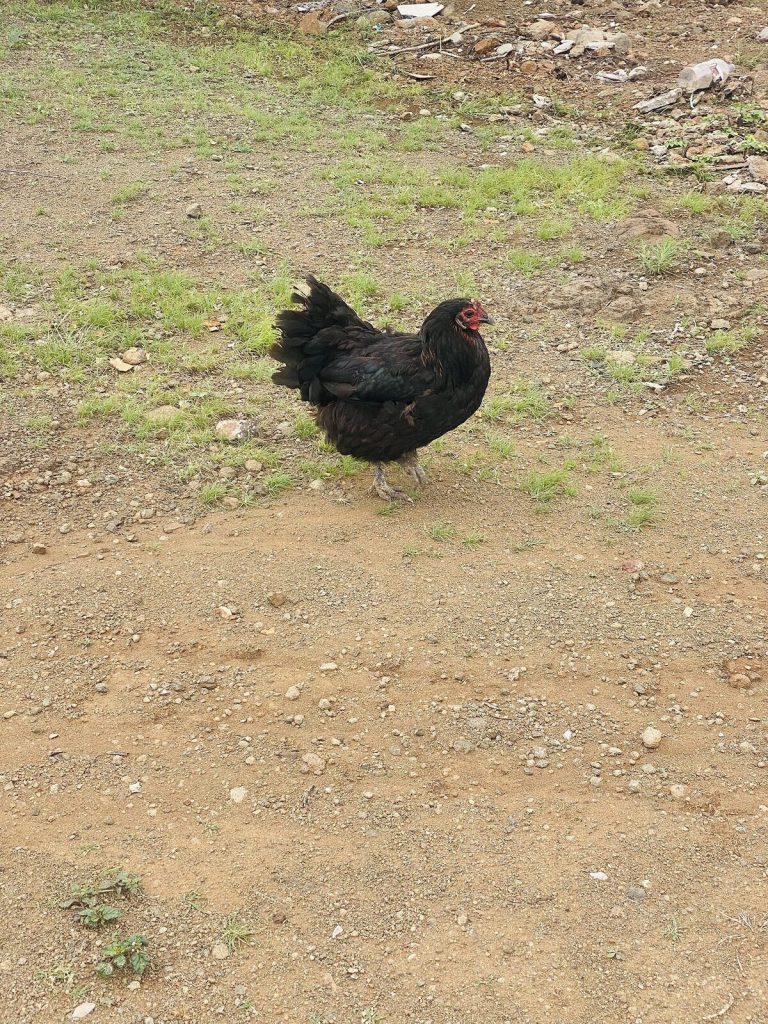
A Kuroiler vaccination schedule runs from day old to point of lay and covers Marek's disease, Newcastle disease, Gumboro, fowl pox and fowl typhoid, each by a fixed route. Most Ugandan hatcheries vaccinate the chicks they sell before you collect them, so confirm what your batch already received. Kuroilers are dual purpose birds, so the schedule splits once you choose meat or eggs.
What the Kuroiler Vaccination Schedule Has to Protect Against in Uganda
Two diseases decide whether a Kuroiler batch survives. Newcastle disease can move through an unvaccinated flock and leave almost nothing standing, and there is no treatment once birds are sick. Gumboro, which vets call infectious bursal disease, works differently and is nastier for it: it attacks the young bird's immune system, so a flock that survives the outbreak goes on to respond badly to every other vaccine you give it afterwards.
The Ministry of Agriculture, Animal Industry and Fisheries lists both, along with infectious bronchitis, fowl pox, fowl typhoid, Marek's disease and coccidiosis, among the diseases that improved dual purpose breeds meet in Uganda. Kuroilers sit in that group. MAAIF's poultry training manual for extension workers names Kuroiler as one of four improved dual purpose breeds kept in the country, beside Sasso, Rainbow Rooster and local crosses, and directs farmers to the commercial layer programme as the starting point.
That is the part worth holding onto. A Kuroiler is not a broiler with a longer life. It is closer to a layer in how long it stays on the farm, and the vaccination schedule follows the bird's lifespan rather than its breed name.
Confirm the Schedule With a Vet and the Hatchery Before You Vaccinate the Flock
Every serious Ugandan supplier that publishes a vaccination programme says the same thing in the footnotes, and farmers skip it. Ugachick Poultry Breeders, which publishes its layer and broiler programmes openly, states that the programme may only be adjusted after consulting a qualified vet or poultry specialist who knows the disease situation in that area. It also states, plainly, that vaccination does not guarantee protection on its own and works alongside feeding, biosecurity and daily stockmanship.
So make two phone calls before you make a schedule. Ring the hatchery and ask what the chicks were given. Ring a vet or your district extension officer and ask what is circulating locally this season, because a fowl pox problem in one sub county and none in the next changes whether week 6 matters to you at all.
Keep that written record. It is the difference between a schedule and a guess, and it costs nothing. Our poultry record keeping template gives you somewhere to put it.
Kuroiler Vaccination Schedule by Bird Age, Disease and Route
This table sets out the Kuroiler vaccination schedule most commonly used in Uganda, built from MAAIF's commercial layer programme, which its manual points improved dual purpose breeds towards, and cross checked against the published programmes of Ugandan and regional hatcheries. Route matters as much as timing. A Gumboro vaccine meant for drinking water will not protect a bird if it goes in the eye, and an injectable killed vaccine cannot be given in water at all. Every row below is a vaccination a Kuroiler flock kept to point of lay normally needs. Vaccines that are a vet's call for your area alone, fowl cholera being the main one, are handled in the prose further down rather than in the table, so that nothing in the table reads as optional.
| Age | Disease | Vaccine type | Route |
|---|---|---|---|
| Day 1 | Marek's disease | Live | Subcutaneous, neck |
| Day 1 to day 7 | Newcastle | Live HB1 or I2 | Eye drop |
| Day 10 to day 14 | Gumboro | Live intermediate | Drinking water |
| Day 18 to day 28 | Gumboro, 2nd dose | Live intermediate | Drinking water |
| Week 4 | Newcastle and bronchitis | Live combined | Eye drop |
| Week 6 | Fowl pox | Live | Wing web stab |
| Week 8 | Fowl typhoid | Killed | Intramuscular |
| Week 9 | Newcastle booster | Live Lasota | Drinking water |
| Week 14 | Bronchitis | Live | Drinking water |
| Week 14 | Fowl typhoid, 2nd | Killed | Intramuscular |
| Week 16 to 18 | Newcastle and bronchitis | Live or killed | Water or eye drop |
After that point the programme becomes a repeat cycle rather than a list of one off dates. MAAIF's guidance is straightforward: if you used a killed Newcastle and bronchitis vaccine at week 16 to week 18, repeat it after six months, and if you used the live vaccine, repeat every six weeks. Deworming sits alongside it, and Ugachick deworms at week 9 and week 15 then every six to eight weeks. Neither the deworming product nor its rate belongs in this article; the rate is on the label.
Marek's Disease Vaccination at Day Old and What the Hatchery Already Did
Marek's is the one vaccination on the Kuroiler vaccination schedule a farmer almost never gives. MAAIF's manual states that Marek's vaccine is normally given to day old chicks at day one in the hatcheries, and it explains why in the transport section: the vaccine travels in liquid nitrogen cylinders, not in an ice box. A smallholder with a cool box has no realistic way to handle it.
The route is a subcutaneous injection in the neck region. Timing is unforgiving. The vaccine has to get into the chick before the chick meets the virus, which in practice means within hours of hatching and before it touches litter, dust or older birds. There is no useful window at day 10, and there is no booster. Where you see a Ugandan blog recommending a second Marek's dose at day 10 by injection, it is wrong, and following it means handling and stressing chicks for nothing.
Practice among Ugandan hatcheries varies by bird type. Ugachick vaccinates its layer chicks for Marek's at day one and gives its broiler chicks no Marek's vaccine at all, which is reasonable because a broiler is gone long before the disease shows. A Kuroiler stays. If you are buying Kuroiler chicks and nobody can tell you whether Marek's was given, treat that as a reason to buy elsewhere rather than a detail. Our guide on where to buy Kuroiler chicks covers what else to check at the point of sale.
Newcastle Disease Vaccination Through the Life of the Flock
Newcastle vaccination starts in the first week and never really stops. MAAIF's layer programme puts the first Newcastle Lasota at week one by water or eye drop, then returns at week 4 combined with bronchitis, week 9, week 17, and on a rolling cycle after that. For village and scavenging birds the manual gives a simpler version: Newcastle within the first week after hatching, again at six weeks, again at three months, then adult birds twice a year.
Two vaccine names come up at the agrovet counter and they are not the same thing. HB1, the Hitchner B1 strain, is the mild one used for the first dose in very young chicks. Lasota is stronger and is used for boosters in older birds. You will see "New Castle 1B" written on farming websites; that is a misspelling of HB1, and asking for it by that name at a counter invites the wrong vial.
Eye drop beats drinking water for young birds, and the evidence behind that is not a matter of opinion. FAO's work on Newcastle disease in village chickens found eye drop administration gave higher antibody levels and became the recommended route where husbandry allows it. FAO's schedule for the thermotolerant vaccine reflects the difference: given by eye drop, it is administered once then repeated every three to four months, while by drinking water it needs two initial rounds two to three weeks apart and repeats at least every three months. One drop in an open eye, held until the bird swallows, and that bird is done.
Uganda has a locally relevant option here. Brentec, a vaccine manufacturer based in Kampala, produces a thermotolerant I2 Newcastle vaccine, developed for distribution through agrovets to farmers in areas where refrigeration is unreliable. Thermotolerant does not mean the cold chain stops mattering, and FAO is explicit on that point, but it widens the margin for a farmer whose nearest fridge is an hour away.
Gumboro Vaccination During Brooding, and Why the Timing Is Tight
Gumboro is where schedules disagree, and where the hatchery's day one work changes your dates most. The chick is born with maternal antibodies passed down from the parent flock. Vaccinate too early and those antibodies neutralise the vaccine, so the bird gets nothing. Vaccinate too late and the wild virus reaches the bird first.
MAAIF's layer programme places Gumboro at week 2 and again at week 3, by water or eye drop. Regional supplier schedules for Kuroiler and similar improved breeds put the first intermediate dose at day 10 to day 14 and a second at day 24 to day 28. Ugachick gives one farm dose at week 2, because their chicks already had a Gumboro vaccine by coarse spray in the hatchery. All three are internally consistent; they just start from different day one positions.
The working answer for a Kuroiler flock is a first intermediate dose around day 10 to day 14 in drinking water, and a second between day 18 and day 28, with the exact interval set by the vaccine strain and by what the hatchery gave. Ask which strain the vial contains, because an intermediate and an intermediate plus vaccine do not carry the same interval. Get this one wrong in either direction and the rest of the schedule sits on a bird with a damaged immune system. Sound brooding practice matters here too, and our poultry brooding guide covers the temperature and litter side of the same two weeks.
Fowl Pox, Fowl Typhoid and Fowl Cholera Vaccination From Week 6
From about week 6 the Kuroiler vaccination schedule moves to injectable and stab routes, and the birds are big enough to handle it.
Fowl pox goes into the wing web, by stab. MAAIF places it at week 6 and Ugachick agrees; other published schedules run it as late as week 8 to week 10, so week 6 to week 10 is the honest range. The advantage of the wing web route is that you can go back a week later and read the result. A small scab or swelling at the stab site means the vaccine took. No reaction across a whole flock means something failed and the birds are not protected.
Fowl typhoid is a killed Salmonella vaccine given by intramuscular injection, at week 8, with a second dose around week 14. MAAIF, Ugachick and the Ugandan farm guides converge on this one, which is unusual enough to be worth saying. Ugachick names an inactivated vaccine covering Salmonella enteritidis, typhimurium and gallinarum strains.
Fowl cholera sits outside the table on purpose. MAAIF does carry it, as a killed vaccine given by subcutaneous injection at week 18 in its layer programme, so the age and the route are real numbers from a real source. What makes it different from the rows above is how thinly it is agreed: MAAIF lists cholera at two different ages, and Ugachick's published layer programme leaves it out of the schedule altogether. For a Kuroiler flock it is a vet's call rather than a default, and it earns its place only where cholera is a known problem in your area. Adding injections a flock does not need is its own risk: every catch and handle costs you growth and invites stress.
Where the Vaccination Schedule Stops for Meat Birds and Continues for Layers
This is the fork almost every schedule online misses, and it is the reason a Kuroiler needs its own page rather than a layer page with the breed name changed.
MAAIF's manual is direct about it. For improved dual purpose breeds, vaccination follows the commercial layer programme, but it depends on whether the bird is being produced for meat or for eggs, and for the meat strain the vaccinations stop at four weeks. A Kuroiler sold for meat at week 8 to week 12 never reaches point of lay, so a point of lay Newcastle and bronchitis vaccine is money spent on a bird that will be slaughtered before it could ever benefit.
Two practical consequences. If you are running Kuroilers as a meat batch, your schedule is short: the hatchery's day one work, Newcastle in the first week, the two Gumboro doses, and the week 4 Newcastle and bronchitis. Fowl pox at week 6 is worth discussing with a vet if pox is active locally and you intend to hold birds past week 8. If you are keeping Kuroilers for eggs, the full programme applies and the point of lay window at week 16 to week 18 is the one you cannot skip, because a Newcastle outbreak in a laying flock takes the birds and the income stream together.
Decide which you are running before the chicks arrive, not at week 6. The Kuroiler chicken farming guide works through that decision, and the layer vaccination schedule is the closer comparison if you are keeping birds for eggs.
Cold Chain, Storage and Buying Vaccines That Still Work
A dead vaccine looks exactly like a live one. That is the whole problem. Farmers who follow their dates precisely still lose flocks, because what went into the birds had already been ruined between the shop counter and the brooder.
MAAIF's procurement guidance is worth following line by line. Buy from a pharmacy or drug shop registered with the National Drug Authority that employs qualified veterinary staff and holds a valid licence to trade in vaccines. Take a receipt showing the vaccine, the active ingredients, the expiry date, the batch number and the date of purchase. Check that the supplier has power backup, because a shop whose fridge dies overnight during load shedding is selling you nothing. Carry the vaccine home in a flask or an ice box with enough ice in it. Store it between 2 degrees and 8 degrees Celsius in a fridge or ice box, in a cool dark place.
Expiry dates are not a formality on a biological product. Neither is that batch number, which is the only way a problem gets traced if a whole batch of vaccine turns out to have been mishandled upstream. Ask for both in writing, every time, and keep the receipts with your flock records.
Drinking Water Vaccination, Chlorine and Reconstitution Timing
The drinking water route is the one most Ugandan farmers use for Gumboro and for Newcastle boosters, and it fails more often than any other, for reasons that are all fixable.
Chlorine destroys a live vaccine. MAAIF says not to use water containing disinfectant, chlorine or organic matter, and not to disinfect the drinkers after washing them on a vaccination day. Use clean water from a borehole, a good spring or clean rainwater. Where tap water is all you have, MAAIF's method is to add skimmed milk powder at 25 grams per 20 litre jerrycan and let it stand for 30 minutes before the vaccine goes in, so the milk protein takes the chlorine out of play. FAO reaches the same place by a different route, either standing the treated water overnight to let the chlorine dissipate or adding powdered milk to neutralise it. Do not use a metal container for any of this.
Then the clock starts. Reconstituted vaccine does not last more than two hours, and once it is in the drinkers the birds should finish that water within an hour. To make them drink it, take water away for about an hour and a half beforehand while leaving feed available, put out as many drinkers as you can find so every bird reaches one, and vaccinate in the cool of the morning. Ugachick adds that the vaccine water should be kept below 20 degrees Celsius and that birds should be thirsted for one to two hours, with the vaccine water consumed inside one to two hours.
Skip the knapsack sprayer. Spray vaccination is a hatchery and commercial house method that needs the right droplet size and a house set up for it, and a garden sprayer in a smallholder brooder gives you an uneven take you cannot measure.
Why Vaccination Fails Even When the Schedule Was Followed
MAAIF defines vaccine failure precisely: the disease appears during the protection period, meaning two weeks or more after vaccination, when immunity should be working. Its list of causes reads like a list of things that happen on ordinary Ugandan farms.
Add one more from the supplier side, because it comes up constantly: do not give antibiotics or antibiotic combinations on a vaccination day. Ugachick's programmes say multivitamins only. An antibiotic given the same morning as a live bacterial vaccine can kill the vaccine before it does any work.
Leftover vaccine is not a saving. MAAIF is blunt: never discard unused vaccine inside the poultry house, because you are seeding the house with the organism. Add hot water or disinfectant to what is left and dispose of the containers in a pit latrine or an incinerator. Wear gloves while you reconstitute, wash your hands afterwards, and use a nose and eye mask for any spray work.
If birds are dying and you do not know why, a vaccination is not the response. Work through poultry mortality causes and prevention and get a vet to look at the flock. For what the vaccines themselves actually are and how the routes work, poultry vaccines explained goes further than this page needs to.
Kuroiler Vaccination Questions Ugandan Farmers Ask
Do Kuroiler chicks arrive already vaccinated? Often, but not always, and not for the same diseases. A major Ugandan hatchery vaccinates its layer chicks for Marek's disease at day one and gives broiler chicks none, and Kuroiler hatcheries are smaller and more varied in what they do. Ask for the list of vaccines given and the hatch date, in writing. Never assume, and never assume "vaccinated" means fully covered.
Can I vaccinate Kuroilers myself, or do I need a vet? Eye drop and drinking water vaccinations are within reach of a careful farmer who has been shown how once. Injections into the wing web, the breast muscle or under the skin of the neck are a different matter, and a bad injection wastes the vaccine and hurts the bird. Marek's is not a farm job at all, because the vaccine needs liquid nitrogen. Whichever you do yourself, the schedule itself should be set by a vet who knows your area.
What happens if I miss a vaccination date? Do not double up to catch up, and do not guess a new date. Ring your vet with the hatch date and the actual dates given, and let them rebuild the remaining schedule. Missing a Gumboro dose in the brooding period is more serious than missing a later Newcastle booster, because the timing window is narrow and what is at stake is the bird's ability to respond to everything else.
Is there a withdrawal period before I sell eggs or meat from vaccinated Kuroilers? Any withdrawal period is printed on the label of the product you used, and that is the number to follow. Do not take a figure from a website, including this one, because it varies by product and by country of registration. In practice the residue question around vaccination day usually comes from something else: if a vet prescribes an antibiotic or a coccidiostat alongside, ask for that product's withdrawal period before you sell a single tray or bird.
Can I vaccinate birds that are already sick? No. MAAIF's conditions for safe use rule out vaccinating poultry during stress or illness, and the health status of the birds is one of the causes of vaccine failure it lists. Vaccinating into an outbreak gives the flock the handling stress without the protection. Get a diagnosis, treat what is treatable, and vaccinate the survivors once they are back to normal behaviour and feed intake.
Why are vaccines sold in 1,000 dose vials when I only keep 50 birds? Because the packs are made for commercial houses. MAAIF's own mixing guidance is written per 1,000 doses, and once a vial is reconstituted the contents are good for about two hours, so the rest is waste. This is the real cost driver for a small flock: the per bird cost depends almost entirely on how many birds share a vial. Farmers get around it by vaccinating on the same morning as neighbours, which is also how community Newcastle campaigns are organised, and some suppliers in Uganda now sell smaller vials aimed at smallholders.
What does it cost to vaccinate a Kuroiler flock? It depends on the pack size you are forced to buy, how many birds share it, which diseases your vet includes, and whether you pay someone to come out and inject. Prices move with the exchange rate and with supply, and any figure quoted without a date is worth nothing, so check what agrovets in your area are charging rather than budgeting from a number online. Our Kuroiler chicks price page tracks the related input costs.
Do Kuroilers need a coccidiosis vaccination? Coccidiosis is one of the common diseases of improved breeds in Uganda, but it does not appear on the standard schedules, and control is a management job rather than a vaccination one. Keep litter dry, turn it, replace it when it cakes, and avoid water spillage. Where a vet advises a coccidiostat, use it at the rate on the label and ask about its withdrawal period. Feeding and litter both feed into this, and the Kuroiler feeding guide covers the feed side.
Finding Kuroiler Chicks and Vaccine Suppliers in Uganda
The schedule on this page is only as good as the two things it depends on: chicks whose vaccination history you actually know, and vaccine that was still alive when it went into the bird. Both come down to who you buy from.
Start at the poultry guides hub if you are still working out how Kuroilers fit your farm. When you are ready to order, use the supplier directory to find hatcheries that will tell you what the chicks received and on what date, and buy vaccine only from a drug shop registered with the National Drug Authority that can hand you a receipt with the batch number and expiry on it. Then put your own dates on paper, counting from the hatch date, and get a vet or your district extension officer to check them against what is circulating locally before the first one falls due. The poultry vaccination calendar gives you a sheet to fill in and pin up in the store.