
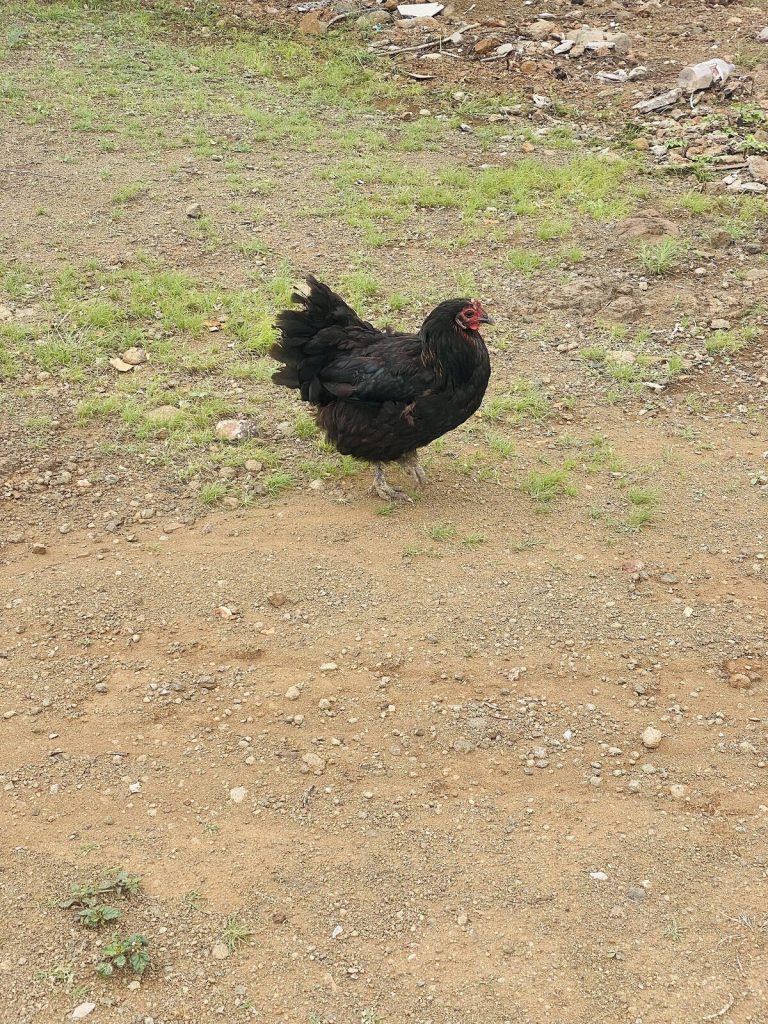
Choosing between Kuroilers and broilers comes down to one question: can you guarantee uninterrupted feed and a buyer on a schedule? If yes, broilers beat Kuroilers on every efficiency measure that matters. If no, the Kuroiler is the better bet, because it forgives the gaps. These are two different enterprises wearing feathers, not two grades of the same bird.
Kuroiler or Broiler: The Short Verdict for Ugandan Poultry Farmers
Most comparisons end on "it depends on your goals", which helps nobody. Here is a verdict, and the condition it turns on.
Everything below tests that verdict against Ugandan figures rather than breeder leaflets. Broiler weights and feed come from the national poultry training manual issued for extension workers by the agriculture ministry. Kuroiler weights and feed conversion come from a Makerere University on farm study that weighed 240 birds individually, week by week, in two northern districts.
What Each Breed Was Selected For, and What That Costs You
Every trait you like in one of these birds was paid for with a trait it gave up. The breeder banked the gain. You pay the bill.
The broiler was selected on one axis and everything tradeable was traded for it. Appetite, frame, heat tolerance, working lifespan: all spent buying growth rate. That is why a broiler cannot wait, cannot pause and cannot improvise. You are renting extreme performance on condition that you supply perfect conditions, and the contract has no grace period.
The Kuroiler was selected the other way round, to keep a village chicken's behaviour while outgrowing one. It kept the scavenging instinct, the tolerance of rough housing and the local look, and it paid for all three in growth rate and feed efficiency. Where its parent lines came from and how Uganda got its stock is set out in our Kuroiler farming guide. What matters to a buying decision is only the trade.
Read that way, the usual question dissolves. There is no better bird here. There is a bird whose bill you can pay and a bird whose bill you cannot, and the rest of this page is about working out which is which on your farm.
Growth Rate and Weeks to Market Weight
This is the comparison everyone makes and it is worth making properly, with the same weight target for both birds.
| Age | Broiler | Kuroiler |
|---|---|---|
| Week 1 | 150 g | 68 g |
| Week 2 | 375 g | 120 g |
| Week 3 | 705 g | 171 g |
| Week 4 | 1,140 g | 264 g |
| Week 5 | 1,600 g | 392 g |
| Week 6 | 2,000 g | 513 g |
| Week 12 | sold | 1,417 g |
| Week 16 | sold | 2,000 g |
| Week 20 | sold | 2,379 g |
Broiler figures are the ministry's own for birds on broiler mash. Kuroiler figures are the measured confined ones, meaning continuous bought feed, which is the fairest comparison available.
A broiler hits 2 kg at week 6. A confined Kuroiler hits the same 2 kg at about week 16, and a free range one somewhere past week 22. At week 6 the broiler is running roughly four times the Kuroiler's weight. That is the gap, and no feeding programme closes it, because it is genetic.
What the gap means in practice is turnover. Six to eight week cycles let a broiler house run several batches a year through the same building. A Kuroiler occupies that building for sixteen to twenty two weeks per batch. Per shilling of housing, the broiler is a different order of enterprise.
Feed Conversion: Where the Broiler Wins Outright
Almost nothing written comparing these birds quantifies feed, which is odd, because feed is where the comparison is actually decided. Feed is also the largest running cost in Ugandan poultry, at 70% to 80% of production cost by the ministry's own reckoning.
The ministry manual's broiler tables let you work it out. On broiler mash, 100 birds eat about 423 kg to reach 2 kg each at week 6, which is roughly 4.2 kg of feed per bird and a whole cycle conversion near 2.1. On pellets the same birds reach about 1.75 kg at week 5 on about 293 kg per 100, so roughly 2.9 kg per bird and a conversion near 1.7.
The Makerere trial measured Kuroiler conversion directly under confinement: about 4.9 at week 8, 7.4 at week 12, 11.8 at week 16 and 15.3 at week 20. Lower is better. Even at its best, week 8, the Kuroiler is converting worse than a broiler manages across its whole life, and by the time it reaches a broiler's market weight at week 16 it is around five times worse.
There is a second point hidden in that series. Kuroiler conversion gets steadily worse with age, so every week you keep the bird past week 16 costs disproportionately more feed per kilogram gained. A broiler never faces this because it is sold before the curve turns. The feeding detail sits in our Kuroiler feeding guide and the broiler side in the broiler feeding guide.
So on feed, the broiler wins and it is not close. If your farm is a feed conversion machine with a guaranteed feed supply, stop reading and buy broiler chicks.
Housing and Management Demands of Each Breed
The demands diverge as sharply as the growth rates, in the opposite direction.
Broilers need a house you control. Dry litter, real ventilation, stocking density respected, feed and water in front of them at all times, and heat managed in the brooding phase. A broiler is carrying a body its legs and heart were never designed for, so wet litter, crowding and heat stress cost you birds rather than just growth. Their water demand climbs from about 40 to 50 ml a bird a day in week 1 to 210 to 230 ml by week 6, and a water interruption on a hot afternoon in week 5 is an emergency.
Kuroilers were bred for the opposite. In the Ugandan village trial across five districts, households gave night shelter, let the birds range the compound by day, and threw a fistful of grain to the flock once or twice a day. Some farmers in the north simply let them roost in trees. The birds performed. MAAIF's manual says much the same, that improved dual purpose birds use less investment in housing and feeding than commercial stock.
This is the practical heart of the comparison. The Kuroiler does not reward good management as much as a broiler does, and it does not punish poor management nearly as hard. If you are learning, or your attention is split across a farm, that asymmetry is worth more than a conversion ratio. Work out the floor area either bird needs with our stocking density and house size figures.
What Happens When the Feed Runs Out
Here is the test that settles most real decisions in Uganda, and no comparison article asks it. Your feed money is late by three weeks. What happens?
Anyone who has farmed through a bad maize season in Uganda understands why this outranks feed conversion for a smallholder. Efficiency matters when nothing goes wrong. Resilience matters when something does.
Disease Risk and Mortality in Broiler and Kuroiler Flocks
The useful framing is not which bird catches less disease. It is what kills each one, because the two lists barely overlap and only one of them sits inside your control.
Broiler losses cluster in things a farmer causes or fails to prevent: heat stress, leg and heart failure under a body the bird cannot carry, wet litter disease, and any break in feed or water. Kuroiler losses on range arrive from outside the house, chiefly Newcastle disease, worms and predators, and farmer surveys in northern Uganda put Newcastle top of the list for village flock deaths, with losses concentrated in the youngest birds. Tighter management shrinks the broiler list a great deal and the Kuroiler list only somewhat, which is another way of saying the broiler rewards skill and the Kuroiler rewards patience.
All of which cuts against a claim worth killing. Kuroilers are widely sold as more disease resistant than exotic birds, including in a Kampala Capital City Authority bulletin, and the research does not support it. Seven month village survival was 85% for Kuroilers and 83% for local chickens, too small a gap to treat as real, with every death recorded as management related and no outbreak at all because every bird had been vaccinated first. An on station evaluation in Nigeria, conducted under an International Livestock Research Institute programme, found the reverse of the marketing, with foreign sourced breeds including Kuroiler surviving less well than locally bred alternatives across brooding, growing and laying. Tolerating a rough house is not immunity, and neither bird is exempt from a vaccination programme.
For either bird, the schedule comes from your hatchery, the product label and a veterinary officer who knows the local disease picture. Never take a dose, a route or an interval from a general article, and observe the withdrawal period on anything medicated before you sell meat or eggs. See our Kuroiler vaccination schedule, the broiler schedule, and poultry mortality and how to prevent it.
Egg Production: The Income Broilers Cannot Give You
A broiler does not lay. That ends the comparison on one axis and it is a genuine point for the Kuroiler, though smaller than the marketing suggests.
The catch is how much weight that axis will bear. Laying starts around week 25 in Ugandan village conditions, and closer to day 120 in a regional on station trial, so eggs arrive after the point where most growers would already have sold a meat bird. Counting on eggs means committing to hold hens through the expensive end of the growth curve first.
The number usually quoted will not carry the argument either, and neither will the ones that replaced it. That 150 to 200 eggs figure traces to breeder and distribution programme material, and the Ugandan village trial left egg output unmeasured altogether, since its households ran Kuroilers and local hens as one flock. Nigerian on station work did count: 127 eggs per hen housed in a year, with the same trial concluding the bird is better cast as a meat producer than a true dual purpose one. Set that beside a Tanzanian study which ranked Kuroiler egg output below Sasso, while the Nigerian figures put Kuroiler at nearly double Sasso, and the picture is of a trait that swings with conditions rather than a number you can bank. Treat published egg counts as evidence that the egg case is unreliable, which is itself a reason to decide this on meat.
So price eggs into a Kuroiler plan as a modest second stream that starts late, never as half the case. If eggs are the real objective, neither bird here is the answer and a layer strain beats both outright, as our layer farming guide sets out.
Market Access Decides This More Than Meat Quality Does
The Kuroiler earns back on price what it loses on feed. Whether you can actually collect that is a separate question, and it is the one to settle before you order anything.
The two birds are sold by different mechanisms, not merely to different people. A broiler is priced per kilogram against a commodity benchmark, so you compete on cost with every other broiler house in the district and your margin is whatever sits between the feed price and the going rate. A Kuroiler is priced per bird against what a buyer will pay for type, which means you barely compete on cost at all. The ceiling is higher and the volume is thinner.
That sets a hard sequencing rule. Broilers need a buyer who exists before the chicks do, because a bird at week 7 has no waiting position. Kuroiler timing is forgiving, and the constraint moves instead to depth of demand: a weekly market and a few roadside grills will absorb fifty birds without blinking and will not absorb five hundred. Scaling a Kuroiler flock is a marketing problem long before it becomes a husbandry one, and growers tend to discover that on the batch after the one that went well.
Ugandan buyers do prefer Kuroiler to local chicken on taste, texture and meat to bone ratio, by wide margins in the Uganda trial's farmer survey, and those figures sit in our Kuroiler farming guide. Two traps hide behind them. "Softer" is not a compliment to every buyer, and some want the firmer local bird, so test a small batch on your real buyer before scaling. And the ministry manual notes that a dual purpose bird on a broiler ration yields softer meat than one on a layer ration, so pushing for weight with broiler feed can quietly spend the premium you were chasing.
Neither Breed Lets You Build a Self Replacing Flock
This one matters because of the argument people build on top of it, which is wrong.
Nobody expects to breed broilers, so that constraint gets priced in from day one. The Kuroiler invites the opposite assumption. It ranges, it behaves like village stock and it looks the part, so farmers reasonably conclude the flock will renew itself. It will not, because the performance comes from a first generation cross and does not survive being bred on. Our Kuroiler farming guide works through what happens to the second generation and why.
Here is the part that changes a decision. Weighed against keeping local chickens, that recurring chick purchase is a real strike against the Kuroiler. Weighed against broilers it is worth nothing at all, because broilers impose exactly the same cost. Anyone reaching for "at least with Kuroilers I can breed my own" as a reason to skip broilers is deciding on a premise that does not hold, and they will meet it in their second cycle rather than their first.
Whichever bird you land on, press the hatchery on where its parent stock comes from. Compare through our Kuroiler chick suppliers and broiler chick suppliers directories.
Which Breed Fits Your Farm
Work through it in this order, because the first question disqualifies more people than the rest combined.
Can you fund continuous feed for the whole cycle, starting today, without needing income from the flock along the way? If no, Kuroilers. A broiler cycle that runs out of money halfway is not a slow batch, it is a written off one.
Do you have a buyer who will take a specific number of birds on a specific date? If no, Kuroilers, because a Kuroiler can wait on range while you find a buyer and a broiler at week 7 cannot wait at all.
Can you keep a house dry, ventilated and correctly stocked through a rainy season? If no, Kuroilers.
If you answered yes three times, broilers will make you more money per shilling and per square metre, and it is not a close contest. Start with the broiler farming guide. If you answered no to any of them, the Kuroiler is the right bird and our Kuroiler farming guide is the place to begin. Either way, the wider picture sits in our poultry farming hub.
A last thought worth holding onto. Plenty of Ugandan farms run both, broilers for turnover into a contracted buyer and a standing Kuroiler flock for the local market, eggs and household meat. They fail in different conditions, which is exactly why holding both is often steadier than doubling down on either.
Kuroiler and Broiler Questions Ugandan Farmers Ask
Which grows faster, a Kuroiler or a broiler? The broiler, by a wide margin. Ministry figures put a broiler at 2,000 g by week 6. Measured Ugandan on farm figures put a confined Kuroiler at about 513 g at week 6 and at 2,000 g only around week 16. The broiler is roughly four times heavier at week 6.
Which is more profitable? Broilers, where you can guarantee feed, housing and a buyer, because their feed conversion and turnover are far better. Kuroilers, where any of those three is unreliable, or where your buyer pays extra for local type meat, or where you want eggs too. The margins depend on your feed price and your selling price rather than on the breed, so run your own numbers with the farm profit calculator and compare raising 100 broilers against raising 500 Kuroilers.
How much feed does each bird need? Ministry tables give a broiler about 4.2 kg of mash to reach 2 kg at week 6, or about 2.9 kg of pellets to reach 1.75 kg at week 5. A Kuroiler needs considerably more feed to reach the same weight because its conversion runs from about 4.9 at week 8 to 11.8 by week 16, against a broiler's whole cycle figure near 2.1 on mash.
Can I keep Kuroilers and broilers together? Not sensibly. They need different rations, different stocking densities and different housing conditions, they go to market fourteen weeks apart, and mixing ages and types in one house is a biosecurity problem. Keep them in separate houses or separate cycles.
Which bird is better for a beginner? The Kuroiler, and not because it performs better. A management mistake with broilers costs you the batch; the same mistake with Kuroilers costs you a few weeks. Learn on the forgiving bird, then move to broilers once your feed supply and your buyer are both dependable.
Do Kuroilers taste better than broilers? Most Ugandan buyers who want a local type bird think so, and the texture is the reason. In the Uganda trial's farmer survey, about 79% preferred Kuroiler meat to local chicken meat and 75% found it softer. Some buyers want the firmer local bird instead, so test your own market.
Which bird costs more to start? The wrong question, because the shape of the spend differs more than the total. Broilers concentrate the whole feed bill into six to eight weeks and only pay at the end, so they need the full amount available on day one. Kuroilers spread a smaller weekly spend across sixteen weeks or more, which is easier on a household budget and ties up the money for far longer. Any shilling figure would be out of date by the time you read it, so pull live numbers from our Kuroiler chick, broiler chick and poultry feed price pages.
Can I hatch my own chicks from either bird? No, for both. Broilers are not kept for breeding, and the Kuroiler is a first generation cross whose performance does not pass to its offspring. Both enterprises need a chick purchase every cycle.
How long can I keep a Kuroiler before selling? Longer than a broiler, but not indefinitely. Village trial birds reached 2.6 kg at week 25 and 3.0 kg at week 43, with gain flattening after about week 27, so the eighteen weeks past week 25 bought only about 400 g. Feed conversion is poor by then. The week by week figures are in Kuroiler weight by age and the broiler equivalent in broiler weight by age.
Settle the buyer first. Everything else on this page is downstream of that one answer, and a grower who orders chicks while still hoping to find an offtake has already picked the wrong bird whichever bird they picked. Once the buyer is real, the feed price you can actually hold for the length of the cycle tells you the rest.