
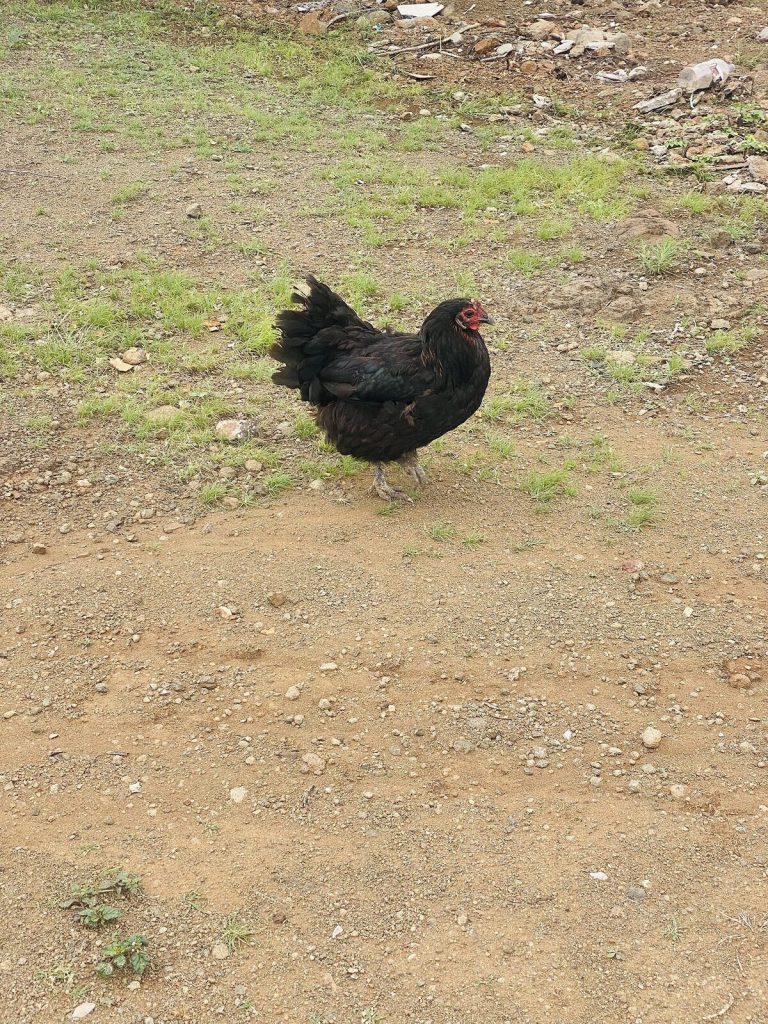
Kuroiler beats local chicken on liveweight and egg numbers, while local chicken beats Kuroiler on price per bird and on raising its own replacements. Which way kuroiler vs local chicken goes on your farm depends on whether you are selling eggs, meat or both, and on what your nearest market pays. Kuroiler is a crossbred dual purpose bird imported into Uganda and multiplied here; local chicken covers the seven indigenous breeds recognised by MAAIF. Feed budget decides the rest.
Kuroiler vs Local Chicken: The Verdict for a Ugandan Farm
Most farmers arrive at this comparison expecting one bird to win outright. Neither does. The Ugandan research that actually measured both breeds side by side found a wide gap on weight, a narrower gap than advertised on meat quality, and no reliable gap at all on survival.
So the verdict splits three ways, and it splits on what you are selling.
What the Kuroiler Breed Is, and How It Reached Uganda
The Kuroiler breed is a crossbred dual purpose chicken developed in India, not in Africa. It came out of crossing coloured broiler males with Rhode Island Red females, or White Leghorn males with Rhode Island Red females, and was selected to look like the Indian backyard chicken while growing and laying far better than it.
Uganda's government imported Kuroiler from India in 2009. Chicks reach farmers through the Poultry Development Unit of the National Animal Genetic Resources Centre and Data Bank at Entebbe, which multiplies and distributes Kuroiler and Rainbow Rooster chicks countrywide and lists the National Agricultural Advisory Services among its stakeholders. The centre holds a franchise from the Indian breeding company and imports the genetics directly.
That distribution route matters more than it sounds. Because Kuroiler is a crossbred hybrid, its performance sits in the first generation only. The parent stock stays with the breeding company, so the chain runs from India to Entebbe to you, every cycle, forever.
MAAIF groups Kuroiler with three other improved dual purpose options in Uganda: Rainbow Rooster, Sasso, and crosses. If you want the full production guide for the breed on its own, the Kuroiler chicken farming guide covers housing, brooding and flock routine in detail, and this page sits inside the wider poultry farming guides.
The Seven Local Chicken Breeds Uganda Actually Keeps
"Local chicken" is not one bird. MAAIF recognises seven local breeds commonly reared in Uganda, and the names carry regional identity rather than a studbook.
The list runs: Ugandan Black and Red, Ugandan Brown, Ugandan Red and Ugandan White, each known regionally as Nganda, Nsoga, Nkore or Nkooki; plus Nsesere, the Teso chicken, and the Ugandan Short Legged bird also called Nyoro. Farmers rarely separate them by name at market. A buyer asks whether the bird is local, and pays accordingly.
Local chicken production runs mainly at homestead level on the extensive system, either full free range or scavenging round the compound. Backyard flocks carry most of Uganda's chicken population, they usually hold fewer than twenty birds, and the hen does the brooding herself. That last point becomes the pivot of this whole comparison later on. The local chicken farming guide goes deeper on managing indigenous flocks, and it covers the middle ground between pure indigenous flocks and improved stock.
Growth Rate and Mature Weight in Ugandan Flocks
This is where the two breeds separate hardest, and it is also where blogs quote figures that Ugandan research does not support.
A field trial run across five Ugandan districts, Apac, Gulu, Kabale, Mayuge and Wakiso, weighed 1,126 birds of both types raised by village households under identical scavenging conditions. Every bird was vaccinated first and held to eleven weeks, then handed to families who fed them the same way. The weights below come from that trial.
| Age | Kuroiler cock | Local cock |
|---|---|---|
| 25 weeks | 2.6 kg | 1.6 kg |
| 43 weeks | 3.0 kg | 2.2 kg |
Read the second row carefully. The Kuroiler gains fast to about 27 weeks and then flattens out, so the gap narrows with age: it is roughly 1.6 times the local bird at 25 weeks, and about 1.4 times by 43 weeks. Holding a Kuroiler longer does not keep paying.
Under better feeding the ceiling lifts. In a separate Makerere, Gulu University and NARO study in Gulu and Kiryandongo, Kuroiler cocks at twenty weeks carried a cold carcass of 2,072 g against 1,159 g for local cocks, which implies live weights near 3.1 kg and 1.8 kg. Treat 2.6 to 3.1 kg as the honest band for a Kuroiler cock between twenty and twenty five weeks, with feeding deciding where inside it you land.
For local birds, MAAIF puts cockerels at market weight around 18 to 20 weeks, with pullets starting to lay at about five months. Hen weights for both breeds are reported less consistently than cock weights, so treat Kuroiler hens as a 2 to 3 kg range rather than a fixed figure. The Kuroiler weight by age page carries the week by week detail.
Egg Production Per Hen, and Where the Big Numbers Come From
You will see "150 to 200 eggs a year" attached to Kuroiler almost everywhere. That figure deserves a label, because it did not come from a Ugandan field measurement.
It traces back to a business school case study on the Indian breeding company that owns the Kuroiler cross, and it is repeated by donor programme documents. Both of the peer reviewed Ugandan papers that cite it cite it to those origins rather than to their own data. The Uganda field trial states plainly that it did not quantify egg production at all, because the two breeds were run as one flock in each household and nobody could reliably tell which hen laid which egg.
What has been measured on farm, in the region rather than in a hatchery brochure, is lower. On farm testing in the Amhara region of Ethiopia recorded about 112 eggs per Kuroiler hen by 45 weeks of age. In Uganda's Pader and Agago districts, local hens laid 12.8 eggs per clutch under free range while crosses of local and Kuroiler laid 18.6, a gap that did hold up statistically.
| Egg measure | Kuroiler | Local chicken |
|---|---|---|
| Claimed per year | 150 to 200 | About 40 |
| Measured on farm | About 112 by 45 weeks | Not measured same way |
| Eggs per clutch | Lays continuously | 12.1 to 15.7 |
| Egg size | Larger | Smaller |
The honest summary: Kuroiler lays more eggs than a local hen, probably two to three times as many over a year, and the 200 figure is a ceiling from the breed's promoter rather than a Ugandan average. Plan on the lower half of that range.
Egg size favours Kuroiler too. Of 76 Ugandan farmers who raised both, 92% judged Kuroiler eggs visibly larger than local eggs. Regional measurements agree on the direction.
The mechanism behind the volume matters for how you manage the bird. A local hen lays a clutch, goes broody, stops laying, and raises chicks. Kuroiler barely expresses broodiness, so it keeps laying instead of sitting. That is why the annual total climbs, and it is also the reason Kuroiler cannot restock your flock.
Feed Conversion and What Each Breed Demands to Feed
Feed is the figure that decides whether the extra weight pays, and it is the figure nobody publishes cleanly for these two breeds. No Ugandan source gives a like for like feed conversion ratio measured on Kuroiler and local chicken under one system. Anyone who quotes you one has built it from mismatched pieces.
What MAAIF does publish is a feed table for improved dual purpose birds on a full ration. Work through it and a bird eats roughly 7.2 kg of feed to reach about 2.5 kg at ten weeks, which is near 2.9 kg of feed for each kilo of liveweight. MAAIF separately notes that the same birds on a standard broiler starter then finisher hit about 1.3 kg in 42 to 45 days.
For local chicken, MAAIF gives supplementary quantities instead: up to 2 kg of chick mash per chick to two months, then about 10 kg for a cockerel and 7 kg for a pullet between two and five months, with breeding birds on roughly 100 g of layers mash a day. The rest of the local bird's diet is whatever it finds.
| Feeding stage | Improved bird | Local bird |
|---|---|---|
| To 2 months | Full ration | Up to 2 kg mash |
| 2 to 5 months, cockerel | Full ration | About 10 kg |
| 2 to 5 months, pullet | Full ration | About 7 kg |
| Space allowance | 3 birds per sq m | 5 birds per sq m |
Those two columns are not measured on the same basis and must not be read as a feed conversion comparison. One is a confined bird on a bought ration; the other is a scavenging bird topped up by hand. Put them in the same table only to see the shape of the commitment.
The behavioural difference is worth knowing before you buy. Kuroiler scavenges harder and more or less continuously, where local birds forage in bursts and rest. That is part of why Kuroiler gains faster on the same compound. It also means Kuroiler punishes a thin scavenging environment faster, because it is looking for more and there is no more to find. To size a ration properly, use the poultry feed requirements calculator, and the Kuroiler feeding guide sets out the stages.
Disease Resistance and Vaccination: What the Uganda Trial Found
Kuroiler is widely sold as the hardier bird. Uganda's field trial does not back that up. Over seven months of village scavenging, 85% of Kuroilers survived against 83% of local birds, a difference that failed the statistical test. All deaths traced to management rather than to any disease outbreak.
Two caveats decide how you should read that. First, every bird in the trial had been vaccinated before it went to a household, so the result says nothing about how either breed fares unvaccinated. Second, regional work in Ethiopia found Kuroiler surviving slightly better than the breeds it was compared against, so the picture is mixed rather than settled. Neither breed is a bird you can skip vaccinating.
For local flocks, MAAIF's schedule covers Newcastle disease in the first week after hatching, again at six weeks, again at three months, and twice a year for adults, with vaccination also against fowl pox, Marek's disease and infectious bronchitis, plus monthly deworming after two months of age. Improved birds follow the commercial layer pattern, with the schedule shortened for birds going to meat. Fowl typhoid and coccidiosis are on MAAIF's list of common problems for both.
No dose, product or interval appears here on purpose. Vaccine handling, dilution and timing vary by product and by local disease pressure, and getting them wrong wastes the vaccine and leaves the flock exposed. Take the dose from the product label, and have the schedule confirmed by a veterinary officer or by the hatchery that supplied your chicks, who will know the picture in your district. The Kuroiler vaccination schedule page sets out the shape of the programme.
Carcass Yield and Meat Quality at Market Age
The Makerere, Gulu University and NARO study slaughtered cocks of both breeds at twenty weeks, under both confined and free range management, and measured the carcass properly. Its findings are the most useful thing in this whole comparison, because they split cleanly into one gap that is real and one that is not.
The real gap is size. Kuroiler cold carcass came in at 2,072 g against 1,159 g for local cocks, and the breast, thigh and drumstick muscles of Kuroiler birds were heavier. Kuroiler also showed the higher carcass yield.
The gap that is not real is quality. Dressing percentage came out at 66.75% for Kuroiler and 63.02% for local, a difference inside the margin of error rather than a breed advantage. Carcass pH after chilling, drip loss and cooking loss showed no breed difference at all. The authors concluded that Kuroiler meat does not differ from local chicken meat and could be promoted on that basis.
One detail cuts the other way. Local cocks carried a higher share of their carcass as wings and neck, while the prized cuts made up a larger share on Kuroiler. If your buyer pays by the piece for wings and necks, that tilts the maths slightly toward local birds.
Farmer opinion runs ahead of the laboratory here, and it is worth separating the two. Among Ugandan households that raised both, 78.9% said Kuroiler meat tasted better, 75% found it softer and 90.8% preferred its meat to bone ratio. Those are perceptions from farmers who ate both birds, not measurements, and the carcass work found no chemical or physical basis for them.
Which Bird the Ugandan Market Pays More For
Here the comparison flips, and this is the section most breed guides leave out.
A study of chicken consumers in Kampala found about 80% preferred local chicken meat over meat from exotic strains, with the preference resting on perceived taste, on the firmer texture, and on a belief that local birds are free of chemical residues. Gender, education and whether the buyer grew up in a town or a village made almost no difference to that preference.
The price follows the preference. On the Kampala chicken market, local chicken has been reported at almost three times the price of exotic chicken. Some buyers who prefer local birds settle for broilers or spent layers purely because local chicken costs too much, which tells you the premium is demand pulling against short supply rather than a quirk.
So the commercial question runs deeper than how many kilos you produce. It is which counter your bird sells across. Kuroiler was bred to look like a backyard chicken, and Ugandan research found its meat indistinguishable from local meat on measurable quality, which is why in practice it often moves through the local chicken channel rather than the broiler channel. Where it does, its extra weight is paid at the local chicken rate and the economics work well. Where a buyer classes it as an exotic bird, the same carcass fetches far less, and the extra feed you bought turns into nothing.
Check what your own buyers actually pay before you commit, using chicken prices in Uganda and Kuroiler chicken prices. Ask them directly whether they price Kuroiler as local. The answer varies by town and it decides your margin.
Breeding Your Own Replacements, and the F1 Problem
A local hen restocks your flock for free. She goes broody, sits, hatches, and raises the chicks herself, and MAAIF even publishes a technique for lining several hens up so they all hatch on one day: ten hens prepared that way can produce 150 chicks together, by swapping in a boiled egg to hold each hen on the nest until the saved fertile eggs are ready. No incubator, no purchase, no transport.
A Kuroiler hen cannot do this. Broodiness is barely expressed in the cross, which is exactly why she keeps laying, and it means she will not sit on her own eggs. Every Kuroiler chick on your farm was bought.
Worse, you cannot breed your way out of it. Kuroiler is a first generation hybrid, and the research is explicit that only that first generation performs: in later generations, both egg production and weight gain fall away progressively. Hatch eggs from your own Kuroilers and the offspring drift back toward ordinary birds while you keep paying for feed as though they were not.
That turns the choice into a question about cash rhythm rather than biology. Kuroiler is a recurring input cost, bought fresh each cycle, in exchange for faster weight and more eggs. Local chicken is a self renewing asset that grows slowly. Farmers in Pader and Agago solved it by crossing their local hens with Kuroiler cocks: the crosses laid more eggs than pure local birds, and researchers noted that some farmers turned to crossing because they could not sustain the cost of keeping pure Kuroilers. Pure Kuroiler operations have failed among smallholders in Ethiopia for that same reason.
Crossing has a limit worth knowing. Under the partly confined system, hatchability of the crossbred eggs was no better than local eggs, probably because the crosses inherit weak broodiness along with the laying. You gain eggs, not a better hatchery.
Choosing the Breed That Fits Your Farm
Work through the situations below rather than picking the bird with the better brochure.
Kuroiler vs Local Chicken: Common Questions from Farmers
Is Kuroiler a local chicken? No. Kuroiler is a crossbred bird developed in India and imported into Uganda from 2009, then multiplied at Entebbe. It was deliberately bred to resemble a backyard chicken in colour and shape, which is why the two are easily confused in a market. Genetically it is a first generation hybrid of broiler or Leghorn males with Rhode Island Red females, and it does not breed true.
How much do Kuroiler and local chicks cost in Uganda? Day old chicks of both types sit in a similar band, broadly a few thousand shillings each, with brooded chicks of about a month costing roughly two to three times a day old chick. What moves the price is the hatchery, how far the chicks travel, order size, whether you buy day old or brooded, and the season, since demand spikes before festive periods. Live bird prices vary far more, because a local bird and a Kuroiler of the same weight can fetch very different money depending on how the buyer classes it. Check the current bands on the Kuroiler chicks price page before budgeting, and never plan a cycle on a price you were quoted last season.
Can I keep Kuroiler on free range like local chicken? Yes, and that is the point of the breed. The Uganda trial raised both under identical village scavenging with households sprinkling a handful of grain once or twice a day, and Kuroiler still outgrew local birds in every district tested. It needs night shelter and vaccination the same way. What it will not do is thrive on a compound that cannot feed it, since it forages continuously rather than in bursts.
Will my Kuroiler hens hatch their own chicks? Almost certainly not. Broodiness is barely expressed in the cross, so hens keep laying instead of sitting. If you want chicks from Kuroiler eggs you need an incubator or a broody local hen to sit on them, and the resulting birds will perform below their parents because only the first generation holds the cross.
Which breed makes more money on a small farm? It depends on your buyer more than on your birds. Kuroiler produces roughly double the carcass weight at twenty weeks and two to three times the eggs, so on weight and volume it wins. Against that, you buy chicks every cycle, you feed more, and local chicken commands a premium in Ugandan markets reported at nearly triple the exotic price. A Kuroiler sold into the local chicken channel usually beats a local bird on margin; one sold as an exotic bird often does not.
Should I cross my local hens with a Kuroiler cock? It is a reasonable middle path and Ugandan farmers already do it widely. Crosses laid 18.6 eggs per clutch against 12.8 for pure local hens under free range, and they held up under drought conditions in northern Uganda. Understand the trade: hatchability of the crossbred eggs was no better than local eggs under partly confined management, so you gain eggs without gaining a self renewing flock.
How long before each breed reaches market weight? A local cockerel is ready around 18 to 20 weeks and a local pullet starts laying near five months. A Kuroiler cock reaches about 2.6 kg by 25 weeks under scavenging, and can reach roughly 3 kg on a fuller ration by twenty weeks. Kuroiler weight gain flattens after about 27 weeks, so holding birds past that point adds feed cost without much extra weight.
Before you commit to either bird, confirm two things locally: what a hatchery near you charges for chicks and how reliably it supplies them, and what your buyers pay for a local bird against an improved one. Those two numbers decide this comparison more than any performance figure does. Current supplier listings are on the where to buy Kuroiler chicks and poultry feed supplier pages, and the poultry feed calculator will tell you what a flock of either breed will actually eat before you buy a single chick.