
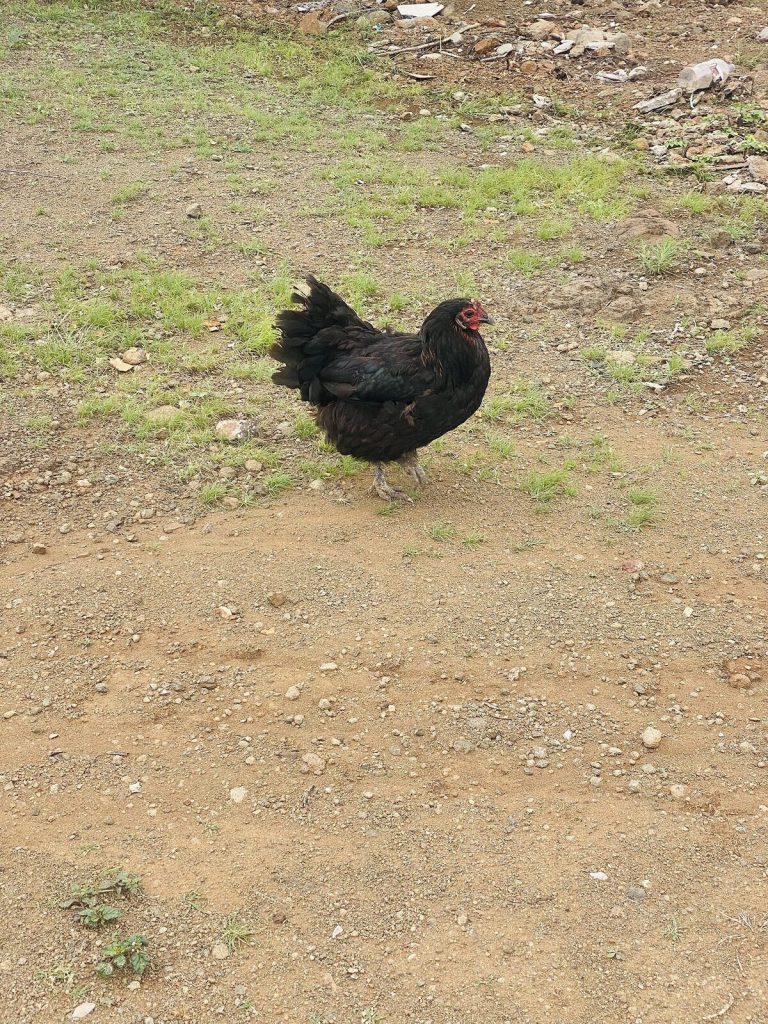
Kuroiler weight by age, measured on Ugandan farms, runs from about 32 g at hatch to roughly 2,089 g at week 20 as a flock average, with confined birds nearer 2,379 g and free range birds nearer 1,829 g at that age. Males pass 2.4 kg by week 20 and reach about 3.0 kg by week 43 under village scavenging. The figures below come from Ugandan trials, not breeder targets.
The Kuroiler Weight Table, Week by Week
Every number here is from on farm trials run through Makerere University in Gulu and Kiryandongo districts, where 240 birds were weighed individually every week from day old to week 20, fasted overnight and weighed on an empty crop. The average column is the breed mean across both management systems and both sexes.
| Age | Average | Confined | Free range |
|---|---|---|---|
| Hatch | 32 g | 32 g | 32 g |
| Week 2 | 120 g | 121 g | 119 g |
| Week 4 | 234 g | 264 g | 204 g |
| Week 6 | 418 g | 513 g | 322 g |
| Week 8 | 676 g | 840 g | 511 g |
| Week 10 | 941 g | 1,138 g | 746 g |
| Week 12 | 1,149 g | 1,417 g | 886 g |
| Week 14 | 1,398 g | 1,687 g | 1,121 g |
| Week 16 | 1,660 g | 2,000 g | 1,340 g |
| Week 18 | 1,866 g | 2,217 g | 1,539 g |
| Week 20 | 2,089 g | 2,379 g | 1,829 g |
Notice that the two systems are identical to about week 3 and then separate sharply. Up to week 3 the birds were brooded together on the same chick mash, so the split you see from week 4 onward is the whole effect of feeding, measured on real farms rather than modelled.
What Management Level This Weight Table Assumes
A weight chart without a management condition attached is close to useless, which is why almost every Kuroiler chart online misleads. Here is exactly what produced these figures.
All birds were brooded in open sided houses on wood shavings for three weeks, over charcoal heat, with clean water always available and a commercial chick mash from a Gulu feed mill carrying 20% crude protein and 3,000 kcal per kg. All were vaccinated. At three weeks they split.
The confined group stayed in pens at three birds per square metre with feed and water in front of them at all times. The free range group was shut in a night house and let out each morning to range the household compound with no limit, fed whatever the farmer provided. Both groups were on real smallholder farms in two districts, six households per district per system.
The ration matters as much as the confinement. These birds were on chick mash and then grower feed, not on a broiler ration. Uganda's ministry poultry manual tabulates dual purpose birds fed broiler starter and finisher and reports considerably heavier weights, so if you feed a Kuroiler like a broiler it will outrun this table. It will also produce softer meat, which can cut against the price a Kuroiler buyer is paying for.
So the confined column is what a smallholder gets on continuous bought feed and nothing clever. It is not a research station ceiling and it is not a commercial best case. The free range column is what a household gets from a night house and a daily handful. Most Ugandan Kuroiler keepers sit between the two columns, and you can place yourself by how many days a week you actually fill a trough.
Kuroiler Chick Weight from Hatch to Week 4
Kuroiler chicks hatch at about 32 g, which is a few grams heavier than a local chick from the same hatchery run. They roughly double in the first week to about 68 g, double again by week 2 to about 120 g, and reach about 171 g at week 3 and 234 g at week 4.
Weight at this stage is a brooding report card, not a genetics report card. The birds are all on the same feed and the numbers barely differ between systems until week 4. If your chicks are well behind these figures in the first fortnight, look at brooder temperature, drinker access and litter dryness before you blame the hatchery. A chick that spent three nights cold never catches up on the curve, it just moves down a parallel one.
The week 4 figures are the first to separate: about 264 g confined against 204 g on range. That 60 g is small in absolute terms and it is the beginning of a gap that reaches 550 g by week 20.
Kuroiler Growth Through Week 5 to Week 12
This is the fast stretch. Kuroilers in the Makerere trial averaged about 16 g of gain a day across week 5 to week 8 and about 17 g a day across week 9 to week 12, against roughly 9 to 11 g a day for local chickens over the same weeks.
Across the whole run from hatch to week 20, Kuroilers averaged about 14.9 g a day and local birds about 9.5 g. Under confinement that rose to roughly 14.5 g a day for the flock against 9.9 g on range, and the differences were large enough to be statistically reliable at every stage tested.
The gap between systems widens fastest here. At week 8 the confined birds are about 64% heavier than the free range ones. At week 12 they are about 60% heavier. Anyone who tells you Kuroilers grow just as fast on scavenging is looking at a leaflet, not at a weighing scale.
District mattered too, which is worth knowing before you compare your flock to anyone else's. Birds in Gulu outweighed birds in Kiryandongo from week 9 onward, reaching a gap of about 434 g by week 20 on the same feeding regimes. Local conditions, forage and heat move these numbers.
Kuroiler Weight from Week 13 to Week 20
Growth is still strong through week 16 and then begins to flatten. Confined birds cross 2 kg at about week 16 and add roughly 380 g more over the next four weeks. Free range birds cross 1.8 kg only at week 20.
Something useful happens late: the free range birds close a little ground. From week 16 to week 20 the range birds gained about 12.7 g a day against 12.2 g for the confined ones, because the confined birds were already slowing. Free range Kuroilers are not permanently smaller birds, they are later birds. If you have no feed budget and no deadline, that is the trade you are making and it is a reasonable one.
One independent check is worth having here, because the free range column is the one most Ugandan keepers actually live on. Nigerian on farm work under the African Chicken Genetic Gains programme, with 2,100 smallholders keeping about thirty birds each under backyard scavenging, recorded Kuroiler cocks at 1,391 g at week 18. The Makerere free range figure at week 18 is about 1,539 g. Two countries, two independent trials, scavenging management in both, and the answers land within about 150 g of each other. That agreement is the strongest reason to trust the free range column and to distrust any chart promising 3 kg by week 16.
Week 20 is also the last age anyone has published a weekly Ugandan figure for, so what follows is thinner.
Mature Kuroiler Weight After Week 20
Past week 20 there is exactly one measured Ugandan series, from a village field trial across Apac, Gulu, Kabale, Mayuge and Wakiso districts, run with Uganda's National Animal Genetic Resources Centre and Data Bank. Birds were confined and vaccinated to week 11, then scavenged in ordinary households where farmers threw a fistful of grain to the flock once or twice a day.
Male Kuroilers in that trial averaged 2.6 kg at week 25 and 3.0 kg at week 43. Local males in the same households reached 1.6 kg and 2.2 kg. Weight gain flattened out after about week 27, so the eighteen weeks between week 25 and week 43 bought only about 400 g. Females followed the same shape and stopped climbing around week 25, which is when laying began.
Breeder material puts mature males at about 3.5 kg and females at about 2.5 kg. No Ugandan measurement found reaches 3.5 kg. The highest measured male figure anywhere in the Ugandan work is that 3.0 kg at week 43 under scavenging, and a confined bird would plausibly beat it, but nobody has weighed one that late and published it. Treat 3.5 kg as a breeder figure rather than a number you should expect.
Cock and Hen Weight Differences in a Kuroiler Flock
Cockerels pull ahead of pullets from week 2 and the gap keeps opening. These are Kuroiler only figures from the same trial.
| Age | Cockerels | Pullets |
|---|---|---|
| Week 4 | 255 g | 223 g |
| Week 8 | 749 g | 648 g |
| Week 12 | 1,351 g | 1,074 g |
| Week 16 | 1,974 g | 1,551 g |
| Week 20 | 2,472 g | 1,932 g |
By week 20 a cockerel is running roughly 28% heavier than a pullet. That matters for two practical reasons. A straight run batch weighed as one flock gives you an average that describes neither half, so weigh the sexes separately once they are distinguishable. And it explains why growers who sell cockerels early and keep pullets for laying are working with the grain of the bird rather than against it.
Pullets also stop gaining around the point they come into lay, because the feed goes into eggs instead. A pullet that plateaus at about 1.9 kg to 2.0 kg is not failing, she is laying.
Scavenging Against Confined Feeding: The Weight Gap in Numbers
Pulling the two columns together gives the single most useful figure on this page.
At week 8 the difference is about 329 g. At week 12 it is about 531 g. At week 16 it is about 660 g, the widest point. At week 20 it has narrowed to about 550 g. In percentage terms the gap peaks around week 8 to week 12 at roughly 60% to 65% and then falls away.
Read practically, this says that bought feed buys you time more than it buys you a bigger bird. If your market wants a 2 kg bird, confinement gets you there around week 16 and range gets you there somewhere past week 22. Which one is cheaper depends entirely on your feed price against the extra weeks of housing, labour and risk. The feed side of that sum, including how feed conversion worsens with age, is worked through in our Kuroiler feeding guide.
Why the Promoted Kuroiler Weight Charts Run Higher
Search for a Kuroiler weight chart and you will mostly find numbers well above the ones on this page. They come from three places, and it is worth knowing which is which.
The ministry figures deserve the closer look first, because there is a real explanation buried in them. That table is explicitly for dual purpose birds fed a broiler starter and broiler finisher, which is a richer ration than the chick mash and grower feed the Makerere birds got. Feeding a Kuroiler like a broiler does make it grow faster, and the manual says as much elsewhere, noting that the same bird raised on layer feed takes longer to reach the same weight while producing firmer, more local tasting meat. Some of the gap between the two tables is a genuine feeding effect rather than an error, and it is a finding you can use: if you want the ministry numbers, you have to buy the ministry ration.
Some of the gap is not a feeding effect. No ration turns a 540 g bird at week 4 into a 1,200 g bird at week 5 and then adds only 100 g in week 6, which is what one row of that table implies, so at least one figure in it is a misprint. And 2,000 g at week 8 sits above what a broiler on the same broiler feed reaches in the same manual's own broiler table, which does not follow. Read the ministry table as an optimistic target for a bird on full broiler feed, not as a weight to expect.
The KCCA figures are weaker again, and a Ugandan government source is still not something to wave away. Two things undermine that table. It reports no method, no sample size, no sex split and no statistics, and it appears in a bulletin that also sells brooded chicks from the same centre, which makes it a demonstration figure rather than an independent result.
The second problem is internal. The same bulletin gives feed use of about 0.49 kg per bird in week 4 rising to about 0.91 kg per bird in week 10, totalling roughly 4.4 kg across that stretch. Set that against its own claim of 1.8 to 2.0 kg at week 10 and the implied feed conversion lands close to a broiler's. The Makerere trial measured Kuroiler conversion at about 4.9 at week 8 and 7.4 at week 12. Both of the bulletin's tables cannot be right, and the feed table is the one that squares with everything else.
How to Weigh Birds on a Ugandan Poultry Farm
None of these figures help unless you weigh your own flock, and most farmers either never do it or do it in a way that produces numbers they cannot compare.
When Your Kuroilers Are Underweight for Their Age
A flock 10% off the table is normal variation. A flock 30% or more below the column that matches your own feeding needs a cause, and the cause is usually one of a short list.
That last point catches more farmers than any of the others. Details are in our guide to Kuroiler farming, and losses with other causes are covered in poultry mortality and how to prevent it.
Kuroiler Weight Questions Ugandan Farmers Ask
How much does a Kuroiler weigh at 3 months? Three months is about week 13. Measured Ugandan figures put the flock average near 1,283 g, confined birds near 1,567 g and free range birds near 1,009 g. Cockerels run well ahead of pullets by this point.
At what age is a Kuroiler ready for market? That depends on the weight your buyer wants rather than on a fixed age. Confined birds reach 2 kg around week 16 and free range birds somewhere past week 22. Feed conversion gets steadily worse after week 16, so the later you sell, the more feed each extra kilogram costs.
Why is my Kuroiler only 1 kg at 3 months? If the birds are on range with occasional feeding, 1 kg at week 12 is close to the measured free range figure of about 886 g and there is nothing wrong. If they are confined on continuous mash and still at 1 kg, check feeder space, water and feed quality, with stale maize bran the first suspect.
Do Kuroilers reach 4 kg? No measurement found supports it. Breeder material quotes about 3.5 kg for mature males, and the highest figure measured in Uganda is 3.0 kg for males at week 43 under village scavenging. Claims of 4 to 5 kg cocks come from unsourced pages and should be ignored when you are planning.
How much heavier is a Kuroiler than a local chicken? In the same trial, on the same farms, week 20 averages were about 2,089 g for Kuroilers against about 1,316 g for local birds, so roughly 59% heavier. The full comparison sits in Kuroiler against local chicken.
When do Kuroiler hens stop gaining weight? Around the point they start laying, which two Ugandan trials put between week 22 and week 25. Feed then goes into eggs rather than body weight, so a plateau near 1.9 kg to 2.0 kg is expected rather than a problem.
How do Kuroiler weights compare with broilers at the same age? Not favourably, and it is not the right comparison. A broiler is a fixed cycle meat bird sold in six to eight weeks, while a Kuroiler at week 8 is under 850 g even confined. The two birds serve different markets, which Kuroiler against broilers works through.
Does buying more expensive chicks give heavier birds? Chick price varies by season, district and hatchery and does not reliably track performance, so there is no figure worth quoting here. What does track performance is where the parent stock came from. Current prices sit on our Kuroiler chick price page, and the chick supplier directory is the place to ask that question.
Weigh ten birds from your own flock this week, on an empty crop, and set the figure against the column that matches how you actually feed. If you are buying chicks, ask the hatchery where its Kuroiler parent stock comes from and check current chick and feed prices with more than one supplier in your district before you commit, since both move with the season. A district extension or veterinary officer can confirm what is holding your own birds back.