
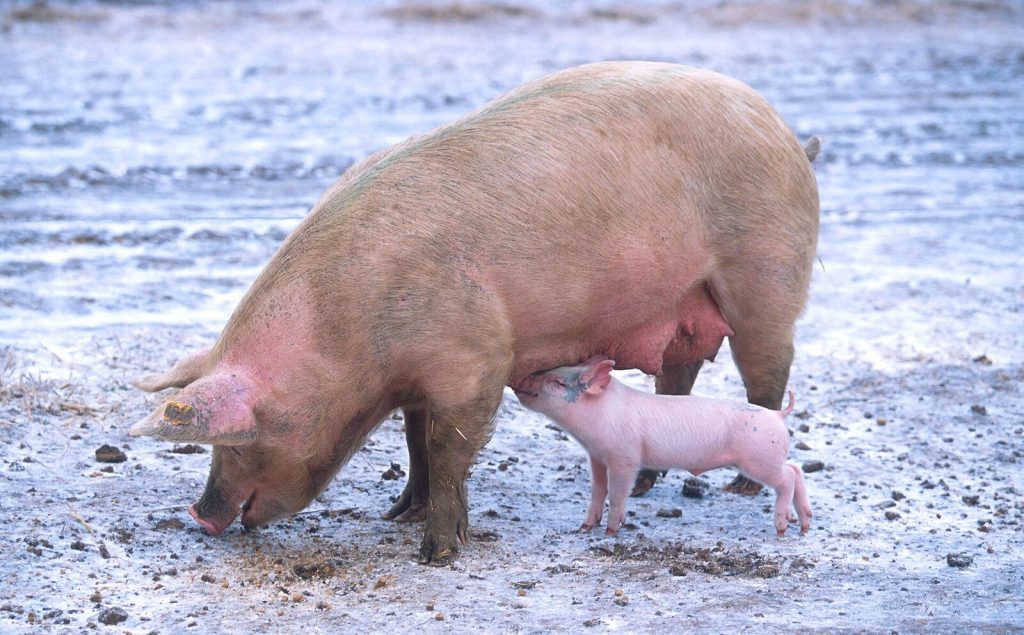
Pig breeding on a Ugandan smallholding is decided mostly by one choice: which boar serves your sows. Most keepers use a boar somebody else owns, and that single arrangement sets the herd's genetics, its inbreeding risk and its disease exposure at once. Everything else, the gilt you keep, the calendar you count on, the pen you farrow in, follows from it.
What a Ugandan Pig Breeding Herd Has to Produce in a Year
A breeding sow is not sold, so her output is counted in piglets weaned per year rather than in kilogrammes. Ugandan value chain research reports 16 to 20 piglets per sow per year for a well managed animal, with crossbred sows giving 8 to 12 piglets a litter and local sows 5 to 8. Training material used with Ugandan farmers notes that an individual sow can carry up to 16 piglets in a single litter.
Those figures imply something the manuals leave the reader to work out. The sow record card used in that training gives weaning at 30 to 36 days, service about six days after weaning, and a further ten days allowed as lost days. Add a gestation of 114 days and the cycle comes to roughly 160 to 166 days, which is a shade over two cycles in a year. That is where 16 to 20 piglets comes from, and it is a paper figure rather than a field one.
Ugandan herds mostly do not reach it. The honest planning number and what it does to margins is worked through on the pig farming profit calculation, which tests a breeding herd at two litters a year and at one and a half, and finds the answer flips between them. Read that before deciding to keep sows at all. This page is about the husbandry that closes the gap.
Choosing a Breeding Gilt on the Farm, and When to Serve Her
A gilt kept for breeding is selected twice: once in the farrowing pen and once at mating age. Ugandan training material tells farmers to identify and separate good quality piglets as replacement stock at weaning, and to cull piglets with serious defects at three days old. Faults you can see are worth acting on early, because the same material states plainly that deformities are heritable and a boar carrying them should be rejected. The same logic runs on the female side.
Service age is specific and it is later than many keepers assume. The Ugandan sow calendar instruction for a first time gilt is to skip the first two or three heats and serve her when she reaches good body weight, at about eight to nine months old. Two reasons sit behind that. A gilt served on her first heat is still growing and has to divide feed between her own frame and a litter. And body weight, rather than age, is the condition being tested, which is why the instruction names both.
Body condition is the part Ugandan farms struggle with. A welfare survey of 270 pig farms across four central districts scored 92 per cent of dry or lactating sows as skinny, at a body condition of 1 or 2. A thin gilt does not come into a strong heat, and a thin sow does not come back into heat quickly after weaning. Before you count calendar days, look at the animal. What she should be eating at each stage belongs with the pig feed requirements and the pig feeding guide.
Selecting a Breeding Boar: Legs, Libido and Heritable Faults
Ugandan guidance for picking a breeding boar reads like a set of physical checks, and every one of them has a reason attached. Legs first: the boar needs well built, straight legs and the athletic ability to serve repeatedly, and knock kneed or angled legs are grounds for rejection. He carries his own weight upright during mating, so lameness or an inflamed joint ends his working usefulness before anything else does.
Then the reproductive checks. Testicles should be of a proper form, neither too small, which points to underdevelopment, nor unusually large, which can mean a scrotal hernia. The sheath over the penis should be trim, because a hanging sheath predisposes him to infection. He should show libido and the desire to mate, and a boar in a sexual mood is described by a specific behaviour Ugandan farmers can look for: he opens his mouth repeatedly, makes a chopping noise and produces foam around the lips, which attracts the female. A boar that cannot achieve entry, or that carries a visible deformity, is rejected, and the reason given is that these faults pass to his offspring.
There is also a field fertility test that costs nothing but time. Give a candidate boar three or four gilts ready for service and watch whether they return to heat. If they do not, he is fertile.
Working life is finite and the numbers are published. A boar's maximum active sexual life is about 18 to 24 months. By 30 to 36 months he should be replaced, or restricted to mature sows, because he has grown too heavy for the small gilts entering the herd for the first time. A boar kept past that point is quietly costing you conceptions.
The Village Boar Problem: Shared Cost, Shared Inbreeding, Shared Disease
Most Ugandan smallholders cannot justify feeding a boar year round for two or three sows, so one boar serves a village or a farmer group. Ugandan guidance sets out both sides of that arrangement without pretending it is a clean solution, and the disadvantages are the more useful half.
The case for it is straightforward. Procurement and upkeep are shared, member contributions stay small enough for a smallholder to pay, and because the cost of replacement is shared the group can change the boar more often, which is itself a way of controlling the village's genetics.
The case against runs in three directions. Genetics: a whole village or group ends up with the same sire's genes in a short time, and if that is not handled deliberately it becomes concentrated inbreeding. Swapping a boar with a neighbouring village does not necessarily solve it either, because the chances are good that he meets his own daughters or other relatives there, which Ugandan guidance calls inter village inbreeding. Fertility: where many sows are waiting, a boar that is not rested suffers sexual fatigue, releases too little semen and forms sperm improperly, and the result is infertile services, poor conception and smaller litters. Disease: the boar is a channel in both directions. If he is incubating something contagious he passes it to the sow and to the farm she came from, and a sow can infect him and, through him, every farm that uses him next. Ugandan guidance names sexually transmitted disease among pigs as one of the routes.
None of that makes a shared boar wrong. It makes the arrangement something to run with rules: a written record of which boar served which sow, a rest interval between services, a refusal to use a boar that looks unwell, and a group decision to replace him before his daughters are old enough to be served. Those rules are cheap. Rebuilding a village herd out of inbred stock is not. The parts of this that are farm layout rather than paperwork sit with the farm biosecurity guide and the pig housing guide.
Heat, Service and the Twenty One Day Return in a Pig Herd
The Ugandan sow calendar builds in a heat cycle of about three weeks without ever calling it that. Its day 21 instruction is a three week pregnancy check, worded as follows: the sow will come back into heat if conception did not happen on day one. That is the cycle length stated as a management action, and it is the single most useful date on the calendar, because a sow that returns on day 21 has cost you three weeks rather than four months.
Standing heat is what you are looking for, and it is the moment the sow will hold still for the boar. The Ugandan material's practical note is the one about boar exposure: gilts show standing heat more clearly when the boar has not been living next to them. Detailed heat detection routines, including the length of standing heat and how many services to give, come from general veterinary reference rather than from Ugandan sources, so treat any specific window you read as a starting point and get it confirmed by your own vet or animal husbandry officer. What Ugandan guidance does commit to is the day 21 return and the day 42 confirmation.
Weigh the timing against feed supply too. A service in the weeks before the long dry season puts late pregnancy and farrowing into the months when feed is scarcest, and the pig production calendar is the place to plan that backwards from when you want piglets on the ground.
The Sow Calendar From Service to Farrowing on a Ugandan Pig Farm
The sow calendar is the spine of Ugandan pig breeding guidance, and the framing is neat: a household wall calendar runs from January to December, while a sow calendar runs from conception on day one to farrowing on day 114. One manual gives the length as 114 days give or take about three, and the figure quoted more widely elsewhere is 115 or 116, so treat the date you calculate as a planning date and be ready a few days either side.
| Day | What happens | Why |
|---|---|---|
| Day 1 | Service, recorded | Every later date counts from here |
| Day 6 to 10 | Flushing period ends | Body reserves mobilised for breeding |
| Day 21 | Three week check | She returns to heat if not in pig |
| Day 42 | Six week check | Pregnancy confirmed, feeding lifts |
| Day 85 | Steaming up begins | Rapid foetal growth and milk formation |
| Day 101 | First wash and parasite treatment | Cuts what she carries into the pen |
| Day 107 to 110 | Second treatment, move pens | She settles before she farrows |
| Day 114 | Farrowing, attended | Colostrum and crushing are decided here |
Two of those rows are a range because the Ugandan documents do not agree with themselves, and it is worth knowing where the slack is. The calendar table in one manual puts the second wash and parasite treatment on day 107 and calls it seven days before farrowing, which is arithmetically right. Its own worked example and its summary both use day 108. The sow record card in the same document also says day 108 for the treatment and for the pen transfer. A second Ugandan manual widens it to day 107 to 110. Meanwhile the prose in the first manual says the sow moves to the farrowing pen two weeks before farrowing, while a newer Ugandan manual says seven days before. The day 101 row has a smaller slip: it is described as fourteen days before farrowing, and 114 less 14 is 100.
The practical instruction that survives all of that is simple. Count back from your own projected farrowing date rather than trusting a day number, get the sow into a cleaned and disinfected farrowing pen somewhere between one and two weeks before she is due, and have the wash and the parasite treatment done in the last fortnight. The treatment itself is not something to guess at: Ugandan guidance names a product and tells farmers to have the area veterinarian or the community animal health worker give the injection. No dose, route or withdrawal period appears on this page, and deworming pigs explains why the interval matters less than the timing relative to sale and farrowing.
The feed changes at day 10, day 42, day 85 and the last days before farrowing are part of the calendar, and the direction is what to remember: reduce after flushing, lift once pregnancy is confirmed, lift again at day 85, then cut back sharply in the final days so a full abdomen does not make farrowing harder or soil the piglets. Ugandan guidance also asks for bulky feed in the four or five days either side of farrowing, to hold off constipation, because constipation leads to a poor farrowing and to mastitis, which dries the sow up. The kilogramme figures for each of those steps sit with the feeding pages, and there is a reason for leaving them there: the manual states the pre farrowing ration three separate times and the three statements do not match.
Feeding and Managing the Pregnant Sow in a Pen of Her Own
A pregnant sow gets her own pen, and Ugandan guidance is blunt about why: housed with other pigs she gets pushed about and injured, and the named consequence is abortion or early embryonic death. That is also why the pregnant sow pen is described as the smallest pen on the unit, sized for one animal and kept quiet, and why a fright counts as a management failure rather than bad luck.
The rest of the list is short and mostly about surfaces and calm. Keep the floor from being slippery, because a fall in late pregnancy causes injury or loss of the litter. Do not over exercise her and do not restrain her at all unless there is no alternative. Avoid mouldy feed, because some moulds cause abortion. Wash her before she goes into the farrowing pen, which removes parasite eggs sitting on her skin. Look her over twice a day for appetite and for listlessness, since those are the two signs that come before anything visible. And once she is in the farrowing pen, get her up on her feet two or three times a day for a little movement.
Bedding goes in ahead of her, at least three days before she is due on one Ugandan instruction, using sawdust or dry grass, with the creep area prepared and the pen disinfected first. From day 112 the guidance asks for an attendant checking hourly. That is the one labour demand in the whole breeding cycle that a smallholder cannot spread out, and it is worth planning your services so two sows are not due in the same week.
Farrowing on a Ugandan Pig Farm, and the Losses That Happen There
Farrowing is where a Ugandan breeding herd loses most of what it produced. A fifth of the farms in the central Uganda welfare survey reported sows having stillbirths, and the causes named in Ugandan value chain work for piglets lost after birth are crushing, starvation, chilling, sows with no milk and sows that eat their own piglets. None of those is a disease. All of them are decided in the first few hours.
The jobs on farrowing day, as Ugandan training material lists them, are these. Be present. Get every piglet onto colostrum, helping the weak ones to the teat. Free any membranes and revive weak piglets. Trim the umbilical cord and dip it in iodine. Provide warmth, because chilling rather than heat is the piglet's risk before weaning. Keep the sow from crushing the litter, which is what the creep area exists for, and she is tired enough at this point that she will lie on them if the pen lets her. Assist a difficult birth with clean, disinfected hands. And if the sow turns nervous or vicious, take the piglets out, wait for her to settle, and test her with a single piglet before returning the rest; Ugandan guidance says a hysterical sow usually recovers in about two hours.
Make sure the afterbirth is removed and disposed of properly. The pen features that do this work, the creep, the guard rails, the non slip floor and the brooder box, are set out in the pig housing guide, and the litter's first weeks belong to the piglet management guide.
Weaning, Flushing and the Feed Change That Restarts the Sow
Weaning is the start of the next pregnancy, not the end of the last one. The Ugandan sow card puts weaning at 30 to 36 days, and the calendar then does something that looks odd until you see the reason: on weaning day the sow gets very little feed, and only from the next day is she put back on a normal ration for a few days, before feeding is lifted for the flushing period in the days that follow. Flushing is not fattening. It is a short, deliberate lift intended to mobilise enough body reserve for her to cycle and conceive, and the Ugandan calendar expects her to come into heat and be served inside that window, about six days after weaning.
Then feeding drops back for most of the pregnancy. That drop is the step smallholders skip, and it costs money in both directions: a sow carried on a flushing ration all through pregnancy eats feed she does not need and arrives at farrowing overweight, which Ugandan guidance links to injuries to the piglets.
The sow card also allows ten lost days per cycle, which is an honest piece of planning most breeding advice leaves out. Lost days are the ones between weaning and a successful service that did not go to plan, and every batch of ten pushes the herd's output down. Writing them on the card is how you find out whether your problem is the sow, the boar or the timing.
Weaned piglets get tagged, sorted small from big, and split by sex into separate pens, with the sow moved out to the dry pen while the litter stays put until they are hardy enough to move to the growers' unit. The growth side from there is the pig fattening guide.
Heat Stress Is a Pig Breeding Problem Before It Is a Welfare One
Ugandan guidance lists what heat does to reproduction, and the list is longer than most keepers expect. In the boar: lower sperm concentration and quality, and temporary infertility. In the sow: changed hormonal status, poor foetal development producing a weak litter, fewer piglets born alive, embryonic death during gestation giving a small litter, a higher stillborn rate, lower farrowing rates, and abortion.
That matters in Uganda because heat stress is common rather than exceptional. Research in Lira district measured 259 pigs across 104 households and found just over half of them heat stressed. So a run of small litters, repeat services or stillbirths in the hot months is worth reading as a temperature problem before it is read as a genetics or a feed problem, particularly in a boar, where the effect is temporary and reversible if you rest and cool him.
One point of encouragement came out of the same work. Farmers at the feedback sessions observed that their pregnant sows showed less heat stress than other classes, and offered their own explanations: pregnant sows rest more, move less, and tend to be the animals kept in shade and given plenty of water. That last clause is the actionable part, because it is a management difference rather than a physiological one. Whatever the pregnant sows are getting, the boar and the gilts should get too. The building measures that deliver it are on the housing page.
Crossbreeding Ugandan Pigs, and What Genomics Found in Smallholder Herds
Ugandan training material recommends crossbreeding as the first improvement a farmer with local pigs can make, on the reasoning that most smallholders already have local stock and local materials, so selecting a good boar and crossing him with the best female raises income from piglet and fattener sales before any money goes into buildings. The stated benefit is that crosses are heavier and grow faster.
Genomic work on Ugandan smallholder pigs then adds two findings worth holding onto. First, the proportion of modern European ancestry in those pigs never exceeded 0.50, which means the animals sold as exotic in smallholder herds are crossbreds rather than pure exotics. Buy accordingly, and treat a seller's breed claim as a description of appearance. Second, sows in the higher ancestry group weaned 2.4 more piglets than those in the lower group, so the improvement is real and measurable at the level that matters, which is piglets weaned rather than piglets born.
Set against that is the thing crossbreeding cannot fix. A crossbred sow eats more than a local one whether she is productive or not, and an improved animal in a system that overheats her, gives her dirty water and keeps her thin will underperform the figures she was sold on. Breed comparisons and what each type actually needs sit with best pig breeds in Uganda, and the money side of the choice is on the cost of starting a pig farm.
Breeding Records That Make Selection Possible on a Pig Farm
Ugandan guidance is emphatic that identification comes before recording, because you cannot keep a record of an animal you cannot name. The methods it lists come with honest weaknesses. Ear notching is hard to read quickly. Tattooing works on white skinned pigs and poorly on black ones, and the ink fades with contact with organic matter. Ear tagging is the easiest to use and read, and it allows a numbering system the farmer chooses. Names work in a small herd. Skin colour, ear shape and colour patches all work in a handful of animals and fall apart the moment a pig escapes into a village where other pigs look the same, or a disease changes how the ears sit.
The records themselves divide into the ones that describe the sow and the ones that describe her offspring. Ugandan guidance names dam records, covering age, services needed to conceive, litter size per farrowing, numbers alive, dead and weaned, and diseases suffered. Breeding records, naming the boar used and the services taken to conceive. Boar records, covering his age, breed, source, conception rate across the sows he served, and the litters that resulted. Litter records for numbers born alive, weak, dead and weaned. Plus health, vaccination, parasite treatment and death records, and a monthly stock count by class.
Ugandan guidance makes a further point about records that is easy to dismiss: good records are a selling tool, because a buyer looking for breeding stock can trace a good animal back to your farm. In a market where informal traders dominate and nobody pays a premium for an undocumented claim, a written history is the only way a breeder gets paid as a breeder. Templates for the paperwork are on the livestock record keeping template and the wider habit is covered in the farm record keeping guide.
Pig Breeding Questions Ugandan Farmers Ask
At what age should I first serve a gilt? Ugandan guidance says skip her first two or three heats and serve her at about eight to nine months, once she has reached good body weight. Weight is the test and age is the guide, so a thin gilt at nine months waits.
How long is a pig pregnant? The Ugandan sow calendar runs 114 days from service to farrowing, and one Ugandan manual gives it as 114 days give or take about three. Figures of 115 and 116 days circulate elsewhere, so mark the date and be ready slightly early.
Is it worth buying my own boar instead of using the village boar? It depends on how many sows you have, because a boar eats year round whether he works or not. The case for owning one is control over genetics, over his rest between services, and over what walks onto your farm. The case against is that he is a full time feed bill for a part time job, and with two or three sows the arithmetic rarely works. The costs either way, including what a breeding service typically costs and the fact that it is often settled with a piglet rather than cash, are handled on the cost of starting a pig farm. The right answer for most smallholders is to keep using a shared boar and to impose rules on the arrangement.
How do I stop inbreeding with a shared boar? Write down which boar served which sow, and never let a boar serve a female he could have sired. That means the group has to replace him before his daughters reach mating age, at eight to nine months, and it means swapping with a neighbouring village is not automatically safe, since a boar moved between villages may well meet relatives there.
Why do my sows come back into heat after being served? A return at about three weeks means conception did not happen, and the causes divide between the boar and the sow. On the boar's side, sexual fatigue from serving too many females without rest produces too little semen and improperly formed sperm, which is the commonest problem with a busy shared boar. On the sow's side, thin condition and heat stress are the two Ugandan sources point at. A vet or animal husbandry officer should look at a sow that returns twice.
How many piglets should I expect? Ugandan figures give crossbred sows 8 to 12 a litter and local sows 5 to 8, with up to 16 possible in one litter. What reaches weaning is the number that matters, and that is set in the farrowing pen rather than at service.
When should the sow be moved to the farrowing pen? Somewhere between one and two weeks before she is due, since Ugandan sources give seven days, day 107, day 108 and two weeks in different places. Move her into a pen that has already been cleaned, disinfected and bedded, and count back from your own projected farrowing date rather than from a day number.
When you are ready to buy a gilt or arrange a service, ask the seller or the boar's owner for written service and litter records before you agree anything, and check what local breeders and traders are asking now rather than working from a figure in an article, since stock prices move by district and by season. The pig farming overview and the wider livestock hub set out where breeding sits in the whole enterprise.