
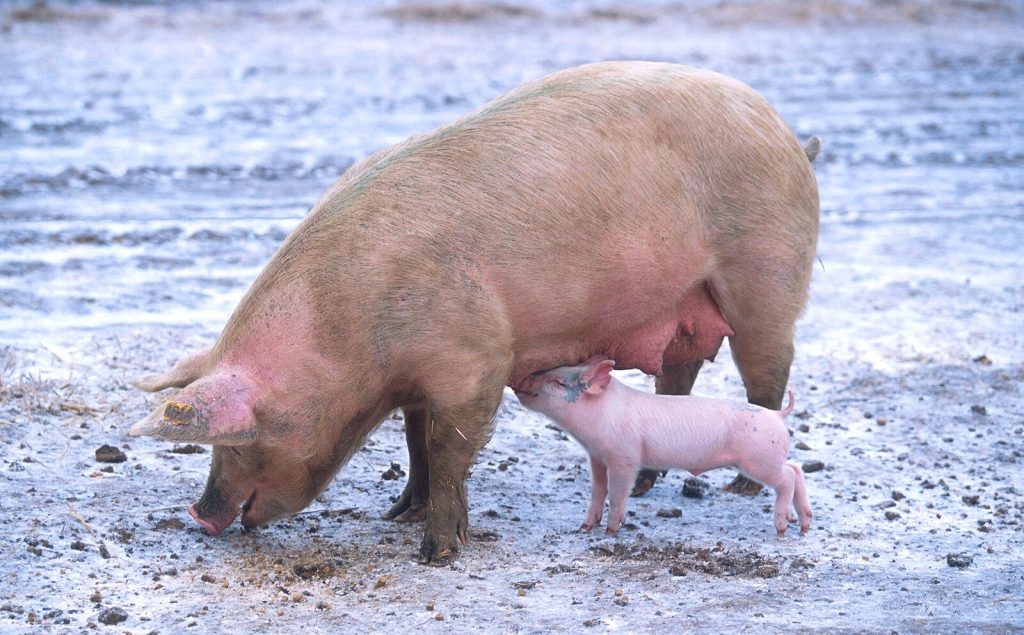
Pigs born in the same litter within three days of each other were weighed at 65 days in a Ugandan trial and ranged from 2.8 kg to 11.4 kg. Fattening starts by accepting that spread, because the heaviest weaner in a litter and the lightest one need different feed to reach the same sale weight. Growth targets, weekly weights, feed conversion, castration and finishing length are all set out below.
What Pig Fattening Is, and the Growing Period a Ugandan Schedule Assumes
Fattening is the stretch between weaning and sale, and on a Ugandan pig unit it is the only stretch where the animal is putting on saleable weight rather than making piglets. The training schedule used with Ugandan pig farmers frames it clearly: a fattener enters the growers' pen at an average starting weight of about 20 kg at two months old, and the schedule runs for 120 fattening days, which is four months, ending with the pig around six months of age.
Where the pig ends up depends on which figure you read, and this is worth knowing before you plan a sale. The schedule's own weight column reaches 91 kg by week 17, which is roughly the 120 day mark, and 106 kg if you carry it to week 20. Ugandan market data says something different: slaughter pigs in Kampala are normally over 50 kg liveweight, with an average carcass around 40 kg. Most Ugandan pigs, in other words, are sold well short of the weight the schedule is built for.
That gap is the central fattening decision and it is a money decision rather than a husbandry one. Every extra week of feeding buys weight, and every extra week costs feed, labour and exposure. Where the crossover sits for your own herd is worked through on the pig farming profit calculation, which builds a break even price across feed conversion ratios and ration prices.
The Weight Spread Inside One Litter on a Ugandan Farm
The single most useful fattening finding from Ugandan research is about variation, not about averages. In a trial on pigs bought from smallholder farms, animals born within three days of each other were weighed at 65 days of age. Local breed piglets ranged from 2.8 kg to 10.2 kg. Crossbred piglets ranged from 3.9 kg to 11.4 kg. Within a single litter, a spread of two to four kilogrammes was typical.
Put that against a schedule that assumes a 20 kg starting weight and the problem is obvious. A weaner at 4 kg is not eighty per cent of the way to the schedule's starting line. It is a different animal on a different timetable, and treating the litter as one batch is how a fattening plan quietly fails for a third of the pigs in it.
So weigh them. Not with anything expensive: a sack, a spring balance and a notebook will separate a litter into thirds in twenty minutes. Ugandan value chain research records that most pig keepers do not weigh their animals at all, which is why average daily gain cannot be explained to them in the first place, and it is also why traders set prices by eye. The profit calculation page deals with what selling by eye does to a farmer's income.
Why the Lightest Weaners Cannot Be Fattened on Farm Grown Forage Yet
The same trial then did something no other pig fattening guide does. It took the lightest third of the pigs by weight at 65 days and followed them on three diets: a commercial ration, a forage based diet, and a silage based diet. Over the next three weeks the small pigs on the commercial ration gained 154 grams a day. The small pigs on forage gained 18 grams a day. The small pigs on silage lost weight, at about 8 grams a day.
By 140 days of age the difference had compounded. The lightest third on the commercial ration averaged 26.3 kg. On forage they averaged 10.0 kg and on silage 9.2 kg. Two and a half months of feeding had left them roughly where they started.
The researchers' conclusion runs against everything the cheap feeding argument assumes: a newly weaned pig with a low body weight has to be fed a commercial ration first, so that it grows to a size where it can actually digest local forage or silage. Their second point is the practical one. Small pigs eat small quantities, so the commercial ration they need is not a large bill, and buying it for the lightest third is cheaper than watching them stand still for three months.
Which ingredients go into either ration, and how a home mix is built, belong with how to formulate pig feed and pig feed requirements. Ugandan material names the ingredients commonly available for fattening as maize bran, silver fish, cotton seed cake, sunflower cake, common salt and a general mineral premix, with restaurant swill used in towns. Swill and institutional leftovers are boiled for at least half an hour before they go in the trough.
Average Daily Gain Targets, and What Ugandan Pigs Actually Achieve
Ugandan training material publishes a five band performance scale for growing pigs, and it is the right tool badly calibrated. Daily gain is ranked poor below 500 grams, fair at 500 to 550, moderate at 550 to 600, good at 600 to 650 and excellent above 650. The same material then adds, in its own voice, that in Ugandan systems a gain of 500 to 550 or up to 600 grams a day has been reached even by smallholders, and that a farmer who cannot feed concentrate throughout should target at least 500 to 550.
Now set that scale against Ugandan measurement. Pen level mean daily gain in a Ugandan weaner and grower trial was 36 grams a day on a forage based diet, 52 on silage and 294 on commercial feed between 9 and 15 weeks, improving to 112, 362 and 574 between 20 and 24 weeks. Confined Ugandan and East African pigs fed the high fibre, low protein diets that most smallholders can afford are described as gaining around 130 grams a day overall.
Every one of those figures is in the scale's bottom band. The best pen mean measured on commercial feed, 574 grams a day in the later period, reaches only the moderate band, and the excellent band sits above anything measured. The scale is not wrong as a target; it is a commercial target printed in a smallholder manual with nothing in between. Use it to rank your own herd against itself, month on month, rather than to judge whether you are a good farmer.
What a Fattening Pig Should Weigh Week by Week Through the Growing Period
The Ugandan schedule's weight column is the most directly useful thing in it, because it gives a fattener's expected weight at each week and lets you catch a stall in the week it happens rather than at sale. What follows is that column, with the gain since the 20 kg start added.
| Week | Target weight | Gain so far |
|---|---|---|
| Week 1 | 20 kg | Start |
| Week 4 | 30 kg | 10 kg |
| Week 7 | 42 kg | 22 kg |
| Week 10 | 56 kg | 36 kg |
| Week 12 | 66 kg | 46 kg |
| Week 15 | 81 kg | 61 kg |
| Week 17 | 91 kg | 71 kg |
| Week 20 | 106 kg | 86 kg |
Two things about that column are worth flagging before you rely on it. The first is a printing gap: the published table runs from week 1 to week 12, then jumps straight to week 14, so there is no week 13 row at all. The weight either side moves by ten kilogrammes over the two week gap, which is consistent, so nothing is wrong with the figures; a row is simply missing. Fill it in yourself at about 71 kg.
The second is that the weight column and the schedule's own summary disagree about growth rate. Going from 20 kg in week 1 to 91 kg in week 17 is 71 kg over 119 days, which is about 600 grams a day. The summary printed underneath the same table claims approximately 650 grams a day. Carrying the column on to week 20 gives the same roughly 600 grams. So the schedule is built on a gain of about 600 grams a day whatever its footer says, which places it in the moderate band of its own performance scale rather than the excellent one. That is worth knowing, because it means the table is a more realistic target than the number advertising it.
Feed Conversion in the Fattening Pen, and the Arithmetic That Does Not Add Up
Feed conversion is kilogrammes of feed per kilogramme of gain, and the same Ugandan scale ranks it: poor above 4.2, fair 3.8 to 4.2, moderate 3.5 to 3.8, good 3.2 to 3.5 and excellent below 3.2. The schedule's summary claims a feed conversion of approximately 3.25, which sits in the good band.
Its own columns say otherwise, and the check is worth showing because it also proves the schedule is sound where it counts. The total feed to the 120 day mark is given as 240 kg per animal. Add up the schedule's daily feed column across the same weeks, restoring the missing week 13 at about 2.5 kg a day, and it comes to 240 kg exactly. So the feed total is real and internally consistent, not an extraction artefact. Divide that 240 kg by the 71 kg of gain the weight column actually delivers and feed conversion comes out at about 3.4, not 3.25. Run the schedule to week 20 and it drifts to roughly 3.5.
Two pieces of context keep that figure honest. A Ugandan feeding source reports feed conversion of 2.53 to 3.40 on dry matter for pigs growing between about 20 and 59 kg on root based diets, which is a different measurement on a different diet and a narrower weight range, so it is not a contradiction. And the 240 kg total sits inside the wider 150 to 290 kg band that the cost of starting a pig farm derives for one pig from weaning to sale off the daily allowance table, although the two cover slightly different periods. Feed conversion falls apart on a poor quality ration long before it falls apart on management, which is why the ration itself is the first place to look.
Castration, Boar Taint and What Buyers Pay for a Male Fattener
Male pigs raised as fatteners are castrated, and the reason given in Ugandan material is commercial rather than behavioural: an uncastrated male carries boar taint, which lowers the sale price of the carcass. Ugandan buyers of carcasses are recorded as paying a premium for pigs that are in good health, carry a thin fat layer, are between six and twelve months old, and are castrated males. That is a specification, and it is the closest thing a Ugandan fattener has to a grading standard.
Timing is where practice and guidance part. The common smallholder practice recorded in Uganda is to castrate at about one month old. The recommendation is to do it at three days old, on two grounds: it hurts the piglet less at that age, and the piglet still has high levels of maternal immunity to carry it through. Later castration on a larger animal is a bigger wound on a stronger pig with less passive protection.
The procedure itself is not written out here. Ugandan guidance treats it as an aseptic operation needing a clean blade, disinfectant, iodine and a second person to restrain the piglet, and it is worth having a veterinary officer or a community animal health worker show you once rather than learning it on your own litter. The same applies to needle teeth trimming, which appears alongside it on the Ugandan piglet activity guide. Litter level work belongs with the piglet management guide.
Sorting Fatteners by Size and Sex in the Growing Pen
Ugandan guidance for weaning gives three sorting instructions and all three pay off in the fattening pen. Tag the piglets, so an individual pig's progress can be followed. Separate small from big, which is the litter spread problem solved with a gate rather than with feed. And separate males from females into different pens.
Attention to hygiene and avoiding extreme cold are named for the same period, and post weaning diarrhoea is flagged as something that happens and that a veterinarian treats. Nothing about that treatment is set out here, because dosing a scouring weaner is a veterinary decision and the product, rate and withdrawal period belong on the label. What the farmer controls is the pen: clean floors, dry bedding and pigs not packed in.
Group size and the space each fattener needs are dimensions rather than management, and they sit with the pig housing guide, along with the finding that a pen drawn for ten growers gets tight once those growers are finished fatteners. Worth repeating here in one line: a Ugandan training photograph of an overstocked growers' unit is captioned as a warning, not an example.
The Pork to Feed Price Ratio, and the Test It Sets for a Fattening Herd
Buried in the Ugandan training material's discussion section is the most portable decision tool on the whole subject, and it needs no shilling figure at all. Divide the price of pork per kilogramme by the price of feed per kilogramme. The stated threshold is that a ratio of about 7 or above means pig keeping can be profitable, and below it the arithmetic is against you.
Two cautions make the difference between using it and being misled by it. First, run it on the price you are paid, not on the retail price of pork in a butchery. A Ugandan smallholder is paid a liveweight price at the farm gate, which is well below the retail pork price, and using the retail figure flatters the ratio by a wide margin. Second, use the feed price you actually pay for the ration you actually mix, including the bran, not a bag price you saw once.
Done honestly, the test is brutal and useful. It tells you whether to fatten at all this season, before you buy a weaner. It also tells you which lever to pull: the ratio improves either because feed gets cheaper or because you get paid more per kilogramme, and for most Ugandan farmers the second is the larger and less explored of the two. Current farm gate and feed prices move by district and by month, so check what your own buyers and suppliers are quoting and run the ratio on today's figures. Both sides of it are worked out with real numbers on the pig farming profit calculation, and feed price movement is stress tested on the cost of starting a pig farm.
Heat, Water and the Feeding Hours That Keep a Fattener Growing
Heat is a growth problem in Uganda and it is measurable. Research in Lira district found just over half the pigs it examined were heat stressed, and Ugandan training material lists reduced body weight in growers and reduced carcass quality among the consequences. A fattener that stops eating between eleven and four is a fattener that misses its weekly target, and no ration fixes that.
The feeding response is free. Feed during the cool hours, early morning and late evening, which is what the Ugandan farmer leaflet on heat stress recommends. Keep water in front of the pigs continuously, and note that in central Ugandan pig farms the problem measured was not access to water but its cleanliness: just under half of what was supplied to sows and only about a third of what was supplied to growers was judged clean enough to drink. A fattener drinking dirty water is a fattener with an intermittent gut problem, and that shows up as a flat week on the scale.
Do not move or work pigs in the hottest part of the day, and let a hot pig rest. The building measures that reduce the heat load, roof height, ventilation, shade, stocking rate and a wallow, are on the pig housing guide.
Finishing Period, Mortality and the African Swine Fever Clock on a Pig Farm
How long to keep a fattener is usually presented as a weight question. In Uganda it is also a risk question, because African swine fever is endemic, has no vaccine and no treatment, kills close to every pig in an infected herd, and can take the whole unit at once. Nothing given in feed, in water or by injection prevents it, and any claim otherwise should be treated as false.
That converts finishing length into exposure length. A pig finished on a bought ration in about four months from 20 kg carries roughly a third of the exposure of a pig kept on forage for a year to reach a similar weight, because the Ugandan growth data says the forage fed route takes that long. The cheap feed saving and the disease risk move in opposite directions, and the arithmetic that puts a number on the trade is on the cost of starting a pig farm, which loads cost per pig sold using measured household level incidence.
Ordinary mortality deserves the same scepticism as the growth targets. The Ugandan performance scale ranks fattener mortality as poor above 4.2 per cent, fair at 3.0 to 4.0, moderate at 2.0 to 3.0, good at 1.0 to 2.0 and excellent below 1.0. Two problems. It leaves 4.0 to 4.2 per cent in no band at all, and its poor threshold of 4.2 is the same number as the poor threshold on the feed conversion row directly above it, which looks like a value copied across. More to the point, smallholder pig mortality in Uganda is reported at around 20.8 per cent as perceived by keepers, with weak biosecurity linked to losses up to 30 per cent. The entire scale sits five to seven times below the reality it is meant to rank. Plan a fattening batch expecting to lose pigs, and read common pig diseases and deworming pigs for what to do about the losses that are preventable.
Selling a Finished Pig: What Ugandan Buyers Say They Want
The buyer specification recorded in Ugandan value chain research is short enough to memorise and it is the fattener's target: good health, a thin fat layer, an age between six and twelve months, and castration for males. Age is in there for a reason. A pig older than twelve months has usually been fed a long time to get where it is and carries fat rather than lean, and the market discounts it.
Fat cover is the one a smallholder can influence through the ration rather than through time. Ugandan guidance caps maize bran in a pig ration partly because too much of it produces soft fat in pork, which is a carcass quality fault the buyer can see and price. So the ration that grows the pig cheaply and the ration that finishes it well are not always the same ration, and the last few weeks are where that matters. The ingredient side is covered on maize bran in animal feeding.
Weight is the other half, and it is the half Ugandan farmers lose. Pigs are priced by traders on visual estimation because farmers do not own scales, and a pig sold without a weight is a pig sold at somebody else's number. Buy or borrow a weigh band and weigh the animal before the buyer arrives; the pricing side of that argument, including the seasonal months when Ugandan pig prices rise and fall, is set out on the pig farming profit calculation and on how farmers should price produce.
Pig Fattening Questions Ugandan Farmers Ask
How long does it take to fatten a pig in Uganda? On a bought ration the Ugandan schedule runs 120 days from about 20 kg, so a pig weaned at two months is ready around six months old. On forage or crop residues alone, Ugandan growth data stretches the same weight gain out to twelve or eighteen months, because daily gain falls to a fraction of what a concentrate delivers. The finishing period is really a feed decision wearing a calendar.
What weight should I sell at? The schedule reaches about 91 kg at 120 days and 106 kg by week 20. Ugandan practice is far below that, with Kampala slaughter pigs normally over 50 kg liveweight and carcasses averaging around 40 kg. Sell where the extra week stops paying for itself, which depends on your feed price and the price you are offered, and use the pork to feed ratio and the break even work on the profit page to find it rather than a rule of thumb.
How much feed will one fattener eat? About 240 kg over the 120 day schedule on a bought ration, which is the figure the schedule's own daily column adds up to. Expect more if your ration is poorer, since a low quality ration raises feed conversion. Daily quantities by weight belong with the pig feeding guide and the calculator at how to calculate pig feed requirements.
Is it cheaper to fatten on forage and swill? Cheaper per day, not cheaper per pig, and the Ugandan evidence is specific about who it fails. The lightest third of weaners barely grow on forage or silage at all, and stretching the finish to a year multiplies both the non feed costs and the time the pig is exposed to African swine fever. A mixed strategy, a bought ration through the first weeks after weaning and local feeds afterwards, is what Ugandan training material itself recommends.
Should I castrate, and when? Yes for males kept as fatteners, because boar taint cuts the price, and Ugandan buyers name castrated males in what they pay a premium for. The recommended age is three days old rather than the one month that is common practice. Have someone experienced show you, and use clean equipment.
Why are some pigs in my pen much smaller than the rest? Because they started smaller. Littermates born within three days of each other differed by two to four kilogrammes at 65 days in a Ugandan trial, with local pigs spanning 2.8 to 10.2 kg. Sort them into groups by weight, feed the small ones a bought ration until they catch up, and stop expecting one pen of pigs to follow one line on a table.
What does poor fattening usually turn out to be? In order of how often it explains a flat week: a ration too high in fibre and too low in protein, dirty drinking water, heat in the middle of the day, and worms. Only the first is a feed formulation problem and all four are cheaper to fix than to feed around.
Before you buy weaners for a fattening batch, weigh what you are offered rather than taking a seller's word for the age, and check the current weaner and feed prices being asked in your own district against each other, since both move by season. The pig farming overview and the wider livestock hub show how fattening sits alongside breeding and housing on the same unit.