
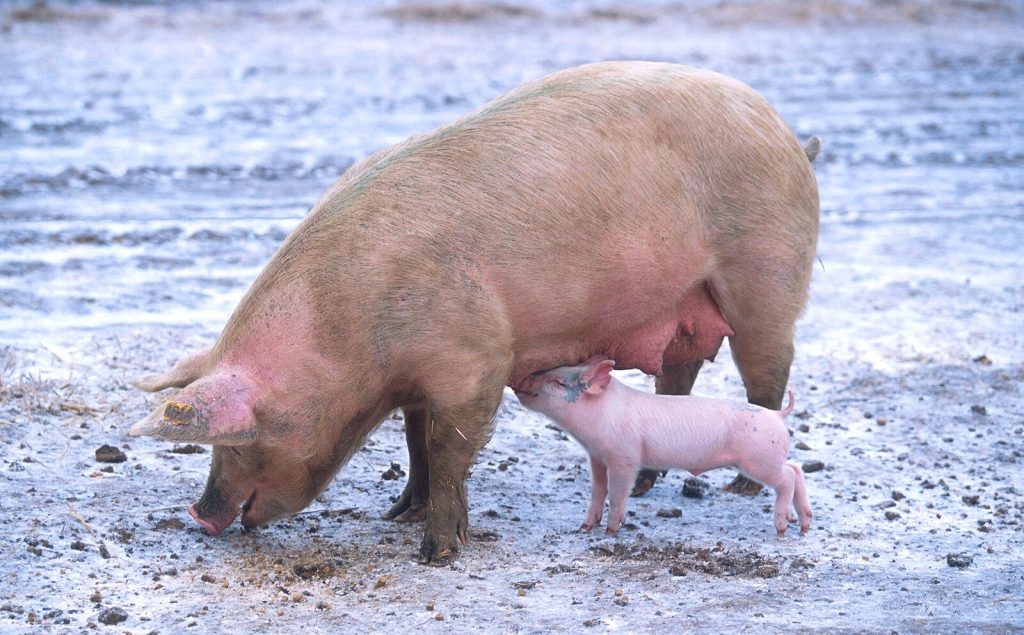
Every published pig feed requirement is stated as dry feed, and most Ugandan pig feeding is wet. A weaner is listed at a quarter to three quarters of a kilogramme a day, a grower at up to one and a half, and a sow in milk at up to three and a half. Those are dry weights, so a bucket of wet swill or fresh vines is not the same quantity at all.
Pig Feed Requirements Are Stated in Dry Feed
The training manual behind most Ugandan pig feeding guidance, produced for the smallholder pig value chain work with the national advisory service, says this explicitly and it is the first thing a farmer needs. The daily amounts it publishes apply to dry feeds. Forages and crop residues can be more than 60 percent water, so the weight a pig eats of those is greater than the figure in the table while the nutrients it delivers are not.
Daily Feed Requirements by Pig Class
The published daily allowances run by class rather than by exact weight, which suits a farm without a scale. Read them as dry feed and as a reference rather than a ration.
| Class | Age | Dry feed per day |
|---|---|---|
| Weaner pigs | 2 to 4 months | 0.25 to 0.75 kg |
| Grower pigs | 5 to 6 months | 0.75 to 1.50 kg |
| Adults | 7 to 10 months and above | 1.50 to 2.50 kg |
| Pregnant or lactating sow | Any | 2.50 to 3.50 kg |
Two things follow from that shape. The first is that a pig's daily requirement roughly quadruples between weaning and slaughter weight, so a feed plan built on the average pig in the sty will overfeed the small ones and starve the big ones. The second is that a breeding sow eats at the top of the range whether or not she is productive. Her feed bill runs all year, and it is the same bill in a year when she raises sixteen piglets and in a year when she raises eight.
These allowances describe what a pig can consume, not the least you can get away with. A pig kept short of feed does not stop needing it. It converts what it does get into maintenance rather than into growth, and the feed disappears with nothing to show for it.
Protein Requirements by Pig Weight
The requirement figures in Ugandan pig training material are taken from the American National Research Council's nutrient requirements of swine, and the manual says so on the face of the tables. That provenance is worth stating plainly: these are not Ugandan measurements, they are international requirement standards reproduced for Ugandan use, which is a reasonable thing to do for a nutrient requirement and a bad thing to do for a price or a growth rate.
Digestible protein falls steadily with weight. A pig up to 3 kg is put at about 17 percent, from 3 to 10 kg at about 16 percent, from 10 to 16 kg at about 14 percent, and from 16 kg to slaughter at about 13 percent. A lactating sow sits at about 13 percent and a gestating sow lower again at about 11 percent, which is the clearest signal in the table that a dry sow and a sow in milk should not be on the same feed.
Stated as crude protein rather than digestible, the same material gives about 180 grammes per kilogramme of feed for a pig of 11 to 23 kg, about 160 for 23 to 34 kg, about 140 for 34 to 57 kg and about 130 for 57 to 102 kg, with a gestating sow at about 120 and a lactating sow at about 130. Those convert to roughly 18, 16, 14 and 13 percent, which lines up with the digestible figures and is the internal check that makes both tables usable.
The energy column of the same table is not reproduced here, and that is deliberate. It is headed as digestible energy in kilocalories per day, and it gives around 3,400 for a pig of 0 to 3 kg. A newly born piglet does not consume 3,400 kilocalories a day. The figures are almost certainly per kilogramme of diet and the column heading carries a units error, so publishing them as printed would put a wrong unit in front of a farmer. The amino acid figures in the same tables are formulation inputs and are also left out for the same reason they are left off the poultry pages: they belong in a formulation worked by a nutritionist, not on a page a smallholder might mix from.
Why a Ugandan Grower Feed Bag May Not Meet the Requirement
Uganda's compulsory specification for this feed is US EAS 55:2019, Compounded pig feeds, amended in 2021, which superseded US 811:2009. Four categories sit inside it: pig starter feed, pig growers feed, pig finishing feed and lactating sow feed. Which of the four a given bag was made to is a question with a printed answer, and it is the first question to ask.
The Maize Bran Ceiling and a Contradiction in the Same Manual
Maize bran from local millers is the commonest feed in Ugandan pig keeping, so the limit on how much of it a ration can carry is the most consequential single figure on this page. The Ugandan training manual gives that limit twice, one page apart, and the two answers do not agree.
The same table caps other Ugandan staples: cotton seed cake at about 15 percent for growing and finishing pigs and 5 percent for sows, dried brewery residue at about 10 percent for growers and 40 percent for a gestating sow, sunflower cake at about 10 percent, fish meal at about 5 percent across every class, and wheat bran at nothing at all for a starter or a growing pig against up to 30 percent for a gestating sow. Those are ceilings for single raw materials and not a recipe, and no ration formulation appears on this page. Building one is the job of the pig feed formulation guide and of a qualified nutritionist.
Water Requirements Beside the Feed Requirement
Water is part of the feed requirement rather than separate from it, because a pig that will not drink will not eat. The published Ugandan figures run by class and by weight.
| Class | Body weight | Litres per day |
|---|---|---|
| Piglets | 3 to 9 kg | 0.25 to 1.0 |
| Grower pigs | 10 to 25 kg | 1 to 3 |
| Finishing pigs | 25 to 65 kg | 2 to 5 |
| Non pregnant gilts | 65 to 105 kg | 4 to 10 |
| Lactating sow | 65 to 95 kg | 10 to 20 |
| Boar | 65 to 112 kg | 18 to 30 |
Four things push those figures up: body weight, sickness, a higher protein ration and hot weather. A pig with fever or diarrhoea needs more water, not less, and a high protein feed raises the water requirement because the pig has to excrete what it cannot use.
Pigs are also fussy about water in a way that costs farms real growth. The manual notes that most farmers pour water into a trough and leave it, where it goes dirty and stale and the pigs refuse it, while putting too much in at once means the pigs play in it and wet the feed. Small amounts, refilled when the trough empties, with the trough kept clean. Ugandan value chain research recorded that water for pigs is often neither clean nor supplied in sufficient quantity or frequency, which makes this a widespread problem rather than an unusual one.
Feed Quality, Mould and Storage in a Pig Ration
The Ugandan feed sector is described in the value chain literature as underdeveloped and unable to supply quality feed all year round, with the market poorly regulated, farmers complaining of poor quality feed from small scale compounders, and buyers being drawn to cheap feed that turns out to be very poor. That is the market a pig keeper is buying in, and it is why the declaration on the bag and the compulsory specification behind it are worth asking about rather than assuming.
The ingredient risks are documented individually. Fish meal goes rancid if it is not dried properly, and the manual's own advice is to dry it well, avoid long storage of feeds containing it and avoid compacting feed in storage. Blood meal is a potential source of disease organisms and needs boiling at 100 degrees Celsius for at least fifteen minutes. Cotton seed cake carries gossypol and has to be heat treated or come from a low gossypol variety. Wheat bran fed as the only grain is linked to obesity in pigs.
Deliberately absent from this page: any number describing how much mould toxin a feed may contain. The Ugandan sources contradict themselves on it, one level in prose and other levels in their own tables, and a half certain threshold is worse than none because a farmer reads it as a line they are comfortably under. Where that line sits belongs to the compulsory feed specification and to the standards bureau. Whether a particular batch crosses it needs a laboratory. What can be said without a number is the direction of risk: mould grows on material that went into storage damp, so the grain or bran that was never dried properly is the dangerous input, and a wet mash in a trough hides the evidence better than a dry bag does.
The manual's own instruction is that mixed feed should be analysed for nutrients from time to time by a laboratory recommended by the local extension agent. Short of that, refuse anything that smells sour or musty, has caked, feels warm inside the bag or shows insect life, keep sacks off the floor and the walls, and mix small batches rather than holding stock. More on that in safe feed storage and on the ingredient itself in maize bran in animal feeding.
Medicated Feed, Withdrawal Periods and Pork
A plain compounded pig feed carries no withdrawal period. Anything medicated does, whether it reached the pig in the feed, in the water, as a drench or by injection, and that period is printed on the product label and is confirmed by the veterinary officer or supplier who provided it. No withdrawal period, dose, dilution, route, inclusion rate or interval appears anywhere on this page, because a residue in pork is eaten by a family and a wrong figure is not recoverable.
Two things make this harder on a pig farm than the label alone suggests. Feed is the route by which a medication most easily enters an animal without the farmer registering that it happened, so a bag that does not state its contents is a food safety question before it is a nutrition question. And Ugandan pigs are frequently sold at short notice for cash, which means the decision to sell often comes after the decision to treat rather than before it. If a pig is treated, the sale date moves. The withdrawal period does not.
An honest note on the evidence. Uganda has a published survey of adherence to withdrawal periods in the commercial poultry sector, covering 374 farms, and it found about a quarter of farms not adhering. No equivalent published Ugandan figure for pig farms was found in a search of the biomedical literature that returned results for closely related Ugandan queries, so there is no adherence figure for pork to report here. Absence of a measurement is not evidence that the problem is smaller. Deworming in particular has its own product label and its own waiting period, covered on deworming pigs, and it is a veterinary decision rather than a feeding one.
Questions Ugandan Pig Farmers Ask About Feed Requirements
How much feed does one pig need from weaning to sale? Work it from the class table rather than from a single number. A pig moving through the weaner, grower and adult bands over roughly six to eight months sits in the range of a quarter of a kilogramme a day at the start and two and a half at the end, so the total depends entirely on how long you keep it and how fast it grows. Weigh or measure the pig, because a pig that grows slowly eats the maintenance ration for longer and the total climbs without the carcass following.
What share of a pig enterprise is feed? Ugandan value chain research puts the cost of feed at about 70 percent of the total cost of producing a pig in the country, with other work in the same literature putting the range higher. Whatever the exact figure, no other decision on a pig farm moves the result as much, and current prices should come from the cost of raising pigs page and your own local quotes rather than from a national average.
Can pigs live on swill, peelings and vines alone? They can live. They will not grow at a rate that repays the months. The requirement figures are dry weights and a wet ration cannot deliver them within the gut capacity of the animal, which is the mechanism behind the very low growth rates recorded for forage fed Ugandan pigs.
Is home mixing cheaper than buying compounded feed? It lowers the cost per kilogramme and it adds a quality risk, a mixing job and a storage problem. It needs a formula from a qualified nutritionist, a periodic laboratory check and respect for the inclusion ceilings above. The pig feed formulation basics page covers what the work involves.
Do I feed a pregnant sow the same as a sow with piglets? No. Both eat at the top of the daily range but the protein requirement differs, roughly 11 percent digestible protein for a gestating sow against 13 percent for a lactating one. The compulsory Ugandan feed specification has a lactating sow category and no gestating sow category, so this is a gap you have to manage with your supplier rather than one the bag solves.
How much water should a pig get? From a quarter of a litre a day for a small piglet up to 10 to 20 litres for a sow in milk and 18 to 30 for a boar. Give it clean, in amounts the pig finishes, and refill rather than filling the trough once.
Will maize bran spoil my pork? Too much of it will, by laying down soft fat that a buyer can see. The manual's prose puts the ceiling at 20 to 25 percent of the ration while its own table allows far more, so err toward the lower figure, and keep bran out of a starter ration entirely.
Finding Pig Feed and Veterinary Advice
The most useful thing you can do with this page is take it to a feed shop and ask which category of the compulsory compounded pig feed specification each bag is made to, then read the declared protein against the weight of the pigs you are actually feeding. Ask whether anything medicated is included, and get that answer from whoever compounded the feed. Compare more than one supplier, since the Ugandan feed market is unevenly regulated in practice and the cheap bag is often cheap for a reason you will pay for later.
For a withdrawal period, a sick animal or a ration that is not delivering the growth the declaration implies, a district veterinary officer or a qualified private veterinarian settles it. The animal feeds and health guides carry the neighbouring topics, the pig feeding guide covers the management side of feeding, common pig diseases covers what a feed problem can be mistaken for, and the pig feed calculator lets you run your own herd numbers. Suppliers are listed on the where to buy pig feed page.