
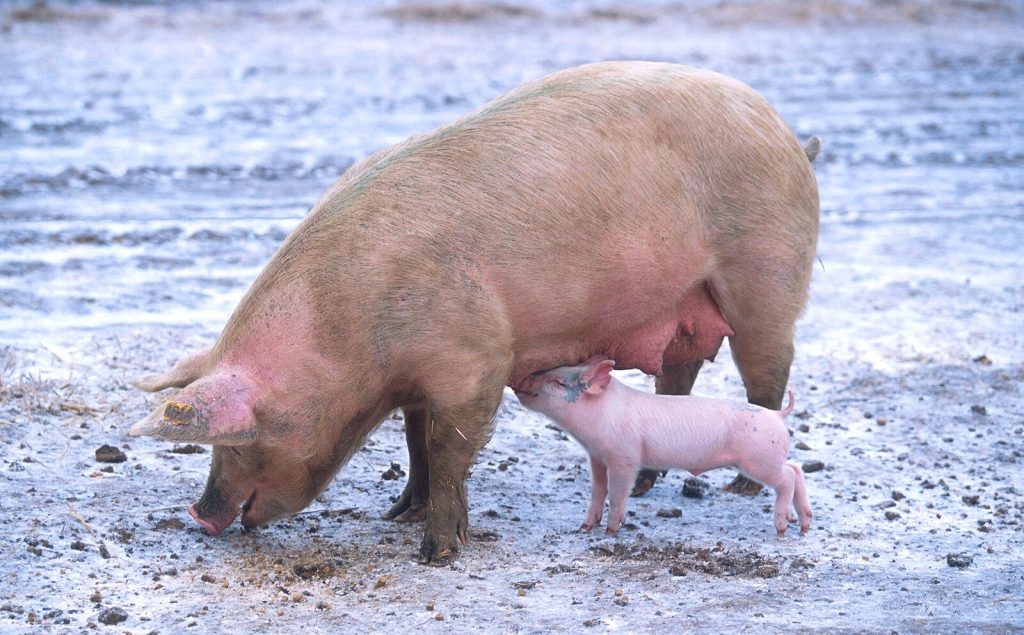
The cost of raising pigs in Uganda is best read as a daily rate rather than a total, because almost every line on a pig farm is charged by the day the animal is alive. Feed, water, labour and the shed all run with the clock, the weaner is the only real one off, and disease is a probability that grows the longer you hold the pig. How many days you keep it decides the answer.
What It Actually Costs to Keep One Pig for One Day
Start with the unit almost nobody uses. A Ugandan pig farmer thinks in batches and sale prices, and the number that would tell them most is the cost of one pig for one day.
Building it takes two inputs. The first is how much a pig eats, and Ugandan pig feeding guidance gives a daily dry feed allowance by class: about a quarter to three quarters of a kilogramme a day for a weaner of two to four months, three quarters to one and a half kilogrammes for a grower of five to six months, and one and a half to two and a half kilogrammes for an animal of seven months and over. Averaged across a weaning to sale cycle that is close to 1.2 kg a day. The second is everything that is not feed, and on the illustrative allowances used for the cost of starting a pig farm the health, water, labour and housing recovery lines come to roughly 95,000 shillings across a cycle, which over about 180 days is close to 530 shillings a day.
Put those together at three ration prices and the daily rate falls out.
Every one of those numbers carries a labelled assumption, because no current Ugandan ration price could be verified. Ration prices in Ugandan sources run from home mixed feed at under a thousand shillings a kilogramme up to compounded concentrate several times that, and the spread is real rather than an error. Drop your own price into the arithmetic rather than taking one from a page.
Now read what the daily rate means. At 2,000 shillings a day, a month of pig costs about 60,000 shillings. Hold a pig three months longer than you meant to and you have spent 180,000 shillings, which is more than most weaners cost. The clock is the cost.
How Fast a Ugandan Pig Grows on Farm, Not in a Trial
The other half of the arithmetic is what the pig does with that feed, and here Ugandan measurement is unusually honest and unusually discouraging.
A longitudinal study in Lira district in northern Uganda weighed 197 weaner and grower pigs on smallholder farms every two months across a year, on the diets those farms actually used. Mean daily weight gain came out at about 144 grams. Mean live weight across the visits was 18 kilogrammes, and the authors record that the pigs were underweight for their age. The feed grades they classified the farms into tell you why: grade one was grazing alone, at 2 to 7 percent crude protein, and grade two was grazing plus maize bran, at 7 to 10 percent.
Set that against controlled Ugandan pen data, where weaner and grower pigs gained 36 grams a day on a forage based diet, 52 on silage and 294 on commercial feed in the same weeks. The field mean of 144 sits between the cheap ends and the bought ration, which is what you would expect of farms feeding bran alongside whatever the pig finds.
Those two growth rates do not describe the same animal, and the rest of this page keeps them apart. A pig eating the daily allowance above is a fed pig and should grow nearer the commercial figure. A pig on grazing and bran is cheap to keep and grows at something like the Lira mean. Mixing a recommended ration with a scavenging growth rate produces nonsense, and the honest move is to cost both routes separately.
The 200 Day Fattening Cycle and the Weight It Does Not Reach
Uganda has a measured cycle length, and it is worth knowing before you plan a batch. The same Lira study takes the average days of fattening in Uganda as 200 days, running from about 2 months to about 8.5 months of age, derived from its own farm data. That is the shape of the Ugandan pig year: buy a weaner at two months, sell around eight and a half.
Then do the weight arithmetic, which nobody seems to have done. Take a weaner bought at about 12 kilogrammes, which is a labelled assumption rather than a measurement. At the Lira field gain of 144 grams a day, 200 days adds about 29 kilogrammes and the pig reaches roughly 41 kilogrammes liveweight. At the commercial pen figure of 294 grams a day it would reach about 71.
Ugandan value chain research records that slaughter pigs in Kampala are normally over 50 kilogrammes liveweight, with an average carcass near 40 kilogrammes. So the measured Ugandan cycle, fed the way measured Ugandan farms feed, ends below the weight the main urban market buys at. That single mismatch explains more about Ugandan pig economics than any price figure: farms are not choosing to sell small, they are running out of pig before they run out of calendar.
| Months of age | Feed eaten, kg | Weight, fed pig | Weight, bran and grazing |
|---|---|---|---|
| 6 | about 95 | about 47 kg | about 29 kg |
| 8 | about 215 | about 65 kg | about 38 kg |
| 8.5 | about 245 | about 71 kg | about 41 kg |
| 12 | about 455 | too heavy to sell as pork | about 55 kg |
| 14 | about 575 | too heavy to sell as pork | about 64 kg |
Feed quantities come from the class allowance and reconcile with the roughly 220 kilogrammes from weaning to eight months published on this site's startup costing, with a spread of about 150 to 290 kilogrammes across the allowance bands. The two weight columns use the two growth rates above from a 12 kilogramme weaner. The last two rows in the fed column are left as words on purpose: a pig fed to allowance is past market weight by then, and nobody should be reading a number off that cell.
Which Costs of Raising Pigs Run With the Clock
The reason the daily rate matters is that Ugandan pig costs divide into three kinds, and only one of them behaves the way farmers expect.
| Cost line | Charged by the day? | What moves it |
|---|---|---|
| Feed | Yes, and it dominates | Ration price, pig class |
| Water | Yes | Source, cartage distance |
| Labour | Yes | Herd size, whose time it is |
| Housing recovery | Yes | Build cost, pigs per year |
| Weaner purchase | No, one off | Local supply, quality |
| Weighing and marketing | No, per sale | Buyer, distance |
| Health and biosecurity | Part daily, part event | Disease pressure, district |
| Death of the pig | A probability, rising daily | Disease, season, biosecurity |
Feed is between 60 and 80 percent of the variable cost of producing a pig in Uganda, which the value chain literature states in two places at slightly different widths. Housing surprises people by belonging in the daily column, but a sty that lasts ten years and carries two batches a year is recovered across twenty pigs whatever you paid for it, and a sty standing half empty is recovered across fewer. Both of those are consequences of how long each pig occupies it.
Only two lines genuinely sit outside the clock, and one of them is the weaner. That matters because it is the line farmers negotiate hardest over and the one where a shilling saved saves a shilling once, while a shilling saved per day saves it two hundred times.
Feed Cost Per Pig Per Day at Three Ration Prices
Break the daily feed cost down by class and the shape of the bill becomes obvious.
| Pig class | At 800/kg | At 1,200/kg | At 1,800/kg |
|---|---|---|---|
| Weaner, 2 to 4 months | 400 | 600 | 900 |
| Grower, 5 to 6 months | 880 | 1,320 | 1,980 |
| Finisher, 7 months on | 1,600 | 2,400 | 3,600 |
All figures in shillings a day, from the midpoint of each class allowance. The finisher costs four times what the weaner costs to keep for a day, and it is also the stage where farmers are most tempted to wait for a better price. Waiting is never free and it is most expensive exactly when people do it.
Feed prices move, and on a pig farm the movement lands on the biggest line. If the ration you buy goes from 1,200 to 1,800 shillings a kilogramme mid cycle, your finisher goes from 2,400 to 3,600 shillings a day, and a batch of ten pigs picks up 12,000 shillings of extra cost every day until you sell or change the ration. Home mixing is the usual answer and the pig feed formulation guide covers it, with the ingredient market on the pig feed suppliers page.
What an Extra Month on the Farm Costs Against What It Adds
This is the calculation that decides whether a Ugandan pig enterprise works, and it is short.
An extra 30 days costs between about 45,000 and 81,000 shillings, being 30 days at the daily rates above. What does it add? A fed pig gaining 294 grams a day puts on about 8.8 kilogrammes in that month. At the verified Ugandan farm gate band of 4,500 to 7,000 shillings a kilogramme liveweight, those 8.8 kilogrammes are worth between about 40,000 and 62,000 shillings.
Push it further and the loss becomes stark. Going from the measured 200 day cycle to a twelve month one, on the bran and grazing route, adds about 210 kilogrammes of feed to gain about 14 kilogrammes of liveweight. At 1,200 shillings a kilogramme that feed costs 252,000 shillings, which works out at roughly 18,000 shillings for each extra kilogramme of liveweight, against a farm gate ceiling near 7,000. Nobody should pay 18,000 for something they can only sell at 7,000.
This is the arithmetic behind a finding already on this site, that a Ugandan pig fed a bought ration breaks even at around 7,400 shillings a kilogramme liveweight against a gate of 4,500 to 7,000, rising to about 9,100 once measured smallholder mortality is applied. The pig farming profit calculation works that through properly across feed conversion ratios and ration prices, and this page does not rebuild it. What the clock adds is the reason the cheap feed escape fails: slow growth does not reduce the cost, it relocates it from the feed sack into the calendar.
The Health Bill on a Ugandan Pig Farm, Measured
Most pig costings treat health as a small guessed allowance. Uganda has a measurement, and it inverts what farmers assume.
The Lira study tracked treatment spending per pig alongside growth, and scored each farm on management standard. Treatment spending per pig fell as management improved, by roughly a sixth between the poorest and best managed farms. Not rose. The better farms spent less on drugs, which is the same direction the Ugandan pig parasite survey found when it showed that routine manure removal and routine disinfectant use cut infection odds measurably while dosing frequency did not.
Then the losses. The same study put a figure on what a single infection costs in lost growth. A grower exposed to porcine reproductive and respiratory syndrome virus gained about 17 grams a day less than a comparable unexposed pig, and a grower carrying Ascaris about 17 grams a day less. Over a 200 day fattening period that is roughly 3.4 kilogrammes of liveweight, or about 2.4 kilogrammes of carcass at the 70 percent dressing the study used for pigs on maize bran diets. Valued at the pork price of 10,000 shillings a kilogramme that study worked with, the loss came to about 24,000 shillings a pig for either infection. Scale it to your own pork price, because that is the one input that will have moved.
Put the two halves together and the ratio is the useful part: the growth lost to one infection was worth roughly six times what those same farms spent on treatment across the whole cycle. The money is not in the bottle. It is in the growth you did not get, and the cheapest interventions measured in Uganda were a shovel and a disinfectant. Treatment detail and the label rules sit on the deworming pigs page, and no dose, product or interval appears here.
African Swine Fever Has No Season, So Time Is the Exposure
African swine fever has no vaccine and no treatment and it can take the entire herd, so it is a cost line rather than a footnote, and Ugandan surveillance tells you something specific about how to budget for it.
Thirteen years of district veterinary officer reports recorded 1,521 confirmed cases, and at least 55 percent of Uganda's districts, 74 of 135, reported at least one. Cases appeared in every month of the year with no observed pattern. Districts on international borders and districts carrying 30,000 pigs or more reported the most, with a confirmed cluster in the south central districts bordering Tanzania, while eight named northern districts reported no case at all across the whole period.
Two things follow for a costing. First, there is no safe window, so any advice to time a batch around a swine fever season is describing a pattern the data does not contain. Second, because exposure accrues with days rather than with months of the year, holding a pig longer buys more risk at the same rate the whole time. That is a cost, and it never appears on a receipt.
Smallholder pig mortality in Uganda is perceived at about 20.8 percent, with weak biosecurity linked to losses up to 30 percent in a recent assessment, against a commercial target under 5. Every pig that dies carries the cost of every day it was alive and returns nothing, which is why mortality belongs in a costing as a divisor rather than a line. The common pig diseases page covers the disease picture and the farm biosecurity guide covers the perimeter.
Cost Lines on a Pig Farm That Cannot Be Priced Honestly
Weaner prices are the sixth and they are irreconcilable rather than missing. Two bodies of evidence sit a long way apart. Survey era producer figures put a piglet at 20,000 to 32,500 shillings in rural chains, rising to 30,000 to 50,000 closer to town. Ugandan farm guides written more recently ask 80,000 to 150,000 for a weaned animal, and up to 300,000 where the stock is good. That spread is evidence of a thin and volatile supply chain rather than a price to plan on, and the piglet price page is where a current figure belongs.
Records That Turn a Pig Into a Cost Per Kilogramme
None of this arithmetic works without two numbers that most Ugandan pig farms do not have: the weight the pig came in at and the weight it left at. Ugandan research records that the trader sets the price by eye, for the simple reason that there is no scale on the farm, and that what the farm spent never enters the bargain. A pig you never weighed cannot be turned into a cost per kilogramme, so the cost of raising it stays permanently unknowable. The profit calculation page makes the case for fixing that first.
The record that makes this page usable is short: date in, weight in, kilogrammes of feed by week, date out, weight out, price received. Six columns. Divide the total by the days and you have your own daily rate instead of the illustrative one above, and divide it by the kilogrammes gained and you have your cost per kilogramme. The livestock record keeping template and the pig production calendar carry the sheets, and the pig feed requirement calculator does the feed side.
Demand is not the constraint here, which is worth saying because it is usually offered as the reason to expand. Uganda leads the region on pork consumption at about 3.4 kilogrammes a person a year, the national census count of pigs has gone from 3.2 million to 7.1 million, and consumption is projected to outrun what the country produces. A growing market does not fix a daily rate that exceeds what the market pays. That is the honest position of the livestock guides on this enterprise, and it is why the arithmetic on this page runs on days rather than on optimism.
Questions About the Cost of Raising Pigs in Uganda
How much does it cost to raise one pig to market weight in Uganda? On the daily rates above, a pig kept 200 days costs roughly 300,000 to 540,000 shillings in feed, water, labour and housing recovery depending on ration price, plus the weaner. Add a weaner at 120,000 and a bought ration at 1,200 shillings a kilogramme and you are near 520,000 shillings for a pig that reaches about 41 kilogrammes on measured Ugandan field growth or about 71 if it is genuinely fed. Sold at 7,000 shillings a kilogramme liveweight, the fed pig is worth about 497,000. That is the problem, stated plainly.
What do most published pig costings leave out? Usually everything after the weaner and the sty. Nothing is sellable for the first six to eight months, and across that stretch the feed sack is almost the entire answer to the question, at 60 to 80 percent of variable cost. Any costing without a feed quantity in kilogrammes is a shopping list rather than a budget.
Is grazing and bran genuinely an easier way to raise a pig? Easier per day, harder per kilogramme of pig. Ugandan pen data puts gain at 36 grams a day on a forage based diet against 294 on commercial feed, and Ugandan field measurement puts a bran and grazing farm at about 144. A cycle that should take 200 days stretches well past a year, and every day of that carries the daily rate plus another day of swine fever exposure. There is no comfortable side to this choice, which is why the site publishes both.
How long should a Ugandan pig stay on the farm? Not longer than it has to, and almost never longer at the finishing stage. A finisher costs 1,600 to 3,600 shillings a day to keep and gains at most about 300 grams, worth roughly 1,350 to 2,100 shillings at the farm gate band. Waiting is a bet that the price will move more than the cost, on the one stage where the cost per day is highest. Selling into a seasonal high is a different and better idea, and it means planning the batch backwards from the month, not waiting once the pig is standing there.
What should I budget for veterinary work on a pig? Less than you fear and less than the loss it prevents. Measured Ugandan on farm treatment spending across a whole fattening cycle was small enough that better managed farms spent about a sixth less than poorly managed ones, while the growth lost to a single infection was worth roughly six times the entire treatment bill. So the budget question is the wrong one. Spend the money on manure removal, a disinfectant and not sharing equipment, all of which measurably cut infection odds, then keep a contingency for a veterinary visit rather than a stock of drugs.
Does a bigger herd make pig farming work? Scale does not repair a bad daily rate, it multiplies it. Feed, water, labour and housing recovery all rise with pig numbers, so a herd of fifty has the same cost per pig day as a herd of five unless something structural changes, such as buying ingredients in bulk or getting a buyer who pays by weight. Uganda's own pig market assessment describes producer profitability as persistently low or negative, driven by how pigs are priced rather than by how many there are.
What single change does most for a pig enterprise? Shorten the cycle, and the way to shorten it is feed rather than patience. Every day removed from the calendar takes the full daily rate off the cost and one day of disease exposure with it. After that, weigh the pig, because a cost per kilogramme you cannot calculate is a cost you cannot manage.
Work out your own daily rate before you buy the next weaner: get the current price per kilogramme of the ration you would actually use from two local sellers, multiply by 1.2, add your own water and labour estimate, and you have the number this whole page is about. Current input and stock prices are on the piglet price page and through local pig input and feed suppliers under farm input suppliers, and a borrowed weigh band or a heart girth tape from your district production office will give you the other half.