
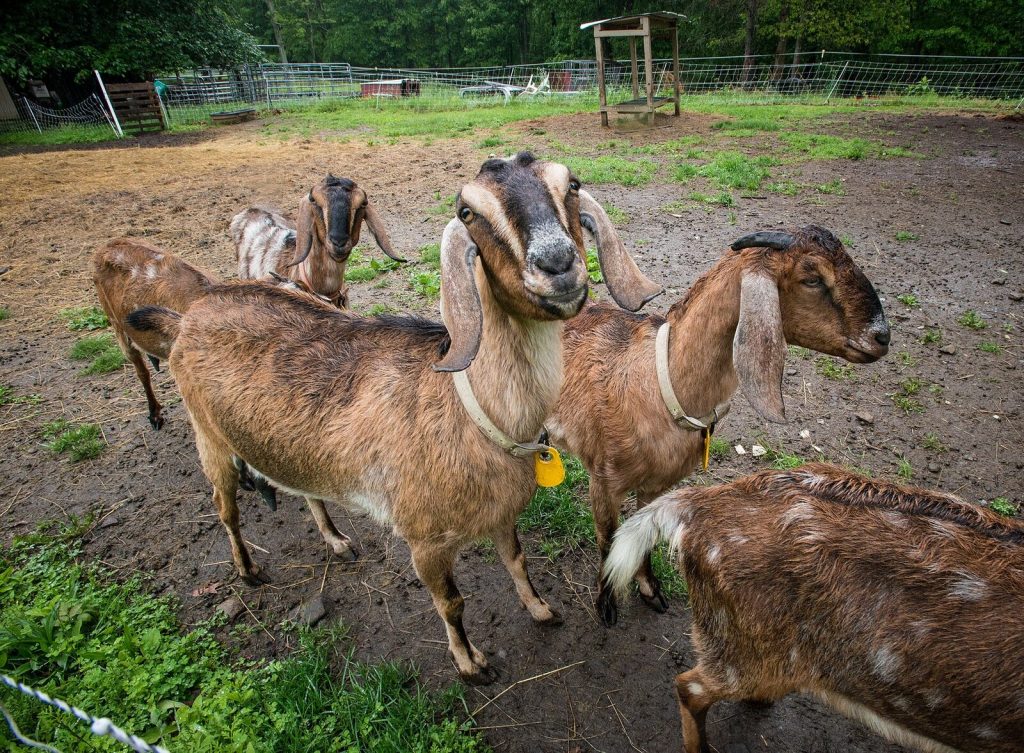
Feeding goats in Uganda is a labour job before it is a buying job. The routine that works is browse and cut fodder as the base, grasses and crop residues around it, clean water in a container the goat cannot foul, and a mineral lick left out all the time. This goat feeding guide covers what to cut, how to present it and when.
Where the hours land is worth saying at the start. In a Ugandan district where goat keeping was surveyed household by household, feeding the goats was the woman's responsibility in 66 per cent of homes, while men owned the animals in 65 per cent, sold them in 76 and decided what happened to the money in 55. Any feeding plan that adds an hour a day is adding it to somebody in particular.
What Goat Feeding Actually Takes Each Day
Strip a Ugandan goat feeding routine down and there are four recurring jobs. Somebody moves the animals or the tether peg. Somebody cuts and carries green material. Somebody fills and cleans the water and checks the lick. And at intervals rather than daily, somebody harvests a fodder tree.
Browse and cut fodder carry the protein. A NARO and Makerere handbook on Ugandan goat feeding puts the crude protein of indigenous fodder trees and shrubs at over 18 per cent against under 10 per cent for grasses and under 20 for most forage legumes, and reports that most of the species assessed supply enough calcium and phosphorus. Grass fills the belly. Trees feed the goat.
How much a goat actually needs, and why the Ugandan system so often fails to deliver it, is set out on our page on goat feed requirements. This page assumes you have read that and want to know what to do on Tuesday morning.
Moving the Tether and the Grazing Height That Decides the Worm Load
A tethered goat eats a circle. Move the peg and you give it fresh material; leave it and the animal is picking over what it has already refused, and standing in its own droppings while it does. The move is the cheapest feeding action available on a Ugandan smallholding and it is the one most often skipped when the person doing it is already carrying water.
There is a height below which you should stop grazing, and it comes from the ministry rather than from folklore. MAAIF's goat and sheep guidelines instruct farmers to practise rotational grazing and not to graze below four inches, because 80 per cent of worm larvae sit in the first few inches of vegetation. Two things follow. The bottom of the sward is where the parasites are, and it is also where the feeding value is lowest, because the animal is working hardest for the least material.
The same guidelines tell you to keep grazing land clean and free of manure, not to graze goats alongside other ruminants, and to avoid grazing where flies are heavy. Rotate so the pasture stays in a vegetative state, which is easier for a goat to eat and to digest than stemmy regrowth. The worm side of the argument is worked through on our deworming goats guide; the feeding side is simply that short regrowth is bad feed.
Cutting Fodder for Goats: Which Parts, and How Often to Harvest
Here is the question almost nobody answers. You are told to feed fodder trees. Nobody tells you how often to cut one, and cutting too often is how a fodder bank dies in its second year.
Ugandan practice recorded in the fodder handbook is that most trees are harvested about every 90 days during the wet season and every four to six months during the dry season. In the dry season, when other feed has run out, lopping provides the green supplement that keeps animals going. What you take is the edible part: soft branches and top twigs, pollarded or pruned. For a big tree kept mainly for timber or poles, coppicing and pollarding branches gives you the leaves and twigs without touching what the tree is for.
| Season | How often to cut | What to take |
|---|---|---|
| Wet | About every 90 days | Soft twigs, prunings |
| Dry | Every 4 to 6 months | Lopped branches |
| Big timber trees | As the tree allows | Coppice and pollard |
On the grass side, elephant grass is the most popular forage for stall fed goats in Uganda, and it has one weakness that decides when to cut it. It matures fast in the dry season and its crude protein falls below 7 per cent when it does. Cut it young. Setaria, Rhodes grass, guinea grass, couch grass and swamp grasses all appear in Ugandan goat feeding, and a goat eats less of any of them once they have gone stemmy, refusing more and wasting more.
Chopping and Wilting Cut Feed Before the Goats Get It
Two things happen to cut material between the garden and the trough, and both are worth doing on purpose.
Chop it. The handbook's instruction is direct: always chop fodder to cut waste and make it more palatable. An unchopped Napier stem gets the leaf eaten and the stalk trampled. A chopped one gets eaten.
Wilt the bitter ones. Some of the most available material in Uganda is bitter or carries anti nutritional compounds, bitter leaf and cassava leaves and peels among them, and those effects are reduced by wilting or drying the leaves before offering them. Wilting also raises palatability and intake, so one afternoon in the shade does two jobs at once. Goats that browse freely have their own tolerance for this material, which is why an animal on the rope handles it differently from an animal eating what you hand it.
Feed a mixture rather than a single species. That is the handbook's stated defence against side effects from species known to be poisonous in quantity, and it is the most transferable rule on this page: no one plant makes up the whole of a day's cut.
Feeders and Water Troughs a Goat Will Use
Goats will not eat or drink anything dirty. They will also knock over a bucket and stand in a trough. The handbook's answer to both is to put the feed, fodder and water boxes outside the pen, and to site the watering bucket outside the wall with a hole cut in it for the goat to put its head through. The animal drinks; it cannot upset the container or foul the water.
The national genetics agency makes a related point about feeder shape: the design should imitate the browsing behaviour of goats. A goat in the field eats upward, off a shrub, at head height. A feeder at ground level is fighting the animal's habits, and what it drops on the floor it will not pick up again.
Water hygiene has its own ministry instructions. Take drinking water from a trustworthy source such as a tap or a deep well. If you use surface water from a well, dam or river, treat it by filtration or sedimentation followed by chlorination, at a strength taken from the product label and confirmed with a local officer rather than guessed. Place bowls and troughs so droppings cannot reach them, throw out contaminated water as soon as you find it, and disinfect the source between changes.
Goats should be able to see out and should go out daily for exercise and to browse whatever is standing. That is the handbook's framing and it is as much a feeding instruction as a welfare one, because an animal kept shut in eats less.
A Daily Goat Feeding Timetable That Uses Browse Twice
Ugandan practice gives the browse an afternoon slot. Fodder from trees and shrubs is normally fed once a day in the afternoon, and for the rest of the day the goats work on grasses such as setaria, guinea grass, Rhodes grass and elephant grass, plus crop residues including banana, sweet potato and cassava peels.
Why the afternoon works: the browse is the protein, it goes in on a stomach that already has grass in it, and it goes in when somebody is back from the garden with a bundle. Do the cutting on the way home rather than as a separate trip, which is the single change that makes cut and carry survive a busy week.
Across the year the browse share swings hard. Indigenous fodder trees and shrubs supply over 15 per cent of the total goat diet in the dry season and very little in the wet, when there is plenty of green. So in the rains your cut is topping up quality, and in the dry months it is most of what the animal gets. Plan the tree harvest around that rather than around a fixed weekly habit.
One counterintuitive finding worth holding on to: zero grazed goats eat more fodder than goats on free range. Confinement does not lower intake if the feed keeps arriving. It moves the whole feed bill onto your shoulders, which is a labour decision and not a nutrition one.
Feeding Crop Residues, Peels and Fruit Without Losing a Goat
Crop residues are the cheapest thing on a Ugandan farm and the weakest. They run low in protein and high in fibre, which makes them poorly used by a goat unless a protein source sits beside them. Lablab is the one the handbook names, and intercropping maize with lablab improves the stover quality and the maize grain yield at the same time, which is a rare case of two benefits from one decision.
Fruit and seeds need a specific precaution. Avocado, jackfruit and mango are commonly fed to Ugandan goats, and they must be chopped or crushed before they go in, because whole they choke the animal. That is a thirty second job that prevents a dead goat.
Peels carry their own risk and it is a serious one. The peel material Ugandan farmers ration most carefully is sweet potato peel, and the mechanism, the named compounds and the specific combination that kills are set out on our goat feed requirements page rather than here. Read it before you feed peels in any quantity.
Agro industrial by products are the other bought option: cotton seed cake, sunflower cake, brewer's grain, molasses, maize bran and rice bran. The handbook is blunt about why they are underused. They are bulky, availability is patchy, transport costs more than the material, and the nutritive value of most of them is poor relative to what farmers expect. Buy them for a reason, not by default.
Fodder Species That Need Care in a Goat Feeding Routine
One finding sits across two Ugandan documents and neither of them joins it up. In the Buyende survey, Lantana camara was among the five browse species goat keepers named most often. In the fodder handbook, Lantana camara is the species carrying the clearest warning.
What the handbook records: farmers in eastern Uganda remove the seeds and fruits before feeding it, because they reported it toxic to animals when fed with seeds. It is not a good feed if given frequently and in large amounts, because it causes blisters on the lining of the intestines. And the leaves and twigs damage the animal's teeth. The handbook's conclusion is that it is best mixed with other browse rather than fed alone.
Two other species carry useful notes rather than warnings. The bark of Ficus species and of mulberry is very palatable, which matters when you are lopping a fig tree anyway. And the most named browse species in Buyende was Ficus natalensis, alongside Harrisonia abyssinica, Acalypha psilostachya and jackfruit, with guinea grass and Imperata cylindrica leading the herbaceous list.
Planting a Fodder Bank for Goat Feeding
Cutting from the wild works until the wild runs out. Planting is the part of a goat feeding routine that pays back a year later, and the exotic fodder trees promoted in Uganda were chosen for exactly that: Calliandra calothyrsus, Leucaena leucocephala, Gliricidia sepium and Sesbania sesban are easy to propagate, ready to harvest within one year of planting, and unlike grasses they hold green foliage and protein content through the dry season.
Now the warning that belongs with that list, because the handbook gives both halves. Leucaena was struck by a psyllid pest across its range. Calliandra, the species most widely promoted in Uganda, is recorded as threatened by a die back disease that has cut biomass yields. Plant four species rather than one, because one of them will fail and you will not choose which.
Propagation runs by natural regeneration, by cuttings or by direct sowing on site. Root and stem cuttings are used for cassava, mulberry, Sesbania sesban and Tithonia diversifolia, which saves buying seed. Planting material comes from the wild, from other farmers, and from a national forestry research institute in Mukono district.
Know the drawbacks before you plant. Big trees such as Ficus grow beyond the reach of anyone trying to cut them, and the fix is to keep the coppicing height low from the start. Some species grow slowly. Climbers can smother the crop they were planted among. Some are bitter. Some compete with human food use. And some are poisonous, which is where the handling section above earns its place.
A documented Ugandan stall fed goat unit mixed its daily cut at roughly half fodder grasses, a quarter forage legumes and planted fodder trees, and a quarter indigenous fodder trees, feeding about 10 kg of fresh material per goat per day. Use the proportions rather than the weight. The document's own daily total divided by its own herd size comes out nearer 13 kg than 10, and the same paragraph claims indigenous fodder trees supplied over 75 per cent of the fodder while its tonnage makes them a quarter, so the mixing structure is the part that survives checking.
Conserving Goat Feed for the Dry Season
Uganda's forage supply is seasonal and the goat's appetite is not. Conservation is the bridge, and Ugandan practice records four workable forms: grass hay, lablab hay, maize and lablab stover, and calliandra leaf hay kept in polythene bags. All of them go into a well ventilated store, because a bag of leaf hay sweating in a corner is compost.
Legume hay beats grass hay where you have the choice, which is MAAIF's own instruction in its goat and sheep guidelines: where hay is used, prefer legume hays because they are more nutritious.
That last one is the constraint to plan around rather than to feel bad about. If the only free labour week is before the crop comes in, cut and dry then, even if the material is slightly less mature than ideal. Storage advice for what you put away sits on our guide to storing animal feed safely.
Salt, Minerals and Clean Water in the Feeding Routine
A mineral lick should be available at all times. Both the national genetics agency's goat manual and the fodder handbook say so, and the handbook lists what a shortage looks like: weight loss, poor reproduction, anaemia, still births, low yields and malformed bones. Any one of those reads as something else, which is why the lick is left out rather than prescribed after a diagnosis. Mineral product choice sits on our page on mineral supplements for livestock.
On water, the handbook records that many Ugandan farmers offer goats no water at all, on the reasoning that green fodder carries some. It does, and it is not enough, because water drives the digestion of everything else the animal ate. Clean water, all the time, in something the goat cannot tip or foul.
Bought feed carries its own hygiene rules from the ministry. Buy from a trustworthy source, carry it in clean carriers, reject anything with visible faeces, manure or mould in it, and store it somewhere secure, clean and dry that vermin and wild animals cannot reach. A mouldy sack is not a cheap sack.
Feeding Concentrates to Goats, and When It Returns Nothing
Small amounts of concentrate do work in the way the textbooks say. The handbook puts the useful range at 0.5 to 2 kg per goat per day, names energy as the limiting nutrient for milk, and notes that a small quantity raises intake of low quality forage rather than replacing it. It suggests a schedule for a milking doe, split half in the morning and half in the evening.
| Doe | Suggested daily meal | Note |
|---|---|---|
| Dry | 0.5 kg | Base allowance |
| Milking 1 litre | 1.0 kg | Steps by 0.5 kg |
| Milking 3 litres | 2.0 kg | Dairy doe only |
| Milking 5 litres | 3.0 kg | Needs a milk buyer |
Read the right hand column before you read the others. That schedule is written for a dairy doe with a market for her milk, and Ugandan reporting states goat milk is not yet marketable in the country. A controlled trial on local African goat weaners put grazing only at the top for gross margin per animal, with the cheapest local protein concentrate alongside it and soya based concentrate at the bottom, and net profit came out negative in four of its five treatments. Our goat farming profit calculation works that through properly.
So the honest instruction on concentrate is narrow. Use it where a doe is carrying twins or milking into an actual buyer's container, and leave it alone as a general feeding habit, because on a browsing Ugandan herd it is the line that turns a margin negative.
One intake figure in the same handbook needs flagging rather than following. It states that a 45 kg dairy goat in milk should take up to 7 per cent of its body weight in dry matter daily. That is more than double the share the national genetics agency gives for a stall fed goat and it sits above the band in general veterinary reference. The lesson is not which number to use. It is that an intake share means nothing without the class of animal and the source travelling beside it, which is why the requirements page handles intake and this one handles the cutting.
Goat Feeding Questions Ugandan Farmers Ask
How much fodder should I cut for one goat a day? A documented Ugandan stall fed unit worked on about 10 kg of fresh material per goat per day, mixed roughly half grasses, a quarter forage legumes and planted fodder trees, and a quarter indigenous fodder trees. Treat the proportions as the guide and the weight as a starting point to adjust, because the same document's own arithmetic does not divide out to it. Watch the trough instead: heavy refusals mean the material was too mature, an empty trough by mid morning means you cut too little.
Can I feed goats only Napier grass? Not well. Elephant grass is the most popular forage for stall fed goats in Uganda and its crude protein falls below 7 per cent when it matures quickly in the dry season, which is exactly when you need it most. Intercrop it with a forage legume, or feed browse alongside it, because the trees carry protein that grass does not.
Is it cheaper to cut fodder or to buy feed? Cutting, almost always, on a Ugandan smallholding, and the Ugandan evidence is stronger than that: buying concentrate is what pushes a goat enterprise into a loss. Bought by products carry their own problem in that transport often costs more than the material. What cutting spends instead is time, so the real comparison is between your hours and your shillings. The goat price page and the profit page are where to check whether the output price justifies any bought input at all.
Can goats eat banana, cassava and sweet potato peels? Peels are fed across Uganda and they are not free of risk. Cassava leaves and peels should be wilted or dried first, and sweet potato peels carry a specific and lethal risk in quantity that is set out on the feed requirements page. Feed small amounts, mixed with other material, never as the day's bulk.
How often should I cut a fodder tree? About every 90 days in the wet season and every four to six months in the dry season, taking soft branches and top twigs rather than stripping the plant. Keep the coppicing height low from the first cut, or the tree grows past the point where anybody can reach the good material.
My goats eat plenty of green fodder. Do they still need water? Yes. Green material supplies some, and Ugandan farmers who rely on that are the reason the handbook raises it at all. Water is what digests the feed already eaten, so a goat short of water is also short of everything else. Put it outside the pen where the animal reaches through rather than stands in it.
What does goat feed cost in Uganda? Concentrate, mineral licks and fodder planting material all move with season, district and supplier, and there is no national figure worth budgeting from. Check the live price pages and ask two local suppliers before you commit, and price your own labour into the cut and carry option so the comparison is a real one.
Concentrate, mineral licks and fodder planting material are all seasonal buys, so price them locally in the week you need them rather than working from a number you read once. Whichever job comes next, the livestock guides hub links the whole cluster: the shed and the yard, the mating calendar, and goat farming in Uganda.