
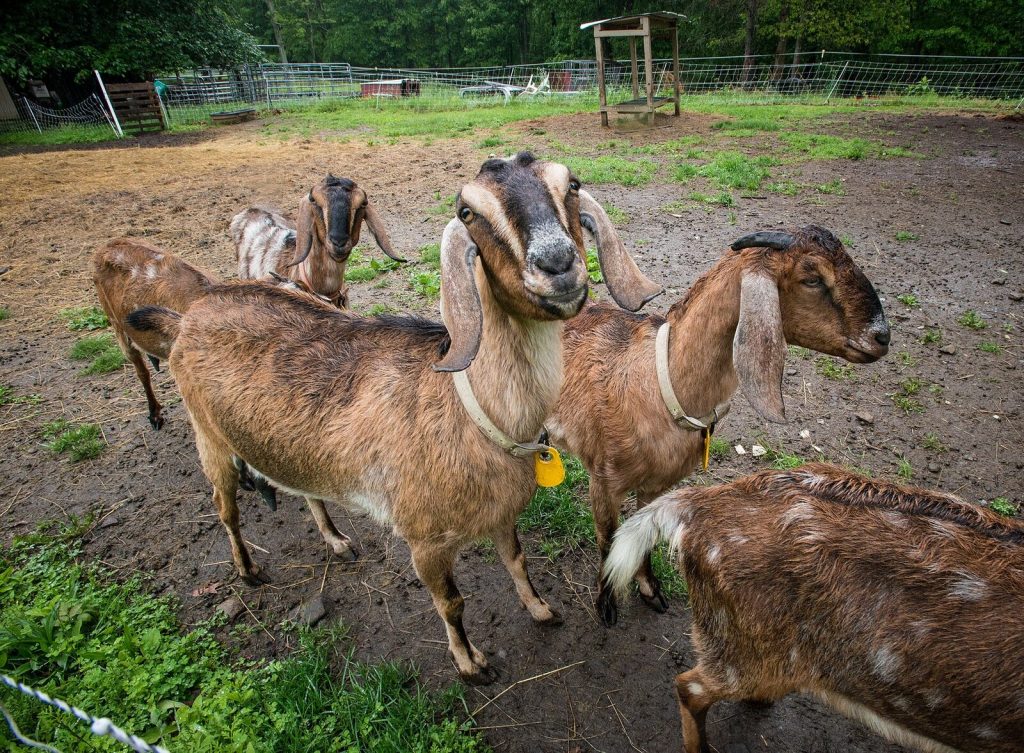
Most Ugandan goats cannot reach their feed requirement, and the reason is a rope. Nine in ten goats in one Ugandan district survey were tethered, and a tethered goat eats only what stands inside the radius of its tether. Goat feeding here is less about choosing a ration than about giving the animal access to the browse it needs, then paying attention at the few points in the year when the requirement jumps.
What a Goat Requires, and Why Browse Answers It in Uganda
Goats are built to convert low quality material into meat and milk. That is the reason smallholders keep them, and it is also why a feeding plan copied from a cattle page misses. A goat is a browser before it is a grazer. It works upward into trees and shrubs rather than downward into grass, and it selects hard, taking leaf and tip and refusing stem.
The nutritional consequence is large. Browse from trees and shrubs carries higher crude protein, lower fibre and better digestibility than the grasses and crop residues sitting under it. Crop residues are the opposite: high in fibre, low in crude protein, and slow to digest. Both are free. Only one of them feeds the animal.
That difference runs the rest of this page. A goat's requirement in Uganda is met mainly by leaves it picks off woody plants, and almost every problem a Ugandan goat keeper has with feeding turns out to be a problem of access to those plants or of the season in which they are available.
Dry Matter Intake for Stall Fed Goats Against Hours of Browsing
Uganda's national animal genetic resources centre states the requirement twice over, in two units, because two different systems are in use.
For a goat that is stall fed, the figure is 3 percent of its live body weight in dry matter per day, and the manual adds that the feeder should be built to imitate browsing behaviour rather than presenting feed at ground level. Indigenous Ugandan goats mature at 20 to 35 kg, so that works out at roughly 0.6 to 1.05 kg of dry matter a day for an adult, which is a derivation from those two figures rather than a published ration. Remember the unit: that is dry matter, so the fresh weight cut and carried is several times higher.
For a goat in extensive rearing, the figure is not a weight at all. It is at least six hours of effective browsing a day. The word doing the work is effective. Six hours standing in a stripped patch is not six hours of browsing.
Wider veterinary reference material puts goat intake across a band of 2 to 4 percent of body weight, with smaller animals at the upper end, and a minimum dietary crude protein near 7 percent of dry matter intake for maintenance alone, rising for growth, pregnancy and milk. Those are useful as a sanity check rather than as a Ugandan recommendation. Cross that line at roughly a fifth crude protein, dry matter basis, and a feedstuff is classed as a protein supplement rather than an energy one. Leaf meal used that way is capped at around 30 percent of the daily ration.
What no source could give was the crude protein of the browse species Ugandan goats actually eat. The Makerere team that catalogued them says plainly that nutrition evaluation of the preferred species has not been done, and recommends it as the next piece of work. That absence is a finding rather than a gap in this article: the requirement is known, and what the local trees supply against it is not yet measured.
What Ugandan Goats Actually Eat, Measured
Rather than assume, a Makerere University team asked 139 goat keepers in 14 villages of Buyende district what their animals fed on, ran focus groups to rank the species, and then walked the ground to see what was still standing. Mean flock size was 13 goats. Almost three quarters of the animals were indigenous, a quarter were crosses with the South African Boer, and 3 percent were exotic.
| Feed resource | Share of farmers using it | What it delivers |
|---|---|---|
| Natural pasture and browse | 70 percent | The whole requirement, if reachable |
| Crop residues | 15 percent | Bulk, high fibre, low protein |
| Food crop by products | 12 percent | Energy, and a toxicity risk |
| Compound feed | 3 percent | Rarely used, rarely pays |
Goats in that district were recorded feeding on 48 plant species across 18 families and 39 genera. The growth habit tells the story: 24 trees and 11 shrubs against only 9 grasses and 4 herbs. The species farmers mentioned most often as browse were Ficus natalensis, Harrisonia abyssinica, Acalypha psilostachya, Artocarpus heterophyllus and Lantana camara, with Panicum maximum and Imperata cylindrica leading the herbaceous list.
Then the awkward part. The ecological survey found 31 of the 35 named browse species on the ground, and the species farmers ranked as most preferred were among the least abundant. The plants carrying the requirement are the ones disappearing, partly because the same trees are cut for firewood, timber, food and craft material. Ficus natalensis is used for firewood and for barkcloth. Mangifera indica is food, firewood and timber. The goat is third in the queue.
Two other measured facts are worth more than any ration table. 58 percent of these farmers did not supplement at all, and 84 percent neither conserved nor treated feed, attributing it to lack of knowledge in 52 percent of cases and lack of money in 37 percent. Of the small group who did supplement, 63 percent sprinkled nothing but common salt on crop peelings. So the realistic question for most Ugandan goat keepers is not which concentrate, it is whether any feed management happens at all.
Why Tethering Stops a Goat Meeting Its Feed Requirement
Tethering was the management practice for 90 percent of goats in the study area, with 9 percent free ranging and 1 percent on cut and carry. More than half the respondents brought the animals into a house at night.
Tethering is not a choice anyone made for nutritional reasons. It exists because land is short, because crops and livestock sit on the same small holding, and because a loose goat in a garden destroys a family's food. The study area averages small scale farmland almost throughout, and most of the original savanna has been replaced by crops. Tethering is the compromise.
The nutritional cost is direct. A goat fastened to one spot for the day can reach only what grows inside the radius of the rope. It does not get to select, which is the very skill that lets a goat thrive on poor land. It cannot walk to the tree it wants. The authors put it plainly: the way goats are tethered limits both the quality and the quantity of what they actually eat, and that lowers productivity.
Two things follow. First, a published intake figure of 3 percent of body weight describes what the animal would eat given access, not what it did eat on a tether, so a ration calculated from it and never fed is worse than no figure at all. Second, the highest return improvement available to a tethered flock is not a bought supplement but moving the animal more often and supplementing with leaf from leguminous trees, which is exactly what the authors recommend on the evidence that tethered animals given tree foliage gained weight faster.
Dry Season Goat Feed Requirements When Only Browse Is Left
The seasonal calendar in Buyende runs against the farmer twice over, and the reason explains most dry season goat losses.
In the wet season there is feed everywhere. Grasses and herbs are up, browse is flushing, and this is precisely when the goat is tied, because the crops are in the ground and vulnerable. Supply is high and access is low.
In the dry season the grasses and herbs dry off. What is left is crop residues, food crop by products, and browse. The goat is now allowed to range freely, because there is nothing in the gardens to damage. Access is high and supply is low.
Then it gets worse. Toward the end of the dry season the peelings run out because the household has eaten through the crop, and the residues are cleared and burnt to prepare gardens for the next rains. At that point the only green material within reach of a goat is the leaf on trees and shrubs. That is the annual bottleneck, and the flock's condition at the end of it sets kidding outcomes for the following year.
Crop Residues and Peelings: The Cheap Goat Feed That Can Kill
Food crop by products were used by 12 percent of farmers, mostly sweet potato, banana and cassava peelings. They look like free feed and they are the part of this subject where a guide can do real damage.
Sweet potato peelings are abundant wherever sweet potato is the staple, which in the study district it is. Farmers there still gave only small quantities, for a specific reason: goats die when they eat a large quantity of peelings and then drink water. The named mechanisms are oxalate and trypsin inhibitors in sweet potato, and cyanogenic glucosides in cassava peel. Cassava peel needs detoxifying before it is used as livestock feed at all.
This page gives no maximum safe quantity, because none could be verified and the cost of a wrong figure is a dead animal. What can be said is the shape of the risk.
Banana peelings, incidentally, were barely used in the study area for the mundane reason that bananas are scarce there. Availability, not nutrition, decides most of what a goat actually gets.
Water and Salt Requirements, and a Government Figure That Cannot Be Right
Water need scales with body weight, with how dry the diet is, and with heat. A goat eating browse takes in some water with the leaf; a goat on straw takes in almost none. Clean water available at all times removes the need to calculate anything, and it is the cheapest input on a goat enterprise.
This article prints no litres figure, and the reason is a plain contradiction in the national manual. It says a goat needs at least 0.2 litres of water per kilogramme of live body weight daily in its nutrition section, and that each goat consumes 0.2 litres per day in its enterprise cost list. For a 30 kg goat those two readings differ by a factor of thirty. One of them is a serious daily requirement and the other would not wet the animal's mouth. Neither is published here, which is the same position the site's goat cost pages took. A local officer sizing a trough for your flock is the authority, and the thirtyfold gap is the reason.
On minerals, the manual's instruction is that goats should have mineral licks available at all times, alongside the carbohydrate, protein, vitamin and trace element requirements it lists. Set that against the measured Ugandan reality, where the few farmers who supplemented at all mostly sprinkled common salt on peelings. Salt is not a mineral lick. It supplies sodium and chloride and nothing else, and a browsing goat on mineral poor soil is short of more than that. Product choice belongs on the mineral supplements page and on the bag label.
Strategic Feeding Windows Where the Goat Feed Requirement Jumps
The most useful part of the national manual's nutrition guidance is not a quantity. It is a calendar. The requirement is not flat, and a smallholder who cannot weigh a ration can still get the timing right, which is where most of the return sits.
| Window | When | Why the requirement rises |
|---|---|---|
| Flushing | From two weeks before mating | Raises ovulation rate |
| After mating | At least two weeks on | Cuts early embryo losses |
| Steaming up | Last six weeks of pregnancy | Foetal growth, colostrum, udder |
| Buck feeding | Eight weeks before mating | Sperm production takes 56 days |
| Creep feeding | Before weaning | Kid growth, relieves the doe |
Two of those have mechanisms worth knowing. The buck's eight weeks is not a round number: spermatogenesis and sperm maturation take more than 56 days, so feed given the week before mating has not reached the sperm being used. And underfeeding during pregnancy does damage that later feeding cannot repair, because the reproductive tract of a female kid and the muscle cells of a male kid are laid down before birth. A doe fed badly while carrying produces kids that will not reach their potential whatever you feed them afterwards.
The manual also notes that farmers synchronise kidding deliberately, and one stated reason is to put the critical periods into the part of the year when balanced feed is abundant and cheap. Timing the breeding to the feed calendar is free, and it is the opposite of buying your way out of a dry season.
Kid Feed Requirements From the Third Week to Weaning
A kid's requirement changes faster than an adult's and the sequence in the national manual is short enough to follow.
The rearing decision comes first: leave the kid with the doe, separate at night and reunite by day, or separate completely and bucket feed. Complete separation suits a commercial dairy goat unit and demands a standard of cleanliness and record keeping that, the manual warns, is often not met, and where it is not met kid mortality and growth both suffer.
From the third week the kid is introduced to good feed and to concentrate, with clean water always in front of it. At about two and a half months its daily milk intake is halved, and it can be weaned two to four weeks after that. Where many does kid together, the risk is that some kids do not get enough milk and go down with low blood sugar, so somebody has to watch that every kid has actually suckled before the does leave for the day and again when they return.
Males are weaned earlier than females, which is a breeding decision rather than a feeding one: bucklings mature early and inbreeding follows if they stay in.
Why Buying Feed for Goats Usually Loses Money
A feed requirements page is expected to end with a purchase. This one does not, and the evidence is the reason.
A controlled pen fattening trial on local African goat weaners compared grazing only against four concentrate diets. The best gross margin per animal came from grazing only, statistically level with the cheapest local protein concentrate, and the worst came from the soya based concentrate diets. Net profit was negative in four of the five treatments, including the grazing control. And the reason is in the growth response: pen feeding added only about 38 grams a day of liveweight gain over grazing.
Put that against a Ugandan pig on commercial feed, which gains about 294 grams a day. A pig converts bought feed into saleable weight roughly eight times faster. This is why the same shilling of concentrate that makes sense in a piggery does not make sense in a goat pen, and it is not a matter of opinion or management skill.
So the honest conclusion is that a goat enterprise's return comes from herd growth and from low cash cost, not from feed conversion. The money goes on giving the animal access to browse, on planting fodder trees so there is browse to access, and on conserving wet season material for the late dry season. Bought concentrate belongs, if anywhere, in the narrow strategic windows above, where a small quantity at the right moment changes a kidding outcome. The goat profit page works the arithmetic through.
Medicated Feed, Deworming and the Withdrawal Point on Goat Meat and Milk
Goats are treated more often than they are fed a formulated ration, and treatments reach the animal through feed and water and by injection. That puts a withdrawal point in the middle of a feeding routine.
Two practical notes that are not doses. Feed changes are made gradually rather than overnight, because a rumen microbial population takes time to shift and a sudden change causes its own problems. And a sick goat that is off its feed is a different situation from a goat eating a poor ration; the first needs a vet, not a better trough.
Where to Get a Goat Feed Requirement Checked Locally
Uganda now regulates animal feeds by statute, and the bag label is a regulated document. It carries the crude protein figure any feeding decision needs, and the batch number you would have to quote if a feed turned out wrong. Selling feed that does not meet established standards is prohibited, and there are feeds inspectors and analysts and a quality control laboratory behind that. Before the Act, the ministry's own written position was that no regulatory mechanism or standard existed and that market feed quality was poor as a result.
For the requirement itself, the people who can answer for your flock are the district veterinary officer and the sub county extension officer. They know which browse species are still standing locally, what the soils are short of, and what quantity of peelings is being fed safely in your area. Prices for feed, licks and stock move by season and district, so current local quotes beat any national figure.
The animal feeds and health hub is the place to start, then follow the trail from there. The goat feeding guide covers the practical routine this page leaves alone, and goat farming in Uganda sets out the enterprise. If the browse supply is your constraint, that is a land and system question rather than a feed purchase, and the cost of starting goat farming treats grazing land as the largest capital item. The economics of feeding are worked through on goat farming profit calculation, and current stock values sit on the goat price page. For the health side, read deworming goats, the livestock vaccination calendar and common goat diseases, and for minerals, mineral supplements for livestock. Conserved feed that spoils is a requirement problem, covered in storing animal feed safely. A goat that stops eating needs a veterinarian rather than a feed change, and if you are feeding for weight to sell, the goat fattening business is the page that costs it.
Goat Feeding Questions Ugandan Keepers Ask
Should I buy goat pellets or dairy meal for my goats? Usually no. In a controlled fattening trial on local goats, grazing only produced the best gross margin and the soya based concentrate diets the worst, and pen feeding added only around 38 grams a day of gain. Concentrate has a place inside the strategic windows, a little for a doe in her last six weeks or a buck two months before mating, and almost no place as a daily habit. Spend the money on planting fodder trees instead, which raises what the animal can eat every day of the year.
How many kilogrammes should I feed a goat per day? This page will not give you one, and the reason is useful. The only published intake basis is 3 percent of live body weight in dry matter, and that describes a stall fed goat. Nine in ten Ugandan goats are tethered, where intake is set by what stands inside the rope. If you genuinely run a stall fed unit, weigh the animal and work from 3 percent of that in dry matter, then remember the fresh weight you carry is several times higher. If you tether, the number to improve is how often you move the animal.
Can I feed sweet potato peels and cassava peels? In small amounts, and not as a bulk feed. Ugandan farmers who have both in quantity still ration them, because goats die after eating a large heap of peelings and then drinking water. Sweet potato peel carries oxalate and trypsin inhibitors, cassava peel carries cyanogenic glucosides, and cassava peel is detoxified before use as livestock feed. Ask your extension officer what quantity is being fed safely on local diets.
How much does it cost to feed a goat for a year in Uganda? On a browsing or tethered flock it is close to nothing in cash, and that is the enterprise's main advantage. The cash lines are salt and minerals, health treatments, and labour, which on a tethered flock is usually unpaid family time and is the real cost. Bought concentrate is the line that destroys the margin, which the profit calculation page works through. Land is the large capital item rather than feed.
What is the best fodder to plant for goats? The evidence here is thinner than you would expect and this article will not rank species, because the crude protein and digestibility of the browse Ugandan goats prefer has not been measured. What is established is that leguminous trees and shrubs are the class that works, that tethered animals supplemented with tree foliage gained weight faster, and that several of the species Ugandan farmers rank highest are now scarce on the ground, which makes propagating them worthwhile. The fodder pages and your extension officer can match a species to your rainfall and soil.
Why are my goats thin at the end of the dry season? Because supply and access are out of phase. In the wet season there is feed and the goat is tied off it. In the dry season the goat is loose and the grass is gone, and by the late dry season the peelings are finished and the crop residues have been burnt for garden preparation. Browse is all that is left. Conserving material cut in the wet season is the fix, and 84 percent of Ugandan goat keepers in one survey did not conserve anything.
Do goats need water if they are eating green browse? Yes. Green leaf supplies some water and nowhere near all of it, and a lactating doe needs far more than a dry one. This page gives no litres figure because the national manual contradicts itself on that number by a factor of thirty. Clean water in front of the flock all day settles the question without arithmetic.
Feed and veterinary supply, and the price of everything in it, varies sharply between districts, so the useful next step is local: ask your district veterinary or extension officer which fodder species establish well in your area and who is supplying good quality licks and feed nearby, then compare labels rather than sacks.