
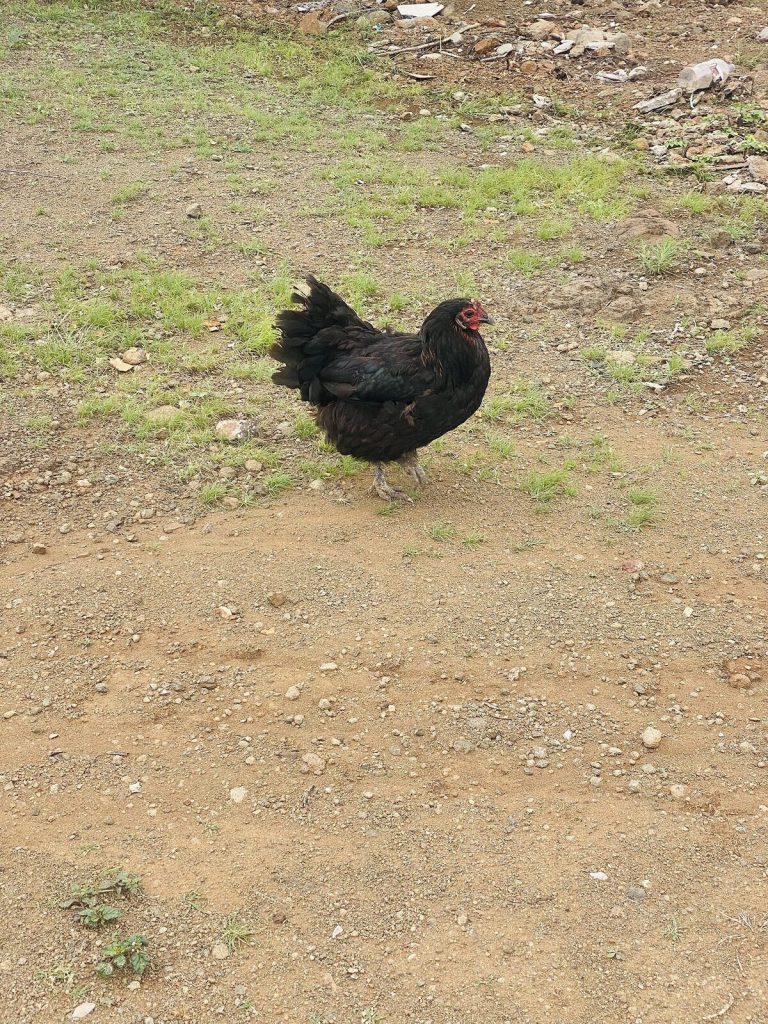
There is no published Kuroiler feed requirement. Uganda's compulsory poultry feed specification has no category for a dual purpose bird, and the ministry's feeding tables for improved breeds borrow their nutrient figures from broiler and layer rations. So the practical question is not what a Kuroiler needs but which existing ration you choose to feed it, because that choice sets both the specification and the total.
Why No Kuroiler Feed Specification Exists in Uganda
Start with the document that decides what a miller may put on a bag. US EAS 90:2019, Compounded poultry feeds, amended in 2021, is compulsory in Uganda and superseded the older US 806:2009. What matters for this breed is its list of categories, because a Kuroiler is not on it.
The ministry's poultry training manual covers improved dual purpose birds in its own section and names Kuroiler, Rainbow Rooster, Sasso and local crosses as the four kept in Uganda. It gives that group feeding instructions by pointing at existing rations rather than by specifying a new one, and that is the honest state of the evidence rather than a gap in the manual.
The Two Ration Routes a Kuroiler Can Be Fed On
The manual describes two routes and says openly that they produce different birds for different markets. This is the single most useful thing published about feeding this breed in Uganda, and it is almost never mentioned in the material promoting the bird.
| Route | Ration | Crude protein | What it produces |
|---|---|---|---|
| Meat, fast | Broiler starter then finisher | 20 to 23 pc, then 18 to 21 | Softer meat, low fat, earlier sale |
| Meat, local type | Layer chick diet then layer grower | About 19 pc at the chick stage | Firmer meat, longer to weight |
| Cheapest per kilogramme | Grower concentrate extended with maize, broken rice or bran | Not specified | Slowest growth, lowest feed bill |
The starter allowance is the one quantity the manual gives twice and consistently: about 1 kg per bird across the first four weeks on either route, whether the bird is on broiler starter to day 25 or 28 or on a layer chick diet to day 28 or 30. That figure also matches the cumulative total worked out of the manual's own daily intake table for improved breeds, which is the kind of internal agreement worth trusting in a document that elsewhere does not reconcile.
Protein figures on the broiler route are stated inconsistently in the manual: one passage gives starter at 20 percent with 2,800 kcal per kilogramme and finisher at 18 percent with 2,900, another gives 23 percent and 3,100 for starter and 20 percent and 3,100 for finisher, and its dietary requirement table gives 23 percent with 3,050 for starter and 21 percent with 3,150 for finisher. The span is published here rather than one of the three, and the declaration on the bag is the figure you feed to, with a veterinary officer to consult if the flock underperforms against it.
The route decision is commercial and not nutritional. A Kuroiler on a broiler ration grows faster and produces meat closer to a broiler in texture. A Kuroiler on layer feed takes longer and produces meat closer to a local bird, which in most Ugandan markets is the meat that fetches the premium. Feeding an expensive ration to get a cheap product is the trap in the middle.
Total Purchased Feed Per Kuroiler, by Route
No single kilogramme figure describes this bird, because a Kuroiler can be sold anywhere between week ten and week twenty five and can be fed anywhere between full confinement and mostly scavenging. Those two decisions move the total by a factor of about three.
| How the bird is fed | Weeks to sale | Purchased feed per bird |
|---|---|---|
| Full commercial feed, confined | 16 to 18 | 7 to 9 kg |
| Brooded then run, fed morning and evening | 18 to 22 or more | 3 to 4.5 kg |
| Broiler ration, ministry intake table | 10 | About 7 kg |
That third row is the one to sit with. The ministry's daily intake table for improved breeds on a broiler ration climbs to about 178 grammes a day by week ten, and adding the weeks up gives roughly 7 kg of feed consumed by that point. In other words, feeding a Kuroiler like a broiler spends the entire commercial feed budget in the first ten weeks, on a bird that most keepers will not sell for another six to twelve.
The manual's own weight column says such a bird should average 2.5 kg at week ten, which would make that 7 kg defensible. Ugandan on farm measurement does not support it. Trials on farms in Gulu and Kiryandongo recorded confined Kuroilers at about 941 grammes at week ten and about 2.4 kg only by week twenty. A bird that has eaten 7 kg of purchased feed and weighs under a kilogramme is the arithmetic that sinks a Kuroiler batch, and it is why the feed requirement for this breed has to be planned against a measured weight rather than against a table.
Daily Feed Requirements and the Weight Column to Distrust
The daily intake series for improved breeds on a broiler ration is tabulated week by week in the ministry's manual and reproduced with its full working on the Kuroiler feeding guide. Read in outline it runs from around 15 grammes a day in the first week to around 178 by week ten, which is the appetite curve of a broiler rather than of a village bird. The column is monotonic, its cumulative total agrees with the manual's separate 1 kg starter allowance, and it is safe to plan a feed order from.
What Scavenging Changes About the Feed Requirement
The claim that sells this bird is that it grows well without commercial feeding. The nutrient requirement of a Kuroiler does not fall when you open the door. What changes is where the nutrients come from, and how reliably.
Water, Grit and Minerals in a Kuroiler Flock
The ministry publishes daily water tables for broilers and for pullets and layers, and none for improved dual purpose birds. Rather than invent one, treat those two as brackets: a broiler is drinking in the low hundreds of millilitres a day by the end of its cycle and a hen in lay is in the same region, so a Kuroiler somewhere between the two is not going to be far from it. The manual's general rule is that water intake runs about 1.6 to 1.8 times feed intake at temperatures up to 25 degrees Celsius, and that water must always be available above 30 degrees.
None of that is a ration. Water goes in clean and without restriction, drinkers get cleaned daily, and the height is set at the level of the bird's tail so the litter stays dry. A flock short of water eats less and grows less, which shows up in your feed records as a bird that is suddenly cheap to keep.
Grit matters more for a scavenging flock than a confined one, because a bird eating coarse material needs something in its gizzard to grind it. No Kuroiler grit quantity is published anywhere. The only figures the ministry gives belong to a layer breeder feeding programme, which is a different class of bird, so treat them as an order of magnitude and nothing more. Mineral sources and their calcium contents are covered under mineral supplements for livestock, and a Kuroiler hen in lay needs the calcium of a layer ration whatever she was reared on.
Feed Quality and the Mould Risk Over a Long Cycle
Run the arithmetic on exposure before anything else. A Kuroiler kept to week eighteen has eaten from your feed store three times as long as a broiler batch, usually from more suppliers and across a change of season. Bran is a milling by product that often reaches the farm already damp, and damp is the condition moulds want.
Mukene deserves its own warning here, because it is the protein most Ugandan Kuroiler keepers reach for and it is widely treated as the safe ingredient. Ugandan work on silver cyprinid held at landing sites and in markets has found microbial and toxin problems in the fish itself, before it ever reaches a feed mixer. Being local and cheap is not the same as being clean.
Not one toxin figure is printed on this page, and that is a decision rather than an omission. The Ugandan sources disagree with themselves, giving one level in prose and others in their own tables. Where a number like that is uncertain, stating it does more harm than leaving it out, because a reader treats it as a line they are safely under. Setting the level is work for the national standards bureau through the compulsory feed specification, and establishing whether a batch exceeds it needs a laboratory.
Your hands and your nose do most of the useful checking, and they cost nothing. Open the sack rather than paying for it closed. Push an arm into the middle, where warmth means something is fermenting. Squeeze a handful: feed that holds its shape has taken up moisture. Sour or musty is a reason to walk away, and so is anything moving. On the storage side, keep the level low and the turnover fast, since farm mixed feed is good for only about a fortnight, and never press sacks tight against each other or against a wall. The ministry's bottle test settles the maize going into a home mix before it becomes feed at all: shake a handful of grain with half a handful of table salt in a dry bottle and watch whether salt clings to the glass.
Medicated Feed, Withdrawal and a Dual Purpose Bird
A dual purpose bird carries the residue problem from both ends, and that is not a theoretical point. The Ugandan survey of 374 commercial poultry farms that measured adherence to withdrawal periods put dual purpose farms worst of every farm type, at 45 percent non adherence, ahead of layer farms at 29 percent and broiler farms at 26 percent. Seven days or longer was the waiting time carried by the majority of products those farms were using.
The mechanism behind that number is worth naming. A dual purpose flock is often producing eggs and meat at the same time, in a household setting, without a clear batch start or end. There is no obvious point at which a treated bird is taken out of the food chain, because eggs are collected daily and birds are sold or eaten as cash is needed. That makes the withdrawal question harder on a Kuroiler flock than on either a broiler batch or a commercial layer house.
No withdrawal period, dose, in feed inclusion rate or interval appears anywhere on this page. A plain compounded ration carries none. A medicated one does, and the waiting time belongs to the medicine rather than to the bird: read it off that product's own packaging and have a vet confirm what it means for a flock you are taking both eggs and meat from. Where a bag is silent on whether it contains a coccidiostat or anything else medicated, treat the silence as a question for whoever compounded it and settle it before the feed goes in the feeder.
Questions Ugandan Kuroiler Farmers Ask About Feed Requirements
Do Kuroilers really need less feed than broilers? Per bird over a whole cycle, no. A Kuroiler on full commercial feed eats more in total than a broiler does, because it is on feed for two to three times as long. What it can do is take a larger share of its intake from scavenging, which cuts the purchased kilogrammes rather than the requirement.
Which feed should I actually buy for a Kuroiler chick? Either a chick or duck mash under the compulsory specification, or a broiler starter, depending on which route you are taking. Ask which category the bag is compounded to and check the declared protein against the spans above. About a kilogramme per bird covers the first four weeks on either route.
How much does it cost to feed 500 Kuroilers? Multiply the purchased kilogrammes for your chosen route by the current bag price, and do it twice, once at the price today and once assuming maize has risen. On full commercial feed a 500 bird batch has come out losing money against Ugandan selling prices, which is worked through on the cost of raising 500 Kuroilers. Current prices sit on the poultry feed price page.
Can I mix my own Kuroiler ration from maize bran and mukene? Only with a formula from a qualified nutritionist and a laboratory check on the mix. Both of those ingredients have inclusion ceilings and quality problems of their own, and a ration guessed by eye puts a whole flock on a deficient diet for four months. The method is on the poultry feed formulation guide.
When should I stop buying feed and sell? When the weekly weight gain stops justifying the weekly feed. Weigh a sample of the flock every week, and once the gain flattens the feed is no longer buying anything you can sell. That point arrives earlier on a scavenging route and later on a confined one.
Is a Kuroiler kept for eggs fed differently? Yes. She needs the calcium of a layer ration once she is laying, and she needs not to be overfed beforehand, because unrestricted feeding on a rich ration lays down fat and can stop pullets laying altogether. The layer feed requirements page covers the laying specification.
Finding Kuroiler Feed and Veterinary Advice
Since no bag in Uganda is compounded for this bird, the useful conversation with a supplier is about categories rather than breeds. Ask which category of the compulsory compounded poultry feed specification the feed is made to, ask for the declared protein and energy, and ask whether anything medicated is in it. Compare more than one seller, because the feed market is unevenly regulated in practice and a low price usually means a low protein.
For a withdrawal period, a sick flock or a bird that is not growing against its own bag declaration, a district veterinary officer or a qualified private veterinarian is the person who settles it. The animal feeds and health guides hold the neighbouring topics, the Kuroiler feeding guide covers the management side of feeding the same bird, maize bran in animal feeding deals with the ingredient most Ugandan rations lean on, safe feed storage covers the mould risk over a long cycle, and the poultry feed calculator lets you run your own bird numbers. Chick suppliers are listed on the where to buy Kuroiler chicks page and feed on the where to buy poultry feed page.