
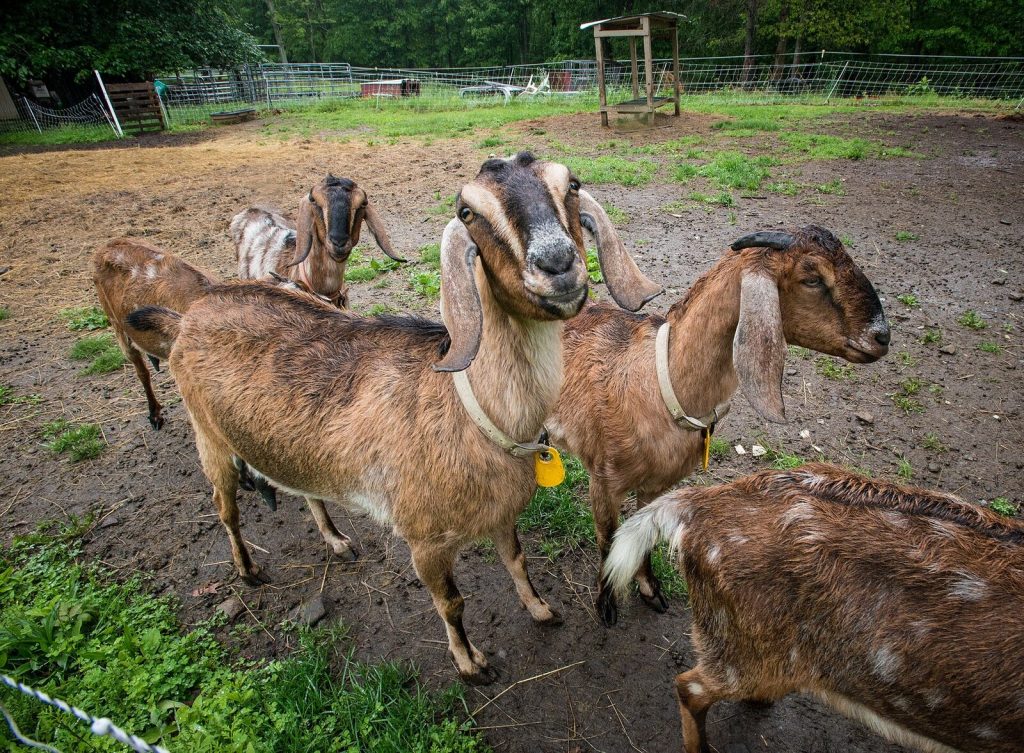
A goat fattening business buys young or thin goats, puts weight and condition on them, and sells them on, which means the animal is both the largest cost and the product. Stock comes from the same open markets the finished goat goes back to, so the margin is a price gap rather than a weight gain. Uganda has about 17.4 million goats and a trade that moves roughly a fifth of them a year.
That framing matters because it changes what a fattening plan has to get right. A breeding herd earns from kids a doe produces on browse the farm already carries, and its hard problem is the wait. Fattening has no wait worth speaking of and no kids at all. Its hard problem is that the purchase price is set in the same market that later sets the sale price, by traders who see the same animals you do.
What Goat Fattening Means on a Ugandan Farm
Fattening is a finishing enterprise. You buy an animal somebody else bred, hold it for a period, and sell it heavier or in better condition than you bought it. Nothing about it requires land for a breeding flock, a buck, or the eighteen to twenty two month wait to a first kidding that dominates a goat farming startup budget. That is the appeal, and it is real: money in and out inside one season rather than across two years.
What it swaps in is turnover risk. Every cycle you buy at a price you did not set, from a market you visit repeatedly, and you carry the animal through the period when it can die, fail to gain, or fall sick and become unsellable. A breeding herd's asset base grows quietly even in a bad year. A fattening pen either clears its purchase price or it does not.
Most Ugandan goats are still kept the traditional way, with tethering at 60 percent of flocks, communal grazing at 19 percent, zero grazing at 14 percent and fenced systems at 7 percent. Fattening sits awkwardly across that. You need enough control to feed and inspect an animal daily, and enough grazing or cut forage to avoid buying the feed that destroys the margin. Which side you land on is the first decision on this page.
Why the Buying Price Decides a Goat Fattening Profit
Here is the arithmetic nobody publishes. A Makerere study of smallholder livestock keepers in two Ugandan districts recorded goat sale prices by age category, and in normal periods a sub adult male fetched roughly 71 to 80 percent of what an adult male fetched in the same district. Turn that round. The entire gross margin available to a farmer who buys a sub adult and sells him as an adult is that remaining 20 to 29 percent, before feed, before health costs, before labour, before transport, and before a single animal dies.
Adult females priced slightly above adult males in both districts, which tells you something about who is buying: breeding demand competes with meat demand for the same animal. Kids priced well below both, and in one of the two districts a kid fetched under half what an adult did. The wider the age gap you buy across, the wider the spread, and the longer you hold the animal and the more can go wrong.
None of those routes is wrong. What is wrong is not knowing which one you are on, because each has a different failure mode and a different cost stack. The goat farming profit calculation page works the breeding side in doe years and never in price per kilogramme; a fattening plan runs the other way and lives entirely on the per animal spread.
Choosing Goats to Fatten: Age, Sex and Breed
Breed does measurably change what an animal weighs, and Uganda has the evidence in house. A station trial run by NARO's Kachwekano institute with Makerere University took twelve male goats of each of the three indigenous Ugandan breeds, sourced from smallholders in Arua, Mubende and Kabale at about seven months old, and held them indoors under the same feeding for twelve weeks. Mubende finished heaviest and dressed out heaviest. Small East African finished lightest on both counts.
| Indigenous breed | Live weight, kg | Carcass weight, kg |
|---|---|---|
| Mubende | 18.6 | 7.7 |
| Kigezi | 14.6 | 5.8 |
| Small East African | 11.2 | 4.4 |
All three differences were statistically reliable. Work the two columns against each other and the dressing percentage comes out at 39 to 41 percent, which sits at and just below the floor of the 40.7 to 45.1 percent band measured for local African goats. That is what you would expect of animals finishing a parasite challenge, and it is a useful reminder that a live goat is not much more than a third to two fifths of itself as meat.
Mubende also held its blood values best under challenge and lost the least weight. Read that as a purchase preference rather than a rule: the authors themselves say twelve animals a breed limits what can be concluded and ask for a longer study on more individuals. Uganda's national animal genetic resources centre breeds pure Black Mubende, pure Mubende spotted, the Kigezi goat and the Kasolwe brown alongside pure South African Boer, and distributes Boer crosses at 50 and 75 percent, so improved genetics do reach farmers. Whether they pay you back is a different question, handled further down and on the best goat breeds page. Boer goat farming covers the pure exotic route.
Castrates and entire males both fatten. Entire males are easier to resell into breeding demand and harder to keep in a group. Females bought for fattening compete with breeders for the same animal, which is why adult female prices sat above adult male prices in both districts studied, and it is usually the reason a female is the wrong animal to fatten.
Weighing Goats Before You Buy and Before You Sell at Market
If you buy by eye and sell by eye, the weight you added is invisible to the transaction and you are trading on the other party's judgement twice. Very few Ugandan smallholders own a scale, which is a practical problem rather than a moral one, and there is a measured way round it.
An ILRI dataset of 1,346 goats and 767 sheep drawn from Uganda, Kenya and Ethiopia establishes that heart girth alone predicts bodyweight. Heart girth is the circumference of the chest taken immediately behind the front legs, and a tape or a length of string against a marked stick measures it. The accuracy is the part to take seriously: about 12 to 14 percent error across the whole girth range for indigenous animals, and about 9 percent for indigenous crossed with exotic stock. The researchers propose printing the conversion directly onto weigh tapes, which is the form a farmer can actually use.
Feeding Fattening Goats Without Destroying the Margin
The instinct is to buy feed, because feeding is what fattening means. Measured against goats, that instinct loses money more often than it makes it. A controlled pen fattening trial on local African goat weaners compared grazing only against four concentrate diets and put the best gross margin per animal on grazing alone, statistically level with the cheapest local protein concentrate, and the worst on the soya based diets. Of the five treatments only one returned a positive net profit, the cheapest local concentrate, and the grazing control lost money along with the rest. Pen feeding raised daily gain by only about 38 grams a day over grazing.
Thirty eight grams a day is not nothing. Over ninety days it is about three and a half kilogrammes, which against a 20 to 29 percent price gap is worth having. It is also small enough that the feed bill eats it easily, and that is the trap. For comparison, a Ugandan pig on commercial feed gains around 294 grams a day, which is why pig fattening is a feed business and goat fattening is not.
So the feeding brief on a fattening pen is narrow: get the animal as much grazing or cut forage as it can handle, use bought supplement only at the point where it visibly changes the animal, and keep the supplement bill inside the price gap you already know you have. Crop residues and agro industrial by products are the affordable route regional programmes push for exactly this reason. What a goat actually needs, what Ugandan goats measurably eat, and which cheap by products are dangerous in quantity are all handled on goat feed requirements, and the practical cutting and feeding routine on the goat feeding guide. This page states no ration, because the honest answer is that most fattening rations sold to Ugandan goat keepers cost more than the gain is worth.
Worms Turn a Fattening Pen Into a Weight Loss Pen on Full Feed
This is the finding that should reorder a fattening plan. In that Ugandan station trial the goats were housed indoors, fed banana peels and napier grass to appetite with lablab and calliandra forage on top, given mineral blocks and free choice water, and kept clean. Then each animal received a measured dose of 18,000 Haemonchus contortus larvae. Over the following twelve weeks daily weight gain was negative in all three breeds: Mubende lost about 7 grams a day, Small East African about 16, Kigezi about 30.
Unlimited good feed did not hold the line. The pen lost weight. Put that beside the 38 grams a day that pen feeding adds over grazing and the arithmetic is blunt: a worm burden does not reduce the benefit of fattening, it cancels it and then keeps going. Every shilling of supplement you buy for an untreated goat is feeding the parasite's host, not building your margin.
Haemonchus contortus is the worm that matters here, and it is a blood feeder, so the signs are anaemia and loss of condition rather than the diarrhoea people watch for. Bought in animals arrive with whatever burden their previous home gave them, which is why the treatment decision belongs at the gate rather than at the end of the cycle. What to do about it is not a number this page can give you, because Ugandan field work has found that the products commonly used no longer reliably work, and it varies by district. Deworming goats carries that evidence district by district. The programme itself is a job for a veterinary officer, and when to call a veterinarian covers where that line sits.
Buying In Is the Disease Risk: Market Goats and Quarantine
A fattening business repeats, every cycle, the act that Ugandan field research keeps identifying as the way disease moves. Of 63 sheep and goat farms and clusters surveyed in Sembabule and Nakapiripirit, 73 percent bought stock from the open market and 73.8 percent did not separate newly introduced animals. Fewer than a fifth had any isolation facility at all. In the same survey, 87.3 percent had lost a sheep or goat in the preceding year.
Among the buying farms, 47.8 percent carried at least one animal with pox antibodies against 23.5 percent of farms that did not buy. Be careful with that pair: the study did not find the difference statistically reliable, at p equal to 0.094, and the introduction route it did find reliable was receiving animals as gifts from friends and relatives. So market purchase is a documented direction rather than a proven risk factor, while animal movement in general is proven. For a fattening enterprise the distinction is academic, because buying in is animal movement.
The mechanism is worse than a single exposure. In Karenga district in Karamoja, every one of 50 interviewed keepers said an animal taken to market and not sold was simply returned to the flock, with no quarantine. The unsold goat spends the day among other people's animals and then comes home. Sheep and goat pox spreads by direct contact, nasal secretions, saliva, dried scabs, shared equipment and transport vehicles, so a market day and a lorry are both part of the route.
How long to hold a new animal apart is a question for your district veterinary office, not for a web page. What the diseases look like is covered on common goat diseases, and the whole gate to gate routine on the farm biosecurity guide.
Timing the Sale: Season, Drought and Goat Market Prices
Ugandan goat prices move, and they move in a direction that surprises people. In the Lake Mburo study both districts saw goat prices roughly double during drought periods. Goat mortality went the other way: in one district the crude death rate fell from 21.4 percent in normal periods to 11.3 percent under drought, a fall the study reports as statistically reliable, and it attributes the resilience to Acacia hokii browse holding up when pasture had gone. Cattle in the same districts suffered badly. Goats browse. That is the whole mechanism.
Now the part a fattening business has to understand. In one of the two districts, the drought that doubled prices also compressed the age premium to almost nothing: a sub adult male fetched about 99 percent of an adult male's price. Scarcity was paying for a goat, any goat, rather than for the weight somebody had put on it. Your gross margin, which is that age gap, vanished at exactly the moment headline prices looked best. In the other district the gap held and widened in absolute terms.
Two lessons fall out. A rising market is not automatically a good market for a finisher, because what you need is the spread and not the level. And the spread has to be checked locally, in your own market, because two districts in one study disagreed about it. The goat price page is where to track the level; the gap between age classes is something you can only learn by standing in the market and asking about both.
Turnover across the country is brisk. FAO's figures put roughly 3.26 million Ugandan goats slaughtered a year against a national herd of about 17.4 million, which is close to a fifth. Treat that as a scale indicator rather than a measurement: Uganda's goat population figures are official returns, but every one of its goat meat, carcass weight and slaughter numbers in that series is flagged as estimated or imputed rather than reported, in every year checked.
How Long to Keep Fattening Goats on Feed
Every competing page gives a number of days. None of them can, and the Ugandan trial evidence explains why. An animal carrying a worm burden loses weight on unlimited feed, so ninety days of that is ninety days of paying to get smaller. An animal that is healthy, well grazed and gaining will keep gaining until it approaches the frame its breed and age allow, and an indigenous Ugandan goat's frame is modest: mature weights of 20 to 35 kg, with the station trial finishing three breeds between 11 and 19 kg at around ten months.
So the useful question is not how many days but whether this animal, this week, is heavier than last week. That is a measurement, and it is the reason the girth section sits earlier on this page than the feeding section. A goat that has not gained across two or three consecutive measurements on adequate feed is either sick or finished, and in both cases holding it longer costs money.
There is one other stopping rule. Condition sells. A sick or scabby animal in Karamoja fetched 56 to 62 percent less than a healthy one, and animals showing pox or ruminant plague signs often could not be sold at all. An animal that is going backwards is losing you value faster than the feed bill suggests, because it is also losing its price class.
Farm Records That Tell You Whether Fattening Paid
A fattening enterprise is unusually easy to measure, because each animal is a closed transaction. Four entries per goat settle it: what it cost, its girth on arrival, its girth at sale, and what it sold for. Add the date on both ends and you have days on feed. That is enough to answer the only question the enterprise asks, which is whether the spread covered what you spent closing it.
Keep it per animal rather than per batch. A batch average hides the one goat that died and the two that never gained, and those are the animals that decide whether the cycle worked. Ugandan small ruminant records are scarce enough that researchers working in the cattle corridor have had to rely on questionnaires because farm records were not there to read. A simple sheet puts you ahead of that, and the livestock record keeping template is a starting point.
Records also tell you whether improved genetics repay their premium, which is the question a Boer cross raises. Ugandan work on community based breeding is blunt about the demand side, and it is the buyer who settles this rather than the animal: the informal markets smallholders sell into do not pay for improved genetics. A premium paid at purchase is not a premium recovered at sale unless your particular buyers are unusual, and the only place that shows up is your own sale ledger. Where to buy Boer goats covers sourcing, and the goat farming overview sets the wider picture.
Where Goat Fattening Claims Fall Apart in Uganda
Promotional material about fattening goats in this region carries a recurring figure, traceable to breeders who sell the stock they describe: that a pure Savanna goat reaches market at five months with at least 45 kg of liveweight or at least 35 kg of carcass. It does not survive checking, and there are now three independent reasons why.
The pattern is worth carrying beyond goats. Where a performance figure comes from the party selling the animal, check whether the numbers in the claim are consistent with each other before you check them against anything else. Two of the three failures above are internal to the claim itself.
Frequently Asked Questions
What do goats cost to buy and sell in Uganda? Two Ugandan studies give farm level bands, and both are dated and district specific rather than national. In Karenga district in Karamoja, 50 keepers put a healthy animal under six months old at 20,000 to 45,000 UGX and a healthy adult at 80,000 to 130,000, with a visibly sick adult at 35,000 to 50,000. In Kiruhura and Isingiro, normal period prices ran about 65,000 to 66,000 for sub adults and 82,500 to 86,250 for adults in one district, and 45,000 to 50,000 for sub adults and 70,000 to 80,000 for adults in the other. Under drought both districts roughly doubled. Prices depend on age, sex, condition, how far the buyer has come and whether the household needs cash that week, so treat every figure here as a shape to test rather than a price to plan on, and check the goat price page for current levels.
Is goat fattening profitable in Uganda? It can be, and the sourced evidence says it is tighter than promotional material suggests. The gross margin available is the age to age price gap, which measured about a fifth to a quarter of the adult price in normal periods. Out of that gap has to come feed, health, labour, transport and mortality. The controlled trial evidence is that bought concentrate rarely earns its cost on goats and that grazing produced the best gross margin, so the pens that work are the ones that keep cash costs very low. Where the enterprise fails it is almost always one of three things: paying too much for the animal, feeding a ration worth more than the gain, or carrying an untreated worm burden that makes the gain negative.
How many goats should I start with? As many as you can inspect daily and separate on arrival, which for most households is a small number. Scale does not fix a bad spread. If the gap between your buying and selling price does not cover your costs on one goat, twenty goats multiply the loss rather than dilute it, because the cost and the revenue both scale with animals and none of it is fixed.
Which goats fatten best in Uganda? On the only Ugandan station comparison available, Mubende goats finished heaviest, dressed out heaviest and lost the least weight under parasite challenge, ahead of Kigezi and then Small East African. That trial used twelve animals a breed and its authors ask for a bigger study, so read it as a purchase preference rather than a ruling. Boer crosses at 50 and 75 percent are distributed by Uganda's national genetics agency and do grow larger, but informal markets undervalue improved genetics, so the premium you pay is not automatically one you recover.
Do I need to deworm goats I buy for fattening? The evidence says an untreated worm burden can make a fattening pen lose weight even on unlimited feed, so the burden has to be dealt with. What it should not be is a product picked off a shelf, because Ugandan field testing has found commonly used dewormers failing on a large share of farms and the pattern differs by district. A veterinary officer or para veterinarian sets the product and the programme for where you farm. This page gives no dose, no product and no interval, and deworming goats explains why.
How long should a fattening cycle run? Long enough that the animal has stopped gaining, and no longer. Measure heart girth on arrival and every two or three weeks after. A goat that has not gained across consecutive measurements on adequate feed is sick or finished, and both mean sell. Indigenous Ugandan goats mature at 20 to 35 kg, so there is a ceiling and it arrives sooner than people expect.
Can I fatten goats without any grazing land? You can house and hand feed them, and 14 percent of Ugandan goat flocks are kept that way. It moves the whole feed bill into cash, which is the line the trial evidence says destroys goat margins. Zero grazing makes more sense where you grow your own forage or have reliable free residues, and it needs the intake and safety detail on goat feed requirements, because some of the cheapest by products kill goats in quantity.
Should I fatten goats or keep a breeding herd? They solve different problems. A breeding herd is cheap to enter, slow to pay and grows an asset; the arithmetic is on goat farming profit calculation. Fattening turns cash over quickly and owns none of the animals for long. Many Ugandan households end up doing both, selling male kids from the herd and buying in when a market gap opens. If you want the same enterprise logic for another species, pig fattening is genuinely a feed business, which is the opposite case.
Before you buy a single goat to fatten, spend a market day doing nothing but asking prices for kids, sub adults and adults of both sexes, and write them down. That gap is your business. Current levels for live goats and for the inputs a fattening pen needs are worth checking against local suppliers and traders each season, because both move with rainfall and with demand, and a spread that worked last year may not be there now.