
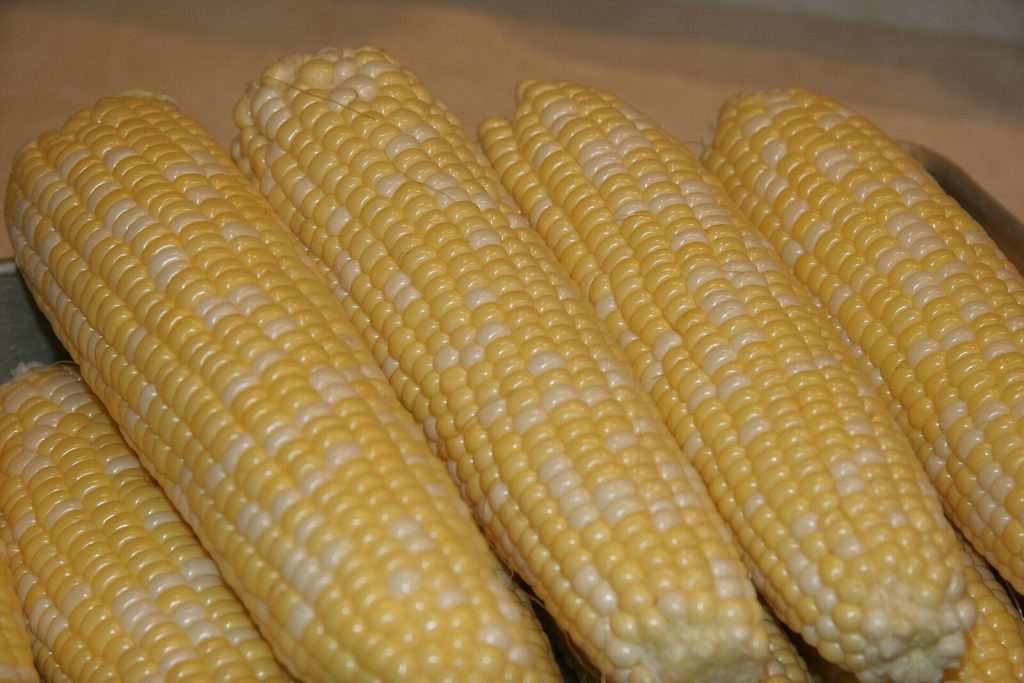
The best maize seeds in Uganda are whichever certified variety matches your altitude, your season length and whether you can afford fresh seed every planting. MAAIF's variety list is built around NARO's Longe hybrids, the UH series and a handful of open pollinated varieties like Longe 5 that growers save and replant. Picking the variety is half the job; checking the packet is the other half.
Maize Seed in Uganda: Open Pollinated Varieties or Hybrids
Uganda has two categories of maize seed, and the difference between them is money rather than agronomy. MAAIF splits them into open pollinated varieties and hybrids. The split decides one thing above all others: whether next season starts with another trip to the stockist.
Maize is where this question bites hardest of any crop in Uganda, and the arithmetic explains why. Maize sells by the kilogram at staple prices, so the revenue from an acre is modest, while the seed for that acre is bought by the bag. Ten kilograms per acre of hybrid seed against a staple price for the grain makes seed a heavy line on a thin margin. Now add the part that makes maize different from a vegetable: the harvest and the seed are the same substance. A farmer standing over a heap of shelled hybrid maize in December is looking at something that appears to be seed, costs nothing and is already in the store. The temptation is built into the crop.
Which is why the recycling rule matters more than any yield figure on this page. MAAIF's extension manual states it directly: seed from an improved open pollinated variety can be saved and replanted for two years with no loss of yield, so long as the selection is done properly. Selection is not a matter of scooping from the heap. Before harvest you walk the field and mark the plants worth keeping, with sticks or ribbon, choosing plants with big healthy grain and no sign of disease or pest damage on stem, leaf or cob. Those plants come off the field separately, dry separately and go into store separately from the eating maize, and the store gets checked often for pests. Skip the selection and you are simply planting average grain, which is how a saveable variety still drifts downward over a few seasons.
Hybrids will not do this at all. Under good management a hybrid gives more than an open pollinated variety, and MAAIF is equally plain that recycled hybrid seed loses yield potential. The reason is genetic rather than agricultural: the uniformity you paid for in an F1 is a single generation event, and grain saved from it breaks apart into a mixture in the next crop. What makes this expensive in maize is that the failure is invisible at planting. The saved grain germinates, the field comes up green, and the shortfall only appears at cob formation, by which time the season's fertilizer, weeding and labour are already spent on a crop that cannot pay them back. The saving of one bag of seed is charged against a whole acre of inputs.
So the honest question is not which variety is strongest. It is whether your cash flow can carry a seed purchase at the opening of every season. If it can, hybrids pay and Longe 10H or a UH hybrid is the conversation. If it cannot, an open pollinated variety you can legitimately hold for two cycles beats a hybrid you can afford once and then recycle, because the recycled hybrid is the worst of the three outcomes. That reasoning generalises to other crops on our page comparing what you gain and lose with hybrid against saved seed.
Longe 5 and the Open Pollinated Maize Seed You Can Replant
Four open pollinated maize varieties carry most of the saved seed traffic in Uganda, and each one trades yield for something else.
Longe 5 is the one most farmers name. MAAIF lists it as a quality protein maize open pollinated variety reaching maturity in about 115 days at 1,000 to 1,600 metres, yielding around 6 tonnes per hectare, resistant to maize streak virus and gray leaf spot, drought tolerant, with high protein content. It is also susceptible to northern leaf blight, which is stated on MAAIF's own list and is the single most useful thing to know about it. If northern leaf blight is your recurring problem, Longe 5 is the wrong variety no matter how cheap the seed is.
Longe 1 matures in about 115 days for a similar 6 tonnes per hectare, resists maize streak virus and tolerates drought. Longe 4 is the early one, 100 to 105 days, yielding 4 to 6 tonnes per hectare, drought tolerant, and it is the variety to reach for when the season is short rather than when the target is a big harvest. Longe 5D appears on NARO's own licensee list as a NARO variety, though the performance figures circulating for it online trace back to social media posts rather than to any NARO or MAAIF document, so treat them carefully.
One point growers miss: quality protein maize is worth something specific. Longe 5 carries close to twice the usable protein of ordinary maize, which matters if you are feeding household children or mixing your own poultry ration rather than selling everything at the gate.
The Longe Hybrid Maize Seed Series and What Each Variety Yields
The Longe hybrid maize seed series runs from Longe 2H upward, all bred by NARO for the 1,000 to 1,600 metre mid altitude band that covers most of Uganda's maize country. The figures below are MAAIF's, not a seed company's.
| Variety | Days to mature | Yield t/ha | Resists |
|---|---|---|---|
| Longe 2H | 125 | 8 | MSV, NLB, GLS |
| Longe 3H | 125 | 8 | MSV, NLB, GLS |
| Longe 6H | 125 | 8 | MSV, NLB, GLS |
| Longe 7H | 125 | 8 | MSV, NLB, GLS |
| Longe 8H | 125 | 8 | MSV, NLB, GLS |
| Longe 9H | 120 | 8 | MSV, NLB, GLS |
| Longe 10H | 120 | 9 | MSV, NLB, GLS |
| Longe 11H | 120 | 8 | MSV, NLB, GLS |
Longe 10H is the yield leader of the series on MAAIF's figures, and the manual uses it as its worked example of productivity: 3,600 kilograms per acre. That is the number to plan against, not a ceiling you are promised. Longe 9H, 10H and 11H all carry drought tolerance on top of the disease package, and they finish about five days earlier than the older 125 day hybrids, which is the reason they have displaced them in shorter seasons.
Two of the older hybrids have attributes the newer ones do not advertise. Longe 2H is listed as resistant to storage pests and to lodging, which is worth real money if your maize has to sit in a store or if your field takes wind. Longe 3H also carries storage pest resistance plus a tendency to set two cobs per plant. Neither trait shows up in the yield column, and neither is mentioned on most of the pages that list these varieties.
There is also Salongo, listed by MAAIF as a quality protein maize hybrid at 120 days and 7 tonnes per hectare with the same three way disease resistance. It sits between the Longe hybrids and Longe 5: hybrid yield, quality protein grain, seed bought every season. The three DK 8031, DK 8051 and DK 8071 hybrids on the same list run long, 145 to 150 days for 8 tonnes per hectare, so they need a season that genuinely lasts that far.
Drought Tolerant Maize Seed for Uganda's Unreliable Rains
Drought tolerance in maize seed does not mean the crop survives without water. It means the variety holds yield through a dry spell at a growth stage that would wreck an ordinary hybrid, which in practice is the difference between a poor harvest and none.
Bazooka is the name most Ugandan farmers use, and it is a trade name rather than the variety code. The variety is UH 5354, bred at NARO's National Crops Resources Research Institute at Namulonge using conventional crossing plus breeding material from CIMMYT and the CGIAR maize programme. NARO's own technology record puts it at 9.5 tonnes per hectare and lists tolerance to gray leaf spot, Turcicum leaf blight, common rust, maize streak virus and maize lethal necrosis on top of the drought tolerance. Maize lethal necrosis is the one that matters most in that list, because it can take a whole field rather than trimming a yield. Which seed company holds the production licence has changed over time, so check the packet against NARO's current licensee list rather than against what you were told a few seasons ago.
Alongside it, MAAIF lists WE 106 at 125 days and 8.25 tonnes per hectare and WE 114 at 125 days and 7.5 tonnes per hectare, both drought tolerant and both carrying resistance to maize streak virus, northern leaf blight and gray leaf spot. The UH series more broadly, including UH 5051, UH 5052, UH 5053, UH 5401 and UH 5556, appears on NARO's licensee list as NARO bred material produced under agreement by named Ugandan seed companies.
Worth saying clearly: no released maize variety in Uganda resists fall armyworm. Drought tolerance and the standard disease package do nothing against it, and a packet marked "disease resistant" is not a substitute for scouting. That is a separate job, covered on our page on catching fall armyworm early enough to act.
The NAROMAIZE Varieties for Striga Infested and Vitamin A Deficient Areas
NARO's newer releases carry the NAROMAIZE prefix, and two of them solve problems the Longe series never addressed. If your field has Striga, or if the maize is feeding a household rather than a buyer, these are the varieties to ask about by name.
NAROMAIZE 64StR is bred for Striga infested ground. NARO records it as tolerant to Striga and to the common foliar diseases, gray leaf spot, Turcicum leaf blight, maize streak virus and common rust, plus drought tolerant, maturing early at 110 to 115 days, yielding 7.2 tonnes per hectare where Striga is absent and holding a reasonable yield where it is present. Milling percentage is above 61, which matters if you sell to a miller rather than at the farm gate.
NAROMAIZE 60IR takes a different route at the same problem. It is bred to tolerate imazapyr, a herbicide that kills Striga, so the seed comes already treated and the treatment works on the weed as the maize germinates. NARO records it at 130 days and 6.7 tonnes per hectare, with a yield advantage of up to 70 percent over popular varieties that lack the imazapyr resistance in Striga infested fields. Two warnings go with it. The seed arrives treated and you must never add a herbicide to seed yourself; whatever the product label prints is the rate, it is not open to adjustment, and your district extension officer should read it with you before you act on it. Treated seed is also not food, for people or for animals.
NAROMAIZE 63VitA is the vitamin A variety, bred to lift vitamin A in the grain rather than to top a yield table. NARO records it at 7.7 tonnes per hectare, 110 to 120 days, tolerant to the same four foliar problems and to drought, with a milling percentage around 61. For a household eating most of what it grows, that nutritional gain is worth more than the tonne per hectare it gives up against Longe 10H. NAROMAIZE 61, also coded UH5961, and NARO MAIZE 62 round out the series on NARO's licensee list.
NARO puts Longe 10H itself at 8 to 10 tonnes per hectare on its technology record, a wider band than the single 9 tonne figure on MAAIF's variety list, with 120 day maturity, drought tolerance and tolerance to gray leaf spot, Turcicum leaf blight and rust. Where the two Ugandan sources differ like that, the honest reading is a range rather than a promise, and the top of the range assumes the management the variety was bred for.
Maize Seed for Highland and Transitional Altitude Farming
Altitude is the constraint that silently ruins variety choice, because almost every popular Ugandan maize variety is bred for 1,000 to 1,600 metres. Plant one of those in Kabale or on the upper Elgon slopes and it will not perform, whatever the bag says.
MAAIF lists three highland hybrids for 1,400 to 2,400 metres: H 517 and H 628 at 11 tonnes per hectare and H 629 at 12 tonnes per hectare. The yields look enormous beside the Longe series until you read the maturity column, which is 200 to 210 days. That is a long season crop, roughly double the time in the ground, and it only works where the growing season and the cold actually allow it.
Between the two bands sit the transitional zone hybrids for 1,400 to 1,800 metres: UH 6303 at 10 tonnes per hectare and UH 615 at 9 tonnes per hectare, both maturing in 150 to 180 days. WH 403 is listed for 1,000 to 1,500 metres at 125 days and 8 tonnes per hectare.
If you do not know your altitude, a district agricultural officer will, and it is the one piece of information that removes most of the guesswork from this decision. Season timing interacts with it, which is covered on our page on when the two maize seasons open in each region.
What MSV, NLB and GLS Mean on a Maize Seed Packet
Every resistance claim on a Ugandan maize seed packet compresses into three or four letters, and most farmers buy without being told what they stand for. They are not marketing shorthand; they are the specific diseases the breeder tested against.
Striga deserves its own warning because variety choice will not save you. MAAIF puts potential yield loss from this parasitic weed at up to 100 percent at farm level, and a single Striga plant can drop up to 500,000 seeds that stay viable in the soil for years. The variety is one part of a package that also includes rotation, legume intercropping, hand weeding and feeding the soil.
Counterfeit Maize Seed: Why Adulteration Is Visible in Maize
A correctly chosen variety in a fake bag performs like a badly chosen one, so the bag deserves a look before you pay. Maize is an unusual case among seed crops, and the reason is that maize seed is maize grain. That cuts both ways.
It cuts against you because the cheapest way to fake maize seed is to tip eating grain into a certified bag. The dilution needs no equipment and no skill. It cuts in your favour because you can see it. Certified maize seed is uniform: one grain size, one colour, one shape, and usually dressed so it is coloured. A bag holding a mixture of grain sizes, or grain of two shades, or undressed grain mixed through dressed grain, has been cut. Open the bag at the counter and pour a handful into your palm.
The evidence on how far this goes is specific to maize and it is not comfortable. Researchers bought hybrid maize seed from retail outlets around Uganda, grew it out under good conditions and measured what came up. On average the bags held less than half authentic hybrid seed. The arithmetic that follows is what drives farmers away from improved seed altogether: at the prices charged, buying that seed returned less than not buying it, which makes the reluctance rational rather than backward.
MAAIF sets out what a genuine bag should contain, and the list doubles as your inspection checklist: uniform grain, germination above 85 percent, moisture down to 13 percent, purity of 98 percent, nothing broken, shrivelled, mouldy, insect damaged, rotten or faded, no stones, dirt or foreign seed, and no more than 2 percent of the bag failing any of that. MAAIF's instruction on where to buy is equally plain: recognised seed companies, or stockists those companies have registered and licensed.
MAAIF has moved to tamperproof labelling, blue on certified seed and green on Quality Declared Seed, and if that label peels away without tearing, the bag never passed through the National Seed Certification Services. Beyond that, the honest position is that inspection capacity is stretched: the ministry's own seed strategy aims to push fake seed below 5 percent, which says what it is now, and formal seed companies account for under a fifth of the seed area Uganda plants. The wider picture of how the fake input trade operates, across seed and fertilizer and pesticide alike, sits on how to judge input quality before you buy, and the channels themselves on where maize seed is sold in Uganda. For maize the practical defence is narrower and better: look at the grain, then test it, which is the next section.
Testing Germination and Setting Your Maize Seed Rate Per Acre
You can settle the authenticity question yourself, a week before planting, for the cost of a handful of maize seed. MAAIF's germination test is simple and it is the only check that tests the seed rather than the bag.
Count out 100 seeds at random. Put them in a container of sand with drainage holes pierced in the bottom, keep the sand moist but never wet, and leave it seven days. Then dig the seedlings out carefully, lay them on paper and sort them into three piles: normal seedlings with developed roots, stem and leaves; abnormal ones missing roots or leaves or visibly weak; and seeds that rotted or never germinated at all.
At the standard spacing of 75 centimetres between rows and 30 centimetres within the row, one seed per hole, that 10 kilograms per acre is what the field takes. The same 10 kilograms covers 75 by 60 centimetres with two seeds per hole. Full method and the arithmetic for other spacings sits on our pages on working out how much maize seed an acre needs and running a germination test properly.
Matching Maize Variety Maturity to Your Planting Season
The last filter on maize seed choice is arithmetic, not agronomy. Count the days your season actually gives you, then pick a variety that finishes inside it with room to spare.
MAAIF's crop calendar for Uganda gives growth durations of 100 to 120 days across most farming systems, which rules the 145 to 150 day and 200 to 210 day varieties out of a single rain season in much of the country. In the Lake Victoria Crescent districts, planting opens as early as late January and runs to the end of August, with harvest from May. In the Northern farming system the window is tighter, opening in mid March and closing in July. Karamoja's wet zone is the tightest of all, roughly a month of planting window in late March and April, which is where the 100 to 105 day Longe 4 earns its place.
First season planting usually means March with harvest in July and August; the second runs August to January. MAAIF's reason for planting on the first rains rather than later is the nitrogen flush, the burst of nitrogen released from soil that has been dry. Late planting costs you that and raises pest and disease pressure at the same time.
Maize Seed in Uganda: Questions Farmers Ask
Can I plant grain from my own maize harvest? If it came from an improved open pollinated variety and you selected it properly, yes, for two seasons. MAAIF's method is to mark healthy high yielding plants before harvest, harvest them separately, dry them and store them apart. If it came from a hybrid, planting saved grain will cut your yield, and the drop gets worse each cycle.
How much does maize seed cost in Uganda? Enough to be the line that decides the whole plan, because maize earns a staple price per kilogram while its seed is bought by the bag. A hybrid bag costs a multiple of the same weight of an open pollinated variety, and the reason is production rather than markup: a hybrid cannot be multiplied from itself, so every cycle it has to be remade from its parent lines and that cost lands in the bag. Around that, three things move the figure. Pack size. How near you are to the opening of a planting window, when demand spikes. And distance from Kampala, since the same variety prices differently at a rural counter. Because 10 kilograms plants an acre, the number worth working out is the cost of one bag set against the gross from one acre, not the price per kilogram. The current maize seed prices in Uganda page is the place to get the figure, since any number printed here would be stale by your next season.
Is the highest yielding variety the best choice? Rarely. H 629 has the highest yield figure on MAAIF's list at 12 tonnes per hectare and it is the wrong seed for most Ugandan farms, because it needs 200 to 210 days and an altitude above 1,400 metres. A variety that finishes inside your season at 8 tonnes per hectare beats one that runs out of rain at 12.
What does "drought tolerant" actually promise? That the variety holds more of its yield through a dry spell than an ordinary hybrid would, not that it produces without rain. It is insurance against a bad season rather than a licence to skip irrigation or plant late.
My seed did not come up. What can I do? Act inside 10 days of planting, because that is the reporting window MAAIF states. Go back to the stockist with the bag, the label, the lot number and your receipt, and report it to the seed company and to your extension worker at the same time. Keep the empty bag rather than throwing it away. Without the lot number there is nothing to trace and no claim to make, which is the practical reason loose seed sold by the scoop leaves you with no recourse at all.
Should I buy treated seed? Most certified maize seed is sold already dressed, which is why it is usually coloured. Treated seed must never be eaten or fed to animals, and it should be stored away from food and out of children's reach. Never dress seed yourself on a neighbour's advice or from a label skimmed in a hurry. Read the rate off the label itself, follow it as written, and have a local extension officer confirm it before anything goes near the seed.
Does a resistant variety mean I can stop spraying? No. Resistance on MAAIF's list covers named diseases only, and it is partial rather than absolute. It does nothing for fall armyworm, Striga or stalk borer. What it buys you is a lower baseline of disease pressure, which makes everything else you do work better.
Once you have settled on a variety and a season, the rest of the maize decisions sit together in the farm inputs guides, and the agronomy runs through our full guide to growing maize in Uganda and the companion pages on variety performance by region and what an acre realistically returns.
Which companies hold NARO production licences changes between seasons, and so do pack sizes and prices. That makes it worth ringing round or walking round the input suppliers in your area rather than going straight to the one you used last time, with a variety name already settled and the NARO number to look for. Keep the label.