
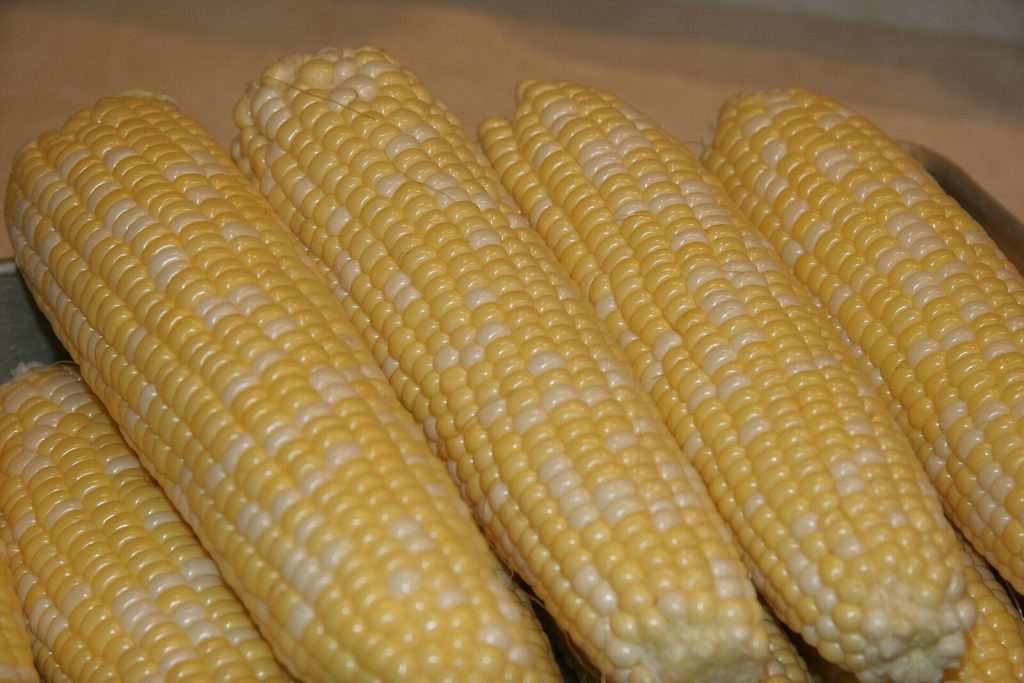
Most of Uganda plants maize twice a year, from around late February or March and again from August, while the north plants once from about April and the south western highlands once from mid August. The window in each region is narrow at the front and unforgiving at the back. Planting date is set by the first rains, not by the calendar on the wall.
That last point is where most of the yield is lost. The rains arrive on a date that moves by a month; they finish on a date that hardly moves at all.
When to Plant Maize in Uganda
Uganda straddles the equator, so the rain belt passes overhead twice a year and the south gets two growing seasons out of it. The first runs roughly March to May and the second roughly October to December, with the second season peaking earlier, in August, in the northern half of the country. North of about three degrees latitude the two seasons run together into one long wet period, which is why the north is called unimodal and the south bimodal.
The Ministry of Agriculture, Animal Industry and Fisheries puts the bimodal pattern in one sentence for maize: first season planting in March with harvest in July and August, second season from August through to January. That is the correct headline and it is too coarse to plant by. Nine Ugandan farming systems have their own published windows, and they do not agree with each other by anything less than six months.
Why the Maize Growing Season Is Shorter Than the Maize Crop
This is the arithmetic that should decide your planting date, and almost nothing written about Ugandan maize sets it out.
Researchers at the National Agricultural Research Laboratories analysed daily rainfall from 37 stations across Uganda over a record of nearly six decades, using the Meteorological Department's own data. For stations in the bimodal zone they measured the March to May season and found the number of growing days running from 70 to 105, the low end at Mbarara, Kasese and Rukungiri, the high end at Kabale.
Now set that against the crop. The ministry's own crop calendar gives maize a growth duration of 110 to 120 days in eight of Uganda's nine farming systems. The National Agricultural Research Organisation's released varieties run from 110 to 135 days. Even the earliest open pollinated material in the ministry's variety annex needs 100 to 105 days.
So in the bimodal first season, across the whole of southern and central Uganda, the maize crop is longer than the rains that started it. That is not a failure of planning. It works, because the last stretch of the crop cycle is grain filling and field drying, and both can run on residual soil moisture and a drying wind. What it does mean is that the season has no slack in it at all.
That last line is the finding, and it comes straight out of the study's conclusions: variability in onset dates across Uganda is far greater than variability in withdrawal dates, so even when rains start late, withdrawal is timely and the growing season is simply shorter. Onset varied by about 15 days at Entebbe and about 35 days at Mbarara. Cessation moved within a band a fraction of that.
Which reframes the ministry's warning against late planting. It is not a general exhortation to be organised. It is a statement that the back end of the season is fixed, so every day you lose at the front is a day taken out of grain filling.
First Season Maize Planting in the Bimodal South and East
In the bimodal zone the first rains typically arrive in the first or second week of March. The spread is wide: the study found rains starting as early as the last week of January in the area represented by Kabale and as late as the first week of April at Mbarara, with Lake Victoria and the hill country moderating the pattern locally.
The ministry's published planting windows open earliest in the Lake Victoria Crescent, from 25 January, and in Busoga, from 25 February. Eastern Savannah, the Northern system, West Nile and the Lake Albert Crescent all open in the second half of March.
Two things follow for a first season crop. Plant on the rain, not on the date: a fortnight of rain that then stops is a false start, and the published practice for uncertain moisture is dry planting at 5 to 10 cm so the seed only germinates once real rain arrives. And plant fast. Ugandan hand planting is a three person job, one digging, one placing fertilizer and covering it thinly, one placing seed and closing the hole, and the reason to organise the labour in advance is that the whole acre wants to go in inside a day or two rather than over a fortnight.
Early planting also buys something free. The ministry notes that it takes advantage of the nitrogen flush, the burst of nitrogen released from soil organic matter that accumulated through the dry season and mineralises when the soil wets. Plant three weeks late and that flush has already been used by weeds.
Second Season Maize Planting and the Harvest Window
The second season is the bigger one by participation and the smaller one by grain. The Annual Agricultural Survey found 52 percent of agricultural households growing maize in the first season and 57 percent in the second, while first season production came in near 1.9 million tonnes against 1.6 million for the second. More growers, less maize, which points at smaller second season plots and thinner second season yields.
Second season planting in the bimodal zone runs from about August, and the ministry's windows close on 31 August in the Lake Victoria Crescent and the Lake Albert Crescent, 15 August in Busoga and Eastern Savannah, and 20 July in the Northern and West Nile systems. Harvest lands between late November and mid January depending on the zone.
The researchers found the October to December season less variable than March to May, both within stations and across the country. Onset and cessation were more uniformly distributed, and in some seasons a late start was matched by a late finish, so season length came out average or even longer. That makes the second season the more predictable of the two to plan, which is worth knowing if you are deciding which season to put your hybrid seed into.
Its harvest also lands in the drier end of the year in much of the bimodal zone, which helps a crop that has to reach 13 percent moisture before it can be bagged. Drying method matters more than season, and the detail is on our maize drying guide.
One Long Maize Growing Season in the North
North of roughly three degrees latitude the gap between the two rainy periods closes and the year carries one continuous growing season. The study found unimodal onset ranging over a narrower band than the bimodal south, with rains starting as early as the third week of March and typically in the first week of April. Onset at Nebbi and Yumbe varied by about 15 days, which for a rainfed crop is close to reliable.
Its length is the real difference. The median onset and cessation pentads the study reports for unimodal stations sit 50 pentads apart, which works out near 250 days of growing season. Against a 120 day maize crop that is room for a second planting, and it is why the ministry's northern and West Nile windows stay open from mid or late March through to 20 July.
The catch is drying rather than growing. The published northern harvest window opens on 5 July and the West Nile window on 10 July, and in the north east the rains run April to November with peaks in April, May, July and August. A crop planted mid March in Gulu or Arua is ready to come off the plant in the middle of a rainfall peak. That is the single hardest maize drying problem in Uganda and it has nothing to do with the growing season and everything to do with what happens in the week after harvest. Covered cribs, tarpaulins and a cemented floor stop being optional there.
Karamoja is the harder case again. Its wet zone window is the shortest published anywhere in the country, 20 March to 20 April, with a growth duration of 100 to 120 days and harvest from 30 June. Annual rainfall in the north east has fallen by roughly 15 to 20 percent since the 1960s, and the decline is concentrated at the end of the season, which shortens an already short window.
Highland Maize Seasons in the South West
Kisoro, Kabale, Kanungu and Rukungiri run on a completely different clock and every general guide to Ugandan maize gets this wrong by silence.
The published window there is 15 August to 15 September, once a year, with a growth duration of 150 to 180 days and harvest in the second half of January into February. Not 110 to 120 days. The reason is temperature: maize grows more slowly at altitude, and the ministry's own figures put the optimum for highland tropical maize at 17 to 20 degrees Celsius against 30 to 34 for lowland types. Cold slows the crop down.
The variety record backs the calendar up independently. Uganda's highland hybrids, released for the 1,400 to 2,400 metre band, carry a duration of 200 to 210 days, and the transitional zone hybrids for 1,400 to 1,800 metres run 150 to 180. Those are the numbers that match the south western window, and none of them will fit a bimodal season.
The Western Rangelands share the August to September window, from Sembabule and Lyantonde through Mbarara, Isingiro, Ntungamo and Bushenyi to Kasese, but with a normal 110 to 120 day duration and harvest from early December. Same planting month, different crop length, different harvest.
Maize Planting Windows by Farming System
These are the published Ugandan windows by agro ecology, from the crop calendar annexed to the ministry's extension manual. The window spans both seasons where two exist, so it is the outer boundary rather than a single planting date. Sowing rate is given as 25 kg per hectare throughout, which is the 10 kg per acre figure in other units.
| Farming system | Plant from | Plant until | Crop days |
|---|---|---|---|
| Lake Victoria Crescent | 25 Jan | 31 Aug | 110 to 120 |
| Busoga | 25 Feb | 15 Aug | 110 to 120 |
| Eastern Savannah | 15 Mar | 15 Aug | 110 to 120 |
| Northern | 15 Mar | 20 Jul | 110 to 120 |
| Lake Albert Crescent | 20 Mar | 31 Aug | 110 to 120 |
| West Nile | 20 Mar | 20 Jul | 110 to 120 |
| Karamoja wet zone | 20 Mar | 20 Apr | 100 to 120 |
| Western Rangelands | 15 Aug | 15 Sep | 110 to 120 |
| South Western Highlands | 15 Aug | 15 Sep | 150 to 180 |
Read the districts off the source rather than off a map. Lake Victoria Crescent covers Wakiso, Luweero, Nakaseke, Mityana, Mpigi, Mukono, Masaka, Kampala, Kalangala and Rakai. Busoga covers Kamuli, Kaliro, Iganga, Jinja, Mayuge, Kayunga and Bugiri. Eastern Savannah runs from Kaberamaido and Katakwi through Soroti, Kumi, Bukedea, Pallisa, Budaka and Butaleja to Tororo and Busia. The Northern system covers Kitgum, Pader, Lira, Dokolo, Amolatar, Apac, Oyam, Gulu and Amuru, and West Nile covers Moyo, Adjumani, Yumbe, Koboko, Arua and Nebbi. Lake Albert Crescent takes in Kibaale, Mubende, Kiboga, Bundibugyo, Kyenjojo, Kabarole, Kamwenge, Buliisa, Masindi and Hoima.
Matching Variety Maturity to the Season You Have
Days to maturity is the only variety figure that interacts with your planting date, and it is the one most seed conversations skip in favour of yield potential.
The practical rule falls out of it. If your rains are already two weeks late, the answer is a shorter variety rather than a later planting of the one you bought, because the finish line has not moved. If your rains are on time and you are in a unimodal zone, a longer variety gets you more grain for the same season. Full variety detail, including what is actually stocked, sits on best maize seeds in Uganda, and the maturity question is one to raise before you pay rather than after.
How Late Is Too Late to Plant Maize
There is no published Ugandan cutoff date, and anybody who gives you one has made it up. What there is, is a method you can run on your own field.
Count forward from the date you would actually plant, using your variety's days to maturity, and see where the harvest lands against the closing end of your zone's published window in the table above. If maturity falls past the harvest boundary for your farming system, the crop will be finishing on moisture that is not there.
The ministry's stated consequences of late planting are higher pest incidence, higher disease incidence and lower yield, and the mechanism is straightforward: a crop that is behind the neighbourhood is the only green thing left when everything else has dried, so pests concentrate on it. Fall armyworm, stem borers and birds all work this way, which is why early planting appears in the ministry's control advice for pests rather than only in its agronomy. Pest detail is on fall armyworm control in maize.
Preparing Land Before the Maize Planting Rains
If the planting date is set by the rain and the rain moves by a month, land preparation has to be finished before the earliest plausible onset rather than triggered by the actual one.
The published instruction is to start either at the end of the previous harvest or at least three weeks before planting, so residues have time to break down, and to plough at least twice for a workable seedbed. Neither of those can be compressed into the week after the first storm. The rainfall researchers put the problem bluntly: in most cases Ugandan farmers begin tilling after the rains have started, and valuable soil moisture is lost before the seed goes in.
The seasonal forecast from the Department of Meteorology Services reaches farmers by mobile phone, community radio, sub county noticeboards and the electronic extension system, and it is worth listening to for the shape of the coming season rather than a planting date. Our planting calendar for Uganda covers timing across crops, the full maize growing guide takes the crop from site selection through to sale, and the rest of the staple crop cluster sits under our crop growing guides hub.
Dry Spells Inside the Maize Growing Season
A season that starts on time can still fail in the middle, and the Ugandan record says this is becoming more common in the first season and not the second.
At Namulonge in central Uganda the researchers found a declining trend in the number of rainy days in April and May and in the amount of rain falling in April, and April and May are the months when a March planted maize crop is flowering and setting grain. The decline shows up as unseasonable breaks of roughly three to four weeks with no rain, sitting inside what is nominally the rainy season. Ugandan farmers reporting to a separate assessment described the same thing: rain arriving in short localised bursts separated by hot dry spells rather than falling steadily through the season.
Maize is least forgiving of moisture stress at flowering and grain filling, so a three week break at the wrong moment costs more than the same break early or late. There are only three real responses and none of them is a planting date. Choose a drought tolerant variety, which most recently released Ugandan material is. Build soil that holds water, through residue retention, minimum disturbance and organic matter. Or irrigate, which for maize at Ugandan grain prices is a hard sum to make work and is covered on irrigation farming in Uganda.
Frequently Asked Questions
What month should I plant maize in Uganda? March for the first season in most of the bimodal south, east and centre, with the Lake Victoria Crescent window opening as early as late January; August for the second season; April for the single unimodal season in the north; and mid August to mid September for the single season in the south western highlands and the Western Rangelands. Plant on the arrival of the rain within that window rather than on a fixed date.
Can I plant maize in the dry season with irrigation? Physically yes, financially rarely. Maize is a low value crop by the kilogramme and irrigating it has to compete against irrigating tomato or onion on the same equipment. If you already have a system running for a higher value crop, off season maize can use spare capacity. Building a system for maize alone is a different calculation, and irrigation system cost per acre has the numbers.
Which maize season gives the better price? Prices fall when everybody harvests and recover as stocks run down, so the season that sells well is the one whose grain you can hold. Monitored Ugandan markets have shown seasonal rises of 6 to 36 percent as cereal stocks deplete. That is a storage question rather than a planting question, and it is worked through on maize farming profit per acre and tracked on maize price in Uganda today.
What happens if the rains fail after I have planted? If the failure comes before emergence you can usually replant inside the window, which is one reason not to plant on the very first shower. If it comes at flowering or grain filling, the yield is already reduced and no input recovers it. Dry planting at 5 to 10 cm depth, deeper than the 2 to 3 cm used in moist soil, is the published hedge: the seed sits and waits until there is enough water to germinate.
Should I plant a different maize variety in the second season? Often yes, and for a reason that has nothing to do with the variety's quality. The second season is the more predictable of the two in the bimodal zone, so a longer maturing variety carries less risk there than in the first season. If your first season rains came late, moving to a shorter variety for that season and keeping the longer one for the second is the sensible split.
Is it still worth planting if I am three weeks late? Work it out rather than guess. Add your variety's days to maturity to the date you would plant, and compare the result with the harvest boundary for your farming system. If it fits, plant and expect a thinner crop from the shortened grain filling. If it does not, the choices are a shorter variety, a different crop, or holding the seed. Seed stored properly to the next season loses less than a crop that never fills.
Planting dates are local, and the district extension office knows what the rains have actually done in your sub county this year in a way no published window can. Check the current seasonal forecast, confirm your variety's maturity with the stockist before you pay, and compare prices on the maize price page before you decide which season's crop you intend to sell and which you intend to store.