
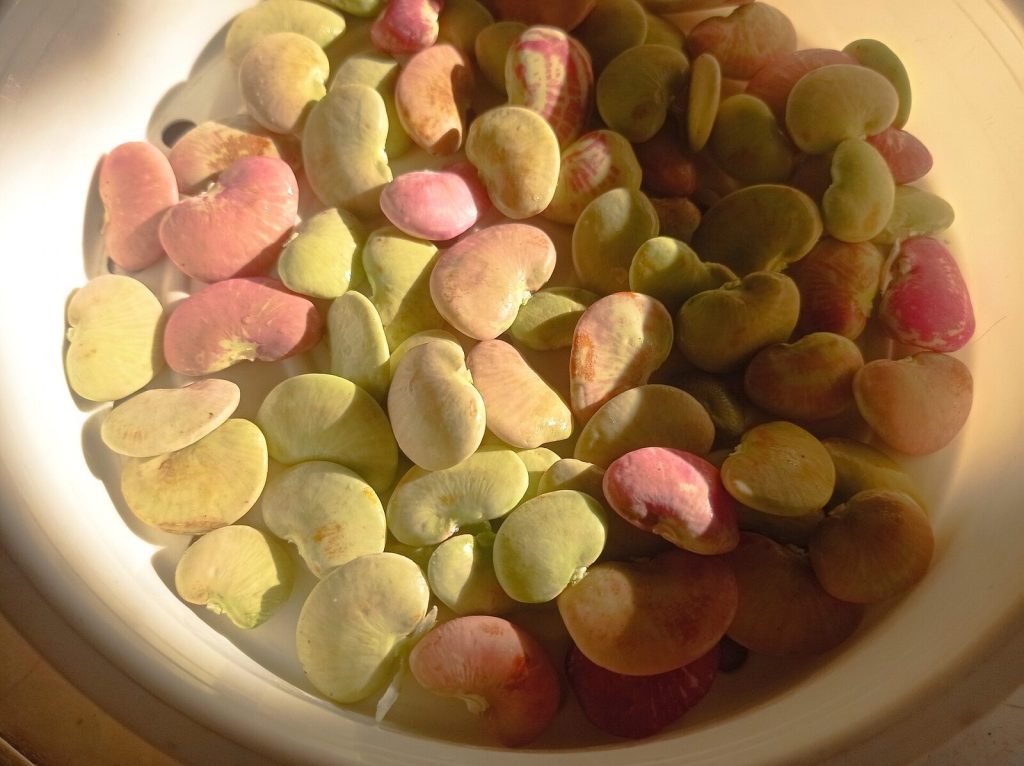
Growing Nambale beans starts with a problem nobody warns you about: the name covers at least three different beans, and the seed you are handed at the counter may be any of them. Seed moves through stockists, neighbours and open markets under the name with no release record behind it. Nambale is a red mottled bush bean type grown across Uganda, and the short and long forms behave differently in the pot and in the field.
Which Bean Is Actually Sold as Nambale in Uganda
Follow the name through the Ugandan record and it splits four ways.
| What the name attaches to | Where it is recorded | Seed described as |
|---|---|---|
| Nambale Omumpi, the short type | Ugandan bean value chain study, glossed as NABE 4 | Large, red mottled |
| Nambale Short | NARO community seed bank records, as a landrace | Small, red and white spotted |
| Nambale Omuwanvu, the long type | Same value chain study, as its own variety | Not described |
| K20, known as Nambale | NARO's NABE 4 release leaflet | Red mottled, released |
Look at the two entries for the short type. One calls the seed large, one calls it small. Those cannot both describe the same bean, and neither source is careless: the first is a peer reviewed study of the Ugandan bean value chain that interviewed traders, processors and consumers, and the second is NARO's own community seed bank documentation. The reasonable conclusion is that the name has settled on different beans in different districts, and both records are locally true.
NARO's own usage supports that. Its NABE 4 release leaflet names K20, which farmers know as Nambale, alongside K132 and NABE 1 as closely related released red mottled varieties, which puts Nambale on a separate line from NABE 4 rather than on top of it. And when NARO benchmarks NABE 19, it does so at 5 to 10 percent above local varieties "such as the Nambale types", plural, treating Nambale as a category of local material rather than as one release.
So the honest summary is this: Nambale is a market name for a class of red mottled bush beans in Uganda, not a released variety. There is no NARO release under the name. That is not a reason to avoid it, because the class includes one of the most sought after beans in the country. It is a reason to stop treating the label as information.
Nambale Short and Nambale Long: Reading the Seed, Not the Label
Three things on a bean seed tell you more than the name does.
Seed size comes first. NARO records Nambale Short as a small seeded landrace, while NABE 4, which one study equates with the short type, carries large seed. Count out a hundred seeds and weigh them. Among NARO's released bush beans the large seeded lines run above 40 grams per hundred seeds, so a hundred count that comes in well under that is not a large seeded release whatever the sack says.
Seed pattern comes second, and it is the check people skip. NARO's seed bank describes both Nambale landraces as red and white spotted. NABE 4 is described as red mottled. Mottling and spotting are different markings: mottling is a broken wash of colour across the seed coat, spotting is discrete marks on a ground colour. A careful look at twenty seeds under daylight settles it.
Cooking time comes third and it is what the market actually pays for. NARO's records put Nambale Short as early maturing and quick to cook, and Nambale Long as the bigger seed that takes longer to cook. That single difference is why the two are not interchangeable to a buyer, and it is why a school or an institutional kitchen will pay for one and not the other.
Where Nambale Beans Sit in the Ugandan Market
Beans are not a side crop in Uganda. They occupy about a million hectares a year, second only to maize, are grown by more than 60 percent of smallholder households, and per capita consumption runs 50 to 60 kilogrammes a year. Women contribute about 57 percent of the labour and commonly lead variety selection and seed keeping.
Against that, a study of 75 traders, 21 processors and 100 consumers put NABE 4 at the top of every group's preferences: 40 percent of consumers, 44 percent of traders and 33 percent of processors named it first. Nambale Omuwanvu, the long type, came in the top five, at 5 percent of consumers and 4 percent of traders but 19 percent of processors. The processor figure splits by sex, at 20 percent of men processors and none of the women, though the study's authors caution against reading those cells hard because the numbers behind them are small.
What buyers say they are paying for is consistent across all three groups and none of it is about yield. For NABE 4 the reasons given were taste at 33.6 percent, shorter cooking time at 23.9, a thick stew at 21.3, soft texture at 11.4 and low flatulence at 3.4. Traders added marketability and reliable local supply. That is the demand a Nambale grower is selling into, and it explains why the cooking time check above is worth five minutes.
There is a practical Ugandan detail behind the cooking time preference that is easy to miss: institutions that cook in bulk care about fuel. A bean that boils soft in less time costs a school kitchen less firewood per meal, which is why quick cooking red mottled beans hold their place in that market regardless of what a seed catalogue says about yield.
Season, Altitude and Soil for Growing Nambale Beans
Uganda gives two bean seasons. The first runs from planting in March to mid April with harvest through June and July. The second runs from mid August into December. Both are workable for a bush bean of this type, and the second season often carries lower disease pressure in the wetter districts because the rains are less prolonged.
Altitude matters for the released line. NABE 4 is typically grown between 1,000 and 1,800 metres, which covers most of Uganda's bean growing districts. The landrace Nambale types carry no published altitude band, which is itself useful information: a landrace has been selected by farmers in a particular place, so its best guide is how it performs for growers near you rather than a printed range.
Soil reaction is where a bean crop is quietly lost. The optimum is pH 5.8 to 6.5, and beans become highly sensitive below 5.2. Below that line the crop will germinate, look thin, take every shilling of fertilizer you give it and still underyield, because the nutrients are chemically unavailable and the root nodules do not form properly. Lime is the input that unlocks such a field, applied well ahead of planting. No rate is given here because none has been verified for Ugandan bean soils, and a soil test is what sets it.
Boron deserves a line of its own for the same reason. Boron deficiency leads to poor nodule formation, so a field that looks nitrogen starved may actually be short of a trace element. That is a soil test finding, not a field diagnosis.
Spacing and Seed Rate for a Nambale Bean Acre
For a bush bean, the documented Ugandan spacings are 50 by 10 centimetres with one seed a hole, or 50 by 20 centimetres with two seeds a hole, planted at about 5 centimetres deep. Either gives roughly 80,200 plants an acre. That figure is worth checking yourself: 50 by 10 centimetres over the 4,047 square metres in an acre works out at about 80,940 planting sites, which lands where the handbook says it should.
The seed rate is the one number where Ugandan sources disagree, and rather than pick one this page gives both. The regional bean cultivation handbook puts a bush acre at 25 to 30 kilogrammes of seed. NARO's own bean training manual puts it at 32 kilogrammes. So plan on 25 to 32 kilogrammes an acre and let your seed size decide where in that band you land, because a large seeded line weighs more per planting site than a small seeded one. That is not a fudge. It is the reason the two sources differ.
Planting goes faster in teams of three, one opening holes, one placing fertilizer and one placing seed, which is the method NARO's extension material describes. Walk the field again 3 to 4 days after germination and fill the gaps. Bean plant population does not recover from a patchy stand the way a tillering cereal does, because a bean plant cannot compensate for its missing neighbour. The bean spacing and seed rate guide carries the full arithmetic for other spacings.
Fertilizer on Beans and Why the Nitrogen Bag Is Not the Answer
The standing recommendation for a bush bean acre in Uganda is about 50 kilogrammes of DAP, placed at planting at roughly one bottle cap a hole, with the actual need set by a soil test. One bag an acre. That is a fraction of what a vegetable crop takes and it surprises people who have grown tomato or onion.
The reason is biological. Beans form a partnership with rhizobium bacteria in root nodules, and that partnership converts atmospheric nitrogen into a form the plant can use. A bean crop with healthy nodules is making a large part of its own nitrogen, so pouring urea onto it buys leaf rather than pods and can suppress the nodulation you already had. Dig up one plant at flowering and cut a nodule: a working nodule is pink or red inside. White or green inside means it is not fixing, and that is the signal to look at pH, boron and compaction rather than at the nitrogen bag.
Phosphorus is the nutrient that does move the yield on most Ugandan bean fields, which is why the recommendation is a phosphate source rather than a nitrogen one. The bean fertilizer guide deals with the other products and with organic sources.
Weeding a Bean Crop and What Weeds Cost Past the Field
Weeds in beans cost more than the competition for nutrients, light and moisture that everyone expects. NARO's extension material sets out the full bill, and two items on it land after harvest. Weeds host pests and diseases that carry into the crop. They make harvesting slower. And they raise the winnowing and sorting labour and cut the purity of the sample, which reduces the price the grain fetches.
That last item is the one that changes behaviour. A weedy bean acre does not just yield less, it produces a dirtier sample that costs more to clean and sells for less when cleaned. Hand weeding twice through a short season bush bean, with the first pass early while the crop is small, is what the Ugandan material describes, and a well prepared seedbed reduces how many passes are needed.
Diseases That Decide Whether a Nambale Crop Finishes
Here is where the variety identification from the first section starts paying off, because the two candidates carry different disease pictures.
NARO's NABE 4 leaflet records it as tolerant of angular leaf spot and anthracnose and susceptible to bean root rot. That is specific and it matters: one Ugandan value chain study describes NABE 4 more loosely as resistant to common bean diseases, and the blanket version would lead a farmer to plant it into a field that has already lost a bean crop to root rot. Use the leaflet's version. If your field has a root rot history, this is not the line to put in it.
The landrace Nambale types read differently. NARO's seed bank records describe Nambale Short as moderately resistant to aphids, caterpillars, anthracnose, bean fly, root rot, halo blight and bean common mosaic virus, and Nambale Long with a narrower list that adds bean weevil. Two cautions on reading that. Those ratings are farmer assessed rather than laboratory screened, and moderate resistance across a broad list is a different promise from strong resistance to one thing.
Ugandan bean root rot is not one organism but a complex of pathogens whose mix changes with altitude and moisture, and a NARO led national survey found southern blight the most common of them. So a tolerance rating earned against one root rot pathogen does not transfer to the others, and a root rot claim on a packet should be read as one part of a package that also needs rotation, fertility and clean seed. The bean diseases guide handles identification and the control options in full. No product, rate or spray interval appears here. Anything you buy carries its own rate on the container, that rate is binding, and a district extension officer or a plant clinic is where to take the question before spraying a bean crop.
Harvesting a Bean That Drops Its Leaves
NABE 4 sheds its leaves at maturity, which is a small trait with a real labour consequence: when you harvest you carry pods rather than whole plants, so there is less bulk to move off the field and less trash to separate at the threshing floor. Ugandan farmers name this as a reason they like it, ahead of any yield claim.
A bush bean of this type is ready at 85 to 90 days for the released line, and the landrace types are recorded simply as early maturing without a figure. Judge it on the crop rather than the calendar: pods dry and rustling, seed rattling loose inside, leaves gone or going. Cut or pull in the dry part of the day.
Bean grain leaves the field at 18 to 24 percent moisture, which is far too wet to store, and that gap is where most of the crop is lost. Uganda loses up to 40 percent of bean produce between harvest and marketing, and almost all of that is a drying and storage failure rather than a field failure.
Drying and Threshing Nambale Grain to a Moisture That Stores
Two moisture targets matter and they are not the same number.
Thresh on a rack rather than on the ground. Beating pods against a raised surface keeps the seed off the soil and away from the stones, and it reduces the mechanical cracking that downgrades a sample. Then clean. One person winnowing by hand moves about 100 kilogrammes an hour; with a screen the same person moves about 500; a mechanical cleaner passes over a tonne an hour. Those figures are the whole argument for sharing a screen between neighbours rather than winnowing a bean harvest by hand.
Sorting and Grading: Who Actually Gets Paid for It
This section exists because the usual advice is half right and the missing half costs money.
Grading does change the bean price. In Ugandan districts where it was measured, grade 3 beans fetched up to 40 percent less than grade 1. That is a large gap and it is real.
What was also measured, in the same country, is who captures it. A study of 136 bean farmers found that traders at the farm gate paid almost the same price for sorted and unsorted beans, then sorted and graded the beans themselves and sold them on at better prices. So the work of sorting created value, and the value went to whoever was standing on the other side of the transaction. Wholesalers, by contrast, were strict about quality.
Storing Nambale Beans Through the Season
Dry bean prices in Uganda barely move across the year. The national monthly series runs from about 4,411 to 4,758 UGX a kilogramme with an annual average near 4,600, an annual swing of roughly 8 percent, and a gap of about 7.9 percent between the dearest and the cheapest month in the ministry's retail price table. Compare maize grain at 29.2 percent or round onions at 65.1 and the difference in what storage can earn is obvious.
So storing beans in Uganda is not a way to catch a price rise. It is a way to avoid losing the crop, and against a documented post harvest loss of up to 40 percent that is the bigger prize anyway. Hermetic bags hold beans safely for over 12 months, killing storage insects by cutting off their oxygen rather than by chemical action, and they keep seed viable. That last point is why a seed lot and an eating lot can go into the same kind of bag.
Bean weevil is the storage pest that decides the outcome, and the one thing that guarantees an infestation is bagging grain above 14 percent moisture. Get the moisture right and the bag does the rest. The bean storage guide covers structures, stacking and inspection intervals.
Saving Nambale Seed and the Point at Which to Stop
Beans are self pollinated, so seed saved from your own crop stays largely true to type, and this is why Ugandan farmers keep landraces going for decades without losing them. Saving Nambale seed is normal practice and not a mistake.
What saving does accumulate is disease. Seed borne pathogens travel in the seed lot, so a field that took a hit from anthracnose or bean common mosaic virus passes a share of that into next season if you replant from it. The practical rule that comes out of NARO's material is to select the seed lot from the cleanest part of the healthiest field, thresh and store it separately, and dry it to 13 percent rather than 14.
Stop saving and buy in fresh seed when the field has had a root rot or virus episode, when germination in your own damp cloth test falls away, or when you want the documented resistance package of a released line. What you are buying at that point is not a magic bean but a known starting point, and the numbers show how rare that purchase is in Uganda: certified bean seed production has run at about 359 tonnes against a national requirement of 64,728 tonnes, which is roughly half of one percent. Almost every bean planted in this country is saved or bought as grain.
Yield to Expect From a Nambale Bean Acre in Uganda
No source publishes a yield figure for either Nambale type. What exists are three bands from three different footings, and knowing which one your field resembles is more useful than a single number would be.
| Band | What it describes | Source footing |
|---|---|---|
| 263 to 324 kg an acre | What Ugandan bean fields actually average | National survey statistics |
| 300 to 500 kg an acre | Current farm level yield, against up to 900 potential | National seed policy |
| 1.5 to 2.5 t a hectare | NABE 4 under good management | Release leaflet, on station and on farm |
The third band is about 600 to 1,000 kilogrammes an acre, so the gap between the best documented figure for the released line and the measured national average is roughly a factor of three. That gap is not mysterious. It is pH, phosphorus, plant population, weeding timing and the 40 percent that leaves between the field and the market.
For a sense of how wide landrace performance runs, Kanyebwa, another Ugandan market class, has been recorded anywhere from 36 to 570 kilogrammes a hectare depending on input use. A landrace is not a fixed yield; it is a yield that follows what you put in. The bean yield per acre guide works through what moves each of those bands.
Common Questions From Ugandan Nambale Bean Growers
Is Nambale an improved variety or a local one? Neither answer is clean, which is the point of this page. There is no NARO release under the name Nambale. NARO's NABE 4 leaflet records K20, which farmers call Nambale, as a released red mottled variety; NARO's community seed bank records list Nambale Short and Nambale Long as local landraces; and a peer reviewed Ugandan study glosses the short type as NABE 4 outright. Treat Nambale as a market class of red mottled bush beans and ask for the release number if a seller claims it is improved.
What is the difference between Nambale short and Nambale long? Seed size and cooking time. NARO's records describe the short type as a small seeded, early, quick cooking bean and the long type as a bigger seed that takes longer to cook. The cooking time is what buyers pay for, so the distinction is commercial rather than cosmetic. Measure it yourself by boiling twenty seeds and timing them, because the name on the sack is not reliable.
What does Nambale bean seed cost in Uganda? No price is published under the name, which follows from it not being a release. The verified bands are 4,000 to 4,800 UGX a kilogramme for improved bean seed and 1,500 to 2,000 for local seed of classes such as yellow bean and kanyebwa. Seed sold loose as Nambale will sit near the lower band because it is grain in all but name, and a sealed pack of a named NABE line will sit near the upper one. At 25 to 32 kilogrammes an acre that difference is material. Check the current bean prices for the grain side, and the cost of bean farming guide for the full acre budget.
Can I plant Nambale beans where beans failed last season? Be careful, and find out which line you have first. NARO records NABE 4 as susceptible to bean root rot, so if last season's failure was a root rot the released short type is the wrong choice for that ground. The landrace Nambale types are recorded as moderately resistant to root rot, but that rating is farmer assessed and Ugandan root rot is a complex of pathogens rather than one, so moderate resistance is not cover. Rotate out of beans for a season and fix the fertility.
How much fertilizer do Nambale beans need? Less than people expect. About 50 kilogrammes of DAP an acre placed at planting, with the real requirement set by a soil test. Beans fix much of their own nitrogen through root nodules, so extra nitrogen buys leaf rather than pods. If the crop looks starved, dig a plant and cut a nodule: pink inside means it is working, and white or green inside points at soil pH, boron or compaction instead.
Should I sort my beans before selling? It depends entirely on the buyer, and this is where most advice goes wrong. Grade 3 beans have fetched up to 40 percent less than grade 1 in Uganda, so the premium exists, but at the farm gate traders were found to pay almost the same for sorted and unsorted grain and to take the sorting margin themselves. Sort for storage always, because holed and mouldy seed spoils the rest. Sort for price only when you are selling to a wholesaler, a processor or an institution that grades.
How long can I keep Nambale beans in store? Over 12 months in a hermetic bag, provided the grain went in at 14 percent moisture or below. The bag kills storage insects by suffocation rather than by chemical action, so there is no residue question and seed keeps its viability. What defeats it is bagging grain that is still damp, because you have then sealed in the conditions for mould.
Can I keep replanting my own Nambale seed? Yes, for a long time, because beans are self pollinated and stay largely true to type. What accumulates is disease rather than genetic drift. Select your seed lot from the cleanest part of the healthiest field, store it separately, dry it to 13 percent rather than 14, and buy fresh seed after a root rot or virus episode or when your own germination test starts failing.
Why can I not find Nambale in NARO's variety catalogue? Because it is not a release, and there is a second surprise alongside it. Going through every crop entry in NARO's current technology catalogue one by one, NABE 4 itself has no record there, although it is the most preferred bean variety among Ugandan consumers, traders and processors. The catalogue carries NABE 12CR, 14R, 17 through 23, 26C, 29 and the NAROBEAN lines. So the absence of a name from that catalogue is not evidence the bean is not real. Ask NARO for the release leaflet for whatever line you are being sold, and see the best bean varieties guide for the lines that do have records.
Finding Nambale Seed and Checking Current Prices
The single most useful thing you can do before this season is settle which bean you actually have. Weigh a hundred seeds, look at the marking in daylight, boil twenty and time them, and write the three answers down. Next season you will be buying against a measurement rather than against a name.
Then compare what several input suppliers are offering, ask each one for the release number and the seed class rather than accepting "Nambale", and check the current grain price against the seed you need for your acre. This guide sits under the crop growing guides hub, and the general bean farming guide covers the parts of the season that are the same whichever red mottled line you end up planting.