
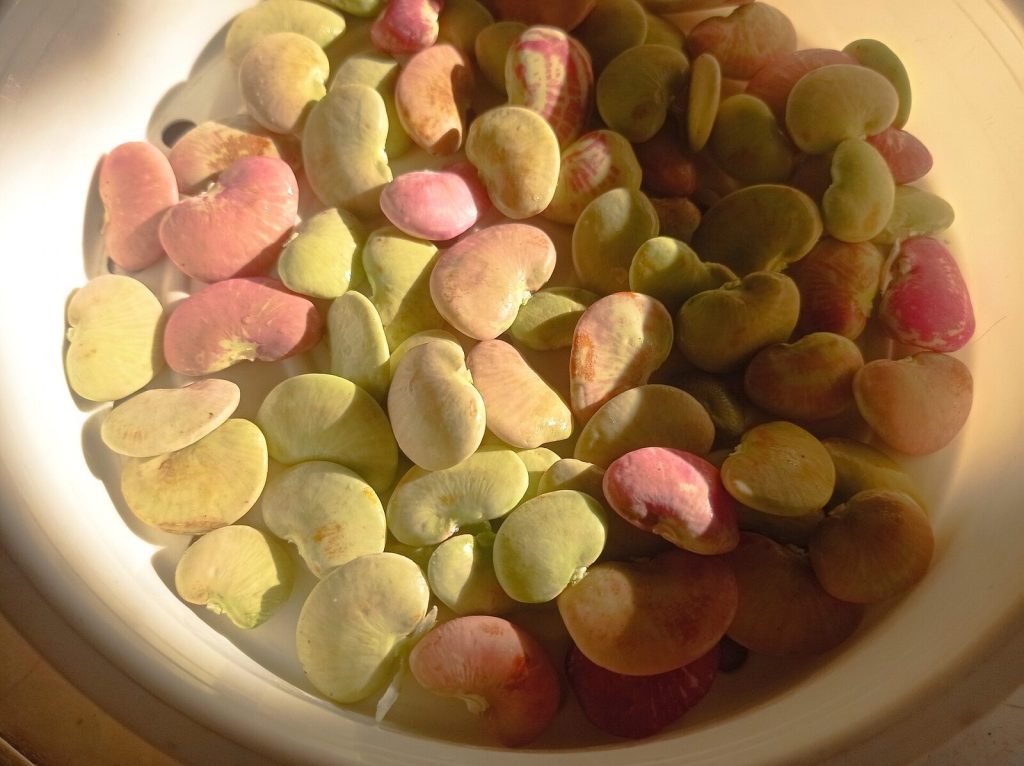
The most useful rule in any bean fertilizer guide is that nitrogen is the nutrient beans need least help with and phosphorus is the one that pays. Ugandan and regional evidence points the same way: a bean crop fixes much of its own nitrogen through root nodules, mineral nitrogen suppresses those nodules, and phosphorus is the only nutrient with a consistent measured yield response across East African farms.
That is a different fertilizer programme from maize, and applying a maize habit to beans costs money twice. You buy nitrogen the crop can partly make for itself, and you shut down the machinery that makes it.
Why a Bean Crop Is Not Fertilized Like Maize
Beans carry a symbiosis with Rhizobium bacteria that converts atmospheric nitrogen into a form the plant can take up. Uganda's Bean Cultivation Handbook, produced by the Alliance of Bioversity International and CIAT under the CGIAR Seed Equal initiative with Ministry of Agriculture guidance, states the consequence directly: beans require only modest amounts of nitrogen because of that relationship.
The crop's total nitrogen demand is not modest at all. Published work puts common bean nitrogen demand at roughly 80 to 140 kg per hectare. The point is where it comes from. A bag of urea is one route. A working population of nodules is the other, and it is nearly free.
Those two routes are not additive. They compete, and the competition has been measured.
What Nitrogen Fertilizer Does to Bean Nodules
A peer reviewed meta analysis pooled 68 studies from seven countries comparing Rhizobium inoculation against mineral nitrogen on common bean, the largest assessment of that question published. Its nodulation results are the clearest argument in this whole guide.
Read that block once more before buying urea for beans. Mineral nitrogen does raise bean yield. It raises it less than it raises maize yield, it does so by a route that costs you the nodules, and past a point it works against you.
One caution on transferring these figures to Uganda. Most of the pooled studies sit in Brazil, and the analysis reports that in tropical climates inoculation ran about 12 percent below mineral nitrogen on seed yield, and about 16 percent below in semi arid ones. Uganda is in the tropical class. The nodulation result is a plant physiology finding that travels; the yield comparison is climate dependent and travels less well.
Phosphorus Is the Nutrient That Pays on Beans
The strongest evidence for Ugandan bean growers comes from on farm nutrient addition trials run across Uganda, Tanzania, Nigeria and Ghana on four grain legumes, published in Field Crops Research. Uganda's contribution to that dataset was climbing bean.
Phosphorus was the only nutrient with a substantial mean effect. Averaged across all crops and countries, adding phosphorus at a mean rate of 15 kg per hectare lifted grain yield by 251 kg per hectare. Potassium added 15 kg per hectare and secondary and micronutrients 49 kg per hectare, and neither figure was statistically reliable.
The climbing bean plots ran like this:
| Treatment | Climbing bean yield | Gain over control |
|---|---|---|
| No inputs | 1,657 kg/ha | Control |
| Phosphorus only | 1,905 kg/ha | 248 kg/ha |
| Phosphorus and potassium | 2,045 kg/ha | 388 kg/ha |
| Plus micronutrients | 2,076 kg/ha | 419 kg/ha |
The largest standard error on those means is 315 kg per hectare, which is wider than the whole distance from phosphorus only to the full package. Treat the step from 1,905 upward as unproven and the step from 1,657 to 1,905 as the one the data supports.
Against the wider literature, that 251 kg per hectare mean is unremarkable in the good sense: published phosphorus responses in common bean, soybean, cowpea and groundnut cluster between 150 and 500 kg per hectare, with occasional reports below 100 and above 500. Uganda's measured response sits inside a well replicated band rather than at the edge of one.
How Often Bean Phosphorus Fertilizer Actually Pays
An average response is not a promise, and this is where the trials earn their keep. They reported the distribution, not just the mean.
Of all fields, 96 percent showed some yield increase from phosphorus. Only 67 percent showed an increase large enough to cover the cost of the fertilizer at the rates tested. Almost a third of fields grew more beans and still lost money doing it. At the extremes, about 11 percent of fields posted heavy losses while about 48 percent posted large gains.
Two more findings from the same analysis matter for how you use a recommendation. Only 2 to 13 percent of the variation in response sat at district level, so a district specific fertilizer recommendation gains very little over a national one; 80 percent of districts were expected to fall between 193 and 309 kg per hectare of phosphorus response. Most of the variation sat at the level of the individual farm and the individual season, which nobody can predict in advance.
That is an uncomfortable answer and it is the honest one. Phosphorus on beans is a bet that pays about two times in three, the odds cannot be improved by knowing your district, and the size of your own response is not knowable until you have tried it on part of your land.
Turning the Bean Phosphorus Rate Into Bags of Fertilizer
The trials talk in kilogrammes of phosphorus. Shops sell kilogrammes of product. Converting between the two is where most bean fertilizer advice quietly falls apart.
DAP as described in NARO's own bean material is 18:48:0, meaning 48 percent phosphate by weight. Phosphate is about 44 percent phosphorus, so DAP carries roughly 21 percent phosphorus. Divide the nutrient rate by 0.21 to get the product rate.
So the defensible window is roughly 29 to 39 kg of DAP per acre, applied at planting, and above that you are buying yield you have no published reason to expect while risking the fixation you already had.
Three Ugandan Bean Fertilizer Recommendations, Reconciled by Conversion
Uganda's three main bean documents look as though they disagree by a factor of two and a half. Convert them into nutrient terms and most of the disagreement turns out to be a unit problem rather than an agronomic one.
| Source and product | As printed | Phosphorus or nitrogen |
|---|---|---|
| NARO manual, DAP | 40 kg/ha | About 8 kg P/ha |
| NARO leaflet, DAP | 100 kg/ha | About 21 kg P/ha |
| Handbook, DAP | 50 kg/acre | About 26 kg P/ha |
| NARO manual, urea | 20 kg N/ha | 20 kg N/ha |
| NARO leaflet, urea | 50 kg/ha | About 23 kg N/ha |
Where a Tier 1 source disagrees with itself or with another, the rate on the fertilizer bag and the judgement of an agricultural extension officer in your district are the operative authority. None of the three documents was written for your soil, and all three say the rate depends on a soil test.
Rhizobium Inoculant on Beans: What It Does and Does Not Do
Inoculant is a sachet of live rhizobia coated onto the seed before planting. NARO's good agronomic practices poster for beans puts it at 350 g for 20 kg of seed, applied as a seed coating before planting, which works out at about 17 g per kilogramme of seed.
That rate matters because the meta analysis found the gap between inoculation and mineral nitrogen narrowed where inoculant was applied at the upper end of the rates it reviewed, around ten grams per kilogramme of seed. NARO's own coating rate sits above that threshold. The rate printed on the sachet you buy governs, because formulations differ in how many live cells they carry.
What inoculant reliably does: raise nodule numbers and nodule mass well above both an untreated crop and a nitrogen fertilized one, and raise seed yield by about a third over an untreated control. It is also cheap. The pooled analysis notes that the energy needed to manufacture one hectare's worth of inoculant is under one percent of that for the equivalent mineral nitrogen, which is why the on farm trial authors describe inoculants as a low risk recommendation while mineral fertilizer, with its high purchase cost, needs a clear yield benefit to justify itself.
What inoculant does not do: match adequate mineral nitrogen on yield in a tropical climate, and substitute for phosphorus. Nodulation itself needs phosphorus, so the two are complements rather than alternatives. The conditions under which inoculation actually beat mineral nitrogen in the pooled data were narrow: dry season planting, no tillage systems, and soils high in organic matter. In the rainy season it ran about 9 percent behind.
Potassium and Micronutrients on Beans: The Honest Answer
Most bean fertilizer advice lists ten nutrients. The Ugandan and East African evidence supports two.
Potassium showed a mean effect of 15 kg per hectare across the on farm trials and it was not statistically reliable. Earlier Ugandan work on potassium in common bean found small and inconsistent effects, and the trial authors conclude that application is unlikely to pay. Secondary and micronutrients averaged 49 kg per hectare, also unreliable, and a wider survey across sub Saharan Africa found legumes had the smallest relative yield increases of any crop type from combined magnesium, sulphur, zinc and boron.
The Ugandan climbing bean trials produced the sharpest result of all: negative responses across every district surveyed to a combination of magnesium, zinc and molybdenum. That is not the same as saying those nutrients never matter; it is saying that buying them blind, as a blanket top up, measurably lost yield in Uganda.
Where a micronutrient does matter it will be a local deficiency, and a soil test is the only way to know. Blanket micronutrient blends sold for beans are the weakest purchase on this page.
Manure and Compost for a Bean Crop
Organic material is the part of bean soil fertility that Ugandan documents treat most consistently, and the part farmers actually keep using.
The Bean Cultivation Handbook gives 2 to 4 tonnes of manure per acre, spread and worked in during ploughing, using material that has decomposed for at least two to three months, with planting two to three weeks after application. Compost takes two to three months to make: layer dry plant material, water, ash, green material, animal droppings and topsoil, repeat the layers three or four times, cover with soil and dry grass, turn the heap layer by layer after three weeks, and it is ready about three weeks after that. Ash goes in as a potassium source and topsoil to introduce the insects and worms that do the work.
Organic material also does things a fertilizer bag does not: it holds soil structure, raises water holding capacity, improves aeration and releases nutrients slowly. A fertile bean soil is described as deep and well drained, well structured and aerated, in the pH range 5.5 to 6.5 for most crops, with a good supply of both available and reserve nutrients and organic matter above 2 percent.
The one number here to be careful with is the tonnage. Two to four tonnes an acre of decomposed manure is a real quantity of material to cart and spread, and the labour, not the manure, is usually what limits it.
Soil Acidity Sets the Ceiling on Bean Fertilizer Decisions
Beans have a narrow pH preference and the handbook is blunt about it: optimum soil pH is 5.8 to 6.5, and beans are highly sensitive to acidic soils below pH 5.2. Below that floor, fertilizer stops being the binding constraint. Phosphorus you apply gets locked up, nodulation suffers, and root rots become more likely, because the same soil conditions that damage bean roots include acidity.
The meta analysis found the same pattern from the other direction: the disadvantage of inoculation against mineral nitrogen shrank on soils with low to neutral acidity and adequate phosphorus availability, and widened at pH below 5 and above 7.
No lime rate appears on this page, because no Ugandan lime rate for beans could be verified, and a lime rate depends on soil texture and buffering as much as on pH. What is publishable is the order of operations: test the soil, correct acidity if it is below the floor, then decide on phosphorus. Buying DAP for a soil at pH 5.0 is buying a nutrient the soil will not release. Soil testing is covered on our page about testing soil before applying fertilizer.
Reading Nutrient Deficiency in a Bean Field
The Bean Cultivation Handbook carries a full deficiency symptom table for beans, which is more useful than it sounds, because several bean deficiencies are commonly misread as disease.
That last entry is worth separating out, because it is the one error a fertilizer buyer is most likely to make: treating a molybdenum problem with nitrogen. The symptoms overlap, the nitrogen suppresses the nodules further, and the crop ends up more dependent on the bag than it started.
Do Not Try to Fertilize Your Way Out of Root Rot
Both NARO's bean manual and CIAT's bean disease handbook carry the same warning in almost the same words, and it belongs in a fertilizer guide rather than only in a disease one. Farmyard manure, green manure and compost are listed as root rot management measures because they improve soil fertility and structure. Mineral nitrogen is not, and both documents add an explicit caution against applying a lot of nitrogen, because it can make root rot worse.
CIAT's handbook lists soils fertilized with ammonium fertilizers among the conditions in which bean root rots are very common, alongside low fertility, compacted soils, acid soils and moisture extremes. So the same soil that grows a poor bean crop grows a good root rot, and the response that helps is organic material and drainage rather than a nitrogen top up. What the pathogens are and how Ugandan growers manage them is covered under bean diseases and their control.
What Ugandan Bean Farmers Actually Buy
A recommendation only means something if somebody follows it, and for bean fertilizer in Uganda there is an unusually clean measurement of what happens when the free bag stops coming.
In climbing bean work across Kabale, Kanungu and Kapchorwa districts, about 80 percent of the farmers who planted received triple superphosphate as part of the trial package, and all but three of them used it. In the following season, use of that fertilizer fell to three farmers in Kabale and three in Kapchorwa, and five of those six were simply using up what the trial had supplied. One farmer bought phosphate fertilizer from an agro dealer.
Organic fertilizer went the other way. Use ran from 10 percent of farmers in Kapchorwa to 40 percent in Kanungu during the trial season, and it rose afterwards in two of the three districts. Among the changes farmers made to the recommended package, growing climbing beans without any fertilizer at all was one of the commonest.
Those two facts together are the real state of bean fertilizer in Uganda. Mineral fertilizer on beans is close to a demonstration crop practice; manure and compost are the farm practice. Any guide that recommends a bag without acknowledging that has not looked at what the same farmers did in the season after the trial.
Pricing Bean Fertilizer Before You Commit
The rate side of this guide is settled enough to act on: roughly 29 to 39 kg of DAP per acre at planting, inoculant at the rate on the sachet, 2 to 4 tonnes of decomposed manure per acre where you can move it, and nothing else unless a soil test names it. The money side is not something a page can settle, because fertilizer prices in Uganda move with the exchange rate, the shipping season and how far you are from a district town.
Before buying, check what fertilizer is currently selling for and compare a phosphate source against the manure you could make instead, since the on farm trials say the phosphorus purchase fails to pay on about a third of fields. Our page on what DAP fertilizer is and how it is used covers grades and handling, using cow manure as fertilizer covers the organic route, the fertilizer requirement calculator converts a nutrient rate into bags for any field size, and current fertilizer prices in Uganda are tracked separately. The rest of the season's work sits in our crop growing guides, and the spacing that sets how many holes your fertilizer has to cover is on bean spacing and seed rate per acre.
Questions Farmers Ask About Bean Fertilizer
Bean fertilizer rewards restraint more than most crops, because the crop already owns a nitrogen supply that a heavy bag will switch off. Get the soil pH above the floor, put a moderate phosphate rate in the planting hole, coat the seed, and put your remaining money into manure rather than into a blend. If you want to know whether the phosphate will pay on your own land, check current fertilizer prices, try it on a measured strip for one season, and ask a district extension officer which rate the soils around you have actually responded to.