
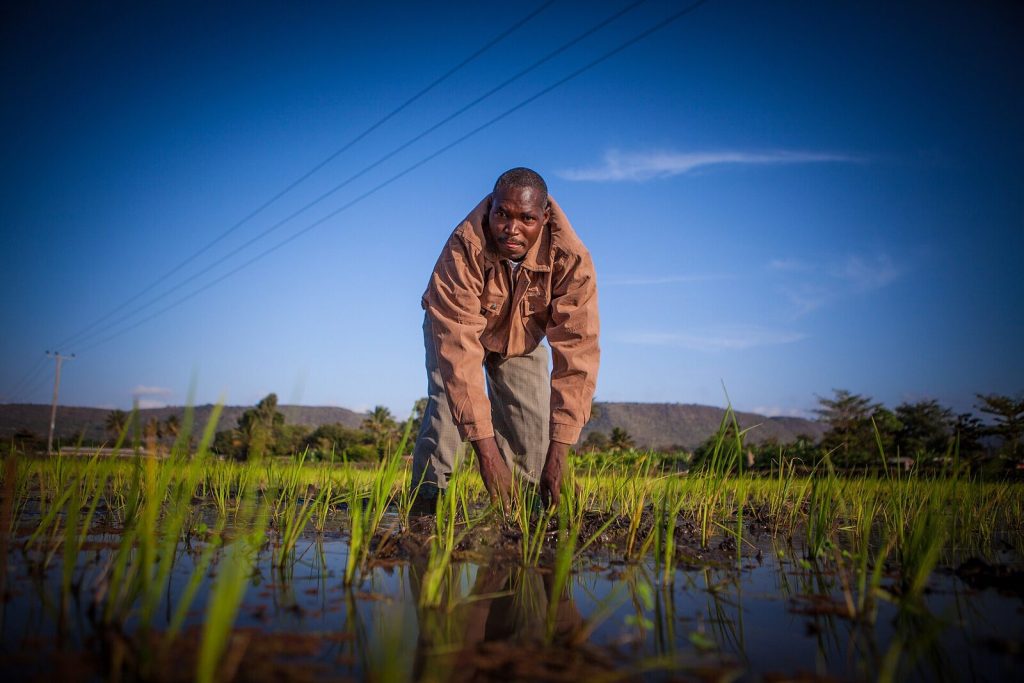
Rice farming in Uganda splits into two systems that want different land and different work: rainfed lowland rice in bunded wet fields, and upland rice living on rainfall alone. Seed rates, spacing and fertilizer schedules come from MAAIF and the National Crops Resources Research Institute, and all of them are written per acre. Most of the crop sits on wetland edges and low lying ground in the east and north.
What follows is built from the training material MAAIF and NaCRRI publish for extension workers, from the trial figures those documents carry, and from the national production series Uganda reports. Where two editions of the same government handbook disagree, both figures appear here with the disagreement named, because that is more useful than a confident number picked at random. Uganda's wider crop guidance sits in our crop growing guides.
Upland Rice and Lowland Rice: Which System Your Land Chooses
You do not really pick the system. The land does, and the deciding question is whether you can hold standing water. MAAIF's guidance is blunt about it: if you cannot keep standing water through the cropping season, plant upland varieties rather than lowland ones. Get that backwards and the crop fails in a way no amount of fertilizer repairs.
Position in the landform matters more than most growers expect. NaCRRI's own site selection leaflet puts an upland field on a slope at about 4 sacks an acre, the same field moved to lower lying ground at about 8 sacks, and a swamp position at about 12. The leaflet does not say what a sack weighs, so read those as a threefold spread rather than as kilogrammes. A separate trial in the earlier edition of the same handbook, run down a slope of about 30 metres, records 0.5 tonnes per hectare at the top, 3 tonnes midway and 5 tonnes at the bottom. The two sets do not match each other, so treat the span as three times to tenfold rather than a fixed multiple. The direction is not in dispute: water runs downhill and so does rice yield.
The physical marker is the water table. Rice planted where the water table sits shallower than 70 centimetres performs well, and you find that out by digging a hole, not by guessing. Note the oddity buried in the naming: MAAIF states plainly that upland varieties perform well under paddy conditions with standing water, so "upland" describes what the variety tolerates, not where it has to go. Planting an upland variety low is a deliberate move, and a good one. Planting any rice where the field floods hard is not, because young plants wash out.
Elevation and soil reaction rule out less land than people assume. The suitability mapping in NaCRRI's handbook treats ground below 1,000 metres as very suitable and 1,000 to 1,700 metres as suitable, with above 1,700 metres unsuitable. Soil pH of 5.5 to 7.0 is very suitable, 4.5 to 5.5 workable, and outside 4.5 to 7.0 unsuitable. The handbook adds that rice performs badly at pH 7.5 and above, and that most Ugandan soil gives no trouble on this score. Anyone telling you rice needs a narrow band around pH 6 is shrinking your options for no reason.
Irrigated rice is the smallest of the three systems by a long way. The area estimate MAAIF's handbook carries splits the national rice area into rainfed lowland at roughly three fifths, upland at roughly a third, and irrigated lowland at under a twentieth. Uganda's public schemes, at Mubuku in Kasese, Olweny in Lira and Dokolo, Doho in Butaleja and Agoro in Kitgum, are surface irrigated and were rehabilitated under government commitment to the sector. Surface irrigation is what rice uses, which our guide to irrigation farming in Uganda covers. Drip lines make no sense in a crop that wants a flooded field.
Rice Varieties Released for Ugandan Farmers
Uganda breeds rice, which sets the crop apart from most vegetables. NARO's licensed variety list carries eleven rice entries: NAMCHE 1 through NAMCHE 6, WITA 9, Komboka, Arize-1, Chinuga 1 and NERICA 4. Certified seed from a licensed company carries a NARO variety identification number on the packaging, and NARO warns that seed bought outside that route carries no quality guarantee from them.
Two extraction methods read that list identically and a third scrambles it, shifting variety names against their licence rows. So the variety names and their existence on the list are firm; which company holds which licence is not something this page will state, because the table cannot be read the same way twice.
Maturity periods and yield figures for the varieties MAAIF's handbook profiles:
| Variety | System | Days to maturity | Yield t/ha |
|---|---|---|---|
| NERICA 4 | Upland | 110 to 120 | 4.0 to 5.0 |
| NERICA 1 | Upland | 105 to 115 | 3.0 to 4.0 |
| NERICA 10 | Upland | 100 to 105 | 3.0 to 4.0 |
| NARIC 1 | Upland | 115 to 120 | 3.5 to 4.0 |
| NARIC 2 | Upland | 115 to 120 | 3.0 to 3.5 |
| NERICA 6 | Either | 130 to 140 | 3.0 to 5.0 |
| WITA 9 | Lowland | 140 to 160 | 5.0 to 6.0 |
Read those yields as per hectare, because that is what the source says. Divide by about 2.47 for an acre. NERICA 4 at 4.0 to 5.0 tonnes per hectare is roughly 1,620 to 2,020 kilogrammes an acre, and you will see the same numbers reprinted elsewhere as tonnes per acre, which multiplies them by nearly two and a half. More on that below.
NERICA came out of interspecific crossing between Asian and African rice at WARDA in the early 1990s. Its selling points are early maturity, drought tolerance, blast resistance and big panicles carrying around 300 grains. Worth noticing that the handbook prints "early maturity 90 to 100 days" as a NERICA characteristic on one page and 100 to 120 days for every NERICA variety Uganda actually released two pages earlier. The released varieties are the ones you can plant, so plan on 100 to 120 days for upland NERICA and 130 to 160 for the long lowland types.
NERICA 4 also travels under two other names, NARIC 3 and SUPARICA 2, which matters at an agro shop counter. Komboka appears as KOMBOGA in one handbook and Komboka on NARO's licence list. The handbook also names NARIC 1, NARIC 2, NAMCHE 1 to 6, OKILE and AGORO as available in Uganda without giving figures for them, and names K85, Supa and the retired Abilony as older material still in circulation.
What is not on any Ugandan list: basmati as a high yielding option, and IRRI varieties as such. The highest yielding variety MAAIF profiles is WITA 9, a lowland type at 5.0 to 6.0 tonnes per hectare. Nor is perennial rice something you can buy here. NARO's own announcements describe perennial rice research beginning in Uganda through a partnership with China, which is a research programme, not a variety in a seed shop.
How Much Rain Upland Rice Farming Needs
This is the single most useful number in the whole handbook and almost nobody repeats it. Upland rice grows well where five day total rainfall stays above 20 millimetres from sowing until about 15 days before harvest, roughly a 90 day stretch. Below that threshold the crop does not merely yield less. It collapses.
Between 15 and 20 millimetres there is a cliff, not a slope. That is why upland rice in a dry spell is not a reduced harvest but a wasted season, and it is why the handbook pushes you to plant low, where the water table props the crop up when the rain misjudges its timing. Two practical consequences follow. Bund the field so rain cannot run off it, and terrace a slope, because NaCRRI's terracing photographs show missing hills where there is no terrace, seed having been washed out by heavy rain.
Fertilizer interacts with this in a way that trips people up. MAAIF warns that a fertilized rice plant grows taller and needs more water, so if the rain fails after the plants have bulked up, the drought damage is worse than it would have been on an unfertilized crop. Fertilizing upland rice is a bet on the rest of the season's rain.
Land Preparation and Seed Preparation for Rice Planting
Rice seed is small. Upland fields want a fine tilth, because rough cloddy soil gives poor germination, and coarse sandy soils give poor yields regardless. Lowland preparation is a different craft. MAAIF asks for bunds of 30 to 60 centimetres and a levelled field, and the reason is not tidiness: a bund lets you control water, and water control is the cheapest weed control there is. Levelling gives even plant growth across the field, and where a plot is too large to level well the handbook says to split it into smaller pieces.
The lowland sequence runs repair the bunds, flood three to five days before tilling, till, flood again to rot the trash in, then puddle about a week after the first tilling. Puddling builds a hard layer below the root zone that slows percolation, which holds both water and nitrogen where the crop can reach them. Anyone advising you to make a rice paddy free draining has the physics inverted.
Seed preparation takes an afternoon and pays for itself. Float the seed in water and discard what floats, because empty grain cannot germinate and you cannot tell by eye. Then test germination: count 100 seeds, soak for 24 hours, wrap in wet paper for 48 hours, count what has sprouted. Below 80 percent, raise the seed rate. That is a rough field check rather than a laboratory count, and the difference between the two is set out in our guide on how to test seed germination.
Seed held from the last harvest may be dormant, and dormancy in rice runs from zero to eight weeks. The handbook's practical fix is drying on a concrete floor for two to three days, with the container left open. Store seed in a dark cool place, off the ground.
Rice Seed Rate, Spacing and Sowing Depth Per Acre
Upland rice takes 20 kilogrammes of seed per acre, and both editions of MAAIF's handbook agree on it. Lowland rice needs 15 kilogrammes per acre, sown on a nursery bed rather than in the field. If you meet a recommendation of 100 kilogrammes per hectare for broadcast rice, that is 40 kilogrammes an acre, double what Uganda's own guidance calls optimum. Our seed rate calculator converts between the units these recommendations arrive in.
Two sowing methods reach that same 20 kilogrammes by different routes. Drilling puts lines 30 centimetres apart with 20 seeds per foot along the line, which works out near one seed per hill at 30 by 1.8 centimetres and about 185 hills a square metre. Dibbling spaces holes 30 by 12.5 centimetres, about 27 hills a square metre, with seven seeds per hole. A forked planting rake made of wood or metal marks the lines and cuts the planting time. Broadcasting is the third option and the handbook is lukewarm about it, because you lose the row geometry that makes hoe weeding possible, and weeding is where this crop's yield lives.
Sowing depth carries a trade off worth working out before you set the hoe. Emergence falls steeply with depth in NaCRRI's own trial:
| Sowing depth | Emergence |
|---|---|
| 1 cm | 71.4 percent |
| 2 cm | 60.3 percent |
| 3 cm | 52.4 percent |
| 4 cm | 34.9 percent |
| 5 cm | 27.0 percent |
| 6 cm | 1.6 percent |
Shallowest is best for emergence, yet the recommendation is 2 to 4 centimetres in one edition and 3 to 4 in the other. That is not carelessness. Seed at 0 to 2 centimetres gets taken by birds and dries out, so the recommended depth buys protection at the cost of some emergence. Plant at 2 to 4 centimetres, which clears both editions, and accept that deeper than 5 centimetres delays maturity and thins the stand, because the plant has to build secondary roots in low oxygen soil.
Missing hills cost yield directly, so raise a small nursery beside the main field purely for gap filling and refill 15 to 20 days after sowing, watering the transplants in. In a lowland field, keep spare seedlings at the corner and replant gaps 10 days after transplanting.
Nursery Beds and Transplanting Rice Seedlings
Lowland rice goes through a nursery, and the nursery is where a lot of lowland yield is quietly lost. Prepare beds one metre wide, any convenient length, raised about 5 centimetres above the field with 40 to 50 centimetres of space between beds. A bed area of 100 to 150 square metres carries the 15 kilogrammes of seed that plants one acre. Sow at 100 grammes a square metre, or up to 200 in the later edition, and note that a heavy sowing rate makes late transplanting damage worse.
Pre germinate first: soak 24 hours in clean water, then incubate 30 to 48 hours in a sack kept moist and warm, which brings the whole lot up together. Then sow, keep a shallow water level once the shoots are three to four centimetres high, and deepen the water gradually as the seedlings grow. Never let the bed surface dry out. One edition says cover the sown seed with soil by pressing it down gently and the other says do not cover it at all, so treat that as unsettled and follow whichever your extension officer uses locally.
Then the part that matters. Seedlings are ready between 16 and 21 days after sowing depending on the edition, and both editions put a ceiling on it: transplant before 25 days. The penalty for waiting is quantified, and it is steep.
MAAIF turns that curve into a single line a farmer can carry: yield falls by about 28 kilogrammes per acre for every day transplanting is delayed. Run the arithmetic across the trial and it checks out, which is reassuring in a document that contradicts itself elsewhere. So advice telling you to transplant after 20 to 40 days in the nursery is, at its upper end, prescribing the loss of roughly half a tonne an acre. Rice starts tillering at about three weeks, and a plant still crowded in a seedbed at that point cannot feed itself enough to tiller.
Transplant in straight rows at 30 by 15 centimetres, which both editions carry and which gives about 22 hills a square metre. The earlier edition also allows 25 by 25 and 25 by 20 centimetres, and the later one allows 20 by 20, yet it prefers 30 by 15 for less transplanting work and easier weeding. Set three to four seedlings a hill at 3 to 4 centimetres deep. Deep transplanting delays rooting, cuts tillering and cuts panicles, and a seedling planted at 12 centimetres is simply wasted. If seedlings are too tall to stand up, cut off the tips rather than pushing them deeper. Mark the rows with a knotted rope stretched across the field, or drain the field the day before and use a line marker.
Weeding Rice: Where the Yield Is Won or Lost
Everything else on this page is secondary to what follows. NaCRRI ran NERICA 4 through five weeding regimes and the spread between the worst and the best is more than fivefold.
Two things about that top figure. The earliest edition labels it "weed free" and the two later ones relabel it "weeding four times", which are not the same treatment, so read it as what a clean plot can do and not as the return on a fourth pass. And notice where MAAIF's own recommendation sits. It asks for at least two weedings, which its own trial puts at 998 kilogrammes an acre, about 55 percent of the three weeding plot. The third weeding at nine weeks is the most profitable hour of labour in Ugandan rice and the standard recommendation leaves it out.
Weed pressure is not the same in every system, and knowing the ranking tells you where to budget labour. Damage runs heaviest in upland fields, less in rainfed lowland, least under irrigation. By establishment method it runs heaviest in dry seeded rice, less in wet seeded, least in transplanted. Most weeds cannot grow submerged, which is the whole argument for a bund: flood the field and a large share of the weed problem never germinates. Transplanted seedlings carry a further advantage, being about three weeks ahead of the weed seeds when those seeds do come up, and straight rows let you run a rotary weeder or a hoe without cutting the crop.
NaCRRI has catalogued 112 weed species from Ugandan rice fields, 78 broad leaved, 21 grasses and 13 sedges, with Luganda names where they exist. Two are parasites and they behave differently from everything else. Rhamphicarpa fistulosa, the rice vampire weed, known in Luganda as kayongo, is a root parasite of rainfed lowland rice that can take 60 percent of a crop and produces up to 10,000 seeds a plant. It cannot survive in upland or irrigated fields, so water management is the control. Striga asiatica attacks upland rice, also runs to more than 10,000 seeds a plant, thrives in dry soil, and the control offered is mixed cropping with legumes. Neither responds to the tactics that work on ordinary weeds, and both are worth identifying early.
On herbicides, the handbooks name the classes rather than a recipe, and this page will do the same. Glyphosate is non selective, applied before planting to the leaves, and it works poorly in dirty water. Butachlor is selective and soil applied before weeds emerge. Benthiocarb is selective and soil applied, usable before or after emergence. Propanil is selective and applied to the leaves after weeds emerge. The phenoxy herbicide 2,4-D is selective and applied after emergence, and it carries a specific warning: it suppresses rice tillering along with the weeds, so the handbook restricts it to the late crop, about two months after planting. Rates belong on the product label and nowhere else, and a local extension officer should confirm both the product and the timing for your field. Our guide to reading agrochemical labels covers how to work out what a label is telling you.
Fertilizer for Rice Per Acre, and When to Apply It
MAAIF's fertilizer schedule for rice is short, split, and different for the two systems.
For upland rice: 20 kilogrammes of DAP plus 20 kilogrammes of urea per acre at three weeks after germination, then 20 kilogrammes of urea per acre at eight weeks. For lowland rice: 25 kilogrammes of DAP plus 25 kilogrammes of urea per acre applied basally at transplanting or before the final harrowing, then 25 kilogrammes of urea per acre at panicle initiation. Urea carries 46 percent nitrogen and DAP carries 18 percent nitrogen with 46 percent phosphate, and the upland schedule works out at 55 kilogrammes of nitrogen and 23 of phosphate per hectare, a figure the handbook prints separately and which reconciles exactly against the rates. Those rates sit inside the wider bands Uganda's fertilizer optimisation sheets give for upland rice, which our page on urea fertilizer in Uganda sets out.
Three cautions, all from the source documents rather than from us.
The first is timing. Panicle initiation is a stage, not a date, and the three documents reviewed here put it at 45 to 50 days after transplanting, at 8 to 10 weeks after transplanting, and at 65 to 70 days after sowing. Those cannot all be the same moment. Work from the plant: the uppermost leaf sheath begins to swell, and that is your signal. The day counts are guides that drift between editions.
The second is water. Top dressing needs the field irrigated to 2 or 3 centimetres of standing water, held for about a week afterwards so the fertilizer does not run off. Apply urea to a dry lowland field and, in the handbook's own words, the application becomes useless. Drain the standing water before the basal dressing so it gets worked into the soil rather than lost to the air.
The third is that more nitrogen is not better. Excess nitrogen worsens rice blast, sheath blight and leaf scald, all three of which the handbook lists as controlled partly by not overdoing the urea. Rice also should not be grown continuously on the same field, and rotating it with another crop or working in rice straw and animal manure is the handbook's answer on fertility.
One wrinkle a careful reader will hit. A training manual built on the same MAAIF material carries two incompatible schedules four pages apart: the MAAIF one above, which contains no potassium at all, and a second that adds muriate of potash at 10 to 15 kilogrammes an acre and splits nitrogen three ways across basal, tillering and panicle initiation. The cost benefit worksheets in the older handbook are budgeted at 25 kilogrammes of DAP and 50 of urea an acre, which is above what the same document recommends. Ask your extension officer which schedule the district is using, and take a soil test before adding potassium on faith.
Rice Diseases in Ugandan Fields, Starting With RYMV
Rice yellow mottle virus is the disease that decides whether lowland rice works in eastern and northern Uganda, and it has no chemical cure. Not a hard one to treat. None. Anything sold to you as a spray for it is being mis sold.
RYMV occurs only in Africa, was first reported in Kenya in 1966, and is now widespread across the continent's rice growing regions. Uganda's eastern, northern and central rice areas all carry it, under both irrigated and rainfed lowland conditions. Symptoms move through pale yellow streaking on young leaves, then yellow mottling with stunting and fewer tillers, then leaf rolling and drying with dwarfed plants, and finally poor panicles and empty grain. Yield loss runs about 10 to 30 percent on a mild infection, 40 to 60 percent on a moderate one, and up to total crop failure where infection arrives early.
It is not carried in seed, which is useful to know. It moves on leaf feeding beetles, on tools, animals and people walking between fields, in irrigation water carrying infected debris, and in volunteer rice and wild grasses that bridge the gap between seasons. Wild rice relatives around the field are reservoirs. Continuous rice with no rotation, poor field sanitation, volunteer plants and overlapping cropping cycles in an irrigation scheme all favour it.
Which variety to plant is where the sources stop agreeing. Three editions of much the same Ugandan manual give three different tolerance lists and no variety appears on all three. NERICA 6, NERICA 4 and WITA 9 each appear on two of the three, which makes them the safest thing to ask for. NARIC 1, NARIC 2, NAMCHE 2 and NAMCHE 5 each appear on one. Since RYMV varies in aggressiveness between places, confirm current tolerance for your zone with NaCRRI or with the company whose seed you are buying rather than treating any list as settled. Direct sowing instead of transplanting cuts the damage, and all three agree on that. Roguing works only where a small share of plants is infected: pull them out and burn them, and clear volunteer rice and wild grasses from the field margins before planting.
Rice blast is the next one down, and it is a fungus rather than a virus. Spots or lesions appear on leaves, nodes, panicles and grain, elongated and pointed at each end. A severe infection takes about half the crop, and upland rice suffers worse than lowland. Control is resistant varieties, the NERICAs among them, plus keeping nitrogen in check. Fungicides that work exist, and the handbook's own judgement is that they are not worth the money in the tropics.
Sheath blight puts spots on the leaf sheath, is worse in heat and humidity, and takes 20 to 25 percent of yield in a bad case. No variety carries high resistance to it, so the lever is nitrogen again. Brown spot shows as brown marks on leaf and grain and points to a soil problem: poor drainage or a nutrient shortage. Fix the soil and the fertilizer and the disease recedes. It travels in infected seed, which is another argument for the flotation test. Leaf scald starts at the leaf tip and worsens with heavy flooding. Grain rot and sheath rot are both named in the handbook with an honest admission that little is known about controlling either.
False smut turns the odd grain into a velvety ball up to a centimetre across, and the handbook's line on it is almost cheerful: the weather that produces false smut is the weather that produces a good crop, damage is usually slight, and no control measures are needed. Do not spray for it.
Rice Pests, Birds and the Ratoon Question
Start with the rule the handbooks state twice: insect damage in rice usually does not call for chemical control, because it does not cut yield by much. That single sentence will save more money than any product on an agro shop shelf.
Stalk eyed fly larvae bore into the stem and kill the growing point, producing dead heart. Stem borers do much the same and also produce white heads, panicles that are empty and bleached. Rice bugs and stink bugs sit on the panicle and suck the milky grain, which stains it and drops its grade rather than its weight. Termites cut stems and bite hardest in dry soil. Rice leaffolder scrapes and folds leaves. Rice mealybug appears, and rice weevil is a storage problem rather than a field one.
Three pests have specific non chemical answers worth knowing. African rice gall midge attacks lowland rice, turning the leaf sheath into a tube called a silver shoot, and early planted fields take less damage than late planted ones, so planting on time is the control. Caseworm larvae float about the field in cases made of leaf and are killed by draining the field for four to six days. Snails attack transplanted seedlings in lowland fields: pick them off by hand, keep the field saturated rather than flooded for the first week after transplanting, and where damage is bad use four week seedlings instead of three week ones, accepting the yield cost to save the stand.
Birds are a labour problem, not a spray problem. MAAIF's answer is chasing by hand, and the useful detail is the window: bird scaring is needed only for about one month, from heading to harvest. The budgets in the handbook allow 30 days of it. Nobody should be spraying a crop within a month of harvest to move birds off it.
Now the ratoon, where two editions of the same government handbook flatly contradict each other, and the contradiction matters.
The later edition presents ratooning as an advanced technique: cut the first crop leaving 15 to 25 centimetres of stubble, keep water on it, and take a second harvest of about 0.4 to 1.0 tonnes an acre within 60 days, recommended where the rainy season runs about six months. The earlier edition, in its RYMV section, says to prevent ratoon growth because it is a main source of the virus. Both statements are MAAIF's.
They can be reconciled, and the reconciliation is the practical answer. A ratoon is a free 60 day crop where RYMV is not in the field, and a standing virus reservoir where it is. Since the same documents place RYMV as a severe problem in eastern and northern Uganda, and since overlapping cropping cycles are listed among the conditions that favour it, the defensible position is: ratoon only where you have seen no RYMV, and in the eastern and northern lowlands treat volunteer regrowth as something to clear rather than to harvest. Upland rice intercrops with maize, soybean, banana and coffee, which is a better way to get a second return off the same land, as long as the companion crop is not planted thickly enough to compete.
Harvesting, Drying and Milling Rice Without Losing Grain
Harvest when 80 to 85 percent of the grains have turned straw coloured and the grains low on the panicle have reached hard dough. Early and you get milling losses; late and the grain cracks, shatters into the field and feeds the birds. Cut the stems close to the ground with a serrated sickle, which is faster than taking panicles off with a knife and easier to thresh.
Thresh with a thresher where you can reach one, manual or engine driven. Beating the crop against a log with sticks leaves paddy behind in the straw and raises the share of broken grain once it reaches the mill. Winnow the empty grain and chaff out before drying.
Slow drying sounds like a counsel of patience and it is really a pricing decision, because broken rice sells below whole rice. The same logic runs through the mill. Ugandan sources put milling recovery at 60 to 67 percent, meaning 100 kilogrammes of paddy gives 60 to 67 kilogrammes of milled rice, and the spread between those two figures is worth more per acre than most input decisions. What moves you along it: how fast you dried, whether you threshed or beat, whether stones were removed by a destoner before milling, and whether you mixed varieties. Mixing varieties with different grain sizes and shapes lowers recovery, which is also why a mixed seed lot costs you twice. General grain moisture practice is covered in our guide to grain moisture management.
One gap worth stating rather than papering over: no Ugandan moisture standard for marketing paddy surfaced in the documents reviewed for this page. The figure that is published, and that our seed pages carry, is 13 percent as the safe maximum for storing paddy as seed. Ask your buyer what moisture they are buying at, and get it in writing.
Saving Your Own Rice Seed for the Next Season
Rice is self pollinated, and MAAIF states in plain terms that harvested seed can be used next season with no yield penalty as long as purity is maintained. That is a different situation from hybrid maize and it is worth taking advantage of.
The method is small and specific. Set aside a seed plot separate from the rest of the field: 100 square metres supplies the seed for one acre the following season. Working from a smaller start, 1 kilogramme of seed planted on 200 square metres yields about 50 kilogrammes, which plants about 2.5 acres the season after. Then walk the plot and pull out off types, the plants that are not the variety you want.
Off types show themselves by maturing at a different time, by plant height and shape, by stem colour, by whether the grain carries an awn, by the colour of the apiculus at the grain tip, and by grain shape and colour. The handbook illustrates the point with NERICA 1 and NERICA 4 side by side, separated by grain colour, maturity, whether the grain is hairy and whether it is fat or slim. Which of the two is which is not something the page can be read to say reliably, so compare your own two lots rather than trusting a remembered description. Impure seed costs you twice over: a crop that does not ripen together cannot be harvested in one pass, and grain of mixed size and shape mills badly.
What Rice Yields in Uganda Actually Are
The variety table above promises 3.0 to 6.0 tonnes a hectare. The national figures are nowhere near it, and any honest page has to say so.
Uganda's officially reported rice area has more than doubled over the past decade and a half, from about 87,000 hectares to about 230,000, with production rising from roughly 218,000 tonnes to roughly 365,000. Reported yield went the other way. It ran near 2.5 tonnes a hectare early in the series, fell to a low of about 0.94, and has settled around 1.2 to 1.6 tonnes a hectare. The production series carries an official flag throughout, while several of the area and yield observations are flagged as estimated or imputed instead, which is worth knowing before leaning on any single one of them.
Before anyone builds an argument on that collapse, look at where it happens. The drop concentrates in a single step, at the point where reported area jumped by roughly two thirds in one season with no matching rise in production. That is the signature of a change in how area is measured, not of farmers suddenly forgetting how to grow rice. So the useful statement is a span rather than a number: Uganda's reported national rice yield has run between about 0.94 and 2.59 tonnes a hectare, and the recent readings sit at the low end. Anyone quoting a single national yield figure for Ugandan rice is quoting one side of a break in the series.
Take the recent end of that span, about 1.2 to 1.6 tonnes a hectare, and convert it: roughly 500 to 640 kilogrammes an acre. Now set it beside NaCRRI's weeding trial. The national average lands below the plot weeded once, and at roughly a quarter to a third of the plot kept weed free. Read that carefully, because it is the argument of this whole page. The gap between what Ugandan rice varieties can do and what Ugandan rice fields do is not mainly a variety gap or a fertilizer gap. It is a weeding and transplanting gap, and both of those are labour.
Which brings us to the figures circulating in the Ugandan press. A national newspaper's rice guide gives average yields of "3 to 4 tonnes per acre" and a variety yield of "three to five tonnes per acre". Compare those against MAAIF's table. NERICA 6 is 3.0 to 5.0 tonnes per hectare and WITA 9, the best lowland variety on the list, reaches 6.0 tonnes per hectare. The newspaper figures are MAAIF's own per hectare numbers with the unit swapped, which inflates them by a factor of about 2.47 before anything else goes wrong. At 3 to 4 tonnes an acre you would be beating the highest yield MAAIF publishes for any released Ugandan variety by half again, on an average field.
The same guide then prices the crop at 2,500 shillings a kilogramme sold on the farm. That is a wholesale level for milled rice, not a farm gate level for paddy, and paddy and milled rice are different goods separated by a mill and by a third of the weight. Multiply an inflated yield by a price from the wrong rung of the ladder and you get the per acre earnings figures that draw people into rice and then disappoint them. Check the going rate on our rice price page and ask whether the quote is for paddy or for milled rice.
Frequently Asked Questions About Rice Farming in Uganda
How many bags of rice can I get from one acre in Uganda?
Honestly, it depends almost entirely on weeding and water rather than on the variety. NaCRRI's trial on NERICA 4 gives 378 kilogrammes an acre unweeded, 998 with the two weedings MAAIF recommends as a minimum, 1,815 with three, and 2,135 on a plot kept clean throughout. Uganda's recent reported national average works out around 500 to 640 kilogrammes an acre. The appraisal figures behind Uganda's rice irrigation planning use 700 kilogrammes an acre for an unimproved lowland acre and 1,000 for an unimproved irrigated one, rising to 1,600 with improved practice and 3,000 where two crops a year are possible. Plan on the lower end for a first season.
What does it cost to grow an acre of rice, and where does the money go?
The structure is more durable than any total, because labour dominates it. Across the four farm models in Uganda's rice irrigation appraisal, labour including family labour runs from 47 to 82 percent of the total cost of an acre. MAAIF's own worksheets put labour at about 58 percent of both an upland and a lowland acre, with slashing, digging, a second digging, planting or transplanting, two hand weedings, 30 days of bird scaring, and harvesting and threshing all charged as separate operations. Seed and fertilizer together come to under a quarter. One warning about the totals in those worksheets: the same shilling figures have been reprinted across three editions of the same handbook without repricing, so the per acre profit quoted from them is built on input and output prices that have long since moved. Use the line items, not the totals, and get current levels from the rice price page linked below.
Is rice farming profitable in Uganda?
At the appraisal's own numbers, yes, and it is more contingent than the enthusiasm suggests. The appraisal put farm gate paddy at 800 to 1,000 shillings a kilogramme against a cost of producing paddy of 550 to 625, and Kampala wholesale for milled rice at 2,250 to 2,520, so a farmer selling paddy was getting somewhere between a third and a half of the wholesale price per kilogramme before allowing for the fact that 100 kilogrammes of paddy becomes only 60 to 67 kilogrammes of rice. Its sensitivity analysis found that below about 700 shillings a kilogramme of paddy, the irrigated rice model stops being profitable. The appraisal was also explicit that rice profitability in Uganda leans on the East African Community import duty on rice, and that cutting that duty to a quarter or removing it would press domestic prices down and cut farm level profitability sharply, while still leaving the activity economically profitable on its own modelling. Those shilling figures are appraisal era, so treat the relationships between them as the useful part and check current levels yourself.
Should I grow upland or lowland rice?
Whichever your water allows, and the test is whether you can hold standing water through the season. If you can, lowland rice gives you higher yielding varieties and much lighter weed pressure, at the cost of a nursery, transplanting labour, bunding and levelling. If you cannot, plant upland varieties, put them on the lowest ground you have, bund the field so rain cannot run off, and accept that a dry spell can take the season outright. One caution on upland rice: Uganda's own agriculture cluster planning declined to promote it, on environmental grounds, while MAAIF's extension handbooks give it full technical coverage. Those two positions coexist in government material and you should know both before clearing land for it.
How long does rice take from planting to harvest?
Between 100 and 160 days depending on the variety. Upland NERICA and NARIC types run 100 to 120 days, NERICA 6 takes 130 to 140, and WITA 9 needs 140 to 160. Underneath that, the plant spends about 60 days in vegetative growth to panicle initiation, about 30 days from panicle initiation to heading, and about 30 more from heading to maturity. Match the variety to how long your rains actually last, working backwards from the date the rain usually stops, and note that upland rice needs its 20 millimetres every five days right up to about 15 days before harvest.
Can I plant seed saved from my own rice harvest?
Yes, and MAAIF says so directly: rice is self pollinated and saved seed does not lose yield provided purity is kept. Set aside a 100 square metre seed plot for each acre you plan to plant next season, remove off types by maturity, height, stem colour, awn, apiculus colour and grain shape, and store the seed dark, cool and off the ground. Test germination before sowing and raise the seed rate if it comes in under 80 percent. This is one of the real advantages rice holds over hybrid maize.
Why do my rice leaves turn yellow and the plants stay short?
Stunting with yellow mottling and reduced tillering is the classic picture of rice yellow mottle virus, and there is no chemical that cures it. It spreads on leaf beetles, on tools and animals moving between fields, in irrigation water and through volunteer rice and wild grasses that carry it between seasons. Management is preventive: plant a tolerant variety, with NERICA 6, NERICA 4 and WITA 9 the names that appear on more than one Ugandan tolerance list, sow directly rather than transplanting where you can, clear volunteer rice and wild grasses from field margins, rotate out of rice, and pull and burn infected plants while only a few are affected. Yellowing of the lower leaves without stunting is a different matter and points at nitrogen instead.
Do I need to spray rice for insects?
Usually not. MAAIF's handbooks state, in both editions, that insect damage in rice does not normally warrant chemical control because it does not cut yield by much. Several of the real problems have answers that cost nothing: draining the field for four to six days kills caseworm larvae, planting on time reduces African rice gall midge, snails can be picked off and managed with water depth, and birds are chased by hand over the single month from heading to harvest. If a genuine outbreak needs treating, the rate is on the product label and a local extension officer or agricultural officer should confirm both the product and the timing before you buy anything.
Where does rice grow in Uganda?
Mostly in the east and north, on wetland margins and low lying ground. In the district tonnages behind Uganda's agriculture cluster planning, the largest recorded rice production sits in Iganga, Soroti and Serere, Pallisa, Amuru with Nwoya, and Tororo, with Hoima, Bugiri, Butaleja, Namutamba and Gulu recording smaller volumes. Butaleja is the district most often named for rice because the Doho scheme is there, yet it records less in that table than several of the others, which is a reminder that a famous scheme and a large district crop are different things. The public irrigation schemes are Mubuku in Kasese, Olweny in Lira and Dokolo, Doho in Butaleja and Agoro in Kitgum.
Before you commit land, get two things straight: the current paddy price in your own district and whether the quote is for paddy or milled rice, and where you will buy certified seed of a named variety. Current levels sit on our rice price page, and the agro input side is covered in our supplier directory. Prices for paddy move with the season and with how far you are from a mill, so ask more than one buyer and weigh your own bags before you sell them.