
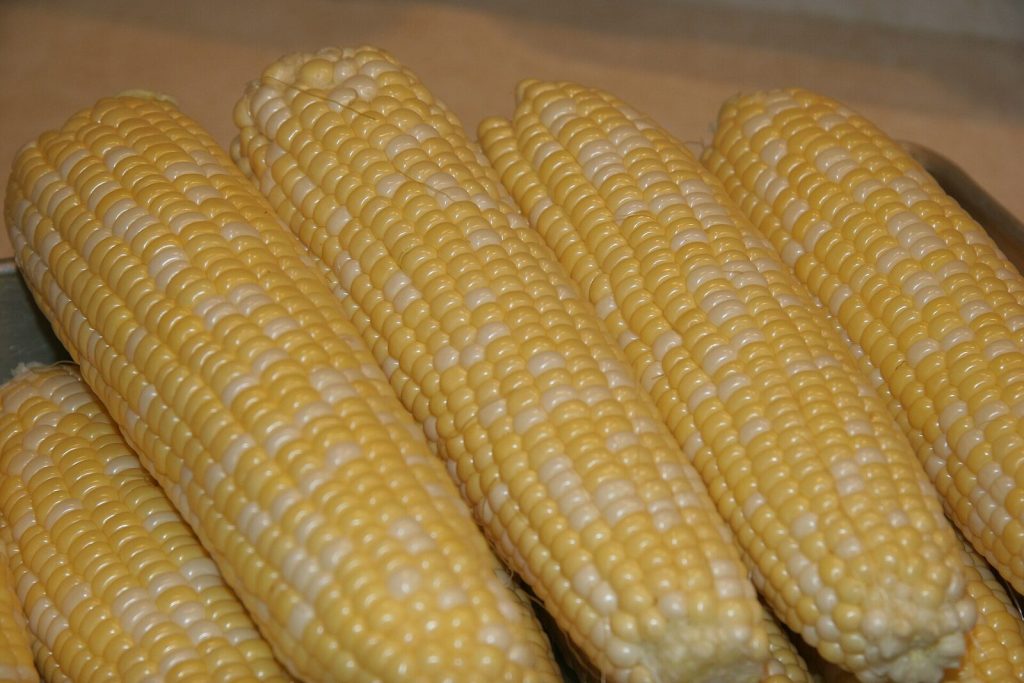
Maize leaves a Ugandan field at 18 to 24 percent moisture and has to reach 13 percent or below before it is bagged, and drying maize is the work of closing that gap without letting the crop touch bare soil. Cobs dry on mats, tarpaulins, a cemented floor or in a ventilated crib, shelled grain finishes on the same surfaces, and a meter settles the argument at the end.
Knowing When Maize Is Ready to Harvest and Dry
Drying starts with a harvest date, because grain picked too early never dries properly and grain left standing too long has already started feeding pests. The ministry's manual lists the signs of full physiological maturity: the stalk and cob sheath turn brown, the ears droop and bend downwards on most varieties, the grain is hard with a floury texture when you bite it, and a black layer forms at the tip of the kernel. Where a meter is available, the grain reads between 18 and 24 percent at that stage.
Two practices the manual warns against at this point cost money later. Throwing cobs onto bare ground and collecting them in dirty containers raises the risk of aflatoxin and other contamination before drying has even begun, and late harvesting invites pests and rotting. Collect into clean containers, onto a tarpaulin or a mat laid under the plant.
The Moisture Content Maize Grain Has to Reach
There are three numbers in play and mixing them up is where farmers lose either weight or a grade.
| Stage | Moisture | What it governs |
|---|---|---|
| At harvest | 18 to 24 percent | Physiological maturity |
| At shelling | 16 percent or below | Breakage |
| Before bagging | 13 percent or below | Storage and grade |
The bagging figure is the one with an argument attached, and it is worth knowing both sides of it. The published grain standard sets a single maximum moisture that applies to all three grades, and it appears at two values in two editions: 13.0 percent in the edition of the East African standard reproduced in a joint FAO, WFP and IFAD study of Ugandan food loss, and 13.5 percent in the fifth edition of the maize grain specification and in the table printed in the ministry's current maize manual. The ministry's separate guidance to traders also uses 13.5 as a storage ceiling. Dry to 13.0 percent or below and no edition can be quoted against you.
The manual is not perfectly consistent with itself here either. Its harvesting chapter says to make certain the moisture is at or below 13 percent before bagging, while its shelling section says to dry shelled grain to "less 13 to 14 percent". Aim at 13. And treat about 14 percent as the level where storage fungi start growing rather than as a target, because that is the biology the trade ceiling is buying margin against. Whether the bet on storage pays afterwards is worked through in the maize storage guide.
Drying Maize on the Cob Before Shelling
Most Ugandan maize dries twice: once on the cob and once as grain. The first stage is where a crib earns its keep. The manual recommends drying cobs in a well ventilated crib because it keeps them off the ground, away from animals and under cover when the weather turns, while air keeps moving through the stack. Hanging cobs is the same principle with no construction cost.
Shelling is the reason cob drying matters. Cobs that are properly dry shell easily, and grain shelled at 16 percent moisture or below breaks far less. Beating cobs with a stick to get the grain off is the practice the manual tells farmers to avoid, because broken grain attracts fungal infection and insect infestation, and once a kernel is cracked no amount of later care undoes it. Machine options and what each one is good for sit with maize shelling machines.
After shelling, the grain goes back out to finish. This second stage is short compared with the first, but it is the one that decides the number the buyer's meter reads.
Drying Surfaces: Anything Except Bare Soil
The instruction in the ministry's manual is that cobs and grain dry on mats, tarpaulins or a cemented floor so that they are not in contact with the ground, with farm animals kept away. Drying yards, drying racks and collapsible dryers all appear in its own photographs. The reason is not tidiness. Soil contact is a route for the moulds that produce aflatoxin, and animal droppings in a drying heap are a contamination the grain carries into store.
The Drying Routine, Day by Day
Four instructions carry the whole operation and they come straight from the ministry's drying section. Turn the grain regularly, which speeds drying and makes it even. Keep animals away. Protect the crop from bad weather by covering it with tarpaulins or keeping it under a ventilated structure. And do not let dry grain get wet again, which means covering before the rain rather than after it starts.
Rewetting is the failure that costs most, because it is invisible a week later. Grain that reaches 13 percent, takes a shower and then dries again is not the same grain: the moulds had their window. In a bimodal season, plan the drying site so one person can cover the whole lot in a few minutes, and plan the volume so you are not drying more than you can cover.
Monitor as you go rather than testing once at the end. The manual asks for close monitoring of moisture content through the whole operation, which in practice means a reading every day or two towards the end rather than an inspection on the day the buyer arrives.
Checking Whether Maize Is Dry Without a Meter
Most Ugandan smallholders do not own a moisture meter, and the manual lists the traditional checks alongside the instrument rather than pretending they do not exist. It also calls them non standard, which is the right description.
None of these resolves 13 percent against 14, and that gap is where a deduction lives. The salt test tells you when you are still clearly wet, which is genuinely worth knowing, and then a meter tells you when to stop. A shared meter in a farmer group is the cheapest way most smallholders get to a real reading, and the reading itself, including how to take a representative sample, is covered under grain moisture management.
Solar and Mechanical Drying of Maize Grain
Mechanical drying blows hot air through grain under controlled conditions, with the heat coming from burning fuel, solar, electricity or biomass. Its advantage in Uganda is not speed for its own sake. It is the ability to dry a lot during a wet spell, when an open yard cannot finish and the clock on mould has already started.
On temperature there is a gap in the published guidance that is worth stating plainly rather than filling in. The older ministry edition instructs the operator to keep the air temperature monitored and not to exceed a stated ceiling for maize grain, but the figure as printed in that document is typographically broken and cannot be read as written, and the current edition drops the instruction altogether. So no temperature is published on this page. What survives both editions is the direction: the ceiling is low, hot air dries the outside of a kernel faster than the inside, and grain dried too fast or too hot cracks and loses grade. Follow the temperature setting in the machine's own operating manual, and where a dryer is hired, ask the operator what setting they are running and why. Equipment options are compared under grain dryers.
Seed is stricter than grain. The manual notes that seed driers can be used to reach the recommended moisture content, and anything destined for planting should be treated as a separate lot dried more gently, because heat damages the germ before it damages the endosperm.
Over Drying and Under Drying Both Take Money Off the Load
Under drying is the familiar loss: moisture above the ceiling gets discounted, refused, or accepted and then docked, and the deduction is calculated on the buyer's meter rather than yours. Over drying is the quieter one. Water is weight you are paid for up to the ceiling, so grain taken to 11 percent has given away kilogrammes for nothing, and brittle over dried grain cracks during shelling and handling, which pushes broken kernels towards the grade limit.
The grade table is unforgiving on that particular defect. Broken kernels are capped at 2.0 percent for Grade 1, 4.0 for Grade 2 and 6.0 for Grade 3, which means two kilogrammes of cracked grain in a hundred uses up the entire top grade allowance. Drying to the target and stopping is the whole skill.
Drying loss has been measured in the Ugandan chain at around 3 percent as a district mean, and the wider reading is worse: drying, shelling and on farm storage losses together came to 26.8 percent in one northern district against 7.2 percent in another, on the same measure. The gap between those two districts is not weather. It is practice, and most of it is drying practice.
Cleaning Maize After Drying
Drying and cleaning belong together, because the grade is read on what is in the bag rather than on how dry it is. Winnow the grain or pass it over a sieve to take out broken grain, chaff and foreign material, then sort out insect damaged, mouldy and discoloured kernels by hand. The manual gives a 4.5 mm mesh as the sorting screen.
Rates are worth knowing before you plan a day. One person winnowing traditionally cleans about 100 kg an hour. One person working a screen mounted on a wooden frame cleans about 500 kg an hour, which is why bulking sites use screens. Motorised cleaners handle above a tonne an hour and belong to warehouses and seed companies rather than to a smallholding.
Foreign matter is capped at 0.5 percent by mass for Grade 1, and filth at 0.1 percent across all three grades, so an afternoon of winnowing is not housekeeping. It is the difference between two grades on the same heap of maize.
Cooling and Bagging Dried Maize
Grain that has been in the sun all day is warm, and warm grain sealed into a bag makes its own condensation. Let a lot cool before it is bagged, then bag it, then weigh it on a calibrated scale and write the weight down against that lot. Bags going into store should be treated as the manual instructs, stacked on pallets rather than on the floor, and never left in a room with paraffin, pesticides or charcoal.
Weigh in kilogrammes, not in bags. The grain standard caps a package at 50 kg while measured Ugandan trader bags have averaged about 122 kg and reach 140 packed tight, with no premium paid for the extra weight, so a drying record kept in bags cannot be turned into a cost per kilogramme by anyone. The same applies to tins and basins. A farm weighing scale is the instrument that makes a drying operation measurable, and current market levels are on the maize price page.
Frequently Asked Questions
How long does maize take to dry in Uganda? There is no fixed number, because it depends on the weather, the layer depth, how often the grain is turned and whether the crop is drying on the cob or as grain. Plan around the moisture reading rather than a day count, keep the drying site small enough to cover in minutes, and treat a long overcast spell as the trigger to look for a crib, a ventilated structure or a dryer.
Can I dry maize on a tarpaulin during the rainy season? Partly. A tarpaulin works on dry days and doubles as the cover, but through a genuinely wet spell an open surface cannot finish the job and the risk of mould rises with every day the grain sits damp. Cob drying in a ventilated crib keeps going through weather that stops a yard, which is why the manual recommends one.
What moisture should maize be at when I shell it? The manual says 16 percent or below for shelling, then dry the shelled grain down to 13 percent or below before bagging. Shelling wetter than that gives incomplete threshing and damaged grain, and shelling far drier makes kernels brittle so they crack.
Do I need a moisture meter, or is the salt test enough? The salt test tells you when grain is clearly above about 15 percent, which is useful, and it cannot tell 13 from 14. Since the deduction lives in exactly that gap, a meter is what settles a sale. Shared ownership in a group is how most smallholders get access to one.
What does drying maize cost per acre? The ministry's own maize budgets carry drying as a line, at 12,000 to 45,000 UGX per acre across its four production systems, with tarpaulins at 20,000 to 80,000 and bags at 12,000 to 35,000 on the same basis. Those are planning figures from a training budget rather than quotations, and hire rates for a dryer are set locally, so ask for a written rate per tonne and compare it against what a mould damaged lot would cost you.
Is sun dried maize worth less than machine dried maize? No. The standard specifies a moisture content, not a method, so correctly sun dried grain and correctly machine dried grain meet the same specification. What buyers discount is grain above the ceiling, grain with broken kernels, and grain carrying soil, mould or a bad smell.
Can I dry maize and beans on the same tarpaulin? Not in the same batch, and be careful with the figures too. Dry beans are graded against their own specification with a moisture ceiling of 14 percent and their own defect limits, so a number lifted from a bean table onto a maize load looks perfectly reasonable and is wrong. Dry each crop separately and read each crop's own sheet. Beans are covered in the bean storage guide.
Drying well is a question of surfaces, cover and one instrument you can trust. Ask to see a moisture meter working on your own grain before paying for it, get a written rate before hiring a dryer or a sheller, and compare current prices from more than one equipment and packaging supplier, since both move with the exchange rate. This page sits in the value addition guides, and the growing side is covered in the complete maize growing guide.