
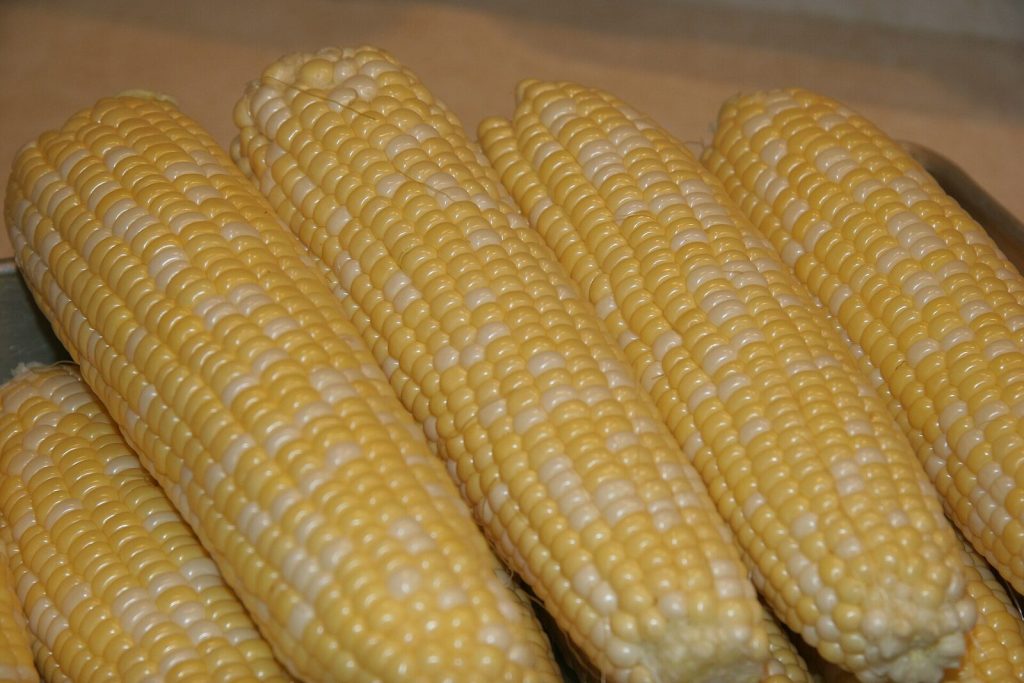
Storing maize in Uganda is a bet on time, and the grain has to be dry enough and clean enough to still be worth selling when the bet pays. Grain goes into store at or below 13 percent moisture, in a clean ventilated building, stacked off the floor and checked on a schedule. Everything below is about the two things that decide the outcome: moisture and months.
What Storing Maize Actually Buys a Ugandan Farmer
Maize is one of the few Ugandan crops where holding the harvest is genuinely worth the trouble. Working through the monthly commodity price series in MAAIF's Statistical Abstract, white maize grain swings about 29.2 percent between its dearest and cheapest month, while dry beans move only 7.9 percent and unpounded groundnuts 5.9 percent. One northern Ugandan study measured the price a farmer got climbing to roughly 60 percent above the immediate post harvest level after six months, and climbing steadily rather than jumping at the end.
That is the whole argument for a maize store. In beans the same six months of storage chase a gain smaller than the weight and quality you stand to lose, which is why a bean store is about loss avoidance and a maize store is about price. The bean storage guide takes that crop on its own terms.
Two conditions sit on the maize figure. These are market prices rather than farm gate prices, so read the shape of the movement rather than the number you will be offered, and check the current maize price before committing to a month. And the gain only exists if the grain survives. Storage that does not keep grain dry does not produce a later price. It produces grain nobody will buy.
The Moisture Content Maize Must Reach Before Storage
The ministry's maize manual is blunt about the gate: before bagging for storage, make certain the moisture is at or below 13 percent. Its own drying section repeats 13 percent as the recommended level, then, a page later, describes drying shelled grain to "less 13 to 14 percent", which is one of those internal disagreements worth knowing about rather than papering over. Take the lower number.
The published grain standard gives the trade ceiling, and it gives it at two values. The specification table in the ministry's current maize manual caps moisture at 13.5 percent across all three grades, while the edition of the same East African standard reproduced in a joint FAO, WFP and IFAD study of Ugandan food loss gives 13.0 percent. The ministry's own aflatoxin booklet for traders tells them not to store produce above 13.5. Dry to 13.0 or below and you clear every published edition, which is the direction to err in for grain that has to sit through a season.
Above about 14 percent is where storage fungi become active, so the trade ceiling is not an arbitrary line drawn by a committee. It is a margin against biology. Measurement itself sits on the grain moisture page, and how to get grain down to the target is the maize drying guide.
Grading Maize Grain, and Why Two Editions of the Table Disagree
The specification a Ugandan buyer grades against is the East African standard for maize grains, and its table sets a maximum for each defect at each of the three grades. Read firsthand from the current ministry manual, the table caps broken kernels at 2.0 percent for Grade 1, 4.0 for Grade 2 and 6.0 for Grade 3, filth at 0.1 percent across all grades, and foreign matter at 0.5, 1.0 and 1.5 percent. Two kilogrammes of cracked grain in a hundred is the entire allowance at the top grade.
| Characteristic | Grade 1 | Grade 2 | Grade 3 |
|---|---|---|---|
| Broken kernels | 2.0 | 4.0 | 6.0 |
| Foreign matter | 0.5 | 1.0 | 1.5 |
| Pest damaged | 1.0 | 3.0 | 5.0 |
| Filth | 0.1 | 0.1 | 0.1 |
All figures are maximum percent by mass. The total defective line is where the editions part company. The current manual's table gives 5, 9 and 14 percent and carries a note explaining that total defectives are not the sum of the individual defects but are limited to 70 percent of that sum. The edition reproduced in the FAO study gives 4, 5 and 7, and a regional training manual renders the same limit again as kilogrammes per hundred kilogrammes. Three renderings of one line. So ask your buyer for the grading sheet they actually work to before you argue about a deduction, and keep broken kernels low regardless, because every edition agrees on that row.
One trap worth naming, because a wrong row looks perfectly well formed. The same FAO study carries a near identical grading table for dry beans at 14 percent moisture with defective limits of 2, 3.5 and 5.5. Lift a line from it onto a maize decision and nothing about the sentence will look wrong. Worse, the older edition of the ministry's maize manual, which is still served, heads its maize grading table "Specific requirements for dry beans" and heads a section about shelling maize cobs "Drying of beans in the pods". The current edition has corrected the table heading to maize grain. Check the crop named on the table, then check the crop the values belong to.
Choosing a Maize Store: Bags, Cribs, Silos and Hermetic Storage
The ministry's manual splits Ugandan storage into traditional and modern. Traditional covers mud and wattle granaries, baskets and pots, and the manual says plainly that these cannot hold grain over a long period. Modern covers jute bags, hermetic options including plastic and metal tanks, cocoons and triple layer bags, and then warehouses and grain stores for volume.
Hermetic storage is an airtight container that cuts off the exchange of oxygen and moisture between grain and air. The manual's claims for it are worth quoting in substance: it removes the need for chemicals against storage pests, insects already in the grain die of suffocation, maize can be held safely for more than twelve months, and open pollinated seed keeps its viability. For long holds, the manual's instruction is hermetic. The hermetic bag page goes into the bag itself.
Building side, four things matter and one is counterintuitive. The roof must not leak, because a leaking roof is named in the manual as a direct route to mould and aflatoxin. The floor should be impermeable and easy to clean. The walls should be cleanable. And the store needs enough ventilation to move air through and cool the grain, though the manual says plainly that fans, cyclones and transparent sheets are not recommended in grain storage structures. Good storage does not improve grain. It holds what arrived.
Receiving, Stacking and Checking Stored Grain
Grain coming into a store is a transaction even when it is your own crop, and the manual sets out the sequence: inspect the bags for signs of non conformity, sample from several bags, test the samples against the standard, and only then offload, weigh and record. Sampling before testing is the step most often skipped, and it is the step that stops one wet bag being discovered three months later in the middle of a stack.
Then the store gets inspected on a schedule rather than when something smells wrong. Check for water leaks, cracks in the floor, rodent or insect damage to bags, spilled grain, live insects. Clear bush around the building, keep rubbish away from it, fit rat guards on any store standing on poles, screen the ventilators, and keep the door shut except when the store is in use. First in, first out, so no lot is quietly ageing at the back.
Two hard separations. Non food materials belong in a different building, and the ministry's trader guidance names petroleum containers, pesticides and charcoal by name. Where a store holds more than one crop, stack each crop separately. No smoking, and no flammable material near food grain.
Aflatoxin Is the Risk That Grows While Maize Sits in Store
Aflatoxins are poisons made by moulds that attack maize in the field and in poorly dried or poorly stored grain. The ministry's manual states the consequences directly: stunting in young children, cancer in humans, heat stability that survives cooking and boiling, and rejection of grain on the market once levels pass the acceptable level. Broken grain and insect damaged grain are the entry points, which is why shelling gently and winnowing properly is a food safety operation and not a cosmetic one.
Ugandan measurements exist and they are worth reading as counts rather than as a single headline. In the FAO, WFP and IFAD Ugandan chain study, more than 70 percent of maize samples held four months in a rural trader's store carried aflatoxin above 30 parts per billion, while after three months on farm, 40 to 50 percent of samples in one district and 30 percent in another exceeded 10 parts per billion. A separate Ugandan market survey found 62.8 percent of 108 maize product samples above 20 parts per billion, with cobs the worst category.
Read those carefully, because each study counts samples against a different threshold. Uganda's own regulatory ceiling is 10 micrograms of total aflatoxin per kilogramme, with a tighter limit on aflatoxin B1, and that is the number a buyer rejects against. The 20 and 30 figures are thresholds researchers chose for their own comparisons, not alternative legal limits. Anyone who tells you there is one universally quoted Ugandan aflatoxin number is simplifying three different documents into one.
Control is all upstream of the store. Dry properly, receive only grain at the recommended moisture, refuse chaff and soil and stones and mouldy or discoloured grain, keep broken grain out, and redry periodically if the store is humid. The manual also names a biological control agent applied in the field where it is available, and mould resistant varieties where they exist, both of which are decisions made long before the store. Confirm availability and registration with your district extension officer rather than from a poster.
Storage Pests and What Pest Control Is Legal
Weevils, larger grain borers, grain moths and beetles all attack stored maize, and rodents follow. Pest activity raises humidity inside the stack, which sets up the fungal growth described above, so an insect problem becomes a mould problem if it is left. Hermetic storage handles insects without chemicals by suffocating them. Detailed control sits on the page about preventing weevils in stored grain.
Two rules govern chemical control, and for a farmer holding grain to sell later, both of them are calendar rules rather than budget rules. The first is that fumigating in Uganda is work reserved to an operator holding official certification, which is how the law treats a substance lethal to people and not merely to insects. So a stack that starts to turn in week nine does not get treated in week nine. It gets treated when a certified operator is free. The second is that once anything has been applied, a stated holding period runs before that grain may be used, eaten or traded, and the length of it belongs to the product label and to the person who applied it rather than to a page like this one.
Put those two intervals end to end and a chemical intervention can push your sale date out by weeks, in a decision whose whole purpose was to choose the week you sell. Which gives a planning rule worth more than any product name: build the hold on the assumption that no chemical rescue is available in time to matter. The lever that does work sits at intake, in the moisture the grain went in at and the container it went into. What the ministry recommends against storage pests, where its own annex contradicts that advice, and why airtight bags outperformed treated ones in trial are all on preventing weevils in stored grain.
Weighing Maize In and Out of the Store
A bag is not a unit of weight in Uganda. The grain standard caps a package at 50 kg, while measured trader bags have averaged about 122 kg and reach 140 kg packed tight, with no premium paid for the extra weight. So a store recorded in bags cannot be reconciled with anything, and a quantity recorded in tins or basins cannot become a cost per kilogramme no matter how carefully the rest of the book is kept.
A sale nobody weighed is a price somebody else set. Where a trader brings the only scale, the farmer is taking the buyer's word on the one number the whole transaction turns on, and Ugandan farmers in the chain study named the manipulation of measuring tools as the single most important cause of loss at the point of sale. A shared scale in a group changes that from an argument into a measurement, and farm weighing scales covers what to buy.
Inside the store, the records the manual asks for are simple and they are what turn storage into a business: a stack card fixed to each stack showing the number and weight of bags added or taken out, an incoming ledger, an outgoing ledger, quality control records, cleaning records and fumigation records. Weigh grain in, weigh it out, and the difference tells you what your store cost you in weight.
How Long to Hold Maize, and How to Decide When to Sell
The gain from holding maize is real and so is the loss, and they are measured on the same crop. The East African Grain Council puts Uganda's annual post harvest maize loss at roughly 20 percent of the crop as a national aggregate. A Ugandan study across three districts in different agro ecological zones put post harvest maize loss at 41 percent, with storage the worst single stage, and that figure is farmer estimated across those districts rather than a national count. Both are worth holding, and the difference between them is mostly basis rather than disagreement.
District detail sharpens it further. In the FAO chain study, drying, shelling and on farm storage losses combined came to 26.8 percent in one district against 7.2 percent in another, a factor of nearly four on the same measure. A 60 percent price gain over six months survives a 7 percent loss comfortably. It does not survive 27 percent plus a mould discount.
Sell in lots rather than trying to call the peak. Splitting a harvest across several sales through the season collects most of the average seasonal gain without requiring you to be right about any single month, and it keeps some cash arriving while the rest of the crop is still earning. Buyers and channels are listed under where to sell maize.
Storing Maize as a Group or Against a Warehouse Receipt
Two routes exist for farmers whose own store is the weak link. Group bulking pools volume, which attracts buyers who will not stop for ten bags, and the ministry's manual lists the advantages and the failure modes side by side: better bargaining power and access to cross border and institutional buyers, against the difficulty of agreeing decisions, poor record keeping, theft from a poorly sited bulking shed and the capital a shared store needs. Synchronising harvest and sorting across members is what makes the pooled lot gradeable.
The second route is the warehouse receipt system, where grain is deposited in a certified warehouse and the depositor receives a document proving that a stated quantity and quality is held in their name. The manual's case for it is that it gives storage to farmers who have none, lets them sell when conditions are better, and provides access to cash against the receipt rather than against a land title. Institutional arrangements in this area have been reorganised recently, so confirm the current position and the certified warehouses near you with your district commercial office rather than assuming a scheme is still running as described.
Frequently Asked Questions
How dry does maize need to be before I bag it for storage? At or below 13 percent moisture. The published grade ceiling is quoted at 13.0 in one edition of the East African standard and 13.5 in the edition printed in the current ministry manual, so 13.0 satisfies both, and above 14 percent storage fungi become active.
How long can I keep maize in store? In hermetic containers the ministry's manual says more than twelve months, without chemicals, and with open pollinated seed keeping its viability. In woven bags in an ordinary room the answer depends on the moisture it went in at, the roof and whether you are checking it, and a few months is a realistic expectation rather than a year.
What does a maize store cost to set up on a smallholding? The ministry's own maize budgets give some of the lines per acre rather than per store: bags at 12,000 to 35,000 UGX, tarpaulins at 20,000 to 80,000, and drying at 12,000 to 45,000, with the range across its four production systems from a no input acre to a high input one. Hermetic bags, pallets, a moisture meter and a scale are priced locally and move with the exchange rate, so collect three written quotations on one specification rather than budgeting from a figure on a page.
Can I just store maize on the cob instead? Yes, and a ventilated crib is the ministry's recommended way of doing it, because it protects the cobs from animals and weather while air moves through. It is a drying and holding arrangement rather than long term storage, and grain still has to come down to the storage moisture before it is bagged.
Is it safe to store maize in the same room as fertilizer or paraffin? No. Non food materials belong in a separate store, and the ministry's trader guidance names petroleum containers, pesticides and charcoal. Grain takes up smells and chemical residues, and a buyer who detects either will treat the whole lot as contaminated.
My grain has some mouldy kernels. Can I sort them out and sell the rest? Sorting and winnowing out mouldy, insect damaged and discoloured grain before storage is exactly what the manual asks for, and it lowers the risk in what remains. It is not a cure for a lot that has already grown toxin, because the toxin is heat stable and is not confined to the kernels that look bad. Grain with a bad smell should not go into a store at all.
Does better grading get me a better price for maize in Uganda? Be careful with this one, because the honest answer is crop specific. In the Ugandan districts studied, bean grades were paid differently, with Grade 3 fetching up to 40 percent less than Grade 1, while for maize in the same districts the study recorded no price incentive for quality at all except from large institutional buyers working to formal standards. So grade maize to avoid a deduction and to reach the buyers who pay on specification, rather than in the expectation of a premium from the trader at the roadside.
Storing maize well is mostly equipment: a meter you trust, a calibrated scale, pallets, tarpaulins and a container that shuts. Prices and availability vary by town and by season, so compare current quotations from equipment and packaging suppliers, ask to see a moisture meter working on your own grain before you pay for it, and check what your buyer's grading sheet says before you agree a deduction. The rest of this section sits in the value addition guides, and the crop itself is covered in the complete maize growing guide.