
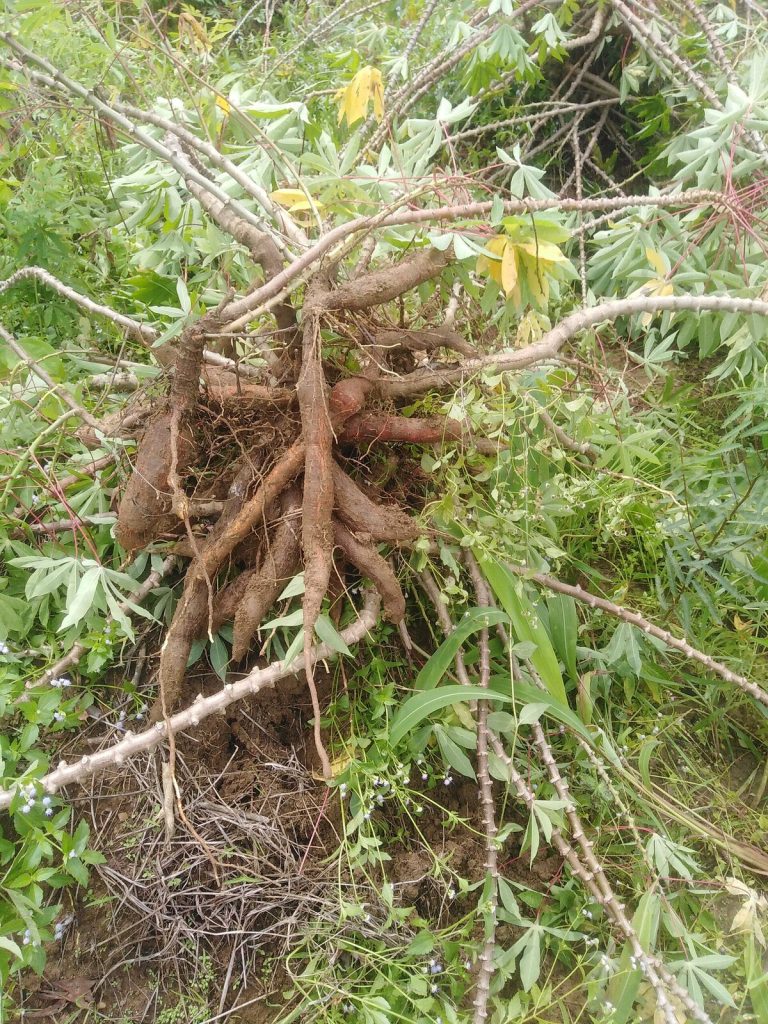
The best cassava varieties in Uganda are NARO's released NASE and NAROCASS lines, and the reason to seek them out is disease resistance rather than yield. Uganda carries two damaging cassava virus diseases and the released varieties were bred against them. The harder problem is identification: variety names in Ugandan cassava do not reliably tell you which plant you have, which is where a buying decision actually starts.
Start with a number. A genotyping study of 547 cassava samples collected from 192 smallholders across four Ugandan districts found 86 genetically distinct varieties. The farmers had 156 names for them. The single largest genetic group, turning up 80 times in the sample, carried up to 32 different names.
Why a Cassava Variety Name Does Not Identify a Variety
That mismatch is not carelessness on anyone's part. Cassava is propagated by cuttings, cuttings move between neighbours and markets, and a plant that arrives in a village without paperwork gets called something local. Do that for a few decades and the naming system drifts until it is describing where a plant came from rather than what it is.
Three findings from that study are worth carrying into a purchase. Most varieties are local in the literal sense: 65 of the 86 turned up in only one of the four districts, and just three were found in all four. So the name your neighbour two districts away uses probably refers to something else. Second, the four commonest names in the sample accounted for under a quarter of the plants, so even the popular names are not doing much identifying work. Third, and the most awkward result for anyone selling improved material, none of the 349 national breeding programme lines in the comparison set was directly observed in the farmers' fields at the time of sampling.
A Ugandan value chain survey in two other districts reached the same wall from the other direction: growers named their cassava by local names, and the report states plainly that varieties released by the national programme were difficult to identify as a result. Nobody in that chain was lying. The naming system simply cannot carry the weight a buying decision puts on it.
The Cassava Varieties NARO Has Actually Released
The list below is the set of released Ugandan varieties carried in NARO's own eight decade variety trial, with what each was selected for at the time it was released. It is not presented as the complete national register; MAAIF's variety list pages were unreachable throughout the research for this page, and four NASE numbers are absent from the trial panel, so treat this as the documented core rather than the whole.
| Variety | Released | Selected for |
|---|---|---|
| NASE 1, 2, 3 | 1993 | Mosaic tolerance, low cyanide |
| NASE 4, 6 | 1999 | Mosaic resistance, low cyanide |
| NASE 5 | 1999 | Mosaic tolerance, low cyanide |
| NASE 9, 11 | 2003 | Mosaic tolerance, brown streak susceptible |
| NASE 12 | 2003 | Mosaic resistance, cooking quality |
| NASE 13, 16 | 2011 | Mosaic resistance, high dry matter |
| NASE 14, 15, 18, 19 | 2011 | Mosaic resistance, brown streak tolerance, high dry matter |
| NAROCASS 1 | 2015 | Mosaic resistance, brown streak tolerance, high dry matter |
| NAROCASS 2 | 2015 | Mosaic resistance, brown streak tolerance, high dry matter |
Two things in that table are worth reading carefully. NASE 1, 2 and 3 came into Uganda as IITA introductions; NASE 15, 18 and 19 are derivatives of a single parent, TME 14; NASE 16 derives from the landrace Bamunanika; and NAROCASS 2 was introduced from Tanzania. So the released set is narrower genetically than seventeen names suggests. And the attributes in the third column are the claims made at release. Whether they held up is a separate question, answered below.
Alongside those sit the landraces, which are what most Ugandan fields actually carry. Seven of them were in the same trial: Magana, Njure Red, Alado Alado, Bamunanika, Bao, Omo and Nyaraboke. They are not a fallback option. They are the baseline any released variety has to beat.
Cassava Breeding in Uganda: What Eight Decades Bought
NARO evaluated 32 varieties spanning eight decades of releases simultaneously at three Ugandan sites, central, eastern and northern, and regressed performance on order of release. The result is the most useful single piece of evidence a Ugandan cassava buyer has, and it is not what the marketing implies.
| Release group | Fresh roots, t/ha | Mosaic severity | Root necrosis |
|---|---|---|---|
| Seven landraces | 17.1 | 3.5 | 1.8 |
| Released 1993 | 20.9 | 2.3 | 1.8 |
| Released 1999 | 25.5 | 1.6 | 1.8 |
| Released 2003 | 25.6 | 1.4 | 2.1 |
| Released 2011 | 22.7 | 1.1 | 2.9 |
| Released 2015 | 17.5 | 1.1 | 1.5 |
| Candidates | 18.6 | 1.3 | 1.4 |
Severity scores run upward with damage, so lower is better in the last two columns. The mosaic column is a breeding programme working: severity falls from 3.5 in the landraces to 1.1 in the recent releases, an average gain of about 1.9 percent a year.
The yield column does not do that. It rises to the 1999 and 2003 cohorts and then falls back, and the newest released cohort sits at 17.5 tonnes a hectare against the landraces at 17.1. Across the whole eight decades the average annual genetic gain in fresh root yield was minus 5 kilogrammes a hectare a year, which the authors call non substantial. Eight decades of Ugandan cassava breeding raised disease resistance and left yield potential roughly where it was.
That is not a criticism of the programme. Protecting 17 tonnes against a disease that can take 85 percent of it is worth far more than adding two tonnes to a crop that then dies. It does change what you are buying, though. You are buying insurance, not output.
The brown streak root necrosis column carries the sting in the tail. The 2011 cohort scores 2.9, worse than the landraces at 1.8. Those are NASE 13, 14, 15, 16, 18 and 19, the varieties Uganda has distributed most widely. Root necrosis is the damage that shows up when you cut the root open at harvest, and it is the damage that decides whether the root sells.
Disease Resistance Is a Variety Trait, Yield Mostly Is Not
The same trial partitioned where the variation in each trait came from, and this is the result that should govern how anyone reads a cassava variety recommendation.
Read together with the cohort table, that settles the shape of the honest answer. There is no best cassava variety for yield in Uganda, because yield is mostly not a variety property. There is a clear best for mosaic resistance, because mosaic resistance almost entirely is. Any page that ranks Ugandan cassava varieties by tonnes an acre is ranking on the trait where variety explains the least.
It also explains why two respectable Ugandan trials disagree by a factor of over two about the same varieties. A district study in Adjumani measured NAROCASS 1 at 41.71 and 46.42 tonnes a hectare in two seasons; NARO's multi site trial put the cohort containing NAROCASS 1 at 17.5. Neither is wrong. One is a well managed demonstration in a district with low disease pressure on those varieties; the other is a mean across central, eastern and northern Uganda including two high pressure sites. The gap between them is the 63 percent. The full ladder of Ugandan cassava yield figures, and what to plan on, is worked through on cassava yield per acre.
Where Released Cassava Varieties Broke in Ugandan Field Trials
A resistance claim made at release is a claim made under the disease pressure of that time and place. Three of the widely promoted varieties failed somewhere in Ugandan trials, and knowing where is more use to a buyer than a resistance label.
NASE 14 on brown streak root necrosis. Released with brown streak tolerance among its stated attributes. In NARO's eight decade trial it ranked 31st of 32 varieties on root necrosis severity, and NASE 13 ranked 32nd. NASE 13 was released noted as brown streak susceptible, so its position is consistent with its label. NASE 14's is not. If you are growing for fresh root sale or for a processor who inspects roots, that matters more than any foliar score.
NAROCASS 1 on mosaic and on root rot. In the Adjumani district trial it developed mosaic disease at 23 percent incidence with a severity score of 3 in one parish, and the authors note the plants later recovered. In the same study it carried cassava root rot at 23 percent and then 33 percent incidence across two seasons, the highest root rot of any variety tested. Farmer preference for it in that district fell from 26.9 percent in the first season to 18.4 percent in the second, while preference for NAROCASS 2 rose from 10.3 to 29.6.
NASE 19 on brown streak root necrosis and root rot. Brown streak root necrosis at 12.3 percent incidence with a severity score of 3 in one parish of the same study, plus root rot at 13 percent. It was still the most preferred variety in both seasons, which tells you farmers were weighing eating quality and yield against a localised disease problem.
Against those, the local check in that trial, Alifasia, ran 100 percent mosaic incidence at severity 4 in both seasons and brown streak root necrosis at 84 then 90 percent, also at severity 4, while yielding 5.46 to 11.94 tonnes a hectare against 15 to 46 for the released varieties. That is the case for released material, and it is a strong case. It is a case about disease, not about yield potential.
A separate NaCRRI trial gives NAROCASS 1 and NAROCASS 2 the clearest dual resistance evidence available: both showed lower brown streak severity, lower incidence and lower virus load than the comparison clone in a uniform yield trial, with virus quantified by PCR rather than scored by eye. The mechanism behind all of this, and what a grower can do about it, is set out in cassava diseases and pest control.
Dry Matter, Sweetness and Cyanide Across Ugandan Varieties
Dry matter content decides how much flour a sack of roots becomes, and 30 percent or above counts as high in the extension literature. Across NARO's release cohorts it ran 35.9 to 39.8 percent, so the released set is comfortably in the high band and the differences between cohorts are small. Harvest index, the share of total plant weight that is root, ran 0.30 to 0.45, and here the older cohorts did better than the newest ones.
Sweetness is what most Ugandan buyers actually select on, and it is not a measured variable in any trial I could find. It is a proxy for something that is measured: cyanogenic glycoside content. Mealy varieties that cook without processing are called sweet; the ones that need processing are called bitter, and the difference is cyanide potential. The table below is from a Ugandan screening study of eight varieties, and it is the only place these two attributes appear together for Ugandan material.
| Variety | Spoilage at day 7 | Cyanide, ppm |
|---|---|---|
| TME 14 | 5.3 percent | 32.6 |
| NASE 14 | 10.0 percent | 31.0 |
| Njule | 11.0 percent | 53.2 |
| Hoima | 14.6 percent | 27.8 |
| Kigita | 30.2 percent | 47.9 |
| Kirimumpale | 31.5 percent | 44.9 |
| Nyaraboke | 36.8 percent | 36.8 |
| Bufumbo | 52.6 percent | 50.4 |
The two columns are independent measurements on different scales and Nyaraboke's identical figures are a coincidence, not a transcription error. Cyanide is measured in the fresh root at harvest.
The study cites 50 parts per million as the allowable ceiling for varieties eaten fresh. Njule sits at 53.2, above it, and Bufumbo at 50.4 is on the line. The report itself describes Njule as falling within the acceptable range, which is true only after seven days of storage, when it drops to 46.5. At harvest it does not. That is worth naming rather than smoothing over, because it is the difference between a variety you can boil and one you have to process.
These numbers also need separating from a different number in the same units. The ceiling above applies to fresh roots and a variety screening decision. The safe level for flour ready to eat is under 10 parts per million, and bitter or wild types reach as high as 2,000 parts per million on a dry weight basis. Processing exists to close that gap, and Uganda has a documented poisoning outbreak from flour that tested at 88 parts per million. So a low cyanide variety reduces how much processing you must do; it does not remove the requirement.
Which Cassava Varieties Keep Longest After Harvest
Fresh cassava roots deteriorate in days, and the spread in that table is a tenfold difference between varieties in how fast. TME 14 and NASE 14 sat at 10 percent or below at day seven, which the study classes as naturally resistant. Everything except Bufumbo fell into a tolerant band between 11 and 40 percent. Bufumbo at 52.6 percent should be sold or processed the day it comes out of the ground.
If you are growing for a fresh root market more than a few hours away, that column is worth more than the yield column. It is also modifiable. Pruning the leaves off the standing plants and lifting the roots a week later cut deterioration across the tested varieties by an average of 44 percent, with the biggest gains on the worst performers: Nyaraboke fell by 84 percent and Bufumbo by 65. NASE 14 was the single exception, moving slightly the wrong way, which fits a variety that is already near the floor.
There is a second kind of keeping quality, which is how long roots hold in the ground. A Ugandan trial harvesting six varieties at twelve, sixteen, twenty and twenty four months after planting found marketable fresh root yield falling by about 14 to 27 percent past the twelve month mark, with root necrosis rising at both sites. One variety held almost undamaged to twenty four months. In ground storability is a variety trait, so a household treating cassava as a food reserve is choosing a variety for that, whether they know it or not.
What Ugandan Farmers Actually Plant, and the Reasons They Give
Preference data from two separate Ugandan studies points the same way, and it is not toward the released varieties.
In a value chain survey along two western supply routes, Nyaraboke was named by 88 percent of men and 83 percent of women in Kiryandongo, and Kirimumpale by 57 percent of men and 73 percent of women in Kabarole. NASE 14, the only released variety in either list, was named by 8 percent of men and 33 percent of women in Kiryandongo and 14 and 20 percent in Kabarole. The reasons growers gave, in order of how often they came up, were sweetness, softness when cooked, yield, root size and early maturity. Disease resistance came last.
The gender split in those numbers is consistent and large. Women named NASE 14 four times as often as men in Kiryandongo, and named Kigita and Kajahi roughly twice as often. Whoever cooks and sells the roots is weighing different attributes from whoever clears the land, which is worth knowing before one person in a household decides what the acre carries.
In Adjumani, where all five varieties on offer were planted side by side and farmers tasted the roots before choosing, NASE 19 came first in both seasons at 42.3 and then 38.8 percent, ahead of NAROCASS 1 and NAROCASS 2, with the local variety on almost nothing. So when growers meet released varieties under their own conditions and taste them, they do choose them. The barrier is exposure and material, not preference.
One historical footnote is worth carrying. In the epidemics of the late nineteen eighties that spread from Uganda to ten other countries, the cultivars hit hardest were mostly the ones farmers preferred, precisely because they gave the better roots when healthy. Preference and vulnerability were correlated. That is the reason not to read a popular local variety as a proven one.
Matching a Cassava Variety to What You Are Growing For
Buying Cassava Planting Material You Can Trace
Since the name cannot carry the decision, provenance has to. Ask where the material came from and how many hands ago, and prefer a chain you can walk back to a research station, a district multiplication site or a grower whose field you have seen standing. Visit the field the cuttings will be cut from, before it is cut, and look for the things that disqualify a source plant: mosaic patterning on the leaves, cankers or gum on the stems, dieback at the shoot tips, and a stand that is visibly mixed in plant type.
Cut and plant inside ten days, take material from the middle brown skinned portion of the stem, and where the variety branches, take the branches rather than the main stem, which sprouts diseased far more often. The practical detail of all of that sits in the cassava farming guide, and the broader question of judging any planting material is in how to choose quality seed.
One more habit is worth building, because it costs nothing and compounds. Walk your field three to four weeks after planting, when the cuttings have just sprouted, and mark every plant that came up without mosaic symptoms. Those plants are next season's planting material. Over a few cycles that single pass upgrades your own stock faster than buying in, and it is the one variety improvement available to a grower with no budget at all.
Questions About Cassava Varieties in Uganda
Which cassava variety gives the highest yield in Uganda? The question does not have a clean answer, and the reason is measurable. In NARO's multi site trial, variety accounted for 13.6 percent of the variation in fresh root yield and the site accounted for 63.0 percent. The newest released cohort averaged 17.5 tonnes a hectare against seven landraces at 17.1. Choose on disease resistance and on the attribute your market pays for, then get the yield from site selection, timely weeding and clean material.
Are NASE and NAROCASS varieties resistant to brown streak disease? Partly, and unevenly. NAROCASS 1 and NAROCASS 2 have the best Ugandan evidence, showing lower brown streak severity, incidence and measured virus load than the comparison clone in a uniform yield trial. The 2011 release cohort, which includes NASE 13, 14, 15, 16, 18 and 19, scored worse on root necrosis than the landraces in the eight decade trial, with NASE 14 ranked 31st of 32 while carrying brown streak tolerance in its release description. Foliar tolerance and root necrosis tolerance are separate things, and the root one is what the buyer sees.
How do I know the cuttings I am buying are the variety I asked for? With certainty, you cannot, short of genotyping. What you can do is shift the weight from the name to the chain: buy from a source you can trace back to a research or multiplication site, see the standing field before it is cut, reject a lot that looks mixed in plant type, and buy from the same source twice so that a bad lot has a cost to the seller. Off types are real even in research managed plots.
What does cassava planting material cost, and how much of the acre budget is it? The one Ugandan survey that costed a cassava acre line by line put planting material at about 22 percent of the total, behind the two weedings at roughly 37 percent combined and ploughing at about 25 percent. So material is a real line but not the dominant one, which matters: paying a premium for traceable cuttings moves your total cost by a few percent, while planting infected material can cost a large share of the crop. Those shilling figures are some years old, so check current rates against the latest Ugandan farm prices.
Is bitter cassava worth growing? It has real advantages, which is why it persists: bitter types tend to be more resilient, store longer in the ground and are less attractive to pigs and monkeys. The cost is that they must be processed, and the margin for error is thin. Wild and bitter types reach as high as 2,000 parts per million of cyanogenic compounds on a dry weight basis against a reference safe level under 10 for flour ready to eat. Uganda's documented poisoning outbreak came from flour of that type sold cheap. If you grow bitter cassava, the peel, soak, dry, scrape and grind sequence is not optional, and a district health or standards officer is the right person to confirm any batch you intend to sell.
Which cassava variety keeps longest after harvest? Of the eight Ugandan varieties screened, TME 14 and NASE 14 deteriorated least at day seven, at 5.3 and 10.0 percent, and Bufumbo worst at 52.6 percent. Whatever you grow, pruning the leaves and lifting a week later cut deterioration by an average of 44 percent across that set, and by more than 60 percent on the varieties that spoil fastest.
Should I keep planting my local variety? If it is performing, there is no reason to abandon it, and the cohort data says the landrace baseline is higher than the marketing suggests. Two cautions. Test any replacement against it on a strip of your own field rather than swapping the whole acre, because the site effect is large enough that another farmer's result tells you little. And check your local variety for root necrosis by cutting roots open at harvest, not by looking at leaves, because the local check in the Adjumani trial ran 84 to 90 percent root necrosis while still looking like a crop.
Cutting prices and availability vary by district and by season, and the supply of genuinely clean material is the binding constraint in most of Uganda. Check current crop and input prices before committing an acre, look through the supplier listings for multiplication sites and stockists near you, and start from the crop growing guides if you are deciding between cassava and another staple this season.