
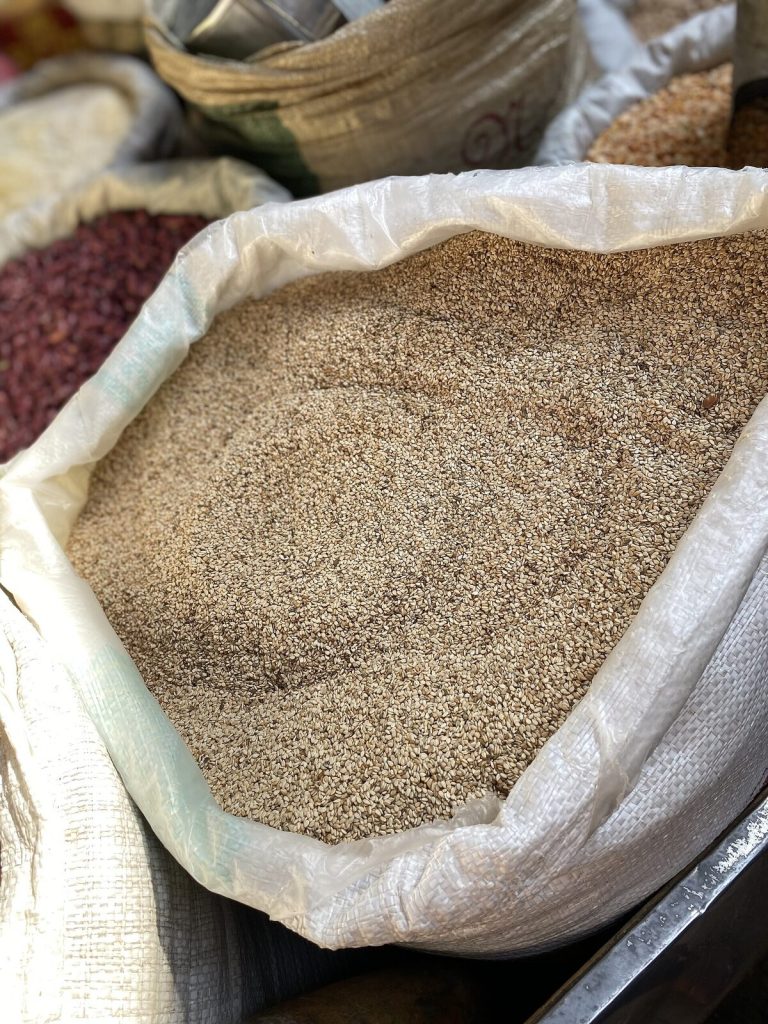
Sesame farming in Uganda sits in the north and the east, is grown twice a year on plots averaging under an acre, and sells mainly for export as cleaned seed. Simsim, as the crop is called here, asks for no expensive input package. It asks for labour, and labour is where the arithmetic of a sesame acre is settled long before the price is.
Where Sesame Farming Sits in Uganda's Export Earnings
Start with a comparison that surprises people. Across the five years tabulated in Uganda's own Statistical Abstract, formal sesame seed exports ran between about 19,400 and 29,200 tonnes a year, worth between roughly 27.5 and 35.7 million US dollars. In the most recent of those years sesame earned about 30.3 million dollars while cotton, one of the four crops Uganda officially calls a traditional export, earned about 27.3 million. A crop that gets almost no policy attention out earned a crop with its own statutory body.
The customs record agrees closely with that. Querying Uganda's own declarations at the six digit commodity code for sesamum seeds, and filtering to the rows Comtrade does not compute itself, gives declared exports of about 15,800 to 23,000 tonnes a year at unit values of roughly 1.35 to 2.00 dollars a kilogramme. Every one of those partner rows is flagged as a Uganda declaration rather than a partner estimate, and they sum exactly to the world total, so this is Uganda's figure and not somebody's guess about Uganda. Read against a reported national crop of well over 100,000 tonnes, the declared export line accounts for only a modest share of what is said to be grown. The rest is eaten at home, traded informally across the northern borders, or never existed in the estimate.
That unit value is a shipping price for cleaned seed leaving Uganda, not a farm gate price. The gap between the two is the whole subject of this article. Anyone quoting an export dollar figure at you as though it were what a farmer receives has skipped about six intermediaries. The difference between a farm gate price and the price further up the chain is worth reading before you plan an acre around either.
Sesame Growing Regions and the Two Planting Seasons
Almost all of Uganda's sesame comes from the northern region, with Lango, Acholi and Teso the districts most often named in the value chain work, and West Nile and the Kumi and Katakwi side of the east also in production. Rainfall there is bimodal. The long rains run March to May and the short rains September into October, and simsim is fitted to both.
Two independent Ugandan value chain studies give the same calendar, which is a useful sign it reflects practice rather than advice. First season sowing falls in March and April, with February and March named as the better window; weeding follows; harvest and drying come in June and July; marketing runs August and September. Second season sowing falls in August and September, with July and August the preferred window, harvest in November and December, and marketing in January and February.
So the honest advice on timing is uncomfortable. The season most people plant heavily is the one that dries worse, which is the one that grades worse, and the crop that most often precedes it is the one that hurts it. If you can only do one season properly, the second season is the one that rewards care.
Why Broadcast Sowing Sets the Weeding Cost on a Sesame Crop
Ugandan sesame is broadcast. Both value chain studies say so plainly, and both then name weeding as the binding labour constraint, because a broadcast stand cannot be weeded along a line. This is not a detail. It is the single structural fact that shapes every other number on a simsim acre.
A survey based partial budget for sesame in northern Uganda, published in an oilseed value chain analysis and reconciling line by line when you add its own columns, splits the variable cost as follows. Weeding and thinning together with harvesting and transport to the drying rack come to about 42 percent of total variable cost. Land preparation is about 18 percent. Rack building and racking is about 14 percent. Threshing, winnowing and moving the crop home add another 12 percent. And purchased inputs, meaning seed plus any field pest and disease control plus storage treatment, come to under 5 percent of the total.
Read that list and the lever is obvious. Fertilizer and spray are not where a sesame acre is won or lost, because they barely appear. Labour organisation is. Row sowing costs nothing but discipline and turns weeding from a search into a pass, and building a proper rack instead of drying on the ground protects the grade that sets the price. Neither change requires a shilling of input credit.
What the Ugandan literature does not give is a sowing rate or a row spacing for sesame. I looked in both value chain documents for a spacing, a centimetre measurement or a seed rate and found none, while the same documents return weeding and broadcast many times over, so the search was working and the absence is real for those sources. Do not accept a spacing figure for Ugandan sesame from a page that cannot say where it came from. Ask the nearest research station or your district extension officer, and if you want to work out a plant stand from whatever spacing you are given, the method is in the guide to calculating plant population.
Sesame Yield Per Acre: Two Numbers, Not One
This is where most sesame pages go wrong, and the fix is to give the basis rather than the number.
| Reading | Per hectare | Per acre |
|---|---|---|
| Household survey average, three northern regions | 673 kg | About 272 kg |
| Same survey, improved seed | 797 kg | About 323 kg |
| Same survey, local seed | 537 kg | About 217 kg |
| Sector report, citing field assessment | Not stated | 150 to 200 kg |
The survey figures come from measured household harvests and split by region: Teso 785, Acholi 693 and Lango 615 kilogrammes a hectare, with the first season at 705 against the second at 636. The lower band of 150 to 200 kilogrammes an acre comes from a sector report citing a separate field assessment. Both are Ugandan and neither is wrong; they are different samples, different years and probably different management levels, so the defensible planning band is roughly 150 to 320 kilogrammes an acre, and the top of that band assumes improved seed and proper weeding.
There is a third figure in wide circulation, about 280 kilogrammes an acre, and it is worth knowing where it comes from before you plan on it. Divide the international database series for Uganda and you get 641 to 702 kilogrammes a hectare, which is 260 to 284 an acre, so that circulating figure is a compilation rather than a measurement. Worse, when you read the observation flags, every sesame area, yield and production value for Uganda over the last decade is flagged as a figure supplied by an outside organisation, not as an official Ugandan return. Uganda did file official sesame figures for decades; the official run stops, and the last several years of area sit frozen at an identical number, which is the signature of a carried forward estimate. Uganda's own Statistical Abstract, meanwhile, names simsim among its sixteen major crops in prose and then gives it no row at all in either the crop area table or the crop production table, while maize, beans, groundnuts and soya beans each get one.
So the truthful answer to "what is the national sesame yield in Uganda" is that nobody currently counts it. Plan from the measured survey band and treat any single national figure with suspicion.
What Improved Sesame Seed Changes and What It Does Not
The measured gap between improved and local seed in that survey is 797 against 537 kilogrammes a hectare, a lift of about 48 percent. That is a real return and it is the strongest argument for buying seed rather than recycling it.
Getting the seed is the problem. Most Ugandan sesame is grown from home saved and recycled seed, which loses purity every time it goes back in the ground, and the sector report states outright that quality assured seed is not reliably on the market and that seed companies struggle to get enough parent material to multiply new varieties quickly. Uganda's national variety allocation list, read firsthand by another writer on this site, carries eighty four entries across twelve field crops, of which three are sesame. So released Ugandan sesame varieties exist and there are few of them. Research sits with the semi arid resources institute at Serere, and a variety rendered as Sesame II or Sesim 2 recurs in both the value chain work and in a current seed multiplication project in Lango as the one growers pick in participatory selection.
Note what the ministry does not publish. Its crop variety lists page offers exactly one download, an extract covering roots, tubers and bananas, so a grower cannot check a sesame variety name against a ministry list at all. The general rules for choosing quality seed and the difference between hybrid and open pollinated seed matter more than usual here, because you are buying largely on the seller's word.
Harvesting, Drying and the Soil in the Seed
Sesame shatters. The capsules split when they dry, and a crop left standing past the point where the lower capsules turn colour drops its seed on the ground. That is why the operation in the budget is not "harvesting" but harvesting plus transport to a rack: the crop is cut, carried and stood to finish drying where the falling seed can be collected rather than lost.
The quality failure that costs Ugandan growers most is not the grade of the seed but what is mixed with it. The value chain study names adulteration with soil during threshing as a direct barrier to the premium markets that ask for traceability, and it happens for a simple reason: threshing on bare ground puts the ground into the crop. A tarpaulin under the threshing is the cheapest quality investment available on a sesame acre, and it is the same fix that keeps the crop off soil during drying.
Post harvest and storage losses in sesame are put at 5 to 15 percent in the sector report. Grain that goes into store damp grows mould, and mould in an oilseed is the beginning of a toxin problem that a buyer selling into an institutional or export market will test for. The general method for getting and keeping grain at a safe moisture is in the moisture management guide, and the habits that keep pests out of a stored crop are in the note on preventing weevils in stored grain. Neither is sesame specific, and for sesame the moisture target is a question for the buyer, because none of the Ugandan documents I read publishes one.
Pest and Disease Pressure on a Sesame Crop
The Ugandan sources are consistent and thin here, and it is better to say that than to fill the gap. Both value chain documents name crop losses from pests and diseases among the top three constraints on northern sesame production, alongside late land opening and unavailable seed, and one states that losses are high according to the national research organisation. Neither names the organisms. One of them notes that the whole question of chemical control is unclear in practice because few if any Ugandan sesame growers use inorganic chemicals on the crop at all.
That last point is the one to act on. A crop that goes almost entirely unsprayed in Uganda does not have an established spray programme you can copy, and a page that gives you one has invented it. If something is taking your crop, get it identified before you buy anything, and read the label rather than the advice. The rules that keep a spray legal and safe sit in how to read agrochemical labels and safe pesticide application, including the interval that has to pass between a spray and a harvest. Nobody on the internet can give you a rate for your field. A district extension officer can look at the damage.
Who Buys Ugandan Sesame and What the Register Shows
Here sesame has something almost no other Ugandan crop has. The ministry publishes a register of registered exporters of Sesamum indicum on its own website. Read firsthand, it runs to thirty five numbered rows, with number twenty nine absent and at least three names appearing twice, so the distinct count is closer to thirty two. That register is the right starting point for anyone trying to find out who is actually licensed to ship the crop, and it is checkable in a way that a list on a blog is not. I am not reproducing the names here, because a register changes and yours should come from the ministry's page rather than from mine.
Below the exporters the chain is long. Foot traders and bicycle traders move between farms during the marketing weeks; open air traders work market days; rural wholesalers with stores buy from all of them; regional wholesalers in the larger towns bulk and clean; exporters in Kampala screen, clean, bag into fifty kilogramme bags and container the crop for shipment through Mombasa. About half of what leaves the farm gate passes through those rural assemblers, and roughly a quarter of it is bought by other farmers and rural consumers rather than moving toward export at all.
Two figures about selling are worth holding together. The value chain survey found households selling 78 percent of what they harvested, with Lango at 88 percent, Teso 79 and Acholi 62, which makes simsim a cash crop rather than a food crop in those districts. The sector report, citing a different assessment, puts the sold share at about a third and then, a few pages later, puts the flow from production to market at about 77 percent. Those two statements in one document cannot both be right, and the 77 percent agrees with the survey. Treat the low figure as belonging to whichever sample produced it.
The other number is more actionable: selling collectively at regional level rather than at the farm gate is put at roughly a 10 percent price improvement in the sector report, and mean household sales of about 173 kilogrammes explain why that gap exists. It is uneconomic to move two bags to a better market. It is economic to move forty. That is the argument for aggregating through a group, and the mechanics of dealing with the next buyer up are in selling to processors.
What the Ugandan Statistics Do Not Count
Three gaps are worth knowing about before you build a plan on somebody's national figure.
The pattern is that Uganda counts sesame when it crosses a border and not while it is in the ground. For a grower that means the market end of this crop is unusually transparent and the production end is unusually dark, which is the reverse of most Ugandan crops. Plan from your own field records rather than from a national average, and keep the weighing honest, because a record kept in basins cannot become a cost per kilogramme. A weighing scale is the instrument that turns a sesame plot into a business.
If you want to see how simsim sits beside the other crops Uganda sells abroad, the export crops hub covers the rest, and sunflower is the crop most often rotated with it and the one most likely to be competing for the same labour weeks. Cotton is the cash crop sesame displaced in much of the north, and the reasons are instructive.
Questions Sesame Growers Ask
Does an acre of sesame break even in Uganda, and at what yield? Work it yourself, because the published answer is unreliable. One sector report prints a cost of about 745,000 shillings per acre, a yield of 150 to 200 kilogrammes an acre and a price starting around 3,500 shillings a kilogramme, then states margins of about 350,000 shillings for a subsistence grower and 1,500,000 for a high input one. Those cannot all be true. At the report's own yield and price the acre earns 525,000 to 700,000 shillings, so the acre loses money. The resolution is a unit error: that cost figure and both margin figures match, to within about one percent, the per hectare totals in the oilseed value chain budget the report draws on, where total variable cost is about 738,000 shillings a hectare and net margins are about 372,000 and 1,602,000. Read per hectare, the variable cost is roughly 300,000 shillings an acre and the arithmetic closes. Never combine a per hectare cost with a per acre yield. Then invert it, which needs only your own numbers: divide the cost of your acre by the price you are actually offered. At roughly 300,000 shillings an acre, a price of 2,500 shillings a kilogramme needs about 120 kilogrammes and 2,000 shillings needs about 150. Price the same acre at 745,000 and the same prices need about 298 and 373 kilogrammes, which sits above the measured band. The whole gap between those answers is whether family labour is costed, and that is a decision you make rather than a fact you look up. The method sits in calculating a break even point.
When do I cut simsim, and how do I stop losing seed? Watch the lower capsules rather than the plant. Sesame capsules split as they dry, so a crop left standing until it looks uniformly ready has already shed the earliest seed onto the ground. The Ugandan cost budgets treat cutting and carrying to a drying rack as one operation for exactly this reason: the crop is taken off the field before it opens fully and finishes drying where what falls can be collected. Build the rack before you need it. It is about a seventh of the variable cost of the acre and it protects both the quantity and the grade.
What price should I expect for simsim? Prices swing hard. One market report cited in the sector work records sesame prices falling 25 to 35 percent inside a single year, and the export unit value in Uganda's own customs declarations moved from about 1.35 to about 2.00 dollars a kilogramme across four years. Ask two buyers on the day you are ready to sell, not one, and check the current prices rather than any figure printed on a guide.
How much land do growers actually put under sesame? Less than people assume. Mean area under sesame in the value chain survey was 0.37 hectares, about 0.9 acres, and the sector report gives an average northern sesame field of 0.975 acres. Growers holding two to ten acres typically allocate around two of them. Sesame is a small plot crop in Uganda, and any budget built on a ten acre block is describing something that mostly does not exist.
Can I press sesame oil in Uganda? Not commonly, and the sector report says why: sesame oil is not processed domestically at any scale, with machinery cost and the wider operating environment given as the reasons, and small volumes of sesame oil are imported. What does happen at village level is grinding into paste, known as odi in Luo, using locally fabricated equipment. Existing plants in the north were reported running at about a fifth of capacity, so the constraint is raw material flow and working capital rather than a shortage of machines.
Is sesame a good crop for a drought year? Better than most, with a caveat. A climate risk assessment for Ugandan sesame growing districts describes the crop as drought tolerant with a short cycle and rates its overall climate vulnerability as low, better than maize. The same work notes it copes badly with heavy rain and flooding, and projects longer dry spells in the March to May season across the northern and central growing areas. So the risk sesame carries in Uganda is a wet harvest, not a dry one, which loops back to drying racks and the second season.
Who does the work on a sesame crop? Worth planning for honestly. The Ugandan value chain work records women as responsible for planting, weeding, harvesting, drying, threshing and sorting, men for land opening and for marketing the larger volumes, and children for carrying to the racks. Since weeding and harvesting are the biggest cost lines, opening more land to sesame adds most of its new work to the household members already carrying the most. Any plan to expand the acreage that does not also plan the labour is a plan to lose the crop to weeds.
Before you commit an acre, get two things from the market rather than from a page: what a buyer near you is paying this week, and whether a group in your area is bulking. Current levels sit on the price pages, the supplier directory is the place to start on seed, and the ministry's own exporter register is the one list of sesame buyers that can be checked against a public source.