
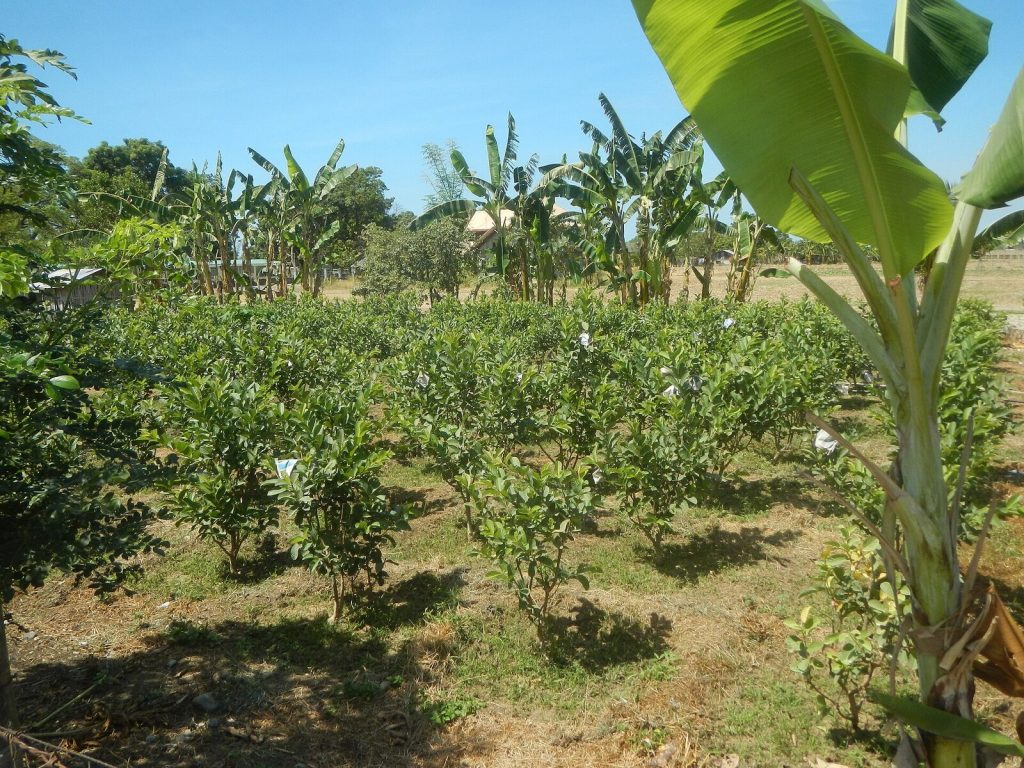
Guava flowers on newly emerging side shoots rather than on old wood, at any time of year. That single habit is what separates guava from every other fruit tree on a Ugandan farm: prune and defoliate, and the tree flushes, flowers and sets a crop on your timetable rather than the season's. A clonally raised tree can begin bearing in its first year after planting.
Guava Fruits on New Shoots, So Pruning Sets the Harvest
Take the mechanism seriously, because every other decision follows from it. Guava flowers are borne on newly emerging lateral shoots, irrespective of the time of year. Whether the tree crops erratically or in a clean seasonal pattern depends entirely on what the environment, or the grower, does to shoot growth.
The two levers are defoliation and pruning, both of which force axillary buds to break into shoot. One caution comes with them: the flowers appear to be already differentiated inside the bud before the side shoot emerges, so forcing buds to break before differentiation has finished produces shoots without flowers. Timing is the skill.
There is a second, quieter mechanism worth knowing. Shoot growth in guava is indeterminate, and under good conditions long vigorous shoots dominate and suppress the flowering side shoots. A load of fruit, by contrast, acts as a strong enough sink to slow extension growth and hold lateral buds shut until after harvest. So good cropping is itself what produces the shoot pattern you want next time, and a tree allowed to run to vegetative growth stays in that state. In the tropics, prolonged quiescence across large parts of the tree is named as the main reason guava yields come in below potential.
The Guava Crop Cycle You Choose, and What It Does to Production
Time from flowering to harvest is 14 to 20 weeks depending on cultivar. Add the flush and the flowering period and a deliberately managed cycle comes out at seven to nine months, which is shorter than a year. That is the fact that makes guava unusual.
| Management | Cropping pattern | What it needs |
|---|---|---|
| Minimal husbandry | One main crop, one minor crop | Nothing, and yields stay low |
| Cycled | One large crop per 7 to 9 months | Prune and defoliate after harvest |
| Continuous | Fruit most of the year | Frequent light pruning, dry season irrigation |
Under minimal husbandry in the tropics the tree follows the natural flushing pattern and gives a main harvest plus a smaller second crop. Cycling means pruning and defoliating shortly after harvest to generate a general flush that carries the next crop's flowers, with fertilizer timed to the cycle: most of it as a basal dressing at the end of harvest, topped up if needed. Continuous cropping, as practised in Thailand, uses frequent light pruning to keep flowering shoots coming plus irrigation through the dry season, and fertilizer then goes on in several small doses instead.
For a Ugandan smallholder the choice is not abstract. Cycling is the one that fits a farm without irrigation, and it has a real advantage: you can aim the harvest away from the heaviest rains, because guava that ripens through a very wet spell loses flavour and may split. Irrigation options are compared on the irrigation farming guide.
Guava Yield Per Hectare and the One Figure to Distrust
The working orchard figure is 25 to 40 tonnes a hectare a year, which is roughly 10 to 16 tonnes an acre. That is what a guava orchard should produce, and it is high for a tree fruit.
There is a second number in the same literature and it needs a label rather than a repetition. Crop cycling experiments in Hawaii returned yields of about 100 tonnes a hectare a year. That is an experimental result under an intensive cycling regime, not a field expectation, and a page that quotes it as what guava yields in Uganda is doing exactly what promotional content does with every tropical fruit: taking a station ceiling and presenting it as a farm figure. Plan on 25 to 40 and treat anything above it as a research result until someone measures it here.
The reason tropical guava yields fall below even 25 tonnes is already covered above: quiescence. Large parts of the tree sit dormant, throwing neither shoots nor flowers, and the fix is management rather than fertilizer.
Soil, Rainfall and Altitude: Where Guava Grows Well in Uganda
Guava is one of the few tropical fruits where Uganda's climate clears the published requirement on every reading of the data, and it is worth setting out why, because most threshold arguments on this site come out the other way.
On water, maximum production in the tropics asks for 1,000 to 2,000 mm of rain a year, evenly distributed. Uganda's national annual mean is 1,576.67 mm on the ERA5 reanalysis and a second gridded dataset gives a reading of 1,282.74 mm. Both sit inside the band. The verdict does not depend on which dataset is right, which is unusual and which is the strongest form this kind of argument can take. Compare banana, whose production manual calls for 2,000 to 2,500 mm, a band Uganda's national mean misses on either reading.
The condition that does bite is even distribution. December, January and February together carry about 14 percent of Uganda's annual rain in a quarter of the year. So the rainfall total is fine and the seasonality is not, and that is an argument for timing the cycle rather than for abandoning the crop. Guava is also described as more drought resistant than most tropical fruit crops, which is what lets it survive that quarter without irrigation even where it will not crop heavily through it.
On temperature, guava tolerates 15 to 45 C and the highest yields are recorded at mean temperatures of 23 to 28 C. Uganda's national annual mean temperature is 23.09 C on the same reanalysis, which puts the country at the bottom edge of the optimum band rather than in the middle of it. Read that as it stands: the warmer, lower lying districts sit better inside guava's optimum than the cool highlands do, and a national mean is not a district figure.
On altitude, the tree is found in the tropics from sea level to about 1,500 m. Uganda's lowest point anywhere is 614 m and most of its cropland sits between roughly 1,000 and 1,400 m, with research stations in the banana belt measuring around 1,156 to 1,210 m and one south western station at 1,405 m. All of that is inside the band. Only the highest south western and eastern highland ground rises past it. Contrast jackfruit, which thrives below 1,000 m and is grown here above its optimum: see the jackfruit farming guide.
Guava is described as a hardy tree that suits a wide range of growing conditions, and it is shallow rooted, branching from the base and often suckering. Shallow rooting matters for two practical reasons: the tree responds quickly to surface mulch, and it is vulnerable when the top layer of soil dries out. Soil testing before spending on fertilizer is covered on the soil testing page.
Uganda Records No Guava Production, and Neither Does the Trade Data
You cannot look up how much guava Uganda grows, and the reason is structural rather than administrative. There is no guava item in FAO's crop production dataset. Guava is bundled into a single item covering Mangoes, guavas and mangosteens, so no country on earth files guava separately.
Under that bundled item, Uganda files no row at all, while 34 African countries report production in the same period. Look at who is on that list and the blank stops looking like a size problem:
| Country | Production reported | Flag |
|---|---|---|
| Kenya | 752,153 to 788,237 t | Official |
| Tanzania | 444,789 to 493,552 t | Official, then imputed |
| Rwanda | 481 to 5,250 t | Official |
| Uganda | No row | None |
Rwanda puts an official figure against a crop group totalling under 5,300 tonnes. Uganda puts nothing against one its neighbours measure in the hundreds of thousands. Whatever Uganda does report for fruit outside bananas is folded into a single residual line, Other fruits, n.e.c., at between 52,415 and 52,532 tonnes on about 7,900 hectares. Not one production or area value in it is a Ugandan declaration: the dataset marks them all as imputed by a receiving agency, with yields marked estimated. Watch the area move 12 hectares in six years and you are watching a model, not a survey.
Uganda is not missing from this dataset in general, which is what makes the guava blank real rather than an artefact of a bad query. Its banana production sits there with FAO's official figure flag against it in three of the last four years. The machinery works. It has simply never been pointed at guava.
Trade data repeats the problem. The tariff heading is 080450, guavas, mangoes and mangosteens, fresh or dried, and guava is not separable inside it at six digits, which is the deepest level served. Reading Uganda's own declared rows under that code for one year, filtering out the computed aggregate rows first, gives roughly 1,090 tonnes of exports against about 13,470 tonnes of imports. Uganda is a net importer under that heading by more than ten to one by weight. None of it can be attributed to guava rather than mango, and any figure presented as Uganda's guava exports has been made up. The mango side of the same code is discussed on the mango farming guide.
There Is No Ugandan Guava Variety Record and No Certified Nursery
Two absences need stating plainly rather than papered over.
First, planting material. Three separate documents point the same way and not one of them describes a scheme a Ugandan guava grower could join. Regional plant health work reports certification for fruit planting material as close to non existent across Eastern and Central Africa. Ugandan researchers working on a neighbouring fruit crop end their paper asking for certified nurseries to be created. And the list of what the ministry actually certifies runs to field crops only. Put together, they mean there is no certified fruit nursery scheme in Uganda: no certificate to ask for and nothing to be inside. This page names no nursery, dealer or supplier for that reason.
Second, varieties. No Ugandan guava release record could be found, and that negative needs its scope stated honestly rather than stretched. The national variety allocation list covers twelve field crops and no fruit. The ministry publishes a variety extract for roots, tubers and bananas, which does not reach guava. Beyond those two documents this page did not enumerate a technology catalogue for guava itself, so the safe statement is that no Ugandan guava variety appears in the national lists that were read, and not that no record exists anywhere.
Separately, the search for Ugandan guava horticultural research returned a clear pattern. Querying a large biomedical and life sciences literature index for Ugandan guava work returns ethnobotanical and medicinal plant studies almost exclusively, and no Ugandan guava production, variety or orchard study surfaced. The control matters: the same index returns Ugandan jackfruit characterisation studies and well over a hundred Ugandan banana papers, so the index works and the absence is specific. Uganda's published guava record is about the leaves, not the orchard.
What names do circulate, then, come from elsewhere: dual purpose types developed in Hawaii and South Africa, large sweet white and light yellow fleshed fresh market cultivars from South East Asia, and a Thai hybrid released from a cross between a leading Thai cultivar and an Indonesian seedless type. Any name attached to guava on a Ugandan farm should be traced to where it actually came from before it is trusted.
Raising Guava Planting Material From Seed, Air Layering and Budding
Guava is one of the easier tropical fruits to propagate and the choice of method is really a choice about what the fruit is for.
Seed works for processing crops. The seed germinates well, within 15 to 20 days of sowing, stays viable a long time, and about 70 percent of seedlings keep the general characteristics of the parent tree. That last figure is worth pausing on. Seventy percent true to type is nothing like the lottery a seedling jackfruit or mango gives you, and that makes seed raised guava a defensible choice where uniformity matters less than cost. Prick out the seedlings into nursery rows or pots and grow them on for six to twelve months, either to plant out or to bud onto.
Clonal propagation is what fresh market growers use. Air layering is the common method in South East Asia; for larger numbers, shield or patch budding onto seedling rootstocks is the recommendation. Both the mother tree and the rootstock have to be growing vigorously for it to take. Budwood should be mature, with bark no longer green, and the leaves are cut about two weeks before budding so the buds swell. Bud as soon as the rootstock is thick enough, because buds do not sprout readily on old stocks. Trees are ready for the field four to five months after budding. Cuttings and grafting also work, and micropropagation from nodal explants has been reported with around 70 percent of plantlets surviving transplant.
The payoff from clonal material shows up in the establishment period, which on a perennial is the part of the budget with costs and no income.
Spacing and Tree Population Per Acre in a Guava Orchard
Spacing follows the management system, and the range is wide. Intensively managed orchards under frequent pruning and continuous cropping are spaced as close as 4 to 6 m. Seedling trees grown for processing are spaced out to about 10 m by 8 m.
Work the arithmetic before choosing. At 5 m by 5 m a hectare holds 400 trees, which is about 162 an acre. At 10 m by 8 m a hectare holds 125, about 51 an acre. That is a threefold difference in tree count, and so in planting material cost, pruning labour and harvesting time, and the close spacing only pays if the pruning that justifies it actually gets done. Replacement pruning is what keeps a closely spaced orchard workable: cutting sagging branches back to a young twig restricts height and spread so that trees can sit close together and no ladders are needed. Population arithmetic for an awkward plot is on the plant population calculator page.
Minimal foliar nutrient concentrations reported for guava are about 1.65 percent nitrogen, 0.26 percent phosphorus, 1.4 percent potassium, 1.25 percent calcium and 0.3 percent magnesium. Those are leaf concentrations rather than application rates, and no Ugandan fertilizer rate for guava could be verified, so the honest position is to feed to the cycle, use farm made organic matter where you have it, and get the soil tested rather than working from a number invented for this page. The compost making guide covers the farm made side.
Pruning, Fruit Thinning and Bagging in a Guava Planting
On a young vigorously growing tree, bend the leading branches down and tip them to promote lateral sprouting. At the start of each later cycle, cut out some of the vigorous branches to keep the tree open. If the tree bears well the wood ages quickly, so on a mature tree the emphasis moves to replacement: sagging branches cut back to a young twig, cycle after cycle.
Thinning is needed for fresh market fruit and it is where growers lose value by doing nothing. A lateral shoot usually carries two to six flowers, and only one or two fruits should be left. Everything left on beyond that divides the same resources into smaller, lower grade fruit.
Bagging goes on after thinning. It improves fruit quality and it is the main protection against fruit flies in a continuously cropped orchard. One warning that comes straight from practice: where polythene bags are used, water vapour condenses inside them, so the fruit has to be harvested green to prevent rot. Paper bags avoid that problem and are what growers in the Philippines use. Choose the bag with the harvest stage in mind rather than on price.
Fruit Flies Are the Main Guava Pest, and a Guava Tree Is a Reservoir
Fruit flies are the most important pest of guava anywhere it grows, and the fruit is described as a major host to species of Anastrepha, Ceratitis, Dacus and Argyresthia. In a Ugandan context that list has a sharp edge to it, because the flies in two of those groups are the ones already doing the damage in Ugandan mango.
Ugandan mango work recovering flies from infested fruit found the invasive Bactrocera fly accounting for the large majority of emergences, with the native Ceratitis species making up the remainder. So a guava tree standing in or beside a mango orchard is not a neutral neighbour: it is another host for the same population, and because guava can be pushed to carry fruit at almost any time of year, it can hold that population through the gap between mango seasons.
That has a consequence most guava pages never mention. If you plant guava next to mango, or next to a neighbour's mango, the sanitation you do is about more than your own crop. No Ugandan guava infestation index has been published, so this page gives no per kilogramme fly count for guava here, and the direction of the argument does not depend on one.
Sucking insects, including scales, mealybugs and thrips, are largely held in check by their own predators plus control of the ants that protect them, so a broad spectrum spray that kills the predators can make those pests worse rather than better. Leaf eating caterpillars and beetles can badly damage young trees and are handled by early detection and spot treatment rather than whole orchard spraying. The Ugandan fruit fly picture in detail sits on the mango orchard management guide.
Guava Diseases and the Rainy Season
Most guava disease pressure lands on the fruit and most of it rises with rain. Trees may wilt after infection by various soil fungi, and Phytophthora root rot is thought to kill trees where it occurs. Leaves are little affected, though anthracnose, Colletotrichum gloeosporioides, hits both leaves and more seriously the fruit. Blossom end rot can become serious in the rainy season and may have physiological alongside pathological causes. Mucor rot spoils fruit that insects have already punctured, which ties it back to the fruit fly work. Young fruit blackened and mummified on the tree points to other fungi, and fruit canker shows as circular raised corky spots.
The first line of response in every case is the same and it costs nothing: orchard sanitation, meaning early removal of infected plant parts, so that the rainy season is entered with low infection pressure. That is also the measure most often skipped.
Where chemical control is needed in the rains, the source consulted here names two products, and this page prints neither name nor rate. The reason is not squeamishness. Uganda's register of agricultural chemicals lists products, active ingredients, registrant, agent, and registration and expiry dates, and it has no crop column at all, so a product being registered in Uganda never means it is cleared for use on guava. The edition of that register reachable at the time of writing carries no expiry date later than 2025, with most falling in 2023 and 2024, so registrations in it have lapsed. What that leaves is the current register plus the product label read together, with a district extension officer who knows both. How to read a label is on the agrochemical labels guide, and the fungicide classes are explained on the fungicides page.
Harvesting Guava and the Four Day Rule
Immature guava does not ripen off the tree. It softens, and it never develops full flavour or colour. So the fruit is picked selectively by hand, and there is no rescuing an early pick.
Judging the moment is genuinely difficult and the literature says so. The recommendation is to pick as the colour changes to pale green with the first sign of yellowing, with the caveat that experience is the better guide. Then the rule that costs growers most: if the harvesting interval goes beyond four days in warm weather, losses to overripe fruit become a problem. A guava orchard is a place you walk through twice a week during harvest, not once a fortnight.
After picking, the fruit is delicate. Grade and move it in small boxes rather than large crates, immediately after harvest while it is still firm, and get it to the buyer before it softens. Where cold storage is available, holding at about 5 C extends post harvest life by around two weeks against holding at 20 C. Packing practice is on the produce packaging page.
What Guava Is Worth Growing For on a Ugandan Farm
The fresh market for guava is limited by two things at once: a short shelf life and a fruit fly susceptibility that makes clean fruit hard to deliver reliably. Both are real and neither is fixable by planting more trees. The route that the literature is more positive about is processing, mainly paste and juice, where the fruit is cooked rather than sold whole and where a glut becomes stock rather than waste.
Guava's composition supports that. Nearly the whole fruit is edible in good cultivars. Vitamin C content is high and extremely variable, reported from 10 to 2,000 mg per 100 g of fruit depending on cultivar, environment and tree management, concentrated in the skin and firm flesh, at a maximum in green fully mature fruit and falling away quickly as the fruit ripens. Pectin runs from 0.1 to 1.8 percent, rising during ripening and dropping away in over ripe fruit. Read all of that as composition and no further: nothing here is a claim about what eating guava does to a person.
Two processing consequences fall straight out of those numbers. If vitamin C peaks in green mature fruit and pectin peaks at ripeness, then the right picking stage depends on the product, and a grower supplying a jam maker and a grower supplying a juice line are not doing the same job. And because pectin collapses in over ripe fruit, the four day harvesting rule is a processing quality rule as much as a wastage rule. Routes are covered on the fruit juice processing page and the dried fruit production page.
The fair summary is that guava is a hardy, fast bearing, high yielding tree that Uganda's climate suits on every published measure, growing in a country that does not count it, has no variety record for it, and has published almost no horticultural research on it. That combination is an opportunity and a warning in the same sentence. Nothing about the agronomy is hard. Everything about the market has to be worked out locally, because there is no national figure to lean on.
Frequently Asked Questions
How soon after planting will a guava tree bear fruit? A clonally propagated tree, air layered or budded, often begins bearing during the first year after planting, and a seedling may flower within about two years. Full bearing comes at five to eight years depending on conditions and spacing. The tree bears heavily for fifteen to twenty five years and lives around forty, so plan for replacement rather than permanence.
How do I make a guava tree fruit when I want it to? Prune and defoliate shortly after harvest. Guava flowers only on newly emerging lateral shoots, so forcing a general flush is what produces the next crop's flowers. Flowering to harvest then takes 14 to 20 weeks, giving a full cycle of seven to nine months. One caution: flowers are already differentiated inside the bud before the shoot emerges, so forcing buds too early gives shoots without flowers, and getting the timing right takes a season or two of watching your own trees.
How much guava does an acre produce? Plan on 25 to 40 tonnes a hectare a year, which is roughly 10 to 16 tonnes an acre, under real orchard management. Figures around 100 tonnes a hectare come from crop cycling experiments in Hawaii and are not a field expectation anywhere. Tree count varies enormously with system, from about 51 an acre at 10 m by 8 m spacing up to about 162 at 5 m by 5 m, and the close spacing only pays if the pruning it depends on is actually done.
How much does guava sell for in Uganda? No verified Ugandan guava price could be found, and the reason is structural: Uganda files no production figure for the crop group that contains guava, the tariff code bundles guava with mango and mangosteen, and the national consumer price series does not carry guava separately. So there is no official price to quote and this page will not invent one. What can be said about the money is the shape of it. Establishment is short by tree fruit standards, with a clonal tree bearing inside a year, so the period of cost without income is months rather than years. The recurring costs are pruning labour, thinning, bagging, sanitation and harvesting rounds every three to four days during the picking window, and harvesting labour is the line that grows with yield. Price the fruit at your nearest market and at any processor within reach before planting, and check the prices section for comparable fruit.
Is guava grown from seed any good? Better than most tree fruits. About 70 percent of guava seedlings keep the general characteristics of the parent tree, so seed raised guava is a reasonable choice for processing crops where uniformity matters less. For fresh market fruit, where size, seediness and firmness decide the grade, air layering or budding onto a seedling rootstock is the recommended route and the tree is field ready four to five months after budding.
Will guava make my mango fruit fly problem worse? It can, and this is the honest answer rather than the comfortable one. Guava is a major host of the fly groups that dominate Ugandan mango infestation, where the invasive Bactrocera fly accounts for the large majority of flies recovered from infested fruit, and a guava tree can be carrying fruit outside the mango season. No Ugandan guava infestation figure has been published, so no number is given here. Bag your fruit, bury fallen fruit deep, favour a defined harvest window over year round cropping, and treat sanitation as a shared job with any neighbouring mango grower.
Why is my guava splitting and tasting flat? Most likely ripening through a very wet spell, which the literature identifies as causing loss of flavour and splitting. It is one of the strongest arguments for cycling the crop deliberately, because a grower who sets the flush can aim the ripening window away from the heaviest rains instead of taking whatever the season gives.
Can I buy certified guava seedlings in Uganda? No. Uganda operates no certified fruit nursery scheme, so no certificate exists to ask for and this page names no nursery or supplier. Judge material on what you can see instead: a vigorous mother tree whose fruit you have eaten, a vigorous rootstock, mature budwood, and a tree that has been in its container long enough to have settled but not so long that it is root bound.
Prices and planting material both vary by district and season, so check the prices section and the suppliers section before committing, and compare guava against the other tree fruits on the fruit farming hub before you clear any ground.