
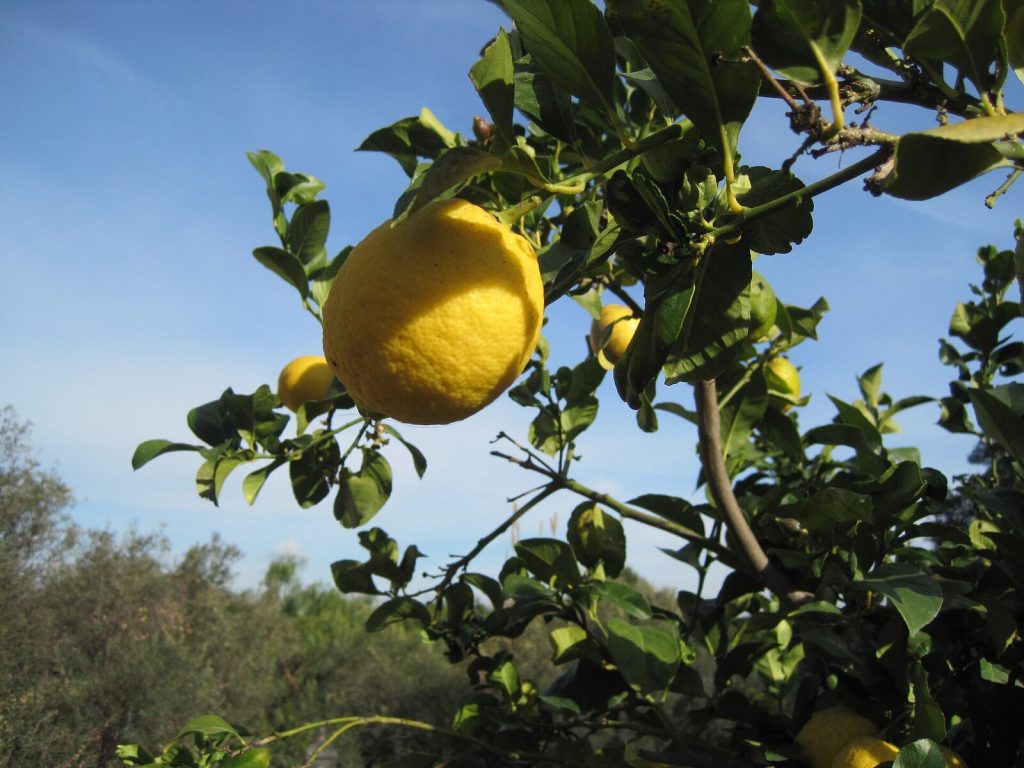
Lemon farming in Uganda starts with a question most guides skip: is the fruit you are planning to grow actually a lemon? Lemon and lime are different species, they behave differently in the field, and not one Ugandan or international statistic separates them. Until you settle that, nothing else can be planned. What follows deals with the true lemon, and points to the lime page where the answer turns out to be lime.
Lemon, Lime and What Ugandan Markets Actually Sell
The true lemon is Citrus limon. It makes a small tree, three to six metres, armed with stout stiff spines. The fruit is ovoid to cylindrical, roughly 7 to 12.5 cm long, yellow to golden when mature, with a thick rough peel and eight to ten segments. It is closely related to the citron, Citrus medica. Lime is a separate species, Citrus aurantiifolia, with smaller, thinner skinned, greener fruit.
Reporting from Ugandan markets describes two distinct fruits both sold as lemon: a large soft yellow one associated with the Lira area, and a small hard green one associated mostly with Busoga. That description fits two different species rather than two grades of one. Nobody at the market will settle it for you, because the trade name covers both.
One more disambiguation, because it causes real confusion online. Lemongrass is not a citrus at all. It is a grass, Cymbopogon, grown for leaf and oil, and its agronomy has nothing in common with a citrus tree. If that is what you were looking for, go to lemongrass farming in Uganda instead. If your interest is the small green fruit, lime farming in Uganda is the right page.
Uganda Is Warmer and Wetter Than Lemon Prefers, on Both Available Datasets
Lemon is a subtropical crop and the reference works are specific about what it likes: cool, dry surroundings, mean annual temperatures of 15 to 18 degrees, and annual rainfall up to about 1,250 mm. The leading producers are California, Italy, Spain and Greece. It is described as widely grown across the subtropics and only occasionally in the tropics.
Set Uganda against that. Two climate datasets exist for the country and they disagree about rainfall by a wide margin, so the honest method is to check the argument against both. The ERA5 reanalysis gives Uganda an annual total of 1,576.67 mm over a thirty year period, verified directly. A second dataset is reported at 1,282.74 mm; that figure could not be confirmed against the climate portal and should be treated as a second reading rather than a settled one. Both readings sit above 1,250 mm, so the rainfall conclusion does not depend on which one you accept, which is the only kind of threshold argument worth making.
Temperature is less clean and the article will not overstate it. ERA5 puts Uganda's mean annual temperature at 23.09 degrees, around five degrees above the top of lemon's stated preferred band. That is a national mean across every elevation in the country, so the cooler cultivated uplands come closer to the band than the figure suggests, and a national average cannot tell you about your own hill. What it does tell you is the direction: Uganda is at the warm, wet end of what this species was selected for.
Now the part that cuts the other way, and it matters more than the mismatch. In tropical conditions, citrus fruit tends to grow large with high juice content and low citric acid, which is what makes tropical sweet orange taste flat. The acid citrus fruits are the documented exception: acidity in lemon and lime grown in the tropics is as high as in the subtropics. So the quality problem that dogs Ugandan oranges does not apply to lemon. The constraint here is not what the fruit tastes like. It is tree health, disease pressure and yield under high rainfall, which is a different problem with different answers.
No Statistic Separates Lemons From Limes, Which Changes Every Market Claim
This is a short section with a large consequence. The international trade classification uses a single heading for lemons and limes together. FAO's production database uses a single item, "lemons and limes", for the same pair. There is no level of either system at which the two are counted separately.
Anything you read that gives a figure for Ugandan lemon production or lemon exports is reporting lemons and limes combined, whether or not it says so. On top of that, FAO carries no entry for Uganda under that item at all, while 29 other African countries do, and Uganda's rows in the same dataset are present and readable because it reports plantains, bananas and pineapples. So the national production figure does not exist even in the combined form.
Treat this as a planning constraint rather than a curiosity. You cannot size a lemon market in Uganda from published data, you can only describe it. Anyone presenting you with a confident Ugandan lemon market figure has either made it up or has quietly included limes.
What the Export Data Shows About Ugandan Lemon Farming
Uganda's own customs declarations are the one firm dataset, and every partner level record in the series is flagged as declared by Uganda rather than estimated from partner returns, so this is real trade.
Two readings follow. First, this is a regional fresh fruit trade into Rwanda and Kenya, not an export crop in the sense that Hass avocado has become one, and the unit values are a fifth to a tenth of what premium avocado markets pay. Second, the recorded trade and what happens on the ground diverge. Market reporting describes lemons coming into Uganda from Tanzania and DR Congo during the hot season and going out to South Sudan during gluts, yet recorded imports are near zero and recorded shipments to South Sudan in the latest year were under 200 kilogrammes. That informal cross border flow is invisible in customs data, which is worth knowing before you treat the official numbers as the whole market.
Also worth knowing: commercial market report pages carrying Ugandan lemon prices are not reliable. One set of them reports Ugandan export prices of roughly 0.11 to 0.20 dollars a kilogramme while another reports wholesale at 1.03 to 2.36, and at least one names a European country as the main destination for Ugandan lemons and limes, against Uganda's own declarations showing that country receiving a few kilogrammes in a year while Rwanda took about 1,900 tonnes. Do not plan on scraped price data.
Rough Lemon: The Most Important Lemon in Uganda Never Sells a Fruit
Here is the twist in this crop. A lemon called Rough Lemon, a hybrid of lemon and citron sometimes given its own species name Citrus jambhiri, is one of the standard citrus rootstocks in the tropics. Nurseries like it because its seed is plentiful, it produces uniform seedlings that come true, and it grows fast and upright, which means a graftable stem quickly. It also tolerates tristeza, the main citrus virus.
So the lemon with the biggest economic footprint in Ugandan horticulture is probably underground, holding up somebody else's orange trees. Two things follow for anyone planting citrus. This rootstock has a known weakness at the collar, which means a tree on it wants free draining ground and a crown kept clear of standing water. And it is recorded as giving fruit that is coarse and short on both sugars and acids, a quality penalty on a sweet orange and much less of one on a fruit bought for its sourness.
Several other rootstocks are in use and each changes the tree above it in a different way. Those trade offs are set out on the orange page, since sweet orange is where the choice costs the most money. What matters here is that you ask the question. Very few sellers volunteer it, and the answer governs how your tree behaves for the next twenty years.
Planting Material and the Diseases That Move in Budwood
Citrus is host to a long roll of viruses and viroids, a good number of which ride inside budwood, resist every spray, and stay silent for years before they show. The remedy used elsewhere is an elaborate chain of laboratory raised, indexed, disease free material, and Uganda operates none of it, so there is no document a lemon buyer can ask to see. What exactly is missing, and what it would look like if it existed, is set out on the orange page, where the commercial exposure is largest.
One habit belongs on every citrus holding regardless. The exocortis viroid travels on cutting tools and survives on steel for months, which means a knife that has touched an infected tree will hand the viroid to every tree it touches afterwards. Dip blades in dilute household bleach, around one part in ten, between trees. The same logic is the argument against taking a cutting or a layer off a neighbour's productive tree: you would be copying its virus load along with its fruiting habit. Tristeza is the one to watch on acid citrus, because its stem pitting shows as dieback in lime, so a small green fruited tree thinning from the top has a candidate cause.
Propagation is not difficult. Budding is standard. Citrus is unusual in that seed from most cultivars gives seedlings true to the parent, which is why so many household trees started as a pip. Two drawbacks come with that: the origin of any particular seed is hard to guarantee, and a seedling stays juvenile longer so it flowers later than a budded tree. Layering gets you a bearing tree fastest and costs more labour. If you raise your own, insist on two things: rootstock seed held in well agitated water at 51 degrees for ten minutes, and a nursery site that has never carried citrus before. Bare rooted trees can go through water at 43 degrees for ten minutes against foot rot before they leave. The mechanics are in the guide to starting a seedling nursery.
One relief compared with other fruit trees: lemon does not need a partner cultivar. Some lemons and grapefruits show female sterility and pollen viability can be low, but citrus sets fruit without fertilisation reliably enough that single cultivar orchards produce good crops. You are not designing a pollination system.
Siting, Spacing and Soil for a Lemon Planting
Since this species wants drier conditions, let drainage drive the site decision and stay off the wettest ground you own. Heavy rain through flowering or fruiting damages a citrus crop outright, and the wetter the district the less suitable a heavy soil becomes. The folklore that citrus grows anywhere is true; the part left out is that it only yields on soil in decent physical condition.
Leave the trees in full light with nothing overhead, because shade costs yield and still humid air makes every disease harder to hold down.
Lemon builds a smaller tree than sweet orange, three to six metres against six to fifteen, so it carries the tighter end of the citrus range more comfortably. The range is 200 to 400 trees per hectare. Do the acre arithmetic yourself from 4,046.86 square metres: a 5 by 6 metre layout comes to roughly 135 trees an acre, and the ends of the range to roughly 81 and 162.
Hole preparation is identical to sweet orange and is described on the orange page, along with the raised planting position that keeps the union clear of standing water. Do not skip the raised position. Collar rot kills more tropical citrus than any insect does. Give new trees about ten litres each a week through a dry spell.
Why a Backyard Lemon Tree Yields Less Than an Orchard Tree
Most Ugandan lemon trees stand behind a house, and the way they behave there is worth knowing before you commit to a block. Unmanaged, a citrus tree flushes and blooms whenever conditions let it, scattering a little fruit across most of the year. For a household that is exactly the point. For a grower it is a low total, partly because the twigs start growing again before flowering has finished.
A block reverses that deliberately. Where a real dry spell exists the trees bloom together once rain returns, and water applied after six weeks or more of dryness will push a flush carrying flowers. A bloom that happens all at once is what makes a calendar possible: feeding, spraying, thinning and picking each get a window instead of running all year long.
Yield expectations should come from measurements rather than potential. Citrus can reach around 50 tonnes per hectare where growing conditions are controlled, and commercial growers elsewhere aim for about 25 tonnes per hectare within four to six years of planting. Tropical reality is far below that. Under the combined lemons and limes item, Kenya measures about 11.0 tonnes per hectare, Tanzania about 5.8, Rwanda about 4.2 and Ethiopia about 4.1, against about 21.8 in South Africa and about 20.3 in Egypt. At 333 trees per hectare, 10 tonnes per hectare works out near 30 kg a tree. No Ugandan yield figure for lemon exists at all, and no Ugandan figure for years to first crop could be verified, so those neighbours are the anchor.
Feeding follows the citrus rule, and the citrus rule is restraint. The crop takes off only a modest quantity of nitrogen per tonne of fruit, and pushing past that figure is recorded as making the fruit worse rather than making more of it. Zinc is the micronutrient that most often holds a citrus tree back. Both questions belong on a soil test before fertilizer application rather than on a guess, and the numbers sit with the orange page. Pruning does little on citrus beyond shaping a young tree and cutting out branches that cross or turn inward.
Harvest, Season and the Sack Problem
Citrus fruit does not ripen after picking and takes seven to eight months from flowering to maturity. Harvest dry, because picking wet spreads moulds. As the fruit matures it sweetens, loses acid and its shelf life shortens, so later fruit has to move faster. Most citrus will hold a month or more in cool storage; under ordinary Ugandan storage, reporting puts lemon shelf life at around two weeks when kept well.
Supply is strongly seasonal. Ugandan market reporting describes plenty of fruit from around March through August, with scarcity in the hot months when fruit is brought in from neighbouring countries. Quality moves with the weather in a way growers describe consistently: fruit grown through a hot dry spell comes out drier inside, while heavy rain during fruiting brings rotting.
Which brings up the real commercial problem on this crop, and it is not agronomic. The only Ugandan lemon price that can be sourced is a price per sack. Reported ranges run from about 20,000 to 25,000 shillings a sack when the market is flooded, up to about 70,000 to 80,000 when fruit is scarce, with mid range values in between. A sack is not a weight. Two sacks packed by different people hold different quantities of fruit, so a price per sack cannot be converted into a price per kilogramme, cannot be compared between buyers, and cannot be turned into a cost of production. Selling by the sack means the buyer sets the price and you cannot check it. Weighing your own fruit before it leaves the farm, even with a cheap scale, is the single highest return action available on this crop. The note on how farmers should price produce works through why.
Value addition is the other route, and lemon is the world's leading acid citrus for drinks and flavouring, with peel oil used in perfumery. Ugandan laboratory work has extracted and characterised peel oil from lemons grown around Soroti, which at minimum establishes that the crop grows there. Juice and oil both need volume and equipment, so read fruit juice processing before assuming processing is a soft landing for surplus fruit.
Pests and Diseases on Lemon in Uganda
Lemon inherits the citrus problem list. Almost all the Ugandan evidence behind it was gathered on sweet orange, because that is the citrus anyone here has studied.
Pseudocercospora leaf and fruit spot, caused by Pseudocercospora angolensis, is capable of taking an entire citrus crop and is confirmed in Ugandan citrus. The Ugandan diagnostic work that confirmed it produced a warning of its own: tested against 150 diseased and 50 healthy leaf samples, one molecular method identified only about a third of genuine infections while microscopy found them reliably. Treat a clean laboratory result as inconclusive rather than as an all clear.
Mango mealybug, Rastrococcus invadens, counts citrus among its hosts. Uganda's official record places it in the country but not widespread, with nobody containing it, after confirmation at a border location in the south west. Reported losses where it settles in run between 89 and 100 percent of the crop, on citrus and on mango alike. Ants act as its bodyguards, chasing off the predators that would otherwise hold it down, so a cleared trunk and a broken ant trail are doing pest work. A suspected sighting goes to the district agricultural officer, since this is a quarantine pest. Its behaviour on the other host crop is covered under mango orchard management.
Foot rot and root rot caused by Phytophthora species kill trees outright, and Phytophthora palmivora is the one that counts in the tropics. Infection begins where soil splashes up onto the trunk and crown roots, and a gummy weep at the trunk base is the visible sign. The defence is drainage plus a deep mulch, the mulch as much to stop the splash as to build the soil. A wound cleaned back properly can be protected with a copper paint, with this caveat: copper accumulates in orchard soil year on year and has been recorded reaching levels that damage it.
Sap sucking insects cost a citrus grower more than chewing ones, and some of them move the virus diseases about while they feed. Fruit flies matter for a market reason rather than a yield one, since the mere possibility that maggots are present is enough to close certain export markets to fresh citrus.
You will not find a dose on this page. Nothing here names a product, a dilution or a spray interval, because the quantity that governs is printed on the container you buy and the withholding period before picking is printed beside it. What is even registered for citrus in Uganda changes over time, so that question belongs to a district extension officer rather than to a website. If reading a label is new ground, start with how to read agrochemical labels.
Where Lemon Fits on a Ugandan Farm
An honest summary rather than an encouraging one. Lemon grows here, it keeps its acidity here, and it has a genuine regional market into Rwanda and Kenya. Against that, Uganda is at the warm wet end of the species' preference on every dataset available, no national statistic separates it from lime, no Ugandan yield or price per kilogramme can be sourced, no certified planting material exists, and the crop is traded by the sack.
That points to lemon as a component of a mixed fruit farm rather than as a monoculture bet. It fits as a block alongside sweet orange, where the operations and the spray calendar overlap and where the lemon's different season spreads the cash flow. It fits around a homestead, where an asynchronous tree producing a little for most of the year is exactly what is wanted. It does not obviously fit as a hundred tree investment made on the strength of a market figure that does not exist. For the citrus crop with more Ugandan data behind it, read orange farming in Uganda, and the whole group sits in the fruit farming guides.
Questions Ugandan Lemon Growers Ask
Is the fruit sold as lemon in Ugandan markets actually lemon? At least two different fruits are sold under the name, one large and yellow and one small, hard and green, and the small green one fits lime rather than lemon. No statistic separates the two, so the market name settles nothing. Identify the species from the tree and the fruit, or ask for the botanical name.
How much can I earn from an acre of lemons? No verified Ugandan figure exists for either yield or price per kilogramme, so any total would be invented. What can be stated: regional measured yields under the combined lemons and limes item run from about 4 to 11 tonnes per hectare, the only Ugandan price available is per sack, and a sack is not a weight. Weigh your fruit, get a price per kilogramme, and build your own figure from those two.
What does a sack of lemons sell for? Reported ranges run from about 20,000 to 25,000 shillings when the market is flooded to about 70,000 to 80,000 when fruit is scarce. Supply is heavy from around March through August, which is when the low end applies. Treat those as market reports rather than as a price you can count on, and note that the range is a three or four fold swing driven purely by supply.
Will lemon grow at my altitude? The species prefers cool dry conditions and mean annual temperatures of 15 to 18 degrees, and Uganda's national mean is around 23. Cooler upland districts come closer to the band than that average suggests. The practical test is drainage first, because excess water kills citrus faster than warmth limits it, then whether you can give the trees a dry spell to synchronise flowering.
Do I need two varieties for pollination? No. Citrus sets fruit without fertilisation reliably enough that single cultivar plantings give good crops, and orchards of one cultivar are normal.
Can I grow lemon from a seed or a cutting? Most citrus seed gives seedlings that come true to type, which is why household trees are often seedlings. A seedling stays juvenile longer and so flowers later, and guaranteeing what a given seed is remains difficult. A cutting or layer from a neighbour's tree carries whatever virus that tree has, and several citrus diseases move exactly that way and show no symptoms for years.
Why is my lemon tree dying back? Check the trunk base first for gummosis, which points at foot rot, especially if the tree was planted deep or on wet ground. Then look for a graft transmissible virus that arrived with the tree. Then nutrition, most often zinc. Then scales, with ants working up and down the trunk. Four causes, four different answers, and only a proper look at the tree tells them apart.
Is lemongrass related to lemon? No. Lemongrass is a grass grown for leaf and oil, and nothing about growing it resembles growing a citrus tree. They share a smell and a name.
Input prices and buyer prices both move with the season and the seller, so check current prices and the supplier listings before committing to a tree count. Before paying for any tree, ask two questions: which species and cultivar is this, and what rootstock is it budded on.