
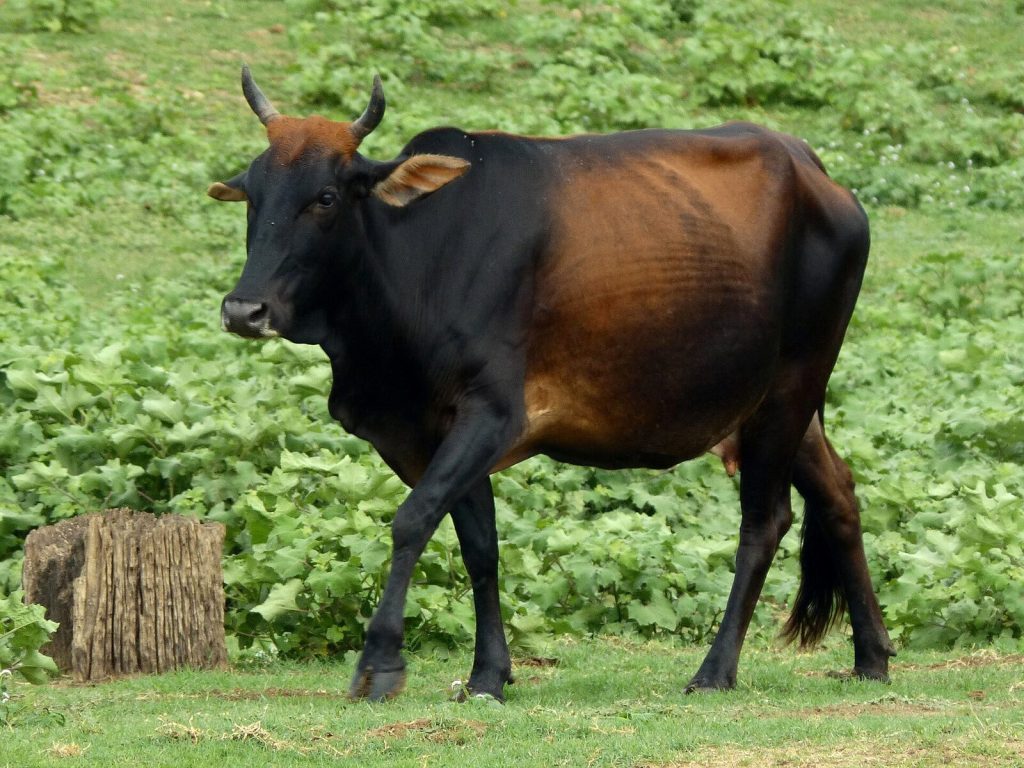
Choosing among the best beef cattle breeds for Ugandan conditions turns on disease tolerance and on what you can actually buy here, not on growth rate. In the one large Ugandan finishing trial that compared genotypes properly, breed barely moved carcass weight at all, and the breed said to be inferior held its own. Uganda's herd is about 77 percent indigenous, so the realistic question is which of those animals to build on.
The wider set of decisions this one sits inside, on feeding, housing, health and milk, is collected in the cattle and dairy guides. Before any of that, one number has to be cleared out of the way, because it is doing more damage to Ugandan beef than any breed ever did.
Why the Ugandan Breed Gap Is Smaller Than the Numbers Suggest
You will meet a claim that Uganda's cattle have a mature weight of about 149 kg against over 600 kg for proven beef breeds. It appears in the abstract of a serious research report on the Ugandan beef value chain. Read as written, it says a Ugandan cow is a quarter of a beef animal, and it is the reason so much advice here starts from "replace your herd".
The same report contains three other versions of that number. On one page it calls 145 to 150 kg a carcass weight at maturity, citing a Ugandan trial. On another it describes 149.6 kg as per animal productivity, arrived at by dividing national meat and offal output by the number of animals slaughtered. And its own value chain mapping puts mature bull liveweight at 352 to 403 kg, cows at 272 to 320 kg and heifers at 83 to 172 kg.
Those readings cannot all hold. The carcass reading is the one that reconciles: Ugandan cattle dress out at around 50 to 52 percent, so a carcass near 149 kg comes off a live animal somewhere near 285 to 300 kg, and the report's own liveweight map lands in the same territory. The arithmetic is ours; both inputs are the report's.
There is a second layer, and it makes the comparison worse rather than better. The 145 to 150 kg figure traces to a Makerere trial whose bulls entered at 191 kg liveweight at about 18 months and were slaughtered 120 days later, at roughly 22 months. Those were finished young bulls, not mature cattle. So a young carcass is being set against a mature liveweight. Correct both units and the gap is closer to twofold than fourfold, and it is between animals of different ages.
We are not replacing the claim with a tidier number of our own, because no Ugandan mature carcass weight by breed could be sourced. The takeaway is a habit: whenever you meet a cattle weight, ask two questions before you believe it. Carcass or live? And at what age? Almost every breed comparison you will read gets one of those wrong.
What Beef Breeds Uganda Actually Has in the Herd
The National Livestock Census counted 11,153,707 indigenous cattle out of 14,477,878. Inside that indigenous group, Ankole is 21.8 percent and the Zebu or Nganda group is 78.2 percent, which works out at roughly 2.43 million Ankole against roughly 8.72 million zebu type animals.
That inverts something the literature repeats. A widely cited Ugandan paper states the Ankole "constitute more than half of the indigenous cattle population", and the ILRI value chain map annotates Uganda's beef chain as mainly Ankole. Both statements are defensible where they were written and wrong nationally, and the census shows why.
| Region | Ankole share | Zebu or Nganda |
|---|---|---|
| Central | 56.4 percent | 43.6 percent |
| Western | 50.8 percent | 49.2 percent |
| Northern | 10.9 percent | 89.1 percent |
| Eastern | 9.4 percent | 90.6 percent |
Ankole is a majority breed in the west and centre and a small minority in the east and north. Nearly all Ugandan beef genotype research has been done on ranches in the centre and south west, so researchers there are describing an Ankole herd accurately, and generalising it nationally is the error. It is the same shape of mistake as any regional trial result dressed up as a country fact.
The improved side of the herd is smaller than it sounds. Of 3,324,171 exotic and crossbred cattle, 90.3 percent are dairy type and 9.7 percent are beef type, which puts the improved beef population at something on the order of 320,000 animals nationally. Regionally that beef share is 37.9 percent of the exotic herd in Northern, 14.7 percent in Central and 10.3 percent in Eastern. So in the regions with the most improved cattle, improved means dairy.
Ankole: a Sanga Breed With Genomic Evidence for Meat Quality
The Ankole longhorn is a Sanga, which means it is not a pure zebu and not a pure taurine but an old stabilised cross between the two. That matters for beef, because taurine cattle carry the muscle and fat characteristics that eating quality depends on, and zebu cattle carry the tropical adaptation.
A whole genome scan compared Ankole against indicine breeds, the Boran among them, and looked for regions under positive selection in the Ankole. It found 238 positively selected genes by one cross population statistic and 213 by another, with 97 picked up by both. The genes sit in categories that matter commercially rather than academically: muscle structure and metabolism, which is what tenderness depends on; adipose metabolism and intramuscular fat; meat colour; and feed efficiency. The authors' conclusion is that Sanga breeds have a basis for quality beef that deserves developing rather than replacing.
Put that beside the Ugandan trial results below and a picture forms that almost nobody sells: the Ankole is not a poor beef animal that Uganda is stuck with. It is an under used one.
The honest counterweight comes from ILRI, and it is about feed rather than meat. Conversion of quality feed and pasture into body mass by Ankole and Zebu is low compared with Boran, Friesian and their crosses. The report's own conclusion from that is instructive: because those breeds convert good feed poorly, rearing them on natural pasture makes more economic sense than investing in improved pasture for them. In other words the Ankole's advantage is that it does not need the expensive input, not that it makes more of it.
Boran and Its Crosses: the Commercial Beef Breed in Uganda
The Boran is a large East African shorthorn zebu developed for beef, and among Ugandan producers who are deliberately targeting commercial beef it is the breed of choice. ILRI puts it plainly: only a few Ugandan producers keep Boran, and those who do are the ones aiming at commercial beef rather than at a household herd.
Its documented advantages in Ugandan and regional work are real but narrower than the marketing suggests. A western Uganda crossbreeding study reported that introduced Boran cows held their body weight at least as steadily as indigenous Ankole and zebu cows did, which is a statement about hardiness under local conditions rather than about growth. A separate Ugandan study found crosses of Boran and Sahiwal had greater pre weaning growth potential than Zebu cattle. Pre weaning growth is a genuine advantage if you are producing weaners for sale.
And then there is the tenderness result, which is the most interesting single finding in Ugandan beef research and runs against the assumption. In a trial of 180 steers across five Ugandan genotypes, Boran and Ankole crossed with Boran reached an acceptable tenderness level by 90 days of finishing only in the feedlot, while Ankole, Ankole crossed with Friesian and the Composite reached the same level at 90 days under both the feedlot and grazing plus supplementation. The improved beef breed needed the more expensive system to deliver acceptable eating quality. The indigenous breed did not.
That does not make the Boran a bad choice. It makes it a choice that comes with a feeding commitment attached, and a farmer who buys Boran genetics and then grazes them is buying the price without the product.
Zebu and Nganda: the Breeds Most Ugandan Beef Comes From
Four in five of Uganda's indigenous cattle are zebu type, and yet the small East African Shorthorn Zebu and the Nganda get a fraction of the attention the Ankole does. Most of the non dairy cattle slaughtered for beef in Uganda are Ankole and small East African Zebu, so the zebu group is the actual supply.
Uganda's native cattle fall into three groups. The Sanga, which is the Ankole. The East African Shorthorn Zebu, which dominates the east and north. And the Zenga, which is a Sanga by zebu backcross, and that is where the Nganda sits: a stabilised cross between the Ankole longhorn and the small shorthorn zebu. Whole genome work on 95 Ugandan animals across five native breeds separated the three groups cleanly, and found something worth knowing for anyone sourcing Nganda stock: there appear to be two distinct subpopulations inside the Nganda, so two animals sold under that name are not necessarily the same genetics.
The same study found elevated inbreeding and lower genetic diversity in the Ugandan breeds than in the comparison populations, along with European genetics introgressed into native breeds. Read together with the census, that is a breed base narrowing while it is being diluted.
The honest position on the zebu group for beef is that it is hardy, cheap to keep, poorly documented and unimproved. ILRI's judgement is blunt: the indigenous breeds, particularly the Zebu and to some extent the Ankole, lack the capacity to increase productivity from their current genetics, and raising that ceiling would take deliberate, long and costly breeding work. That is a statement about the ceiling, not about whether the animal in front of you is worth finishing. Almost no Ugandan zebu is anywhere near its own ceiling.
Crossbreeding With Friesian for Beef: What the Ugandan Trials Show
Crossing Ankole with Friesian is normally a dairy decision, and its milk side belongs on Friesian cattle farming. As a beef cross it has been measured here, and the result is mixed in a way that is useful.
In the 144 bull Makerere trial, Ankole crossed with Friesian gained 620 grams a day, pure Ankole 560 and Ankole crossed with Boran 500. The Friesian cross led on paper. The authors attribute that to its larger frame and heavier mature size, and its heavier feet in the carcass breakdown fit the same explanation.
In the 180 steer tenderness trial, the Ankole by Friesian cross behaved like the Ankole rather than like the Boran, reaching acceptable tenderness at 90 days under both feeding regimes. So the Friesian cross brought frame without costing eating quality, at least on those measures.
What it also brings is the tick problem, and that is dealt with under disease tolerance below. A quarter Friesian animal in a cattle corridor district is a different veterinary proposition from a pure Ankole, and the beef gain does not pay for a dead animal.
Brahman and Composite Breeds Uganda Is Trying to Build
Uganda's public breeding effort runs through the National Animal Genetic Resources Centre and Data Bank, which operates through 11 ranches and satellite centres with a bull stud at Entebbe producing bull semen and liquid nitrogen, and liquid nitrogen plants installed at Mbarara and Njeru.
Its beef work is concrete enough to plan around. Conservation and breed improvement for Ankole, Boran and Zebu runs at Aswa Ranch in Pader, with the Ankole herd at Nshaara in Kiruhura and Zebu at Lusenke in Kayunga, and each of the beef focused ranches carries more than 1,000 head. Stated plans have included producing first generation stock of beef breeds including Brahman and the Simbra composite by artificial insemination, and acquiring 20 Boran and Sahiwal breeding bulls for the bull stud in response to demand from beef ranchers. In one year the centre passed 124 head to the Uganda Meat Producers Cooperative Union, and committed 3.8 percent of its budget to technical breeding activities.
Two cautions before you plan around any of that. Whether the centre currently sells or allocates stock to individual farmers, and on what terms, could not be established from anything reachable in this research, so ask the centre and your district production office rather than assuming. And a first generation composite is not a breed you can buy in numbers; it is a programme in progress.
What the Feeding System Does That No Breed Can
Here is the comparison that should decide where a Ugandan beef shilling goes first, and it comes from a single trial so nothing is being smuggled in from elsewhere.
| Genotype | Gain, g per day | Statistical verdict |
|---|---|---|
| Ankole by Friesian | 620 | above Ankole by Boran |
| Pure Ankole | 560 | not reliably different |
| Ankole by Boran | 500 | below Ankole by Friesian |
Read the third column, because it is the one competitors drop. The only genotype difference in daily gain large enough to be statistically reliable was the Friesian cross beating the Boran cross. Pure Ankole sat between them and was not reliably different from either. And on slaughter weight, empty body weight, hot carcass weight and dressing percentage, genotype made no reliable difference at all. The paper's own conclusion is that the lack of difference between pure Ankole and the Friesian cross reflects the Ankole's potential for beef without crossbreeding.
Genotype did change some non carcass parts. Ankole and Ankole by Boran bulls had heavier skin plus tail, which the authors attribute to the dewlap, the large umbilical flap and the extra skin over the hump, all features of indigenous tropical cattle. Scrotal fat, feet and total gut weight also differed. None of that is meat you sell by the kilo, though the hide has a market of its own.
Against that null genotype result, the same trial's feeding systems produced a spread of roughly 3.1 times between the slowest and fastest growing groups, while the widest genotype spread was about 1.24 times. Both ratios come out of the trial's own means. One lever moves the animal three times as far as the other, and it is the one that does not require finding rare genetics. The feeding side is worked through on beef cattle farming in Uganda.
Disease Tolerance: the Trait That Decides Breed Choice in Uganda
If you take one thing from this page, take this. East Coast fever mortality in exotic cattle runs at around 90 percent, with death usually inside a week of the first signs. Indigenous cattle become infected at high rates and die at much lower ones. A genetic variant associated with tolerance has been identified in Bos indicus cattle, which is consistent with the tolerance being real rather than a matter of management.
MAAIF's surveillance says how much exposure that tolerance is buying. East Coast fever leads the national cattle case and death counts, with lumpy skin disease, anaplasmosis and trypanosomiasis close behind on cases. Pastoral herds, which are about 98 percent local breeds, absorb that load year after year. An exotic or high grade animal dropped into the same environment does not.
There is a subtlety in the Ugandan farm records that is worth knowing, because it looks like evidence and is not. A study matching genomic data against farmer recorded disease on Ugandan crossbred herds found that animals with a lower share of exotic genetics were the ones showing up with East Coast fever in the records. The authors read that as survivor bias: the high grade animals that caught it died before anyone could sample them, so they are missing from the data. Farm records of a disease that kills fast will always understate the risk to the animals it kills fastest.
The practical ordering that falls out of this is not subtle. Match the breed to the disease pressure where the animal will stand, then to the feed you can supply, then to what is available to buy, and only then to a growth figure. Tick control and the vaccination question are covered on cattle tick control and the cattle vaccination guide, and the second of those explains why East Coast fever, the biggest killer, is not on the routine campaign list.
Where to Get Breeding Stock and What the Herd Books Do Not Tell You
Sourcing improved beef genetics in Uganda is hard because there are so few of them. Roughly 320,000 beef type animals sit inside an exotic and crossbred herd of 3.3 million, and most of those are on a small number of ranches. That scarcity, rather than the animals' merit, is what sets what you will be asked to pay.
The public route is the national genetic resources centre and its ranches, described above. The private route is a commercial ranch, and the caution there is the one briefing writers on this site apply to any seller's own account of its own stock: a ranch describing its elite genetics and its artificial insemination programme is marketing, and the claims in it are not measurements. Ask for weights taken with a tape on a stated date, not a description.
Two documentation problems are worth going in prepared for. Nganda sold under one name may come from either of two genetic subpopulations. And the relationship between heart girth and liveweight itself changes with breed group and production system, so a weigh tape calibrated on confined crossbred dairy animals will misread a grazing zebu. Record what you measure and how, using something like the livestock record keeping template, because there is no herd book that will do it for you.
How to Choose a Beef Breed for Your Own Farm
The ranked list this page refuses to give you is the wrong tool, because the answer changes with where you are standing. What survives the evidence is an order of questions.
First, what disease pressure will the animal live under? In a cattle corridor district with ticks and no reliable spraing routine, indigenous or low grade crossbred animals are the defensible choice, and the East Coast fever mortality asymmetry is the whole reason. In a fenced, sprayed, watered unit the calculation opens up.
Second, what can you feed through a dry season? A Boran needs a feedlot to deliver acceptable tenderness by 90 days on the Ugandan evidence; Ankole and its crosses got there on grazing plus supplementation. If you cannot commit to the ration, the improved animal will underperform its own price.
Third, what is actually available within reach, and at what real weight? You are shopping in a herd that is 77 percent indigenous and roughly 78 percent zebu type within that. Plan the enterprise around what exists nearby rather than around what a breed page recommends.
Fourth, and last, the growth figure. On the Ugandan trial evidence the breed effect on carcass weight was not even reliably present, while the feeding effect was large and consistent. A growth rate quoted without a feeding system attached is not information.
Two special cases where the obvious answer flips. If you are producing weaners rather than finished animals, pre weaning growth matters more than anything on the finishing trials, and that is where the Boran and Sahiwal crosses have a documented Ugandan edge. And if you are already running a dairy herd, your beef animals will be culls and immature bulls from that herd whatever you would have chosen, so the breed question was settled by the milk decision. Compare that route through best dairy cattle breeds in Uganda.
Frequently Asked Questions About Beef Cattle Breeds in Uganda
Which is the best beef breed in Uganda overall? The Ugandan evidence does not support a single answer, and the honest version is a pairing rather than a breed. If you can feed a full ration and control ticks, Boran or a Boran cross gives you a breed developed for beef and documented hardiness under East African conditions. If you cannot, Ankole and its crosses reached acceptable tenderness at 90 days on grazing plus supplementation in a Ugandan trial where Boran needed a feedlot to do the same, and Ankole was not reliably behind on growth either.
Is the Ankole really a poor beef animal? The evidence says it is an under used one. A whole genome scan against indicine breeds found around 97 genes under positive selection in Ankole by two separate statistics, sitting in muscle structure, intramuscular fat, meat colour and feed efficiency. A Ugandan finishing trial found no reliable genotype difference in carcass weight or dressing percentage, and its authors concluded that Ankole has real beef potential without crossbreeding. Where the Ankole genuinely loses is in converting bought quality feed into weight, which is why ILRI's own recommendation is to keep it on natural pasture rather than to spend on improved pasture for it.
How much does a Boran or improved beef animal cost in Uganda? No Ugandan price that meets this site's sourcing standard could be established, and the one figure circulating on the primary keyword is a seller's asking price in a social media post, which is not a market price. What drives it is scarcity: roughly 320,000 beef type animals exist inside a 3.3 million strong exotic and crossbred herd, concentrated on a few ranches. Check current animal prices on the cattle price page, ask the national genetic resources centre and your district production office what public stock is available, and get any private quote in writing against a measured weight.
Will crossbreeding my local cattle with an exotic beef breed pay? It depends almost entirely on whether your tick and disease control can carry the higher grade animal. East Coast fever kills around 90 percent of the exotic cattle it infects, usually within a week, against much lower mortality in indigenous animals. On the growth side, the Ugandan trial found the Friesian cross ahead of the Boran cross and pure Ankole between them and not reliably different from either. So the growth gain from crossing is modest and measurable; the disease risk is large and abrupt. Fix the second before you buy the first.
What does the 149 kg figure for Ugandan cattle actually mean? It is a carcass and offal figure, not a mature liveweight. The report it comes from calls it a carcass weight in its body text and prints mature bull liveweight at 352 to 403 kg in its own value chain mapping, and Ugandan cattle dress out near 50 to 52 percent, so the two reconcile. The version that compares 149 kg against 600 kg for improved beef breeds is setting a young carcass against a mature live animal, which makes the gap look about twice as wide as it is.
What is the Nganda, and should I consider it? The Nganda is a stabilised cross between the Ankole longhorn and the small East African shorthorn zebu, which puts it in the Zenga group alongside similar African backcrosses. It is hardy, widely distributed and barely documented for beef. The one thing to know before buying is that whole genome work found two distinct subpopulations inside the breed, so animals sold under the name are not a single genetic type. Judge individuals on measured weight and condition.
Which breed grows fastest in Uganda? On the only large Ugandan comparison, Ankole crossed with Friesian at 620 grams a day, pure Ankole at 560 and Ankole crossed with Boran at 500. Two cautions make that less useful than it looks. Only the top against bottom difference was statistically reliable. And in the same trial the feeding system produced a spread about three times as wide as the breed spread, so a growth figure quoted without its feeding system attached tells you very little.
Are Uganda's indigenous breeds disappearing? They are being crossed out fastest where crossbreeding pays best. The exotic and crossbred share of all Ugandan cattle rose from 6.4 percent to 23.0 percent between two census rounds, and in the Ankole sub region, the longhorn's own heartland, 60.3 percent of cattle are now exotic or crossbred. Whole genome work on Ugandan native breeds also found elevated inbreeding and lower diversity than comparison populations, along with European genetics moving into native herds. If a specific indigenous type matters to you, the time to source it is not later.
Finding Breeding Stock, Feed and Veterinary Suppliers Near You
Prices for breeding stock, semen, cotton seed cake and veterinary services all move with the season, the district and how scarce the genetics are that week, so the only useful figures are local and current. Ask the national genetic resources centre and your district production office what public stock and semen are available and on what terms, compare feed and input stockists through farm input suppliers, check what animals are going for on the cattle price page, and start your search for stock at where to buy cattle in Uganda. Take a tape measure, write down the girth and the date, and buy the animal in front of you rather than the breed name on the paper.